Malaysia Wood Charcoal Market Size, Share & Growth Rate
The Malaysia Wood Charcoal Market was estimated at USD 390 Million in 2025 and is projected to reach USD 472 Million by 2032, growing at a CAGR of 2.8% from 2026 to 2032. This steady growth is primarily fueled by the increasing adoption of wood charcoal in the restaurant and barbecue industries, where its eco-friendly attributes appeal to a growing number of conscious consumers. Moreover, the cultural significance of charcoal in traditional cooking practices is contributing to its sustained demand across various culinary settings.
Malaysia Wood Charcoal Market Year-wise Growth Rate and Key Drivers
This graph highlights how the Malaysia Wood Charcoal Market has steadily grown over the years, supported by major growth factors.
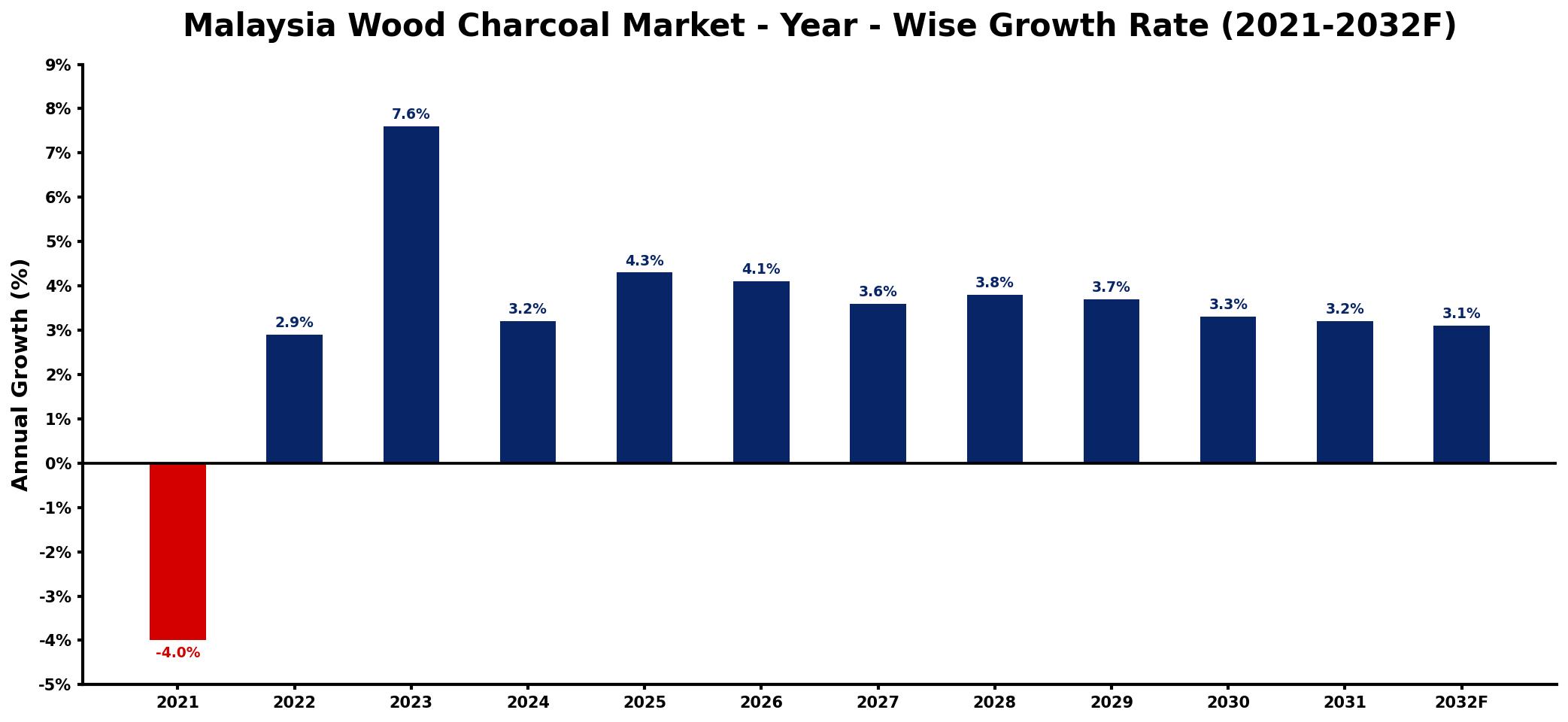
The table below presents the year‑wise growth rates along with the key drivers influencing the market
| Year | Growth Rate | Major Drivers |
| 2021 | -4.0% | decreased consumer interest in alternatives |
| 2022 | 2.9% | increased demand for grilling products |
| 2023 | 7.6% | growing popularity of outdoor cooking |
| 2024 | 3.2% | expansion of eco-friendly initiatives |
| 2025 | 4.3% | rising investments in sustainable practices |
| 2026 | 4.1% | enhanced export opportunities for products |
| 2027 | 3.6% | growing awareness of environmental benefits |
| 2028 | 3.8% | increased usage in hospitality sector |
| 2029 | 3.7% | increased production capacity utilization |
| 2030 | 3.3% | growing interest in barbecuing events |
| 2031 | 3.2% | increased domestic production output |
| 2032 | 3.1% | increased collaboration with culinary schools |
Note: Market size estimations and growth projections presented in this report are based on 6Wresearch's proprietary forecasting methodology, utilizing the latest available industry data, government publications, and primary research inputs.
Malaysia Wood Charcoal Market Synopsis
The most significant driving force in the Malaysia Wood Charcoal Market is the rising popularity of sustainable and eco-friendly cooking options. Consumers are increasingly opting for wood charcoal, not only for its unique flavor-enhancing properties but also for its minimal environmental impact compared to conventional charcoal. This shift in consumer preference is closely aligned with a broader global movement towards responsible sourcing and sustainable living.
Furthermore, Malaysia's abundant forest resources serve as a strong foundation for the local wood charcoal industry. The traditional use of wood charcoal in culinary practices, particularly among street vendors and restaurants, ensures a continuous demand. As outdoor cooking and barbecue culture gains traction, the market is poised for steady growth in the coming years.
Malaysia Wood Charcoal Market Key Takeaways
- Steady growth driven by the culinary sector and eco-friendly consumer choices.
- Abundant forest resources provide a competitive advantage in raw material sourcing.
- Increased interest in outdoor cooking and barbecuing fuels market expansion.
- Emerging sustainability concerns drive the need for responsible sourcing practices.
- Post-COVID-19 recovery phases reveal adaptability among producers and retailers.
Evaluation of Restraints in Malaysia Wood Charcoal Market
Despite the promising growth, the Malaysia Wood Charcoal Market faces several significant restraints. The escalating concerns surrounding deforestation pose a critical challenge for the industry, as sustainable sourcing practices become increasingly important to consumers and regulators alike. Additionally, the market could be impacted by stricter environmental regulations aimed at preserving Malaysia's rich forest ecosystems. As the industry continues to evolve, addressing these challenges will be pivotal for long-term sustainability and market viability.
Malaysia Wood Charcoal Market Trends
Current trends in the Malaysia Wood Charcoal Market highlight a shift towards premium, quality products that meet evolving consumer preferences for sustainability. There is a growing emphasis on eco-friendly production methods and certifications that assure environmentally responsible practices. Furthermore, the rise of online platforms has enabled greater consumer access to diverse wood charcoal products, facilitating informed purchasing decisions.
Malaysia Wood Charcoal Market Opportunities
Opportunities for growth in the Malaysia Wood Charcoal Market lie in diversifying product offerings to include value-added options such as flavored or infused charcoal. Additionally, partnerships with local restaurants and outdoor event organizers can enhance market penetration. The increasing awareness of health and wellness also presents a unique opportunity to market wood charcoal as a healthier alternative for grilling compared to other fuel sources.
Government Initiatives in the Malaysia Wood Charcoal Market
The Malaysian government has implemented various initiatives aimed at promoting sustainable forestry practices. Policies encouraging reforestation and responsible sourcing are increasingly important in regulating the wood charcoal industry. Moreover, incentives for businesses adopting environmentally friendly production methods are being introduced, further driving the shift toward sustainability. These government actions are crucial for ensuring the longevity and health of the wood charcoal market.
Future Insights of the Malaysia Wood Charcoal Market
Looking ahead to the period from 2026 to 2032, the Malaysia Wood Charcoal Market is expected to continue its upward trajectory, primarily due to the sustained interest in outdoor cooking and the cultural significance of charcoal. Innovations in production technology aimed at enhancing sustainability and efficiency may also play a key role. As consumer preferences increasingly align with eco-friendly practices, market participants who prioritize quality and responsible sourcing will likely gain a competitive edge.
Malaysia Wood Charcoal Market Latest Developments (2025 - 2026)
Recent industry developments indicate a shift towards enhanced transparency in sourcing practices, with players in the Malaysia Wood Charcoal Market actively seeking certifications for eco-friendly production methods. Additionally, there has been a noticeable increase in promotional campaigns focused on outdoor cooking, leveraging both traditional and digital marketing platforms. This focus not only highlights the products unique benefits but also supports the industry's adaptation to changing consumer behaviors.
Malaysia Wood Charcoal Market - Key Attractiveness of the Report
- 10 Years of Market Numbers
- Historical Data Starting from 2022 to 2025
- Base Year: 2025
- Forecast Data until 2032
- Key Performance Indicators Impacting the Market
- Major Upcoming Developments and Projects
Key Highlights of the Report:
- Malaysia Wood Charcoal Market Outlook
- Market Size of Malaysia Wood Charcoal Market, 2025
- Forecast of Malaysia Wood Charcoal Market, 2032
- Historical Data and Forecast of Malaysia Wood Charcoal Revenues & Volume for the Period 2022-2032F
- Malaysia Wood Charcoal Market Trend Evolution
- Malaysia Wood Charcoal Market Drivers and Challenges
- Malaysia Wood Charcoal Price Trends
- Malaysia Wood Charcoal Porter's Five Forces
- Malaysia Wood Charcoal Industry Life Cycle
- Historical Data and Forecast of Malaysia Wood Charcoal Market Revenues & Volume By Product for the Period 2022-2032F
- Historical Data and Forecast of Malaysia Wood Charcoal Market Revenues & Volume By Charcoal Lumps for the Period 2022-2032F
- Historical Data and Forecast of Malaysia Wood Charcoal Market Revenues & Volume By Charcoal Briquettes for the Period 2022-2032F
- Historical Data and Forecast of Malaysia Wood Charcoal Market Revenues & Volume By Charcoal Powder for the Period 2022-2032F
- Historical Data and Forecast of Malaysia Wood Charcoal Market Revenues & Volume By Wood for the Period 2022-2032F
- Historical Data and Forecast of Malaysia Wood Charcoal Market Revenues & Volume By Softwood for the Period 2022-2032F
- Historical Data and Forecast of Malaysia Wood Charcoal Market Revenues & Volume By Hardwood for the Period 2022-2032F
- Historical Data and Forecast of Malaysia Wood Charcoal Market Revenues & Volume By Application for the Period 2022-2032F
- Historical Data and Forecast of Malaysia Wood Charcoal Market Revenues & Volume By Fuel Feedstock for the Period 2022-2032F
- Historical Data and Forecast of Malaysia Wood Charcoal Market Revenues & Volume By Reducing Agent for the Period 2022-2032F
- Historical Data and Forecast of Malaysia Wood Charcoal Market Revenues & Volume By Filtration Agent & Gas Masking for the Period 2022-2032F
- Historical Data and Forecast of Malaysia Wood Charcoal Market Revenues & Volume By Decolorizing Agent for the Period 2022-2032F
- Historical Data and Forecast of Malaysia Wood Charcoal Market Revenues & Volume By Gastric Medicine for the Period 2022-2032F
- Historical Data and Forecast of Malaysia Wood Charcoal Market Revenues & Volume By Sketches & Paints for the Period 2022-2032F
- Historical Data and Forecast of Malaysia Wood Charcoal Market Revenues & Volume By Soil Conditioning for the Period 2022-2032F
- Historical Data and Forecast of Malaysia Wood Charcoal Market Revenues & Volume By Others for the Period 2022-2032F
- Historical Data and Forecast of Malaysia Wood Charcoal Market Revenues & Volume By End Use for the Period 2022-2032F
- Historical Data and Forecast of Malaysia Wood Charcoal Market Revenues & Volume By Residential for the Period 2022-2032F
- Historical Data and Forecast of Malaysia Wood Charcoal Market Revenues & Volume By Cooking Fuel for the Period 2022-2032F
- Historical Data and Forecast of Malaysia Wood Charcoal Market Revenues & Volume By Gardening for the Period 2022-2032F
- Historical Data and Forecast of Malaysia Wood Charcoal Market Revenues & Volume By Commercial Paints & Sketches for the Period 2022-2032F
- Historical Data and Forecast of Malaysia Wood Charcoal Market Revenues & Volume By Water Treatment for the Period 2022-2032F
- Historical Data and Forecast of Malaysia Wood Charcoal Market Revenues & Volume By Industrial for the Period 2022-2032F
- Malaysia Wood Charcoal Import Export Trade Statistics
- Market Opportunity Assessment By Product
- Market Opportunity Assessment By Wood
- Market Opportunity Assessment By Application
- Market Opportunity Assessment By End Use
- Malaysia Wood Charcoal Top Companies Market Share
- Malaysia Wood Charcoal Competitive Benchmarking By Technical and Operational Parameters
- Malaysia Wood Charcoal Company Profiles
- Malaysia Wood Charcoal Key Strategic Recommendations






































