Malaysia X-Ray Tube Market Size, Share & Growth Rate
The Malaysia X-Ray Tube Market was estimated at USD 481 Million in 2025 and is projected to reach USD 628 Million by 2032, growing at a CAGR of 3.9% from 2026 to 2032. This growth trajectory is driven by an increasing demand for advanced diagnostic imaging technologies and a rapidly aging population necessitating more medical imaging procedures. Furthermore, enhanced healthcare infrastructure and technological innovations in imaging, particularly digital X-ray tubes, are set to catalyze this markets expansion.
Malaysia X-Ray Tube Market Year-wise Growth Rate and Key Drivers
This graph highlights how the Malaysia X-Ray Tube Market has steadily grown over the years, supported by major growth factors.
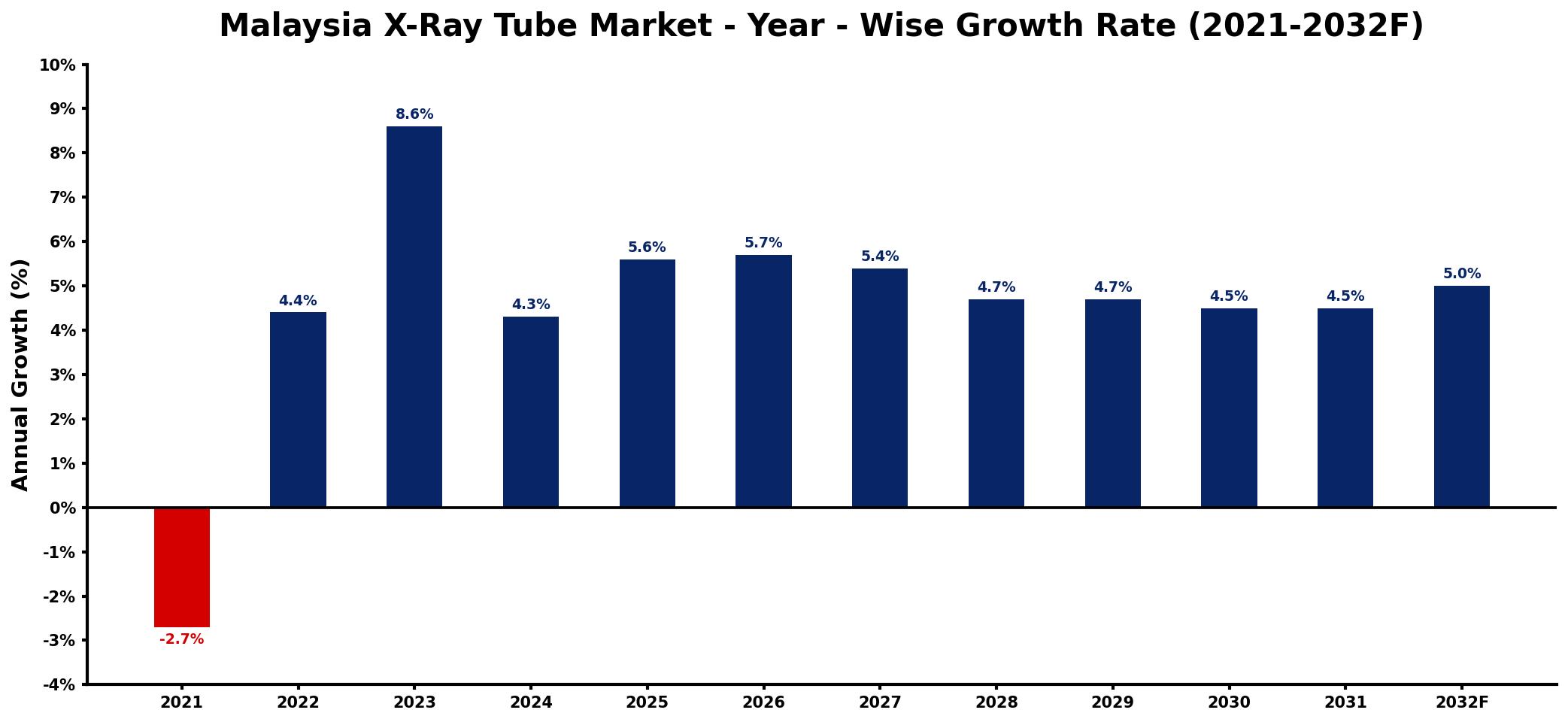
The table below presents the year‑wise growth rates along with the key drivers influencing the market
| Year | Growth Rate | Major Drivers |
| 2021 | -2.7% | decrease in healthcare investments |
| 2022 | 4.4% | increase in diagnostic imaging demand |
| 2023 | 8.6% | expansion of healthcare facilities |
| 2024 | 4.3% | growing aging population needs |
| 2025 | 5.6% | advancements in medical technology |
| 2026 | 5.7% | rising awareness of preventive care |
| 2027 | 5.4% | rising infrastructure development spending |
| 2028 | 4.7% | growing telemedicine adoption rates |
| 2029 | 4.7% | enhanced government healthcare funding |
| 2030 | 4.5% | surge in international collaborations |
| 2031 | 4.5% | boost in medical research initiatives |
| 2032 | 5.0% | growing focus on health equity |
Note: Market size estimations and growth projections presented in this report are based on 6Wresearch's proprietary forecasting methodology, utilizing the latest available industry data, government publications, and primary research inputs.
Malaysia X-Ray Tube Market Synopsis
The X-ray tube market in Malaysia is currently experiencing a renaissance, fueled by rising healthcare demands and a commitment to enhanced diagnostic capabilities. However, this momentum is accompanied by an imperative to address challenges such as durability and environmental sustainability in X-ray tube production.
As healthcare facilities upgrade their imaging technologies, the market is positioned for significant growth. There is a discernible shift towards incorporating advanced digital solutions, which aligns with the broader trends of technological advancement in medical diagnostics. The upcoming years promise further opportunities for manufacturers and stakeholders to innovate and contribute positively to healthcare outcomes.
Malaysia X-Ray Tube Market Key Takeaways
- The market is poised for robust growth, driven by an aging population and increased chronic disease prevalence.
- Technological advancements are leading to a rising demand for digital X-ray tubes.
- Market participants are expected to focus on enhancing durability and lifespan of X-ray tubes.
- Environmental concerns regarding disposal methods are prompting innovations in eco-friendly tube solutions.
- Government initiatives aimed at improving healthcare infrastructure will further stimulate market growth.
Evaluation of Restraints in Malaysia X-Ray Tube Market
Despite the promising growth of the Malaysia X-ray tube market, several restraints are evident. One notable limitation is the frequent need for replacement, which can lead to downtime and increased operational costs for healthcare facilities. Additionally, the environmental implications of disposing of outdated or malfunctioning X-ray tubes pose significant challenges. Addressing these concerns will require manufacturers to prioritize the development of X-ray tubes that are not only more durable but also environmentally sustainable, ensuring a balance between performance and ecological responsibility.
Malaysia X-Ray Tube Market Trends
Emerging trends within the Malaysia X-ray tube market include the continuous integration of digital technologies and a heightened focus on patient-centered imaging solutions. As healthcare providers prioritize accuracy and speed in diagnoses, the transition toward more efficient digital X-ray systems is becoming apparent. Furthermore, the push for minimally invasive procedures is driving the demand for advanced imaging techniques, which in turn is shaping the evolution of X-ray tube design and functionality.
Malaysia X-Ray Tube Market Opportunities
There exist substantial growth opportunities in the Malaysia X-ray tube market, particularly in developing solutions that combine durability with cutting-edge technology. Innovations such as the integration of artificial intelligence with imaging can enhance diagnostic accuracy and operational efficiency. Moreover, increasing government and private sector investment in healthcare infrastructure further paves the way for manufacturers to introduce more advanced imaging systems, catering to a rising demand for high-quality diagnostic services.
Government Initiatives in the Malaysia X-Ray Tube Market
The Malaysian government has undertaken various initiatives aimed at enhancing the healthcare landscape, which indirectly benefits the X-ray tube market. Investments in public health infrastructure, coupled with policies promoting technology adoption in medical settings, are crucial. Programs designed to improve diagnostic capabilities in both urban and rural healthcare facilities are helping to stimulate demand for advanced medical imaging equipment, including X-ray tubes, thereby supporting market growth.
Future Insights of the Malaysia X-Ray Tube Market
Looking ahead to the 2026-2032 period, the Malaysia X-ray tube market is set to enter a phase of significant transformation. The shift towards personalized medicine and the enhancement of diagnostic technologies will likely shape future developments. As manufacturers continue to innovate and streamline production processes, the introduction of more efficient, longer-lasting X-ray tubes will emerge as a competitive advantage. The focus on sustainability will further influence product development, with eco-friendly solutions becoming essential in meeting both regulatory and market expectations.
Malaysia X-Ray Tube Market Latest Developments (2025 - 2026)
The X-ray tube market in Malaysia is witnessing notable shifts as manufacturers adapt to evolving healthcare needs. Recent developments include the introduction of enhanced X-ray tubes designed for better performance and extended operational life. There is also a trend toward collaborative efforts between industry stakeholders to address environmental issues related to X-ray tube disposal. As healthcare facilities increasingly integrate advanced imaging technologies, ongoing research into safety and efficiency is becoming a critical focus for market players.
Malaysia X-Ray Tube Market - Key Attractiveness of the Report
- 10 Years of Market Numbers
- Historical Data Starting from 2022 to 2025
- Base Year: 2025
- Forecast Data until 2032
- Key Performance Indicators Impacting the Market
- Major Upcoming Developments and Projects
Key Highlights of the Report:
- Malaysia X-Ray Tube Market Outlook
- Market Size of Malaysia X-Ray Tube Market, 2025
- Forecast of Malaysia X-Ray Tube Market, 2032
- Historical Data and Forecast of Malaysia X-Ray Tube Revenues & Volume for the Period 2022-2032F
- Malaysia X-Ray Tube Market Trend Evolution
- Malaysia X-Ray Tube Market Drivers and Challenges
- Malaysia X-Ray Tube Price Trends
- Malaysia X-Ray Tube Porter's Five Forces
- Malaysia X-Ray Tube Industry Life Cycle
- Historical Data and Forecast of Malaysia X-Ray Tube Market Revenues & Volume By Type for the Period 2022-2032F
- Historical Data and Forecast of Malaysia X-Ray Tube Market Revenues & Volume By Rotating Anode Tube for the Period 2022-2032F
- Historical Data and Forecast of Malaysia X-Ray Tube Market Revenues & Volume By Stationary X-Ray Tube for the Period 2022-2032F
- Historical Data and Forecast of Malaysia X-Ray Tube Market Revenues & Volume By End-user Industry for the Period 2022-2032F
- Historical Data and Forecast of Malaysia X-Ray Tube Market Revenues & Volume By Manufacturing for the Period 2022-2032F
- Historical Data and Forecast of Malaysia X-Ray Tube Market Revenues & Volume By Healthcare for the Period 2022-2032F
- Historical Data and Forecast of Malaysia X-Ray Tube Market Revenues & Volume By Food for the Period 2022-2032F
- Historical Data and Forecast of Malaysia X-Ray Tube Market Revenues & Volume By Aerospace and Defense for the Period 2022-2032F
- Historical Data and Forecast of Malaysia X-Ray Tube Market Revenues & Volume By Other End-user Industries for the Period 2022-2032F
- Malaysia X-Ray Tube Import Export Trade Statistics
- Market Opportunity Assessment By Type
- Market Opportunity Assessment By End-user Industry
- Malaysia X-Ray Tube Top Companies Market Share
- Malaysia X-Ray Tube Competitive Benchmarking By Technical and Operational Parameters
- Malaysia X-Ray Tube Company Profiles
- Malaysia X-Ray Tube Key Strategic Recommendations






































