Maldives Forklift Market Growth Rate Analysis (2025 - 2031)
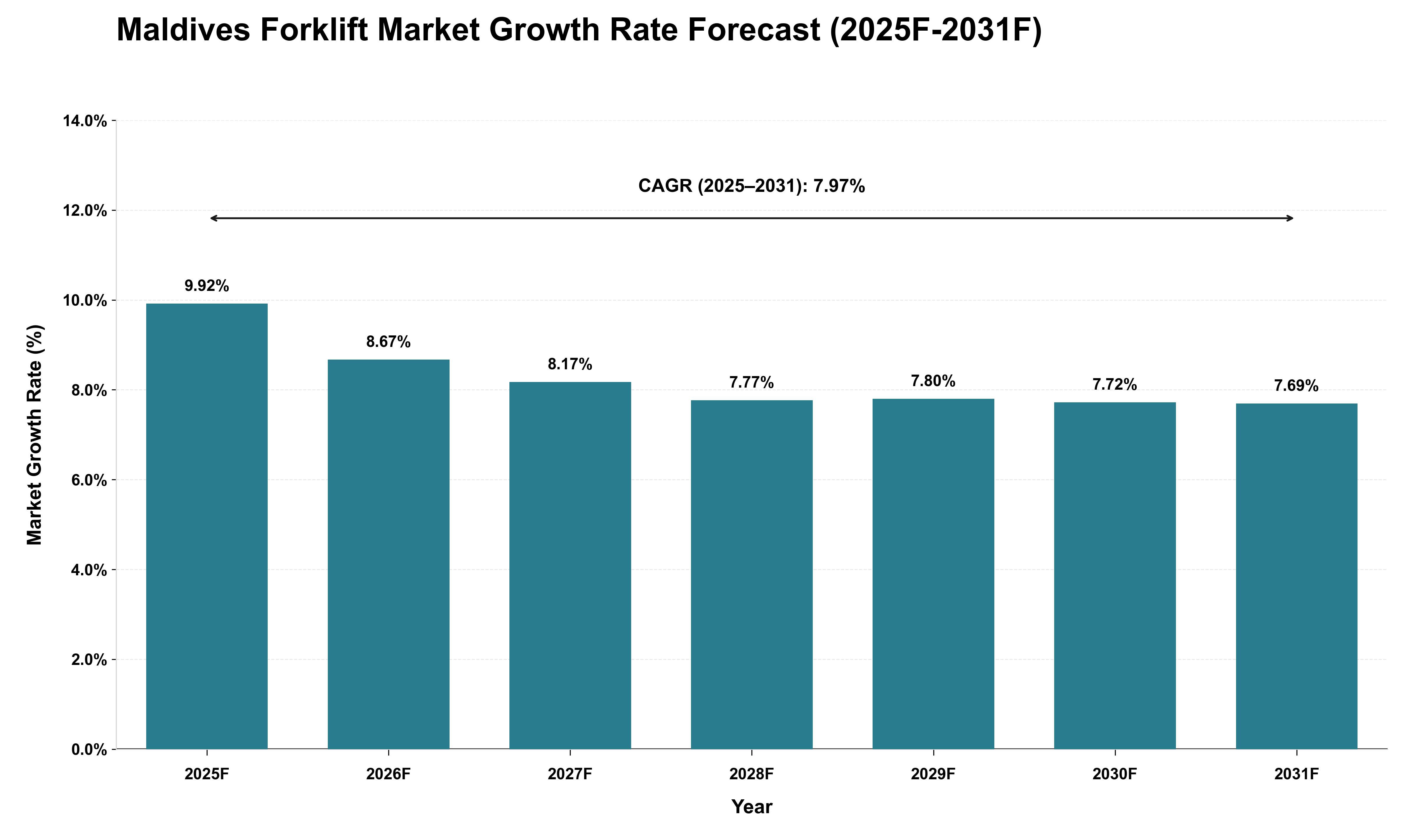
The forecasted growth trajectory for the Maldives forklift market will exhibit a notable deceleration from an initial 9.92% in 2025 to approximately 7.69% by 2031, reflecting a gradual shift in demand dynamics influenced by regulatory and trade policy factors. As the market expands, import dependencies will likely play a critical role, particularly as the Maldives continues to rely on foreign manufacturers for advanced machinery. Trade policies may evolve to either facilitate or hinder these imports, impacting pricing and availability. Additionally, cyclical trends in construction and logistics sectors will shape demand; as infrastructure projects ramp up initially, growth may moderate as these projects reach completion and operational efficiencies are realized. The projected CAGR of 7.97% underscores a robust yet increasingly competitive landscape that necessitates strategic adaptations from stakeholders navigating regulatory frameworks and global supply chain fluctuations.
Key Highlights of the Report:
- Maldives Forklift Market Outlook
- Market Size of Maldives Forklift Market, 2025
- Forecast of Maldives Forklift Market, 2032
- Historical Data and Forecast of Maldives Forklift Revenues & Volume for the Period 2022 - 2032F
- Maldives Forklift Market Trend Evolution
- Maldives Forklift Market Drivers and Challenges
- Maldives Forklift Price Trends
- Maldives Forklift Porter`s Five Forces
- Maldives Forklift Industry Life Cycle
- Historical Data and Forecast of Maldives Forklift Market Revenues & Volume By Class for the Period 2022 - 2032F
- Historical Data and Forecast of Maldives Forklift Market Revenues & Volume By Class 1 for the Period 2022 - 2032F
- Historical Data and Forecast of Maldives Forklift Market Revenues & Volume By 2 for the Period 2022 - 2032F
- Historical Data and Forecast of Maldives Forklift Market Revenues & Volume By 3 for the Period 2022 - 2032F
- Historical Data and Forecast of Maldives Forklift Market Revenues & Volume By 4/5 for the Period 2022 - 2032F
- Historical Data and Forecast of Maldives Forklift Market Revenues & Volume By Propulsion for the Period 2022 - 2032F
- Historical Data and Forecast of Maldives Forklift Market Revenues & Volume By Electric for the Period 2022 - 2032F
- Historical Data and Forecast of Maldives Forklift Market Revenues & Volume By ICE for the Period 2022 - 2032F
- Historical Data and Forecast of Maldives Forklift Market Revenues & Volume By Battery Type for the Period 2022 - 2032F
- Historical Data and Forecast of Maldives Forklift Market Revenues & Volume By Li-Ion for the Period 2022 - 2032F
- Historical Data and Forecast of Maldives Forklift Market Revenues & Volume By Lead Acid for the Period 2022 - 2032F
- Maldives Forklift Import Export Trade Statistics
- Market Opportunity Assessment By Class
- Market Opportunity Assessment By Propulsion
- Market Opportunity Assessment By Battery Type
- Maldives Forklift Top Companies Market Share
- Maldives Forklift Competitive Benchmarking By Technical and Operational Parameters
- Maldives Forklift Company Profiles
- Maldives Forklift Key Strategic Recommendations






































