Malta Blenders Market Size (2020-2030)
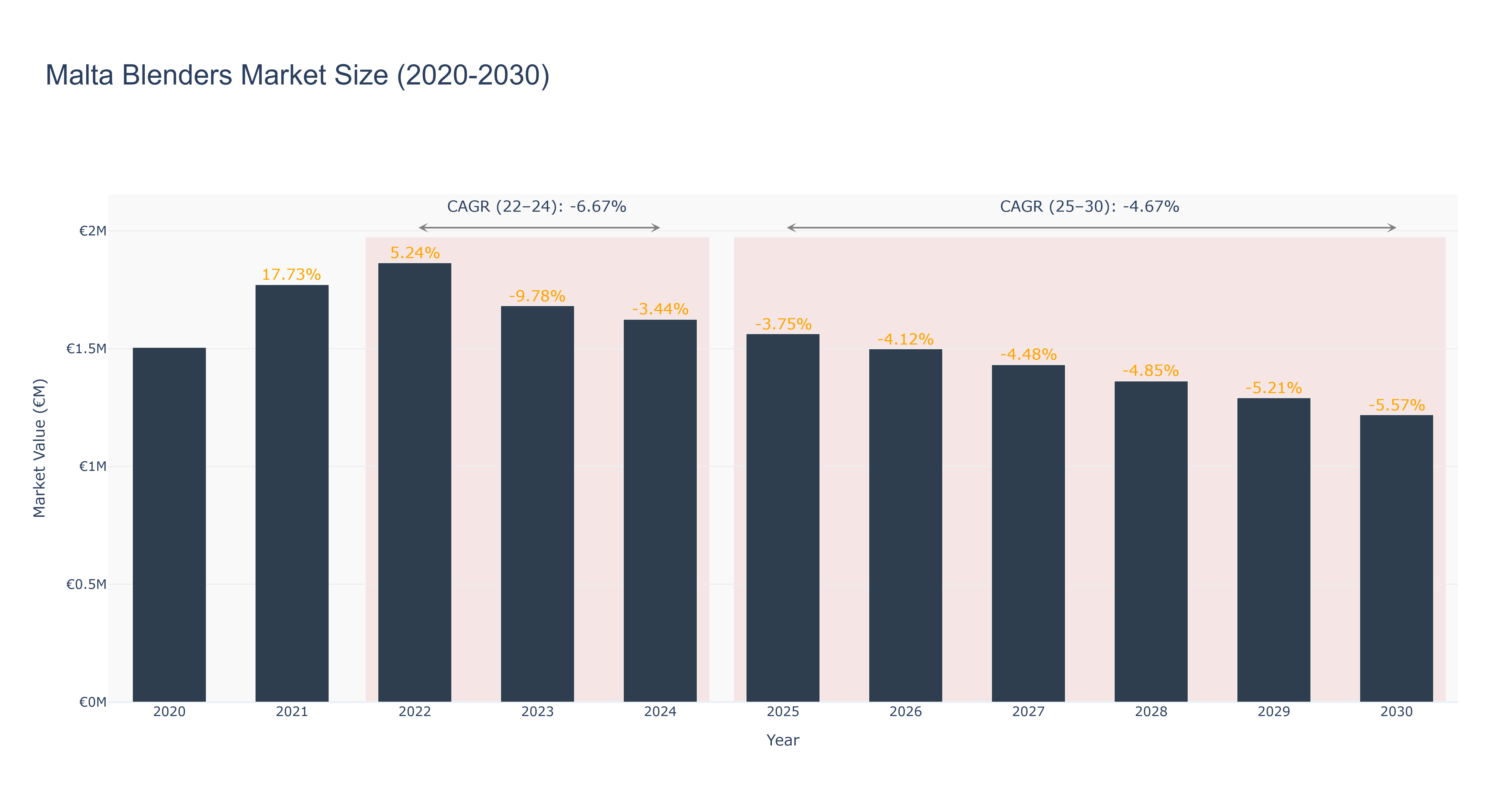
Malta Blenders Market has experienced a fluctuating trend over the years. The peak market size of €1.86 million was observed in 2022, followed by a decline to €1.22 million in 2030. The actual market size decreased from €1.86 million in 2022 to €1.62 million in 2024, with a negative growth rate. The forecasted market size is expected to continue decreasing from €1.56 million in 2025 to €1.22 million in 2030, with a CAGR of -4.67% from 2025 to 2030. The market faced challenges due to changing consumer preferences and increased competition, leading to the downward trend. Looking ahead, Malta is set to launch a sustainable packaging initiative in the blending industry, aiming to attract environmentally conscious consumers and drive market growth in the coming years. Industry drivers include shifting consumer demands towards healthier and sustainable products, technological advancements in blending equipment, and the growing trend of home blending and juicing.
Malta Blenders Market: Production & Trade Performance (2019-2025)
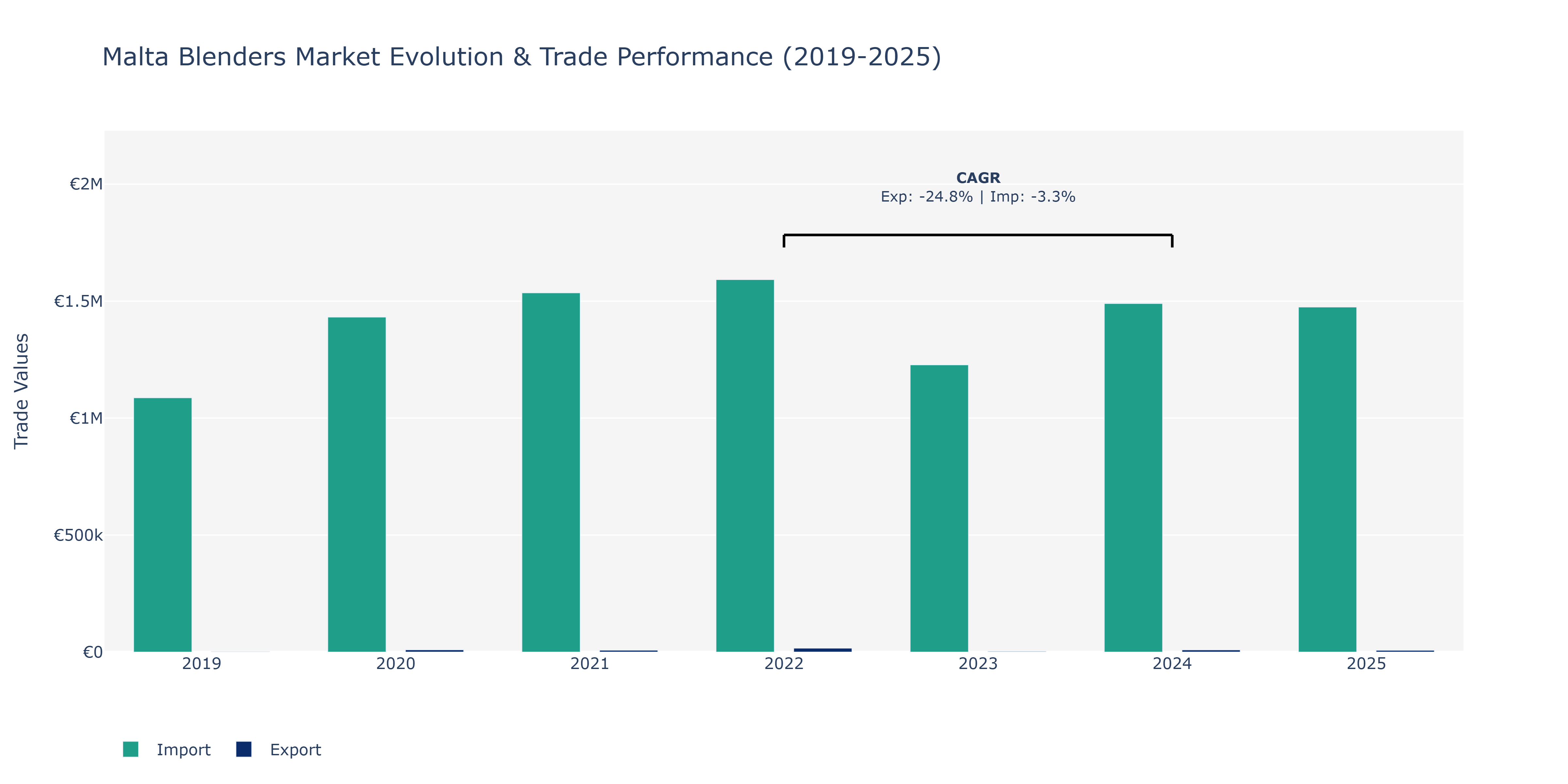
The Malta Blenders Market experienced fluctuations in both exports and imports between 2019 and 2025. In 2022, exports peaked at €16.23 thousand, followed by a notable decline to €3.19 thousand in 2023, before recovering to €9.18 thousand in 2024. Imports, on the other hand, steadily increased from €1.09 million in 2019 to €1.59 million in 2022. Despite a slight dip in 2023 to €1.23 million, imports rebounded to €1.49 million in 2024. Both exports and imports saw a decrease in 2021 compared to the previous year. The fluctuations in exports can be attributed to changes in global demand for blender products, possibly affected by economic conditions and trade agreements. The imports growth trend reflects a steady demand for overseas blender components and raw materials. The market's recovery in 2024 might indicate improved market conditions or strategic shifts in the industry to enhance competitiveness. External factors such as global economic recovery efforts or shifts in consumer preferences could have driven these trends, showing the market's responsiveness to a dynamic external environment.
Key Highlights of the Report:
- Malta Blenders Market Outlook
- Market Size of Malta Blenders Market, 2025
- Forecast of Malta Blenders Market, 2032
- Historical Data and Forecast of Malta Blenders Revenues & Volume for the Period 2022 - 2032F
- Malta Blenders Market Trend Evolution
- Malta Blenders Market Drivers and Challenges
- Malta Blenders Price Trends
- Malta Blenders Porter`s Five Forces
- Malta Blenders Industry Life Cycle
- Historical Data and Forecast of Malta Blenders Market Revenues & Volume By Types for the Period 2022 - 2032F
- Historical Data and Forecast of Malta Blenders Market Revenues & Volume By Hand Blenders for the Period 2022 - 2032F
- Historical Data and Forecast of Malta Blenders Market Revenues & Volume By Single-Serve Blenders for the Period 2022 - 2032F
- Historical Data and Forecast of Malta Blenders Market Revenues & Volume By Full-Size Blenders for the Period 2022 - 2032F
- Historical Data and Forecast of Malta Blenders Market Revenues & Volume By Applications for the Period 2022 - 2032F
- Historical Data and Forecast of Malta Blenders Market Revenues & Volume By Commercial for the Period 2022 - 2032F
- Historical Data and Forecast of Malta Blenders Market Revenues & Volume By Household for the Period 2022 - 2032F
- Malta Blenders Import Export Trade Statistics
- Market Opportunity Assessment By Types
- Market Opportunity Assessment By Applications
- Malta Blenders Top Companies Market Share
- Malta Blenders Competitive Benchmarking By Technical and Operational Parameters
- Malta Blenders Company Profiles
- Malta Blenders Key Strategic Recommendations






































