Mexico Agriculture Market Size, Share & Growth Rate
The Mexico Agriculture Market was estimated at USD 196 Million in 2025 and is projected to reach USD 226 Million by 2032, growing at a CAGR of 2.1% from 2026 to 2032. This growth trajectory is largely fueled by a combination of technological advancements in farming practices and the rising demand for organic produce. Additionally, government initiatives aimed at enhancing productivity and sustainability are further underpinning this positive outlook.
Mexico Agriculture Market Year-wise Growth Rate and Key Drivers
This graph highlights how the Mexico Agriculture Market has steadily grown over the years, supported by major growth factors.
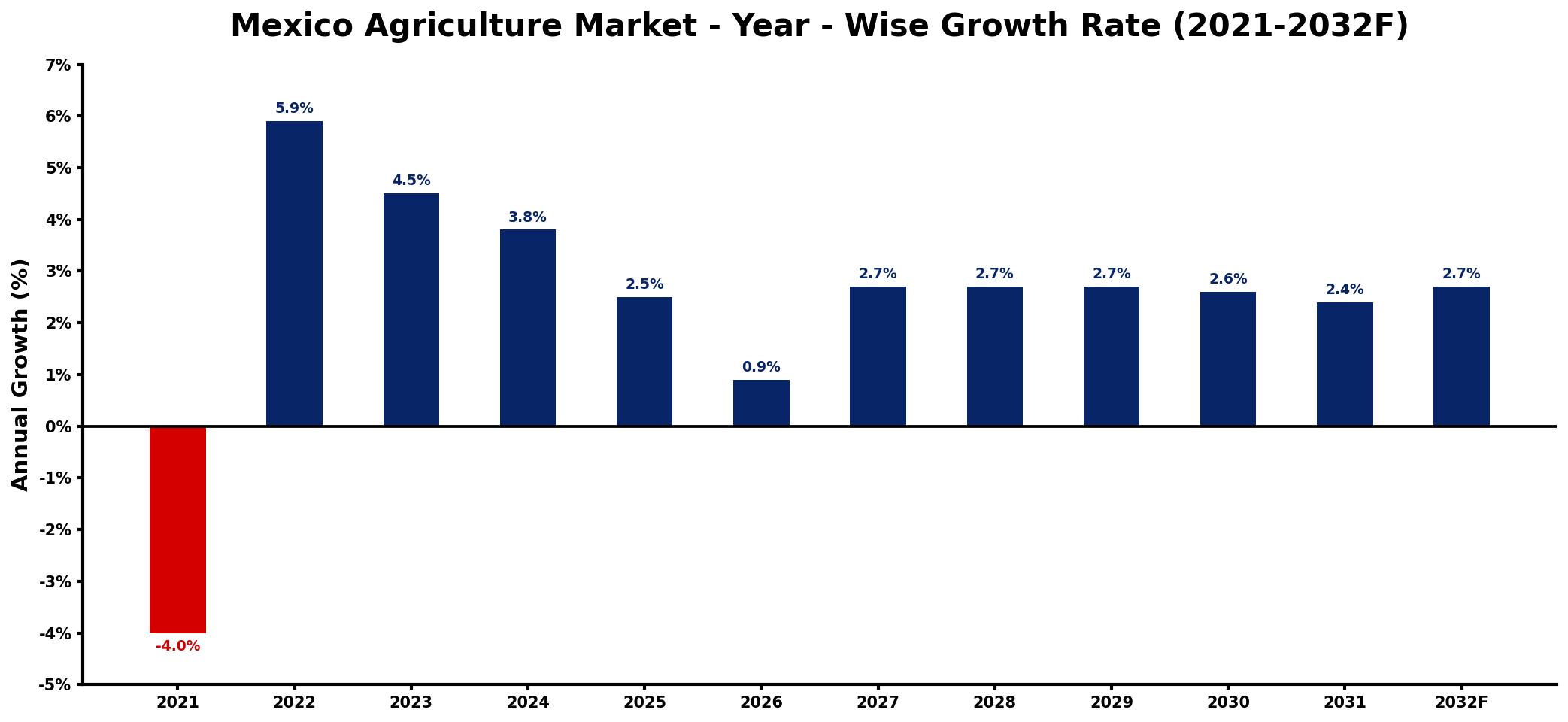
The table below presents the year‑wise growth rates along with the key drivers influencing the market
| Year | Growth Rate | Major Drivers |
| 2021 | -4.0% | Decline in export market demand |
| 2022 | 5.9% | Increase in foreign investments influx |
| 2023 | 4.5% | Rising consumer health consciousness trends |
| 2024 | 3.8% | Expansion of sustainable farming practices |
| 2025 | 2.5% | Growth in organic product preferences |
| 2026 | 0.9% | Technological advancements in production |
| 2027 | 2.7% | Boost in local market consumption |
| 2028 | 2.7% | Enhanced distribution network capabilities |
| 2029 | 2.7% | Rising demand for specialty crops |
| 2030 | 2.6% | Increased government support initiatives |
| 2031 | 2.4% | Growing interest in urban farming |
| 2032 | 2.7% | Development of export partnerships |
Note: Market size estimations and growth projections presented in this report are based on 6Wresearch's proprietary forecasting methodology, utilizing the latest available industry data, government publications, and primary research inputs.
Mexico Agriculture Market Synopsis
The Mexico Agriculture Market has recently gained momentum, particularly in sectors like fruits and vegetables, where the demand for exports, especially to the U.S., has surged. Yet, as the market evolves, it faces pressing issues such as climate change and resource scarcity that necessitate a shift towards sustainable agricultural practices.
Looking ahead, the focus is increasingly on integrating technology, such as precision agriculture, to enhance efficiency and mitigate environmental impact. This transition reflects not just a response to market demands but also a proactive approach to ensure the resilience of Mexicos agriculture sector in the face of ongoing challenges.
Mexico Agriculture Market Key Takeaways
- Robust growth projected, driven by technology adoption and sustainability initiatives.
- Export of key products like avocados and tomatoes remains a pillar of the economy.
- Emerging trends in organic farming are reshaping consumer preferences.
- Government policies are actively supporting smallholder farmers and technological advancement.
- Investment opportunities abound in precision agriculture and sustainable practices.
Evaluation of Restraints in Mexico Agriculture Market
Several key restraints hinder the growth of the Mexico Agriculture Market. Water scarcity is perhaps the most pressing issue, directly impacting crop yields and overall productivity. Inefficient irrigation practices compound this problem, making it difficult for farmers to maximize their output. Additionally, fluctuating market prices create uncertainty, which affects the financial viability of agricultural operations. Many small-scale farmers also struggle with limited access to financing, hindering their ability to invest in modern technology and equipment. Lastly, the impacts of climate change, such as droughts and extreme weather events, pose significant risks that require urgent attention from both farmers and policymakers.
Mexico Agriculture Market Trends
A significant trend in the Mexico Agriculture Market is the shift towards sustainable farming practices. This includes a marked increase in organic farming and initiatives aimed at water conservation. Furthermore, the adoption of precision agriculture technologies—such as drones and sensors—is gaining traction, allowing farmers to optimize their crop production efficiently. The increasing consumer preference for sustainably sourced and organic products is reshaping market dynamics, encouraging farmers to adapt accordingly. Additionally, investments in agtech solutions are on the rise, underscoring the sector's pivot towards more efficient agricultural methodologies.
Mexico Agriculture Market Opportunities
The landscape for investment within the Mexico Agriculture Market is ripe with opportunities. As the market evolves, areas like precision agriculture technology, sustainable farming, and organic food production present lucrative avenues for growth. The demand for Mexican agricultural products continues to rise both domestically and internationally, particularly in health-conscious consumer segments. Government initiatives aimed at modernizing agricultural practices further enhance these investment prospects. Overall, stakeholders can find significant potential in agribusiness, supply chain management, and the development of innovative agricultural technologies.
Government Initiatives in the Mexico Agriculture Market
The Mexican government has rolled out various policies designed to bolster the agriculture sector. These initiatives include financial subsidies for small-scale farmers, investments in agricultural technology and infrastructure, and promotion of sustainable farming practices. Trade agreements, such as the USMCA, facilitate the export of agricultural goods, while programs like "Sowing Life" provide vital support to enhance farmer productivity. Overall, these initiatives aim to foster growth, sustainability, and resilience in Mexicos agriculture sector, addressing key issues like rural poverty and food security.
Future Insights of the Mexico Agriculture Market
The future outlook for the Mexico Agriculture Market is bright, with technology adoption and sustainable practices at the forefront. As consumer preferences shift towards organic and specialty crops, the Mexican agriculture sector is well-positioned to meet these needs. Continued investment in infrastructure, irrigation, and research and development will likely enhance competitiveness and productivity. However, challenges such as climate change and water scarcity will require ongoing strategies to ensure long-term market viability. Overall, stakeholders should remain vigilant to capitalize on emerging trends and opportunities.
Mexico Agriculture Market Latest Developments (2025 - 2026)
In recent months, the Mexico Agriculture Market has seen significant developments focused on sustainability and technology integration. Growing interest in organic products has prompted several initiatives aimed at supporting farmers transitioning to organic farming practices. Additionally, advancements in precision agriculture are being adopted across the sector, allowing for enhanced resource management and improved yields. Ongoing discussions about infrastructure investments suggest that public spending will likely increase, aiming to bolster agricultural productivity in the years to come.
Mexico Agriculture Market - Key Attractiveness of the Report
- 10 Years of Market Numbers
- Historical Data Starting from 2022 to 2025
- Base Year: 2025
- Forecast Data until 2032
- Key Performance Indicators Impacting the Market
- Major Upcoming Developments and Projects
Key Highlights of the Report:
- Mexico Agriculture Market Outlook
- Market Size of Mexico Agriculture Market, 2025
- Forecast of Mexico Agriculture Market, 2032
- Historical Data and Forecast of Mexico Agriculture Revenues & Volume for the Period 2022-2032F
- Mexico Agriculture Market Trend Evolution
- Mexico Agriculture Market Drivers and Challenges
- Mexico Agriculture Price Trends
- Mexico Agriculture Porter's Five Forces
- Mexico Agriculture Industry Life Cycle
- Historical Data and Forecast of Mexico Agriculture Market Revenues & Volume By Type for the Period 2022-2032F
- Historical Data and Forecast of Mexico Agriculture Market Revenues & Volume By Animal Produce for the Period 2022-2032F
- Historical Data and Forecast of Mexico Agriculture Market Revenues & Volume By Crop Production for the Period 2022-2032F
- Historical Data and Forecast of Mexico Agriculture Market Revenues & Volume By Distribution Channel for the Period 2022-2032F
- Historical Data and Forecast of Mexico Agriculture Market Revenues & Volume By Supermarkets/Hypermarkets for the Period 2022-2032F
- Historical Data and Forecast of Mexico Agriculture Market Revenues & Volume By Convenience Stores for the Period 2022-2032F
- Historical Data and Forecast of Mexico Agriculture Market Revenues & Volume By E-Commerce for the Period 2022-2032F
- Historical Data and Forecast of Mexico Agriculture Market Revenues & Volume By Others for the Period 2022-2032F
- Historical Data and Forecast of Mexico Agriculture Market Revenues & Volume By Nature for the Period 2022-2032F
- Historical Data and Forecast of Mexico Agriculture Market Revenues & Volume By Organic for the Period 2022-2032F
- Historical Data and Forecast of Mexico Agriculture Market Revenues & Volume By Conventional for the Period 2022-2032F
- Mexico Agriculture Import Export Trade Statistics
- Market Opportunity Assessment By Type
- Market Opportunity Assessment By Distribution Channel
- Market Opportunity Assessment By Nature
- Mexico Agriculture Top Companies Market Share
- Mexico Agriculture Competitive Benchmarking By Technical and Operational Parameters
- Mexico Agriculture Company Profiles
- Mexico Agriculture Key Strategic Recommendations






































