Mexico Algorithmic Trading Market Size & Growth Rate (2026-2032)
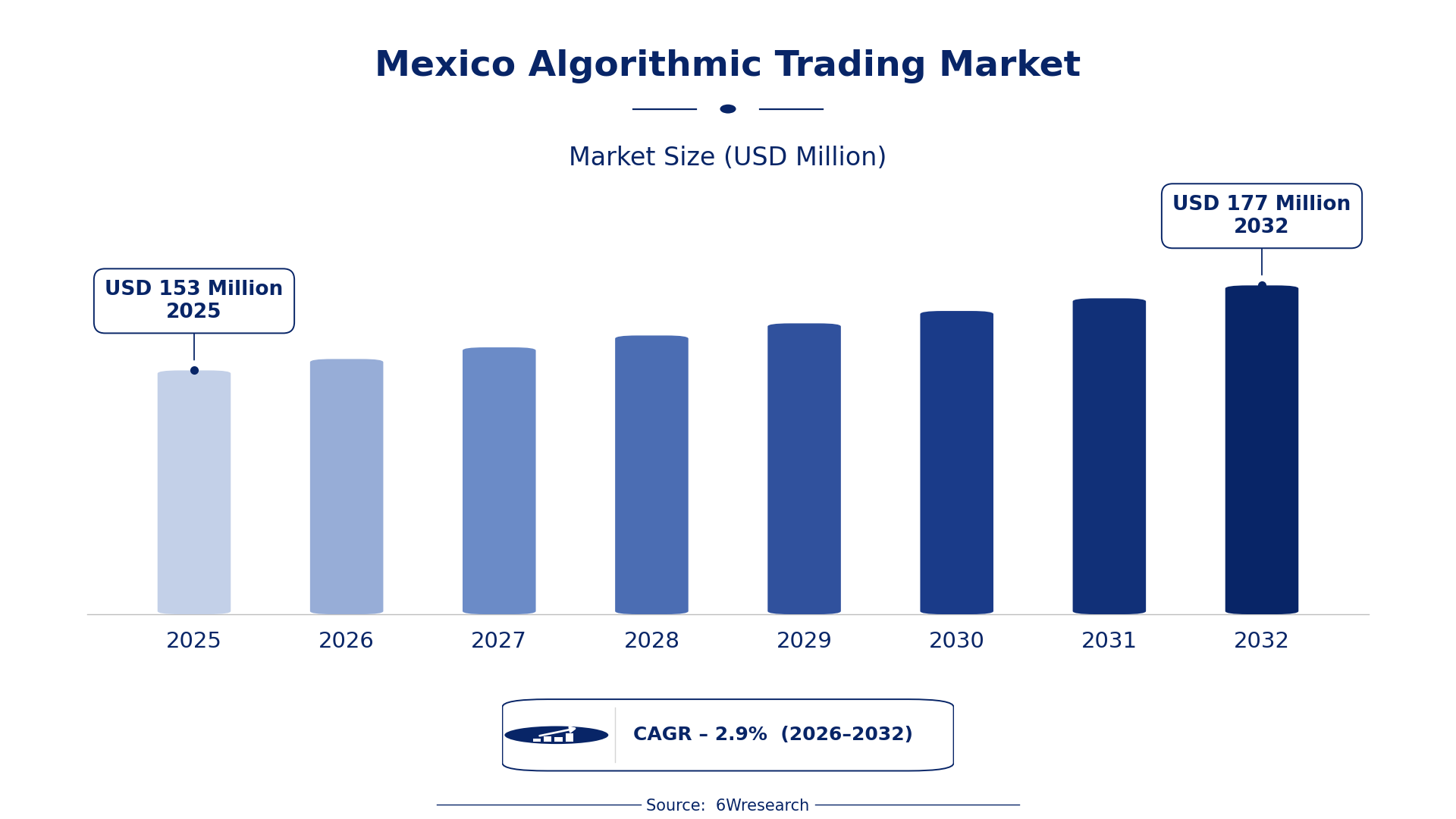
The Mexico Algorithmic Trading Market was estimated at USD 153 Million in 2025 and is projected to reach USD 177 Million by 2032, growing at a CAGR of 2.9% from 2026 to 2032.
Mexico Algorithmic Trading Market Synopsis
The demand for algorithmic trading in Mexico is surging as institutional investors increasingly seek efficient and cost-effective trading solutions. With the rise of high-frequency trading and sophisticated algorithms, financial institutions are reshaping their trading strategies to gain a competitive edge.
Additionally, the market is witnessing an influx of algorithmic trading firms providing tailored solutions to meet diverse client needs. As automation and data-driven strategies gain traction, more participants are expected to enter the market, further fueling growth in the coming years.
Mexico Algorithmic Trading Market Year-wise Growth Rate and Key Drivers
This graph illustrates the annual growth rates of the Mexico Algorithmic Trading Market from 2021 to 2032, highlighting a steady upward trajectory and projected expansion over the forecast period.
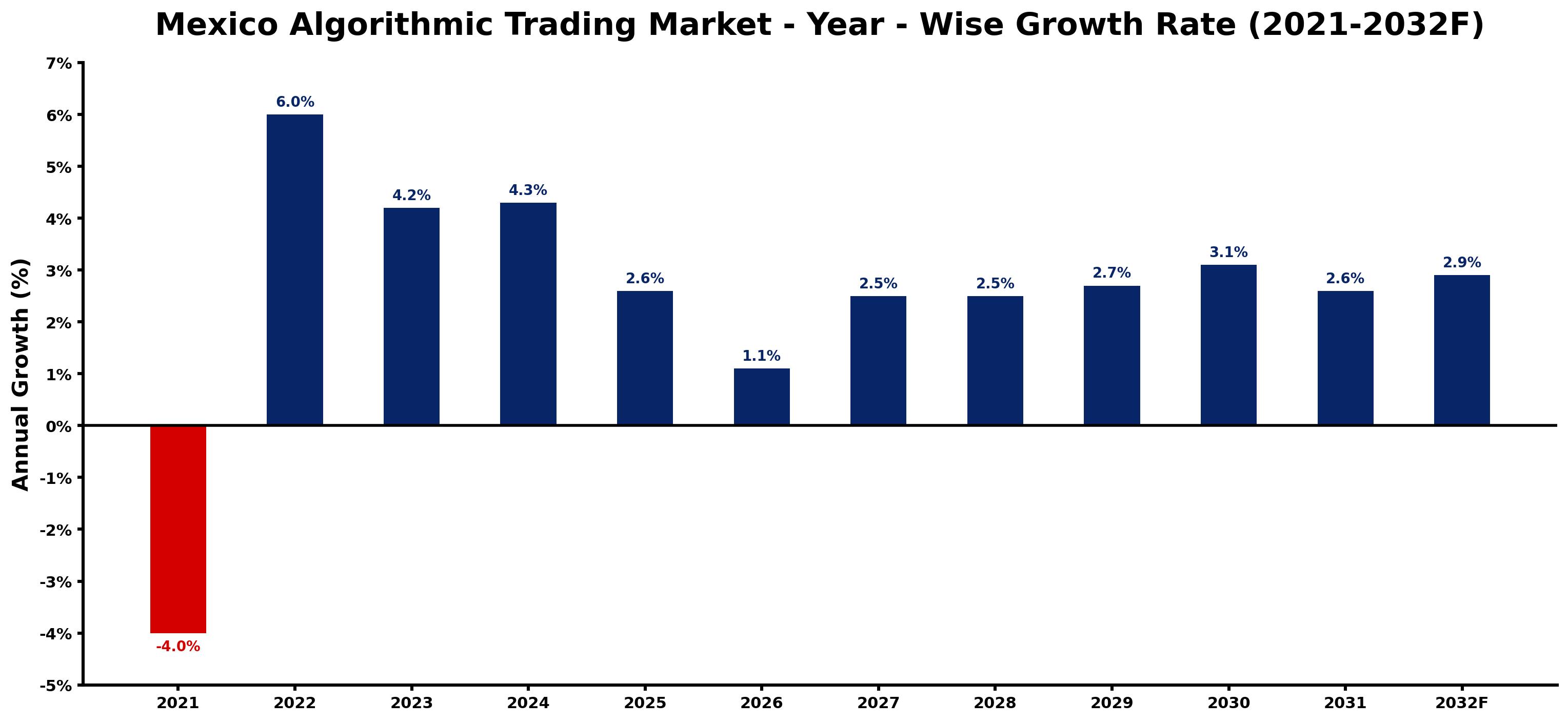
The table below presents the year‑wise growth rates along with the key drivers influencing the market
| Year | Growth Rate | Major Drivers |
| 2021 | -4.0% | AMLO's financial policies hindered technology investments. |
| 2022 | 6.0% | Increased retail investor participation through digital platforms. |
| 2023 | 4.2% | Regulatory support from CNBV enhancing algorithmic trading guidelines. |
| 2024 | 4.3% | Collaboration between fintech startups and traditional brokerages. |
| 2025 | 2.6% | Evolving risk management strategies incorporating algorithmic solutions. |
| 2026 | 1.1% | Growth of Mexican stock exchange enabling diverse trading strategies. |
| 2027 | 2.5% | Rising awareness of data analytics among investment firms. |
| 2028 | 2.5% | Emergence of blockchain technology in trading transactions. |
| 2029 | 2.7% | Increase in financial literacy programs boosting investor confidence. |
| 2030 | 3.1% | Development of local talent in quantitative finance specialization. |
| 2031 | 2.6% | Integration of ESG factors influencing algorithmic trading models. |
| 2032 | 2.9% | Adoption of machine learning tools by Mexican hedge funds. |
Note: Market size estimations and growth projections presented in this report are based on 6Wresearch's proprietary forecasting methodology, utilizing the latest available industry data, government publications, and primary research inputs.
Mexico Algorithmic Trading Market Key Takeaways
Below are some of the specific key takeaways from the market, including:
- Algorithmic trading is becoming essential for institutional investors aiming to optimize trading efficiency.
- The incorporation of machine learning technologies is driving more sophisticated trading strategies.
- Regulatory measures are focused on enhancing transparency and reducing market manipulation risks.
- Retail investors are increasingly adopting algorithmic solutions to improve trading outcomes.
- Investments in advanced trading infrastructure are critical for firms to remain competitive.
Evaluation of Restraints in Mexico Algorithmic Trading Market
While the Mexico Algorithmic Trading Market is on an upward trajectory, several restraints hinder its full potential. Regulatory complexities can create uncertainty for market participants, often leading to compliance challenges that may stifle innovation. on top of that, the lack of adequate technological infrastructure limits the efficiency of trading operations. Access to high-quality market data remains a significant hurdle, impacting the performance of algorithmic strategies. Addressing these issues will require concerted efforts from all stakeholders involved.
Mexico Algorithmic Trading Market Trends
The trends driving the Mexico Algorithmic Trading Market are largely technology-focused. The increasing integration of artificial intelligence and machine learning into trading algorithms is allowing for more precise decision-making and risk management. High-frequency trading continues to gain traction due to its speed and efficiency, while firms are investing heavily in compliance and risk management frameworks. Additionally, there’s a notable shift towards automation among retail investors, who are seeking efficient methods to enhance trading profitability.
Mexico Algorithmic Trading Market Opportunities
Investment opportunities are abundant in the Mexico Algorithmic Trading Market. As the adoption of automated trading strategies accelerates, there is a growing demand for advanced trading software and analytics services. Collaborations with local financial institutions can pave the way for innovative algorithmic solutions tailored to the regional market. Training programs focusing on algorithmic trading education are also emerging as a key opportunity to equip new investors with the necessary skills to thrive in this environment.
Government Initiatives in the Mexico Algorithmic Trading Market
The Mexican government is actively shaping the algorithmic trading market through various regulatory initiatives aimed at promoting market integrity and technological advancement. Regulatory bodies are focused on establishing clear guidelines that encourage compliance while fostering innovation. These policies are crucial for creating an environment where algorithmic trading can flourish.
- A regulatory framework introduced in 2025 mandating risk management reporting for algorithmic traders.
- Current initiatives by the National Banking and Securities Commission (CNBV) to enhance transparency in trading practices.
- Ongoing efforts to improve the technological infrastructure supporting financial markets.
- Upcoming public-private partnerships aimed at fostering innovation in algorithmic trading technologies.
Future Insights of the Mexico Algorithmic Trading Market
Looking ahead to 2026-2032, the Mexico Algorithmic Trading Market is set for continued expansion. As technological advancements continue to reshape trading practices, we anticipate a rise in the sophistication of algorithmic strategies across various asset classes. Institutional investors and hedge funds are likely to drive demand for customized algorithms tailored to specific trading objectives. Regulatory support for transparency and efficiency will further enhance market attractiveness, drawing in new participants and investments.
Mexico Algorithmic Trading Market Latest Developments
Recent activity in the Mexico Algorithmic Trading Market indicates a strong focus on innovation and compliance. Firms are increasingly prioritizing technological upgrades to stay competitive and meet regulatory standards. As the market evolves, these developments are crucial for maintaining investor confidence and market integrity.
- A leading regional operator launched a new algorithmic trading platform in Q1 2025, aimed at enhancing execution speed.
- Ongoing collaborations between local universities and trading firms to develop advanced trading algorithms, which began in mid-2025.
- A major technology vendor announced plans for a data analytics service expected to roll out in early 2026.
- An initiative to upgrade trading infrastructure across the Mexican Stock Exchange is currently underway, anticipated to be completed by late 2025.
Mexico Algorithmic Trading Market - Key Attractiveness of the Report
- 10 Years of Market Numbers
- Historical Data Starting from 2022 to 2025
- Base Year: 2025
- Forecast Data until 2032
- Key Performance Indicators Impacting the Market
- Major Upcoming Developments and Projects
Key Highlights of the Report:
- Mexico Algorithmic Trading Market Outlook
- Market Size of Mexico Algorithmic Trading Market, 2025
- Forecast of Mexico Algorithmic Trading Market, 2032
- Historical Data and Forecast of Mexico Algorithmic Trading Revenues & Volume for the Period 2022-2032F
- Mexico Algorithmic Trading Market Trend Evolution
- Mexico Algorithmic Trading Market Drivers and Challenges
- Mexico Algorithmic Trading Price Trends
- Mexico Algorithmic Trading Porter's Five Forces
- Mexico Algorithmic Trading Industry Life Cycle
- Historical Data and Forecast of Mexico Algorithmic Trading Market Revenues & Volume By Trading Type for the Period 2022-2032F
- Historical Data and Forecast of Mexico Algorithmic Trading Market Revenues & Volume By Foreign Exchange (FOREX) for the Period 2022-2032F
- Historical Data and Forecast of Mexico Algorithmic Trading Market Revenues & Volume By Stock Markets for the Period 2022-2032F
- Historical Data and Forecast of Mexico Algorithmic Trading Market Revenues & Volume By Exchange-Traded Fund (ETF) for the Period 2022-2032F
- Historical Data and Forecast of Mexico Algorithmic Trading Market Revenues & Volume By Bonds for the Period 2022-2032F
- Historical Data and Forecast of Mexico Algorithmic Trading Market Revenues & Volume By Cryptocurrencies for the Period 2022-2032F
- Historical Data and Forecast of Mexico Algorithmic Trading Market Revenues & Volume By Others for the Period 2022-2032F
- Historical Data and Forecast of Mexico Algorithmic Trading Market Revenues & Volume By Deployment Mode for the Period 2022-2032F
- Historical Data and Forecast of Mexico Algorithmic Trading Market Revenues & Volume By Cloud for the Period 2022-2032F
- Historical Data and Forecast of Mexico Algorithmic Trading Market Revenues & Volume By On-premises for the Period 2022-2032F
- Historical Data and Forecast of Mexico Algorithmic Trading Market Revenues & Volume By Component for the Period 2022-2032F
- Historical Data and Forecast of Mexico Algorithmic Trading Market Revenues & Volume By Solutions for the Period 2022-2032F
- Historical Data and Forecast of Mexico Algorithmic Trading Market Revenues & Volume By Services for the Period 2022-2032F
- Historical Data and Forecast of Mexico Algorithmic Trading Market Revenues & Volume By Enterprise Size for the Period 2022-2032F
- Historical Data and Forecast of Mexico Algorithmic Trading Market Revenues & Volume By Small and Medium-sized Enterprises (SMEs) for the Period 2022-2032F
- Historical Data and Forecast of Mexico Algorithmic Trading Market Revenues & Volume By Large Enterprises for the Period 2022-2032F
- Mexico Algorithmic Trading Import Export Trade Statistics
- Market Opportunity Assessment By Trading Type
- Market Opportunity Assessment By Deployment Mode
- Market Opportunity Assessment By Component
- Market Opportunity Assessment By Enterprise Size
- Mexico Algorithmic Trading Top Companies Market Share
- Mexico Algorithmic Trading Competitive Benchmarking By Technical and Operational Parameters
- Mexico Algorithmic Trading Company Profiles
- Mexico Algorithmic Trading Key Strategic Recommendations






































