Mexico Animal Feed Enzymes Market Size, Share & Growth Rate
The Mexico Animal Feed Enzymes Market was estimated at USD 114 Million in 2025 and is projected to reach USD 132 Million by 2032, growing at a CAGR of 2.1% from 2026 to 2032. This growth is primarily fueled by an increasing demand for high-quality animal feed, which is essential for enhancing livestock health and productivity. Factors such as rising meat consumption, greater awareness about the role of enzymes in nutrition, and the need for improved feed efficiency are driving the adoption of these products across various livestock sectors.
Mexico Animal Feed Enzymes Market Year-wise Growth Rate and Key Drivers
This graph highlights how the Mexico Animal Feed Enzymes Market has steadily grown over the years, supported by major growth factors.
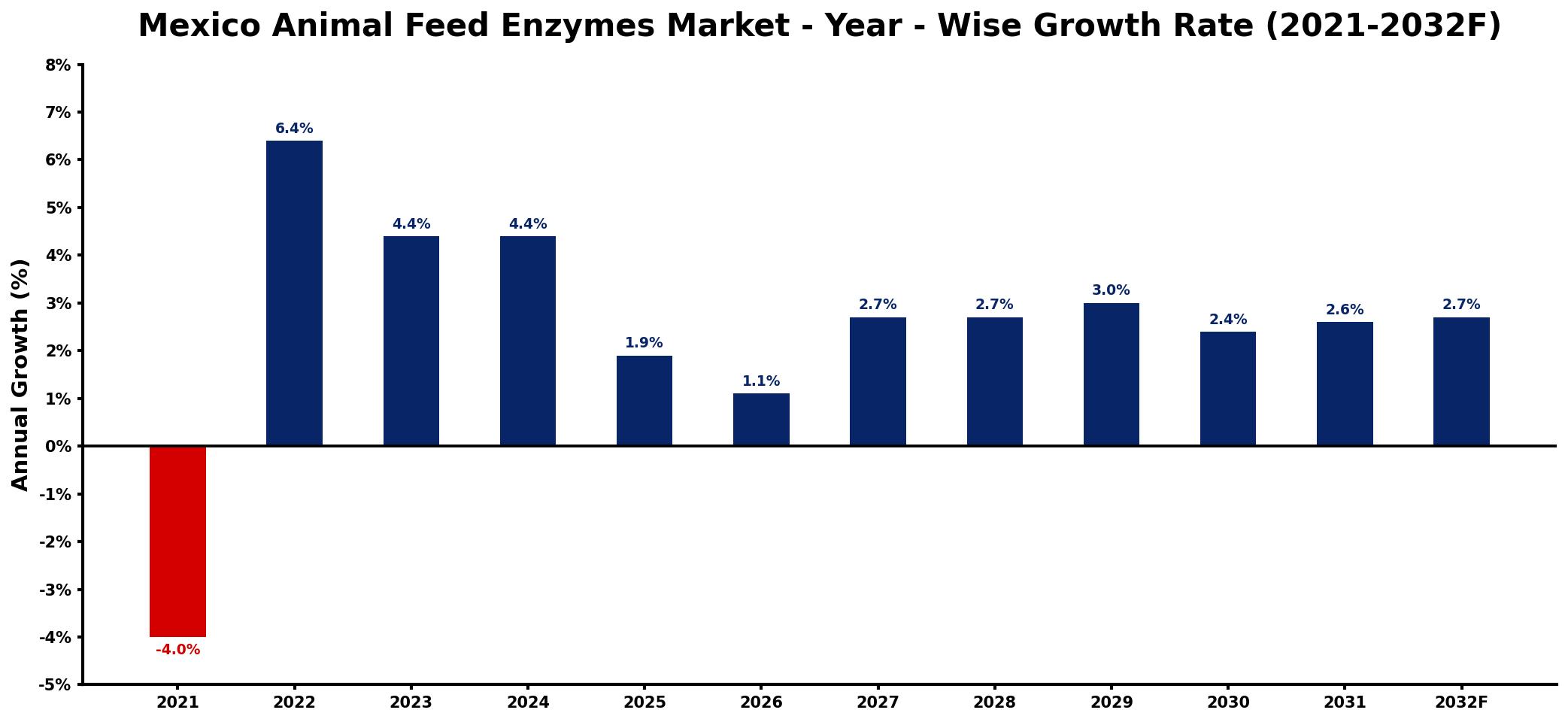
The table below presents the year‑wise growth rates along with the key drivers influencing the market
| Year | Growth Rate | Major Drivers |
| 2021 | -4.0% | decreased livestock production volumes |
| 2022 | 6.4% | increased livestock health awareness |
| 2023 | 4.4% | rising demand for sustainable practices |
| 2024 | 4.4% | growth in aquaculture sector investments |
| 2025 | 1.9% | expansion of poultry industry operations |
| 2026 | 1.1% | increased focus on nutrition optimization |
| 2027 | 2.7% | growing popularity of organic farming |
| 2028 | 2.7% | enhanced research in livestock genetics |
| 2029 | 3.0% | rising consumer demand for quality |
| 2030 | 2.4% | increased adoption of technology solutions |
| 2031 | 2.6% | strengthening international trade flows |
| 2032 | 2.7% | growing trends in precision agriculture |
Note: Market size estimations and growth projections presented in this report are based on 6Wresearch's proprietary forecasting methodology, utilizing the latest available industry data, government publications, and primary research inputs.
Mexico Animal Feed Enzymes Market Synopsis
In Mexico, the adoption of feed enzymes is gaining momentum, particularly among poultry and swine producers who recognize their ability to optimize feed utilization. The introduction of innovative enzyme formulations tailored to different species has played a significant role in advancing livestock production efficiency.
Furthermore, the transition towards sustainable agricultural practices is influencing market dynamics. Livestock farmers are increasingly seeking natural enzyme products to meet consumer demands for environmentally friendly and ethically sourced feed ingredients, positioning themselves favorably in a competitive marketplace.
Mexico Animal Feed Enzymes Market Key Takeaways
- The market is characterized by the rising demand for phytase and protease enzymes, enhancing nutrient digestibility.
- Technological innovations in enzyme production are expected to improve product availability and efficacy.
- Increased emphasis on sustainable practices is driving the development of eco-friendly enzyme formulations.
- Educational initiatives are crucial to raising awareness among farmers regarding the benefits of feed enzymes.
- Partnerships between manufacturers and local producers can facilitate market expansion and accessibility.
Evaluation of Restraints in Mexico Animal Feed Enzymes Market
Despite the positive outlook, the Mexico Animal Feed Enzymes Market faces several restraints. One of the main challenges is the limited awareness among livestock farmers about the advantages and effectiveness of feed enzymes. Many producers still rely on traditional feeding practices, which can hinder market penetration for innovative enzyme solutions. Additionally, regulatory hurdles and the availability of affordable enzyme products can restrict growth potential. Addressing these issues will require concerted efforts from industry stakeholders to promote education and streamline regulatory processes.
Mexico Animal Feed Enzymes Market Trends
Currently, there is a noticeable trend towards the adoption of multi-enzyme formulations that target multiple aspects of animal nutrition. This trend is accompanied by growing research into the efficacy of specific enzyme blends designed to improve nutrient bioavailability. Moreover, the market is increasingly favoring natural and organic feed additives, as producers align their offerings with consumer preferences for sustainability and animal welfare.
Mexico Animal Feed Enzymes Market Opportunities
Investment opportunities in the Mexico Animal Feed Enzymes Market are robust, particularly in developing enzyme solutions tailored to local livestock needs. The expanding poultry, swine, and aquaculture sectors present significant avenues for growth. Furthermore, partnerships with local feed manufacturers are essential for effective market penetration. This collaborative approach can streamline distribution channels and enhance the accessibility of advanced enzyme products in the region.
Government Initiatives in the Mexico Animal Feed Enzymes Market
The Mexican government plays a pivotal role in regulating the animal feed enzymes market. Through the Secretariat of Agriculture and Rural Development (SADER), the government ensures that products meet stringent quality and safety standards. The National Service for Agro-Alimentary Public Health, Safety and Quality (SENASICA) monitors the production and distribution processes to safeguard livestock health. Additionally, the government supports research and innovation in the sector to enhance competitiveness and promote sustainable practices.
Future Insights of the Mexico Animal Feed Enzymes Market
Looking ahead to the years 2026-2032, the Mexico Animal Feed Enzymes Market is set to expand significantly, driven by the increasing demand for quality animal feed and the push for enhanced productivity. As livestock farmers become more educated about the benefits of enzyme supplementation, adoption rates are likely to rise. The focus on sustainable and natural feed additives will also propel the market, ensuring that innovations align with evolving consumer expectations and regulatory standards.
Mexico Animal Feed Enzymes Market Latest Developments (2025 - 2026)
Recent developments in the Mexico Animal Feed Enzymes Market indicate a strong push towards technological advancements in enzyme production. Innovations aimed at improving the stability and efficacy of enzyme formulations are becoming increasingly common. Additionally, industry collaborations focused on research and development are emerging, with stakeholders investing in educational programs to raise awareness among livestock producers about the tangible benefits of enzyme incorporation in animal diets.
Mexico Animal Feed Enzymes Market - Key Attractiveness of the Report
- 10 Years of Market Numbers
- Historical Data Starting from 2022 to 2025
- Base Year: 2025
- Forecast Data until 2032
- Key Performance Indicators Impacting the Market
- Major Upcoming Developments and Projects
Key Highlights of the Report:
- Mexico Animal Feed Enzymes Market Outlook
- Market Size of Mexico Animal Feed Enzymes Market, 2025
- Forecast of Mexico Animal Feed Enzymes Market, 2032
- Historical Data and Forecast of Mexico Animal Feed Enzymes Revenues & Volume for the Period 2022-2032F
- Mexico Animal Feed Enzymes Market Trend Evolution
- Mexico Animal Feed Enzymes Market Drivers and Challenges
- Mexico Animal Feed Enzymes Price Trends
- Mexico Animal Feed Enzymes Porter's Five Forces
- Mexico Animal Feed Enzymes Industry Life Cycle
- Historical Data and Forecast of Mexico Animal Feed Enzymes Market Revenues & Volume By Formulation for the Period 2022-2032F
- Historical Data and Forecast of Mexico Animal Feed Enzymes Market Revenues & Volume By Dry for the Period 2022-2032F
- Historical Data and Forecast of Mexico Animal Feed Enzymes Market Revenues & Volume By Liquid for the Period 2022-2032F
- Historical Data and Forecast of Mexico Animal Feed Enzymes Market Revenues & Volume By Product for the Period 2022-2032F
- Historical Data and Forecast of Mexico Animal Feed Enzymes Market Revenues & Volume By Phytase for the Period 2022-2032F
- Historical Data and Forecast of Mexico Animal Feed Enzymes Market Revenues & Volume By Carbohydrase for the Period 2022-2032F
- Historical Data and Forecast of Mexico Animal Feed Enzymes Market Revenues & Volume By Protease for the Period 2022-2032F
- Historical Data and Forecast of Mexico Animal Feed Enzymes Market Revenues & Volume By Non starch polysaccharides for the Period 2022-2032F
- Historical Data and Forecast of Mexico Animal Feed Enzymes Market Revenues & Volume By Livestock for the Period 2022-2032F
- Historical Data and Forecast of Mexico Animal Feed Enzymes Market Revenues & Volume By Poultry for the Period 2022-2032F
- Historical Data and Forecast of Mexico Animal Feed Enzymes Market Revenues & Volume By Swine for the Period 2022-2032F
- Historical Data and Forecast of Mexico Animal Feed Enzymes Market Revenues & Volume By Ruminant for the Period 2022-2032F
- Historical Data and Forecast of Mexico Animal Feed Enzymes Market Revenues & Volume By Aquaculture for the Period 2022-2032F
- Historical Data and Forecast of Mexico Animal Feed Enzymes Market Revenues & Volume By Others for the Period 2022-2032F
- Mexico Animal Feed Enzymes Import Export Trade Statistics
- Market Opportunity Assessment By Formulation
- Market Opportunity Assessment By Product
- Market Opportunity Assessment By Livestock
- Mexico Animal Feed Enzymes Top Companies Market Share
- Mexico Animal Feed Enzymes Competitive Benchmarking By Technical and Operational Parameters
- Mexico Animal Feed Enzymes Company Profiles
- Mexico Animal Feed Enzymes Key Strategic Recommendations






































