Mexico Cybersecurity Market Growth Rate
According to industry databases and market research insights, the Mexico Cybersecurity Market is projected to grow at a compound annual growth rate (CAGR) of 12.4% during the forecast period 2026–2032.
Mexico Cybersecurity Market Year-wise Growth Rate and Key Drivers (2022-2032)
This graph illustrates the annual growth rates of the Mexico Cybersecurity Market from 2022 to 2032, highlighting stable industrial expansion, infrastructure-driven demand, and increasing adoption of precision finishing solutions.
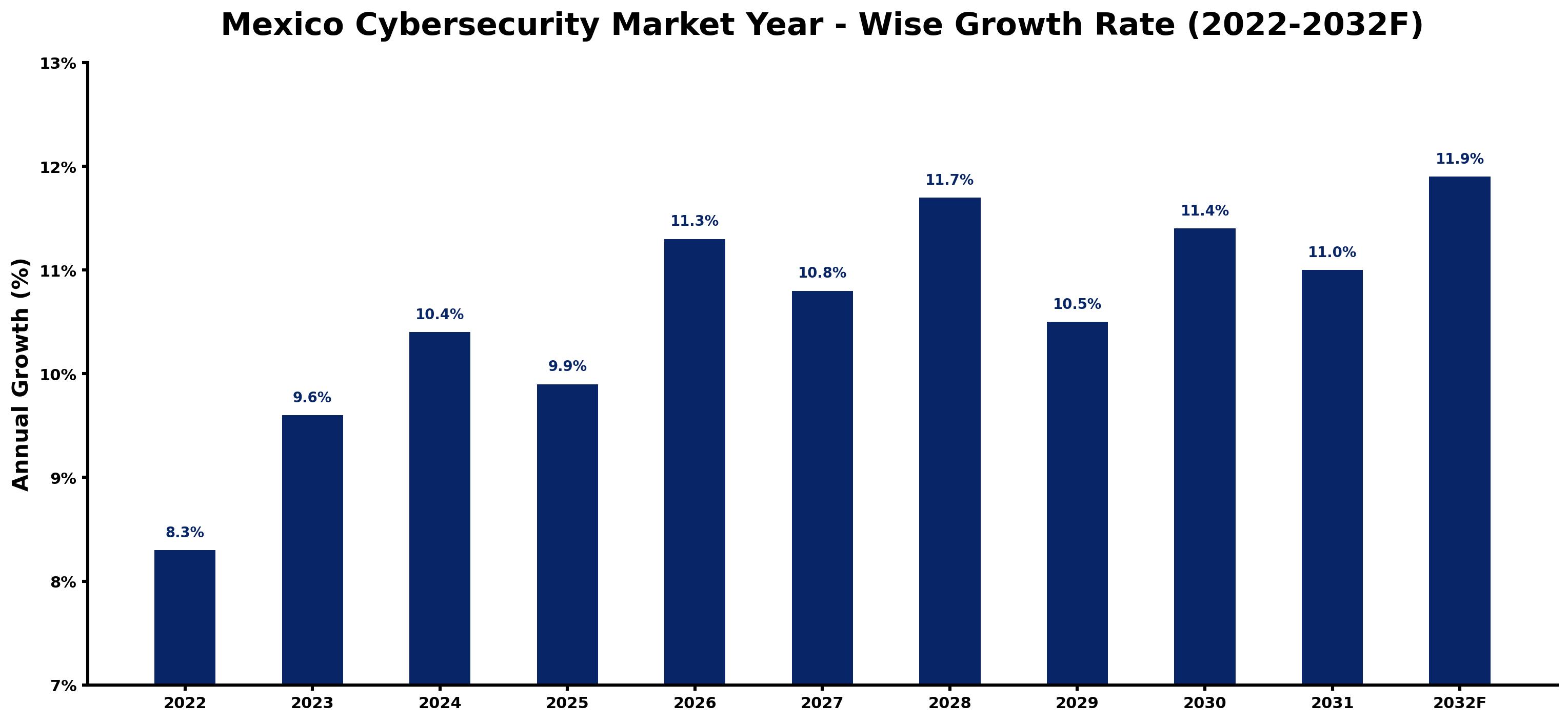
The following table summarizes the historical and forecasted growth rates of the Mexico Cybersecurity Market, along with the rationale behind each year’s performance.
| Year | Estimated Growth | Market Rationale |
| 2022 | 8.3% | Cybersecurity spending increased as organizations strengthened defenses against ransomware, phishing, and hybrid work vulnerabilities. |
| 2023 | 9.6% | Rapid cloud adoption, digital banking expansion, and increasing regulatory compliance requirements accelerated security investments. |
| 2024 | 10.4% | Growing deployment of AI-powered threat detection, Zero Trust architecture, and endpoint security solutions supported stronger market growth. |
| 2025 | 9.9% | Expansion of managed security services and SME cybersecurity adoption continued despite cautious enterprise IT budgets. |
| 2026 | 11.3% | Rising cyberattacks on critical infrastructure, manufacturing, and financial services boosted demand for advanced security platforms. |
| 2027 | 10.8% | Increased investments in identity and access management, SOC modernization, and cloud workload protection sustained market expansion. |
| 2028 | 11.7% | Wider adoption of OT security, IoT protection, and AI-driven security analytics across industrial sectors accelerated growth. |
| 2029 | 10.5% | Market growth moderated slightly as large enterprises matured, while mid-sized businesses continued increasing cybersecurity spending. |
| 2030 | 11.4% | Growing adoption of cybersecurity-as-a-service, secure access service edge (SASE), and data protection solutions fueled demand. |
| 2031 | 11% | Expansion of digital government initiatives, stricter privacy regulations, and cyber resilience strategies maintained healthy growth. |
| 2032 | 11.9% | Continued investments in AI-enabled security, cloud-native protection, and critical infrastructure security supported long-term market expansion. |
Topics Covered in the Mexico Cybersecurity Market Report
The Mexico Cybersecurity Market report thoroughly covers the market by security type, deployment, and end-user sector. The report provides a detailed analysis of ongoing market trends, opportunities/high-growth areas, and market drivers, helping stakeholders devise and align their market strategies according to current and future market dynamics.
Mexico Cybersecurity Market Highlights
| Report Name | Mexico Cybersecurity Market |
| Forecast Period | 2026–2032 |
| CAGR | 12.40% |
| Growing Sector | Digital Security and Information Protection |
Mexico Cybersecurity Market Synopsis
The Mexico Cybersecurity Industry experiences growth as all sectors in the country including BFSI, manufacturing, retail, and government, undergo digital transformation. The rising number of cybercrime incidents which include ransomware attacks, data breaches and financial fraud, drives companies to seek better security solutions. The increasing use of cloud services together with mobile banking and international digital trade requirements, drives organizations to invest more in identity access management, network monitoring, and infrastructure security.
Evaluation of Growth Drivers in the Mexico Cybersecurity Market
Below are some prominent drivers and their influence on the market dynamics:
| Drivers | Primary Segments Affected | Why It Matters |
| Rising Cybercrime Incidents | By Security Type (Network Security, Data Security, IAM) | Rising attack frequency forces organizations to reinforce security defenses. |
| Growth in Digital Banking | By End-User (BFSI) | Digital financial services demand strong fraud prevention and encryption solutions. |
| Cloud Migration | By Deployment (Cloud) | Expansion of cloud environments increases demand for cloud-native security solutions. |
| Regulatory Compliance Requirements | By End-User (Government and Defense, Healthcare) | Data protection laws drive investments in monitoring and reporting systems. |
| Industrial Digitalization | By Security Type (Infrastructure Protection, Network Security) | Smart factories and connected devices require advanced security layers. |
The Mexico Cybersecurity Market Size is projected to grow at a CAGR of 12.4% during the forecast period of 2026–2032. The Mexico Cybersecurity Market is driven by increasing adoption of cloud computing, expansion of fintech services, and growth of digital government initiatives are key growth accelerators. Nevertheless, enterprises are investing in encryption technologies, identity governance frameworks, and live monitoring systems to strengthen risk mitigation. Rising investment in AI-driven threat intelligence and managed detection services also strengthens market expansion. Subsequently, integration of IoT devices across industrial and smart city projects contributes significantly to the growth trajectory of the market.
Evaluation of Restraints in the Mexico Cybersecurity Market
Below are some prominent restraints and their influence on the market dynamics:
| Restraints | Primary Segments Affected | What This Means |
| High Implementation Costs | By Security Type (Comprehensive Enterprise Suites) | Advanced solutions may be unaffordable for SMEs. |
| Shortage of Skilled Professionals | By End-User (All) | Implementation timelines and threat response performance suffer due to lack of trained professionals. |
| Legacy IT Infrastructure | By Deployment (On-Premise) | The existing security tools of the organization experience difficulties as outdated infrastructure of the organization requires modern security tools for proper operation. |
| Complex Compliance Landscape | By End-User (Healthcare, BFSI) | Changing regulations heighten operational complexity and reporting obligations. |
| Rising Sophistication of Cyber Threats | By Security Type (Network Security, Data Security, Infrastructure Protection) | Increasingly advanced attacks require continuous upgrades in security frameworks and higher investment. |
Mexico Cybersecurity Market Challenges
The Mexico Cybersecurity Industry faces several challenges such as limited cybersecurity awareness among small enterprises, budget constraints for comprehensive solutions, and dependence on legacy IT systems. However, evolving cyber threats, such as ransomware-as-a-service and complex phishing attacks, demand ongoing improvements in detection and response systems. A shortage of qualified cybersecurity professionals further limits effective risk management. Meanwhile, the growing demand for managed security solutions supports expertise augmentation and improves defensive strength.
Mexico Cybersecurity Market Trends
Some major trends contributing to the Mexico Cybersecurity Market Growth are:
- Rise in Zero-Trust Architecture: Organizations use zero-trust security frameworks to protect their hybrid environments by requiring users to complete multiple authentication steps before accessing systems.
- Growth of AI-Based Threat Detection: Organizations use artificial intelligence and machine learning technologies to strengthen their threat detection systems which protects their systems from attacks.
- Expansion of Managed Security Services: Companies establish partnerships with cybersecurity experts to address their need for security experts who work outside their internal teams.
- Increased Investment in Cloud Security: Organizations that expand their cloud environments now use SASE frameworks and cloud workload protection tools as essential components for protecting their digital systems.
Investment Opportunities in the Mexico Cybersecurity Market
Some investment opportunities that will shape the dynamics of the Mexico Cybersecurity Market include:
- SME-Focused Security Solutions: The organization creates security solutions which focus on small and medium-sized enterprises through development of economical security packages that can grow according to business needs.
- Industrial IoT Security: The investment supports platforms which protect Internet of Things deployments used in manufacturing and energy production facilities.
- Cybersecurity Training Programs: The funding supports programs which create skilled cybersecurity professionals to address the existing talent deficits.
- Government Partnerships: Collaborating with national cybersecurity agencies and defense programs to strengthen infrastructure protection.
Top 5 Leading Players in the Mexico Cybersecurity Market
Below is the list of prominent companies leading the Mexico Cybersecurity Market Share:
Cisco Systems, Inc.
| Company Name | Cisco Systems, Inc. |
| Established Year | 1984 |
| Headquarters | San Jose, California, USA |
| Official Website | Click Here |
Cisco provides advanced network security, firewall systems, secure access solutions, and cloud security platforms widely adopted across Mexican enterprises.
IBM Corporation
| Company Name | IBM Corporation |
| Established Year | 1911 |
| Headquarters | Armonk, New York, USA |
| Official Website | Click Here |
IBM offers AI-powered cybersecurity solutions, threat intelligence platforms, and managed security services supporting financial institutions and government agencies.
Fortinet, Inc.
| Company Name | Fortinet, Inc. |
| Established Year | 2000 |
| Headquarters | Sunnyvale, California, USA |
| Official Website | Click Here |
Fortinet delivers integrated cybersecurity solutions including firewalls, endpoint protection, and secure networking solutions for enterprises and SMEs.
Palo Alto Networks, Inc.
| Company Name | Palo Alto Networks, Inc. |
| Established Year | 2005 |
| Headquarters | Santa Clara, California, USA |
| Official Website | Click Here |
Palo Alto Networks specializes in next-generation firewall technologies, cloud security, and AI-driven threat detection platforms.
Check Point Software Technologies Ltd.
| Company Name | Check Point Software Technologies Ltd. |
| Established Year | 1993 |
| Headquarters | Tel Aviv, Israel |
| Official Website | Click Here |
Check Point provides comprehensive cybersecurity software and hardware solutions focusing on network security, endpoint protection, and advanced threat prevention.
Government Regulations in the Mexico Cybersecurity Market
According to Mexican government data, the National Digital Strategy and the National Cybersecurity Strategy which operate through federal frameworks provide cybersecurity protection for their operations. The Federal Law on Protection of Personal Data Held by Private Parties (LFPDPPP) mandates strict data protection compliance. National incident response capabilities receive enhancement through the National Guard Cybersecurity Division and its partnership with the Organization of American States (OAS). Through secure digital government service initiatives public institutions strengthen their cybersecurity infrastructure.
Future Insights of the Mexico Cybersecurity Market
The Mexico Cybersecurity Market Share will continue to expand as digital payments are increasing, fintech systems are growing and smart manufacturing technologies are being used more widely and government cybersecurity programs are becoming stronger. The ongoing trend of enterprises moving their operations to the cloud is driving organizations to seek solutions for protecting cloud environments, managing user access and authentication. The increased emphasis on proactive risk management, AI-based threat detection and essential infrastructure safeguarding will create major effects that will shape market growth and investment patterns in various business sectors.
Market Segmentation Analysis
The report offers a comprehensive study of the following market segments and their leading categories:
By Security Type – Network Security to Lead the Market
According to Ritika Kalra, Senior Research Analyst, 6Wresearch, Network Security is expected to dominate the market due to rising cyberattacks targeting enterprise networks, expansion of remote work infrastructure, and the need for real-time monitoring and firewall systems. Growing demand for intrusion detection, secure gateways, and next-generation firewalls strengthens this segment’s leadership.
By Deployment – Cloud to Lead the Market
The Mexico Cybersecurity Market is expected to be propelled by cloud deployment, as enterprises increasingly transition their operations to cloud-based environments.
By End-user – BFSI to Lead the Market
The BFSI sector is anticipated to lead the market, supported by high digital transaction volumes, strict compliance requirements, and rising demand for sophisticated fraud detection technologies. Sustained digital banking growth further strengthens cybersecurity spending in this sector.
Key Attractiveness of the Report
- 10 Years of Market Numbers
- Historical Data Starting from 2022 to 2025
- Base Year: 2025
- Forecast Data until 2032
- Key Performance Indicators Impacting the Market
- Major Upcoming Developments and Projects
Key Highlights of the Report:
- Mexico Cybersecurity Market Outlook
- Market Size of Mexico Cybersecurity Market, 2025
- Forecast of Mexico Cybersecurity Market, 2032
- Historical Data and Forecast of Mexico Cybersecurity Revenues & Volume for the Period 2022 - 2032F
- Mexico Cybersecurity Market Trend Evolution
- Mexico Cybersecurity Market Drivers and Challenges
- Mexico Cybersecurity Price Trends
- Mexico Cybersecurity Porter's Five Forces
- Mexico Cybersecurity Industry Life Cycle
- Historical Data and Forecast of Mexico Cybersecurity Market Revenues & Volume By Security Type for the Period 2022 - 2032F
- Historical Data and Forecast of Mexico Cybersecurity Market Revenues & Volume By Cloud Security for the Period 2022 - 2032F
- Historical Data and Forecast of Mexico Cybersecurity Market Revenues & Volume By Data Security for the Period 2022 - 2032F
- Historical Data and Forecast of Mexico Cybersecurity Market Revenues & Volume By Identity Access Management for the Period 2022 - 2032F
- Historical Data and Forecast of Mexico Cybersecurity Market Revenues & Volume By Network Security for the Period 2022 - 2032F
- Historical Data and Forecast of Mexico Cybersecurity Market Revenues & Volume By Consumer Security for the Period 2022 - 2032F
- Historical Data and Forecast of Mexico Cybersecurity Market Revenues & Volume By Infrastructure Protection for the Period 2022 - 2032F
- Historical Data and Forecast of Mexico Cybersecurity Market Revenues & Volume By Others for the Period 2022 - 2032F
- Historical Data and Forecast of Mexico Cybersecurity Market Revenues & Volume By Deployment for the Period 2022 - 2032F
- Historical Data and Forecast of Mexico Cybersecurity Market Revenues & Volume By Cloud for the Period 2022 - 2032F
- Historical Data and Forecast of Mexico Cybersecurity Market Revenues & Volume By On-Premise for the Period 2022 - 2032F
- Historical Data and Forecast of Mexico Cybersecurity Market Revenues & Volume By End-User for the Period 2022 - 2032F
- Historical Data and Forecast of Mexico Cybersecurity Market Revenues & Volume By BFSI for the Period 2022 - 2032F
- Historical Data and Forecast of Mexico Cybersecurity Market Revenues & Volume By Healthcare for the Period 2022 - 2032F
- Historical Data and Forecast of Mexico Cybersecurity Market Revenues & Volume By Manufacturing for the Period 2022 - 2032F
- Historical Data and Forecast of Mexico Cybersecurity Market Revenues & Volume By Government and Defense for the Period 2022 - 2032F
- Historical Data and Forecast of Mexico Cybersecurity Market Revenues & Volume By IT and Telecommunication for the Period 2022 - 2032F
- Historical Data and Forecast of Mexico Cybersecurity Market Revenues & Volume By Others for the Period 2022 - 2032F
- Mexico Cybersecurity Import Export Trade Statistics
- Market Opportunity Assessment By Security Type
- Market Opportunity Assessment By Deployment
- Market Opportunity Assessment By End-User
- Mexico Cybersecurity Top Companies Market Share
- Mexico Cybersecurity Competitive Benchmarking By Technical and Operational Parameters
- Mexico Cybersecurity Company Profiles
- Mexico Cybersecurity Key Strategic Recommendations
Market Covered
The report provides a detailed analysis of the following market segments and subsegments:
By Security Type
- Cloud Security
- Data Security
- Identity Access Management
- Network Security
- Consumer Security
- Infrastructure Protection
- Others
By Deployment
- Cloud
- On-Premise
By End-User
- BFSI
- Healthcare
- Manufacturing
- Government and Defense
- IT and Telecommunication
- Others






































