Mexico Graph Database Market Size & Growth Rate (2026-2032)
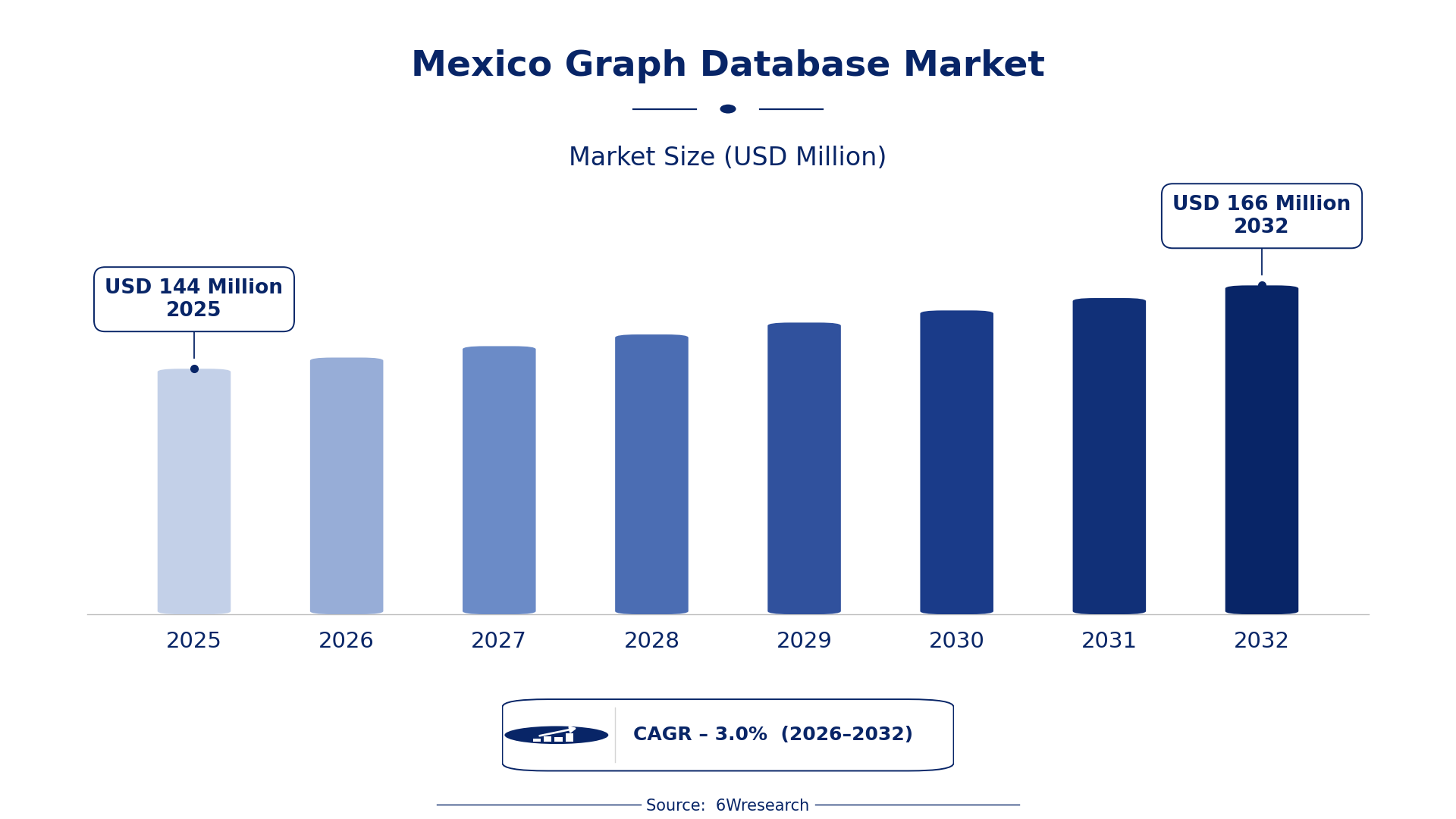
The Mexico Graph Database Market was estimated at USD 144 Million in 2025 and is projected to reach USD 166 Million by 2032, growing at a CAGR of 3.0% from 2026 to 2032.
Mexico Graph Database Market Synopsis
The demand for graph databases in Mexico is primarily driven by the need for advanced analytics across multiple sectors. Industries such as finance, healthcare, and retail are increasingly recognizing the potential of graph databases to model complex relationships within their data, leading to improved decision-making.
As organizations strive for greater operational efficiency, they are integrating graph databases to handle vast amounts of interconnected data. This trend is not just about data storage; it’s about gaining actionable insights that can influence strategic direction and enhance customer experiences.
Mexico Graph Database Market Year-wise Growth Rate and Key Drivers
This graph illustrates the annual growth rates of the Mexico Graph Database Market from 2021 to 2032, highlighting a steady upward trajectory and projected expansion over the forecast period.
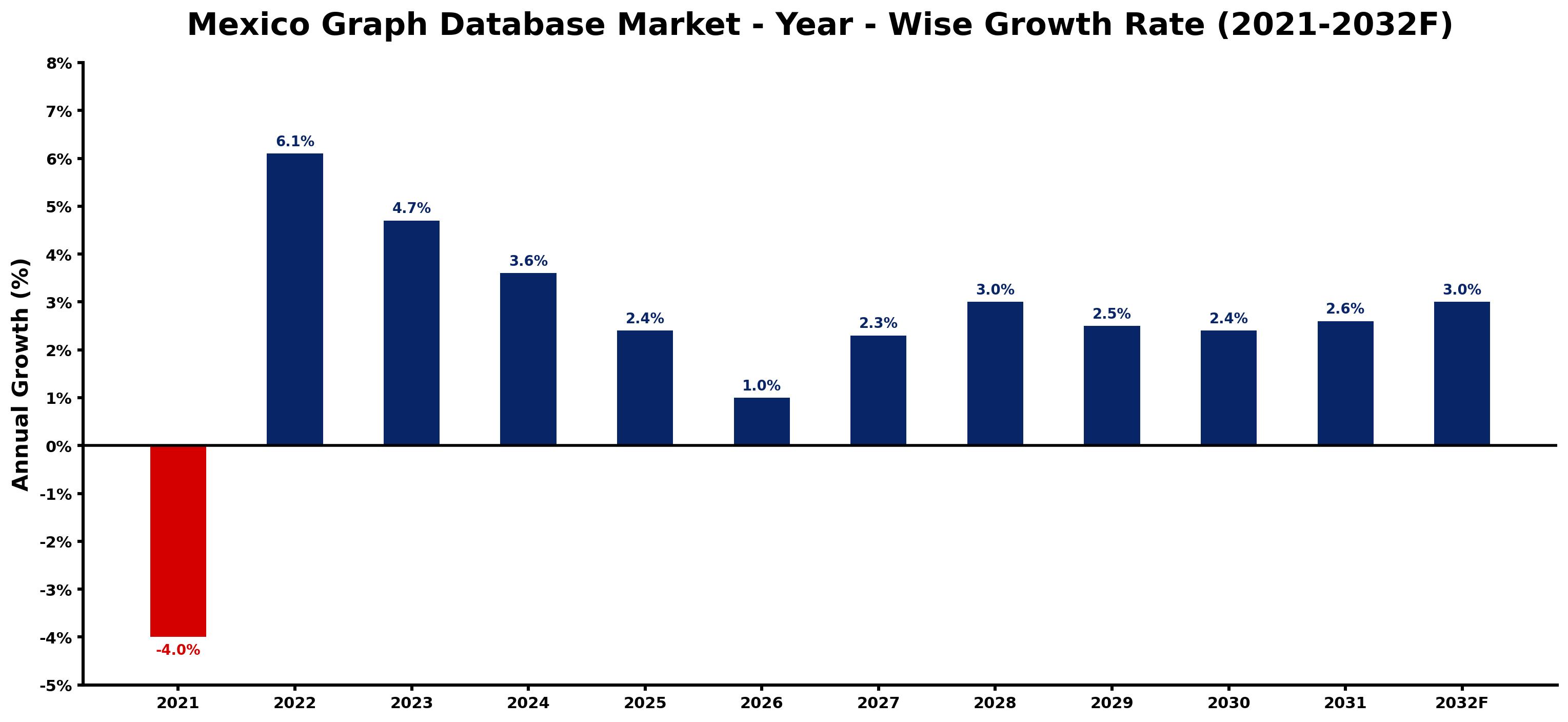
The table below presents the year‑wise growth rates along with the key drivers influencing the market
| Year | Growth Rate | Major Drivers |
| 2021 | -4.0% | Reduced funding from CONACYT for tech innovation projects. |
| 2022 | 6.1% | Growing adoption of AI technologies in Mexican businesses. |
| 2023 | 4.7% | Surge in ecommerce requiring robust data management systems. |
| 2024 | 3.6% | Emergence of local startups leveraging graph databases. |
| 2025 | 2.4% | Increased focus on fraud detection in financial services. |
| 2026 | 1.0% | Rising digitalization among small and medium enterprises. |
| 2027 | 2.3% | Boost in analytics-driven marketing campaigns by firms. |
| 2028 | 3.0% | Government support for tech innovation funding initiatives. |
| 2029 | 2.5% | Adoption of graph databases for urban mobility solutions. |
| 2030 | 2.4% | Utilization of databases for enhancing transportation logistics. |
| 2031 | 2.6% | Growing importance of customer data privacy regulations. |
| 2032 | 3.0% | Increased investments in cybersecurity for data protection. |
Note: Market size estimations and growth projections presented in this report are based on 6Wresearch's proprietary forecasting methodology, utilizing the latest available industry data, government publications, and primary research inputs.
Mexico Graph Database Market Key Takeaways
Below are some of the specific key takeaways from the market, including:
- The growing adoption of graph databases is transforming data management strategies across various industries.
- Organizations are utilizing graph databases for applications such as fraud detection and recommendation systems.
- The market is challenged by a lack of awareness and skilled professionals in graph database technologies.
- Government initiatives are fostering a favorable environment for technological advancements.
- Real-time data processing is becoming increasingly essential for businesses seeking competitive advantages.
Evaluation of Restraints in Mexico Graph Database Market
Limited awareness about graph databases remains a considerable barrier. Many businesses in Mexico are still unfamiliar with the advantages of this technology, leading to slow adoption rates. Additionally, a shortage of professionals who are well-versed in graph database management further hampers progress. Security and privacy concerns also pose a challenge, as companies grapple with the implications of regulations on handling sensitive data.
Mexico Graph Database Market Trends
The trend towards real-time data analytics is reshaping the graph database market in Mexico. Businesses are increasingly leveraging this technology to gain deeper insights from their data, facilitating more informed decisions. on top of that, user-friendly graph database platforms are gaining traction, encouraging more companies to adopt these solutions.
Integration of graph databases into existing IT infrastructures is becoming smoother, allowing for quicker adoption. As organizations recognize the need for sophisticated data management tools, the market for graph databases is set to expand.
Mexico Graph Database Market Opportunities
Investment opportunities in the Mexico Graph Database Market are abundant, especially as industries like healthcare and finance continue to seek advanced data solutions. Companies are looking to harness the power of graph databases for various applications, from fraud detection to network analysis.
Investors can explore opportunities in software development, consulting services, and training programs focused on graph database technologies. As the demand for data-driven insights grows, these sectors are likely to see substantial growth.
Government Initiatives in the Mexico Graph Database Market
The Mexican government is actively supporting the technology sector, including the graph database market, through several initiatives aimed at enhancing digital capabilities. These policies are designed to foster innovation and improve the country’s technological infrastructure, which is crucial for the growth of graph databases.
- A national digital infrastructure upgrade program is currently underway, focusing on enhancing connectivity and data management across various sectors.
- The National Digital Strategy, recently updated, emphasizes the integration of advanced technologies like graph databases in public sector data management.
- Tax incentives for technology investments have been established to encourage private sector involvement in graph database solutions.
- Planned initiatives include grants for research and development in data technologies expected to roll out by 2026.
- A public-private partnership aimed at increasing access to digital tools for small businesses is anticipated to be launched in 2025.
Future Insights of the Mexico Graph Database Market
Looking ahead to 2026-2032, the Mexico Graph Database Market is set for steady expansion. As industries increasingly rely on data-driven decision-making, the demand for sophisticated data analytics tools will rise. Graph databases will be integral to this transformation, offering unique capabilities to handle complex data relationships.
The ongoing digital transformation efforts across Mexico will further bolster market growth, positioning graph databases as vital components of modern data management strategies.
Mexico Graph Database Market Latest Developments
Recent activity in the Mexico Graph Database Market reflects a growing interest in innovative data solutions. Companies are increasingly investing in technologies that enhance data analytics capabilities, indicating a positive trend for the market's future.
- A major technology vendor announced a partnership with local firms in Q1 2025 to develop tailored graph database solutions for the healthcare sector.
- A leading regional operator launched a new graph database platform in early 2025, focusing on providing real-time analytics for retail applications.
- Ongoing training programs are being rolled out to educate professionals on graph database technologies, which began in mid-2025 and continue to expand.
- Plans for a new research initiative aimed at exploring the potential of graph databases in fraud detection are expected to kick off by the end of 2025.
- An upcoming conference dedicated to graph database technologies is scheduled for late 2026, focusing on innovation and best practices in the field.
Mexico Graph Database Market - Key Attractiveness of the Report
- 10 Years of Market Numbers
- Historical Data Starting from 2022 to 2025
- Base Year: 2025
- Forecast Data until 2032
- Key Performance Indicators Impacting the Market
- Major Upcoming Developments and Projects
Key Highlights of the Report:
- Mexico Graph Database Market Outlook
- Market Size of Mexico Graph Database Market, 2025
- Forecast of Mexico Graph Database Market, 2032
- Historical Data and Forecast of Mexico Graph Database Revenues & Volume for the Period 2022-2032F
- Mexico Graph Database Market Trend Evolution
- Mexico Graph Database Market Drivers and Challenges
- Mexico Graph Database Price Trends
- Mexico Graph Database Porter's Five Forces
- Mexico Graph Database Industry Life Cycle
- Historical Data and Forecast of Mexico Graph Database Market Revenues & Volume By Component for the Period 2022-2032F
- Historical Data and Forecast of Mexico Graph Database Market Revenues & Volume By Software for the Period 2022-2032F
- Historical Data and Forecast of Mexico Graph Database Market Revenues & Volume By Services for the Period 2022-2032F
- Historical Data and Forecast of Mexico Graph Database Market Revenues & Volume By Organization Size for the Period 2022-2032F
- Historical Data and Forecast of Mexico Graph Database Market Revenues & Volume By Large enterprises for the Period 2022-2032F
- Historical Data and Forecast of Mexico Graph Database Market Revenues & Volume By Small and medium-sized enterprises (SMEs) for the Period 2022-2032F
- Historical Data and Forecast of Mexico Graph Database Market Revenues & Volume By Application for the Period 2022-2032F
- Historical Data and Forecast of Mexico Graph Database Market Revenues & Volume By Customer Analytics for the Period 2022-2032F
- Historical Data and Forecast of Mexico Graph Database Market Revenues & Volume By Risk, Compliance and Reporting Management for the Period 2022-2032F
- Historical Data and Forecast of Mexico Graph Database Market Revenues & Volume By Recommendation Engines for the Period 2022-2032F
- Historical Data and Forecast of Mexico Graph Database Market Revenues & Volume By Fraud Detection and Prevention for the Period 2022-2032F
- Historical Data and Forecast of Mexico Graph Database Market Revenues & Volume By Supply Chain Management for the Period 2022-2032F
- Historical Data and Forecast of Mexico Graph Database Market Revenues & Volume By Operations Management and Asset Management for the Period 2022-2032F
- Historical Data and Forecast of Mexico Graph Database Market Revenues & Volume By Infrastructure Management, IoT, Industry 4.0 for the Period 2022-2032F
- Historical Data and Forecast of Mexico Graph Database Market Revenues & Volume By Knowledge Management for the Period 2022-2032F
- Historical Data and Forecast of Mexico Graph Database Market Revenues & Volume By Deployment Mode for the Period 2022-2032F
- Historical Data and Forecast of Mexico Graph Database Market Revenues & Volume By Cloud for the Period 2022-2032F
- Historical Data and Forecast of Mexico Graph Database Market Revenues & Volume By On-premises for the Period 2022-2032F
- Historical Data and Forecast of Mexico Graph Database Market Revenues & Volume By Vertical for the Period 2022-2032F
- Historical Data and Forecast of Mexico Graph Database Market Revenues & Volume By BFSI for the Period 2022-2032F
- Historical Data and Forecast of Mexico Graph Database Market Revenues & Volume By Retail and eCommerce for the Period 2022-2032F
- Historical Data and Forecast of Mexico Graph Database Market Revenues & Volume By Telecom and IT for the Period 2022-2032F
- Historical Data and Forecast of Mexico Graph Database Market Revenues & Volume By Healthcare, Pharmaceuticals, and Life Sciences for the Period 2022-2032F
- Historical Data and Forecast of Mexico Graph Database Market Revenues & Volume By Government and Public Sector for the Period 2022-2032F
- Historical Data and Forecast of Mexico Graph Database Market Revenues & Volume By Manufacturing and Automotive for the Period 2022-2032F
- Historical Data and Forecast of Mexico Graph Database Market Revenues & Volume By Media and Entertainment for the Period 2022-2032F
- Historical Data and Forecast of Mexico Graph Database Market Revenues & Volume By Energy and Utilities for the Period 2022-2032F
- Historical Data and Forecast of Mexico Graph Database Market Revenues & Volume By Type for the Period 2022-2032F
- Historical Data and Forecast of Mexico Graph Database Market Revenues & Volume By RDF for the Period 2022-2032F
- Historical Data and Forecast of Mexico Graph Database Market Revenues & Volume By Labeled Property Graph for the Period 2022-2032F
- Mexico Graph Database Import Export Trade Statistics
- Market Opportunity Assessment By Component
- Market Opportunity Assessment By Organization Size
- Market Opportunity Assessment By Application
- Market Opportunity Assessment By Deployment Mode
- Market Opportunity Assessment By Vertical
- Market Opportunity Assessment By Type
- Mexico Graph Database Top Companies Market Share
- Mexico Graph Database Competitive Benchmarking By Technical and Operational Parameters
- Mexico Graph Database Company Profiles
- Mexico Graph Database Key Strategic Recommendations






































