Mexico Mobile Security Market Size & Growth Rate (2026-2032)
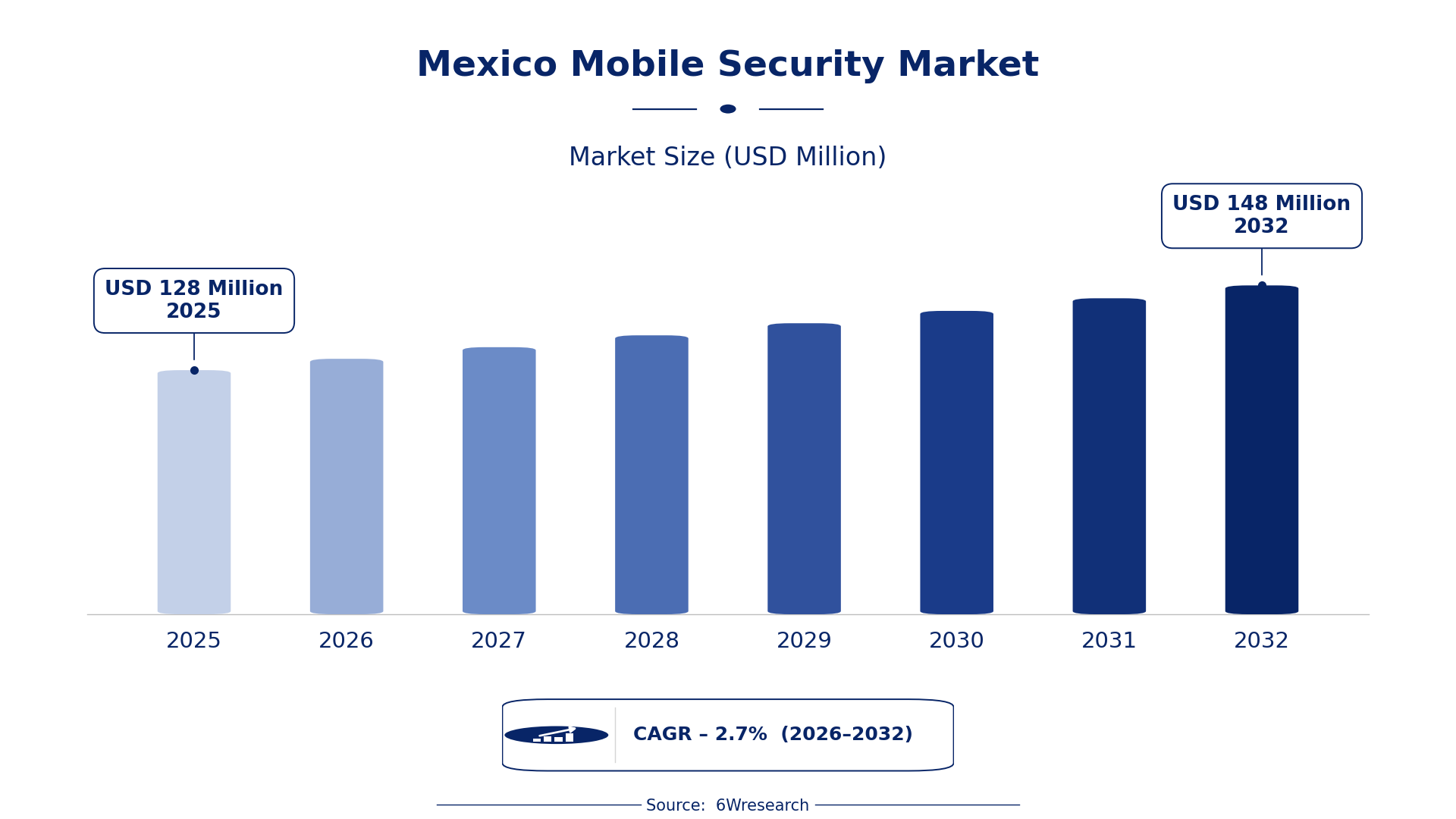
The Mexico Mobile Security Market was estimated at USD 128 Million in 2025 and is projected to reach USD 148 Million by 2032, growing at a CAGR of 2.7% from 2026 to 2032.
Mexico Mobile Security Market Synopsis
The mobile security market in Mexico is increasingly crucial as mobile device usage continues to skyrocket. With more users relying on their devices for personal and business transactions, the stakes for protecting sensitive data have never been higher. Cyber threats are evolving rapidly, prompting both consumers and enterprises to seek robust security measures.
Growing awareness about data privacy and the significant impact of breaches on businesses are central to market expansion. Solutions like mobile device management, secure communication applications, and antivirus software are becoming standard in safeguarding users from potential cyberattacks.
Mexico Mobile Security Market Year-wise Growth Rate and Key Drivers
This graph illustrates the annual growth rates of the Mexico Mobile Security Market from 2021 to 2032, highlighting a steady upward trajectory and projected expansion over the forecast period.
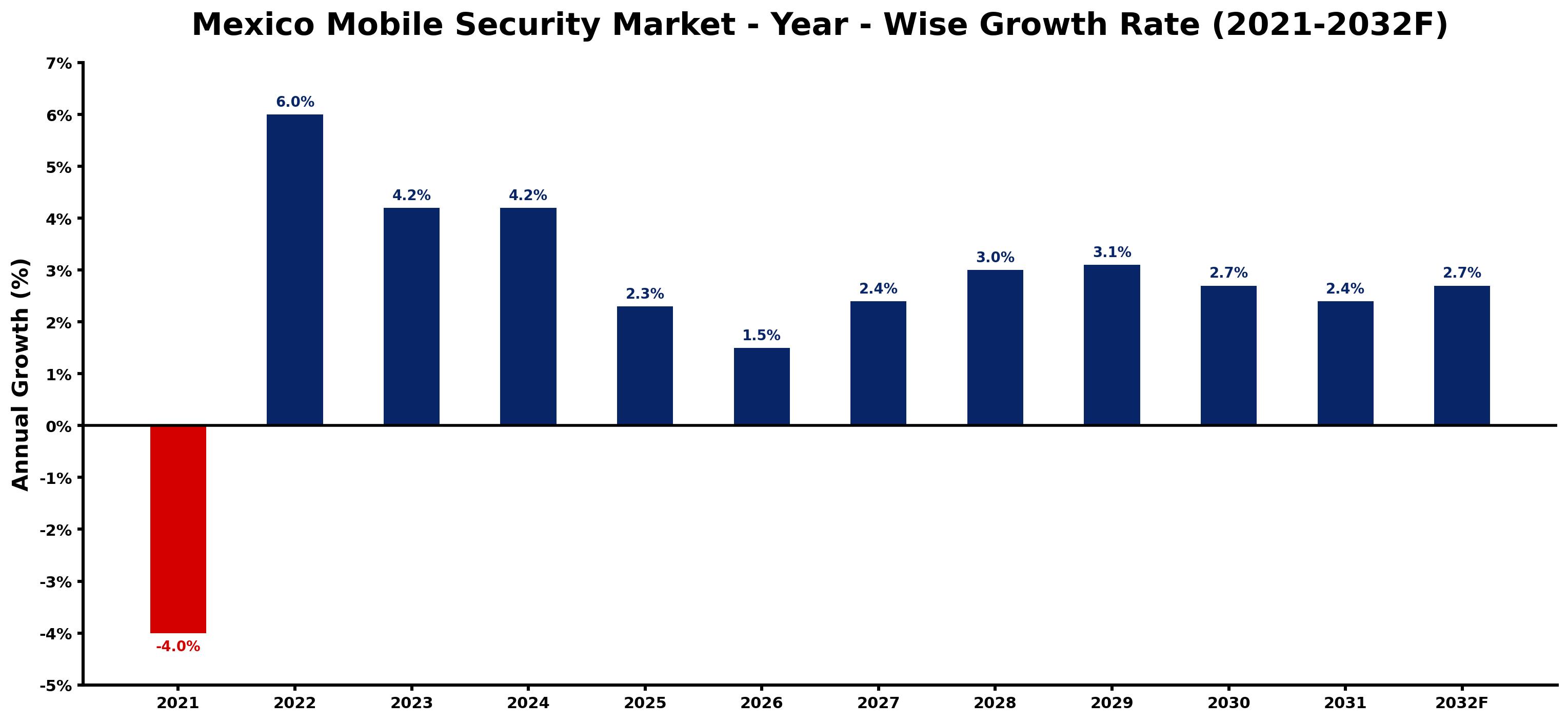
The table below presents the year‑wise growth rates along with the key drivers influencing the market
| Year | Growth Rate | Major Drivers |
| 2021 | -4.0% | Government cybersecurity investment delays hinder market advancements. |
| 2022 | 6.0% | Increased cybersecurity regulations by Mexico's National Cybersecurity Center. |
| 2023 | 4.2% | Growing smartphone adoption among urban populations in Mexico. |
| 2024 | 4.2% | Enhanced focus on digital identity protection post-data breaches. |
| 2025 | 2.3% | Local demand for mobile fraud prevention services surges. |
| 2026 | 1.5% | Government initiatives to promote secure mobile payments expand. |
| 2027 | 2.4% | Rise in mobile app development boosts security solution needs. |
| 2028 | 3.0% | Strengthened partnerships between telecoms and security vendors emerge. |
| 2029 | 3.1% | Growing awareness of phishing attacks among mobile users increases. |
| 2030 | 2.7% | Telecom reforms stimulate investment in mobile security infrastructure. |
| 2031 | 2.4% | Increased mobile banking usage drives demand for security solutions. |
| 2032 | 2.7% | Regulatory compliance mandates elevate interest in mobile security. |
Note: Market size estimations and growth projections presented in this report are based on 6Wresearch's proprietary forecasting methodology, utilizing the latest available industry data, government publications, and primary research inputs.
Mexico Mobile Security Market Key Takeaways
Below are some of the specific key takeaways from the market, including:
- The market is driven by the increasing frequency and complexity of cyberattacks targeting mobile devices.
- Regulatory compliance is a critical factor pushing businesses to adopt mobile security solutions.
- Data protection regulations are becoming more stringent, necessitating advanced security protocols.
- Consumer awareness regarding personal data security is driving demand for mobile security applications.
- Mobile security solutions are increasingly integrated with broader IT security frameworks within organizations.
Evaluation of Restraints in Mexico Mobile Security Market
Despite the favorable growth outlook, the mobile security market in Mexico faces significant hurdles. The rapidly changing nature of cyber threats means that security solutions must continuously adapt, which can strain resources for both providers and users. Compliance with evolving data protection regulations is another layer of complexity, often requiring ongoing investment in technology and training.
on top of that, a delicate balance must be struck between implementing stringent security measures and ensuring user convenience. Users are often reluctant to adopt solutions perceived as cumbersome or intrusive, which can slow the overall uptake of mobile security applications.
Mexico Mobile Security Market Trends
Several trends are currently shaping the Mexico Mobile Security Market. The adoption of cloud-based security solutions is gaining momentum, allowing for more scalable and flexible security measures. There is a notable increase in demand for end-to-end encryption across mobile applications as users prioritize data privacy.
Artificial intelligence is also being integrated into mobile security tools, enhancing threat detection and response capabilities. The focus on user education about mobile security risks is becoming more pronounced, as companies aim to mitigate human error, often the weakest link in security protocols.
Mexico Mobile Security Market Opportunities
Opportunities in the mobile security sector are abundant, especially for companies that can innovate in response to user needs. The increasing prevalence of remote work creates a demand for security solutions that protect corporate data on personal devices. Partnerships between technology providers and telecom operators could expand service offerings and improve security infrastructure.
Investment in training programs to enhance awareness of cybersecurity among users can also lead to more resilient mobile security practices. As businesses adapt to new regulations, there is room for growth in compliance-focused mobile security solutions.
Government Initiatives in the Mexico Mobile Security Market
The Mexican government is taking decisive steps to bolster mobile security and protect its digital economy. Recent policy shifts have emphasized the importance of cybersecurity in safeguarding both personal and corporate data. As digital threats evolve, the government is enhancing regulatory frameworks that govern mobile security practices.
- A recently completed initiative introduced new guidelines mandating data encryption in mobile applications, improving user privacy standards.
- Currently, an ongoing national awareness campaign is educating the public and businesses about mobile security threats and protective measures.
- A planned regulatory framework is set to be implemented in 2026, focusing on mandatory mobile security audits for all major telecom operators.
- The government is also investing in public-private partnerships aimed at enhancing the overall cybersecurity infrastructure throughout the country.
- Upcoming initiatives will focus on developing a comprehensive national cybersecurity strategy to safeguard digital assets across sectors.
Future Insights of the Mexico Mobile Security Market
The Mexico Mobile Security Market is expected to evolve significantly between 2026 and 2032. As the threat landscape continues to expand, businesses will be compelled to invest in advanced security technologies that adapt to new vulnerabilities. Cybersecurity will become an integral part of business strategy, with companies viewing mobile security not just as a cost, but as a vital component of their operational integrity.
Consumer demand for seamless security experiences will push developers to create solutions that are both effective and user-friendly. With stronger government initiatives supporting cybersecurity, the market is well-positioned for sustained growth, driven by both compliance and the ever-increasing need for protection against digital threats.
Mexico Mobile Security Market Latest Developments
Recent activities within the Mexico Mobile Security Market have highlighted an urgent response to emerging cybersecurity threats. The past 12-14 months have seen increased collaboration among stakeholders, aiming to strengthen both public and private security measures. Innovations in technology are being rapidly embraced, with companies striving to stay ahead of increasingly sophisticated attacks.
- A major technology vendor launched an advanced mobile threat detection system in early 2025, which is designed to respond to real-time threats.
- An initiative that began in mid-2025 focuses on developing industry-wide security standards, currently underway with participation from multiple sectors.
- A planned rollout expected to begin in late 2026 aims to enhance cybersecurity training for professionals in the mobile security sector.
- In early 2025, a leading regional operator announced upgrades to their mobile security infrastructure, enhancing encryption and user protection protocols.
- A pilot program for secure mobile payment systems is set to launch by mid-2026, aimed at increasing consumer confidence in digital transactions.
Mexico Mobile Security Market - Key Attractiveness of the Report
- 10 Years of Market Numbers
- Historical Data Starting from 2022 to 2025
- Base Year: 2025
- Forecast Data until 2032
- Key Performance Indicators Impacting the Market
- Major Upcoming Developments and Projects
Key Highlights of the Report:
- Mexico Mobile Security Market Outlook
- Market Size of Mexico Mobile Security Market, 2025
- Forecast of Mexico Mobile Security Market, 2032
- Historical Data and Forecast of Mexico Mobile Security Revenues & Volume for the Period 2022-2032F
- Mexico Mobile Security Market Trend Evolution
- Mexico Mobile Security Market Drivers and Challenges
- Mexico Mobile Security Price Trends
- Mexico Mobile Security Porter's Five Forces
- Mexico Mobile Security Industry Life Cycle
- Historical Data and Forecast of Mexico Mobile Security Market Revenues & Volume By End User for the Period 2022-2032F
- Historical Data and Forecast of Mexico Mobile Security Market Revenues & Volume By Individual for the Period 2022-2032F
- Historical Data and Forecast of Mexico Mobile Security Market Revenues & Volume By Enterprise (Solution (Authentication, Application Security, & Device Security), Service) for the Period 2022-2032F
- Historical Data and Forecast of Mexico Mobile Security Market Revenues & Volume By Deployment Mode for the Period 2022-2032F
- Historical Data and Forecast of Mexico Mobile Security Market Revenues & Volume By On-premises for the Period 2022-2032F
- Historical Data and Forecast of Mexico Mobile Security Market Revenues & Volume By Cloud for the Period 2022-2032F
- Historical Data and Forecast of Mexico Mobile Security Market Revenues & Volume By Organization Size for the Period 2022-2032F
- Historical Data and Forecast of Mexico Mobile Security Market Revenues & Volume By Small and Medium-Sized Enterprises (SMEs) for the Period 2022-2032F
- Historical Data and Forecast of Mexico Mobile Security Market Revenues & Volume By Large Enterprises for the Period 2022-2032F
- Historical Data and Forecast of Mexico Mobile Security Market Revenues & Volume By Vertical for the Period 2022-2032F
- Historical Data and Forecast of Mexico Mobile Security Market Revenues & Volume By BFSI for the Period 2022-2032F
- Historical Data and Forecast of Mexico Mobile Security Market Revenues & Volume By Telecom & IT for the Period 2022-2032F
- Historical Data and Forecast of Mexico Mobile Security Market Revenues & Volume By Retail for the Period 2022-2032F
- Historical Data and Forecast of Mexico Mobile Security Market Revenues & Volume By Healthcare for the Period 2022-2032F
- Historical Data and Forecast of Mexico Mobile Security Market Revenues & Volume By Government & Defense for the Period 2022-2032F
- Historical Data and Forecast of Mexico Mobile Security Market Revenues & Volume By Manufacturing for the Period 2022-2032F
- Historical Data and Forecast of Mexico Mobile Security Market Revenues & Volume By Others for the Period 2022-2032F
- Historical Data and Forecast of Mexico Mobile Security Market Revenues & Volume By Operating System for the Period 2022-2032F
- Historical Data and Forecast of Mexico Mobile Security Market Revenues & Volume By iOS for the Period 2022-2032F
- Historical Data and Forecast of Mexico Mobile Security Market Revenues & Volume By Android for the Period 2022-2032F
- Mexico Mobile Security Import Export Trade Statistics
- Market Opportunity Assessment By End User
- Market Opportunity Assessment By Deployment Mode
- Market Opportunity Assessment By Organization Size
- Market Opportunity Assessment By Vertical
- Market Opportunity Assessment By Operating System
- Mexico Mobile Security Top Companies Market Share
- Mexico Mobile Security Competitive Benchmarking By Technical and Operational Parameters
- Mexico Mobile Security Company Profiles
- Mexico Mobile Security Key Strategic Recommendations






































