Chile Mobile Security Market Size & Growth Rate (2026-2032)
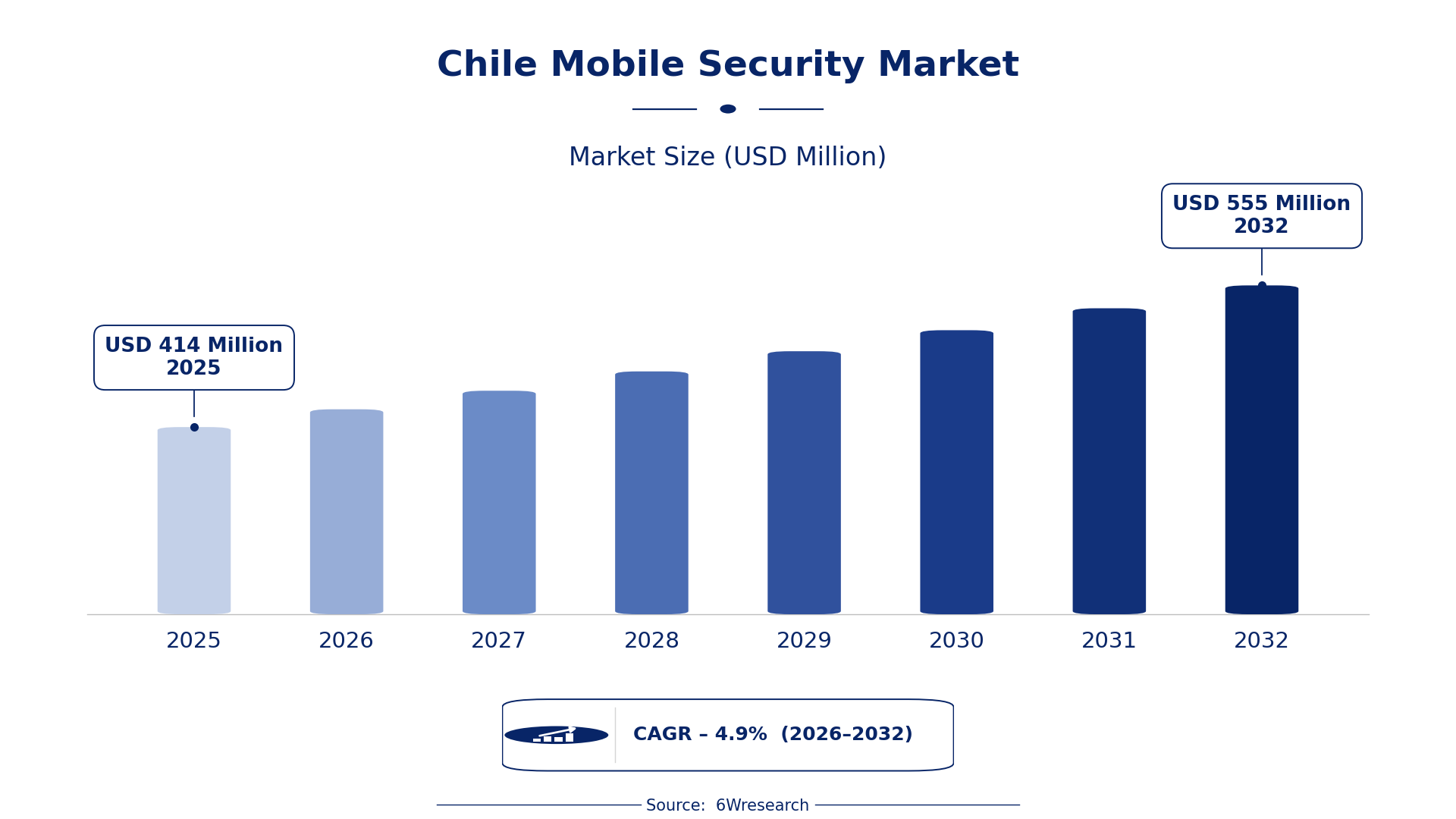
The Chile Mobile Security Market was estimated at USD 414 Million in 2025 and is projected to reach USD 555 Million by 2032, growing at a CAGR of 4.9% from 2026 to 2032.
Chile Mobile Security Market Synopsis
With mobile devices becoming integral to both business and personal activities in Chile, the demand for mobile security solutions has surged. Organizations and individuals are increasingly concerned about protecting sensitive information from rising cyber threats, prompting investments in advanced security measures.
The shift towards remote work further amplifies the need for comprehensive mobile security solutions. As mobile applications grow in sophistication, so do the threats targeting them, compelling stakeholders in Chile to bolster their defenses against potential breaches and vulnerabilities.
Chile Mobile Security Market Year-wise Growth Rate and Key Drivers
This graph illustrates the annual growth rates of the Chile Mobile Security Market from 2021 to 2032, highlighting a steady upward trajectory and projected expansion over the forecast period.
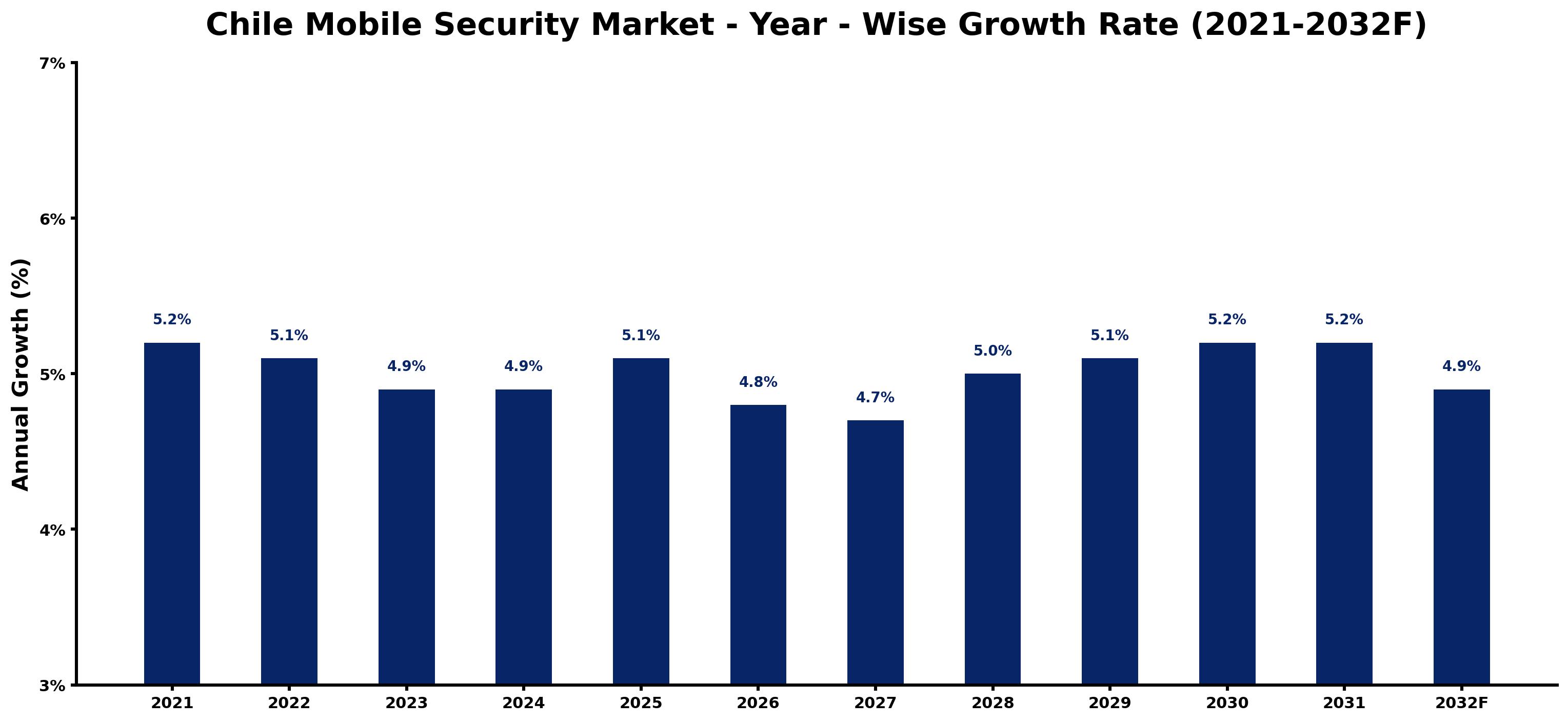
The table below presents the year‑wise growth rates along with the key drivers influencing the market
| Year | Growth Rate | Major Drivers |
| 2021 | 5.2% | Increased mobile payment adoption amid fintech growth. |
| 2022 | 5.1% | Cybersecurity regulations introduced by Chile's Financial Market Commission. |
| 2023 | 4.9% | Rise in remote work fueling demand for mobile security. |
| 2024 | 4.9% | Government support for digital identity initiatives enhancing trust. |
| 2025 | 5.1% | Local startups innovating mobile security solutions gain traction. |
| 2026 | 4.8% | Growing internet penetration driving mobile device use. |
| 2027 | 4.7% | Heightened awareness of personal data protection regulations. |
| 2028 | 5.0% | Digital transformation initiatives bolstering mobile security investments. |
| 2029 | 5.1% | Public-private partnerships enhancing cybersecurity infrastructure. |
| 2030 | 5.2% | Youth demographic increasingly engaged in mobile technology. |
| 2031 | 5.2% | Major telecom operators prioritizing advanced security features. |
| 2032 | 4.9% | Emerging threats prompting companies to upgrade mobile security. |
Note: Market size estimations and growth projections presented in this report are based on 6Wresearch's proprietary forecasting methodology, utilizing the latest available industry data, government publications, and primary research inputs.
Chile Mobile Security Market Key Takeaways
Below are some of the specific key takeaways from the market, including:
- Growing investments in mobile security due to increasing data breach incidents.
- Regulatory frameworks are shaping the deployment of security measures among businesses.
- Adoption of biometric authentication and mobile VPNs is rising among users.
- Challenges related to user awareness and evolving cyber threats are persistent.
- Government initiatives are actively promoting cybersecurity awareness and best practices.
Evaluation of Restraints in Chile Mobile Security Market
While the Chile Mobile Security Market exhibits promising growth, several restraints hinder its full potential. The rapidly evolving nature of cyber threats means that security solutions must continuously adapt, often outpacing organizational capabilities. Additionally, many users lack sufficient awareness of mobile security best practices, which complicates efforts to maintain secure environments. Organizations face budget and talent constraints, making it difficult to prioritize security investments amidst competing operational needs.
Chile Mobile Security Market Trends
As organizations become increasingly aware of mobile security challenges, they are gravitating towards sophisticated solutions. The rise of zero-trust security models is notable, focusing on strict access controls and continuous verification for all users. on top of that, the integration of artificial intelligence in security solutions is gaining traction, offering enhanced threat detection and response capabilities.
Another trend is the growing importance of regulatory compliance. Companies must align their mobile security practices with national and international standards, emphasizing the need for continuous monitoring and reporting to ensure compliance.
Chile Mobile Security Market Opportunities
Opportunities for growth in the Chile Mobile Security Market are abundant. The increasing reliance on mobile devices for transactions and communications creates a pressing demand for innovative security solutions. Additionally, public-private partnerships can significantly enhance the cybersecurity framework, fostering collaboration between technology providers and government agencies to create robust security infrastructures.
Investments in cybersecurity awareness initiatives can cultivate a more security-conscious culture, ultimately strengthening the overall defenses against cyber threats. As awareness grows, so does the potential for developing tailored solutions to meet the unique challenges faced by various sectors.
Government Initiatives in the Chile Mobile Security Market
The Chilean government plays a crucial role in shaping the mobile security market through regulatory measures and initiatives aimed at enhancing cybersecurity. Recognizing the potential risks associated with increased mobile device usage, the government is prioritizing the establishment of robust frameworks to protect data privacy and improve overall security standards across sectors.
- A national cybersecurity strategy implemented in 2023 emphasizes the importance of protecting mobile data across public and private sectors.
- Current awareness campaigns are underway to educate citizens and businesses on cybersecurity best practices, focusing on mobile security.
- A planned regulatory framework, expected to launch in 2026, will mandate stricter compliance measures for mobile application developers.
- In 2024, a public-private initiative was launched to improve the resilience of critical infrastructure against cyber threats, including mobile security aspects.
- Funding programs have been introduced to support research and development in cybersecurity technologies within local universities.
Future Insights of the Chile Mobile Security Market
Looking ahead to 2026-2032, the Chile Mobile Security Market is expected to continue its upward trajectory, driven by the escalating sophistication of cyber threats and a growing awareness of mobile security needs. The integration of advanced technologies like machine learning and AI will redefine security measures, allowing for proactive rather than reactive defense strategies.
Additionally, the government's commitment to bolstering cybersecurity frameworks will further instill confidence in mobile security solutions. Organizations that prioritize mobile security as a core component of their operations will likely gain a competitive edge, fostering trust with users in an increasingly digital economy.
Chile Mobile Security Market Latest Developments
In the last 12 months, the Chile Mobile Security Market has witnessed several significant developments that underline the industry's commitment to enhancing mobile security protocols. The urgency for effective solutions has prompted many companies to step up their offerings, introducing advanced technologies to combat the evolving threat landscape.
- A leading regional technology vendor launched a new mobile security suite in early 2025, focusing on AI-driven threat detection.
- An ongoing initiative by a major telecom operator is enhancing its mobile VPN services to provide better encryption and protection for remote workers.
- In mid-2025, a partnership was established between a security firm and local government entities to improve public sector cybersecurity measures.
- A rollout of an upgraded mobile security application is expected to begin in Q3 2026, aimed at providing users with personalized security features.
- A recent survey conducted by industry analysts in late 2024 revealed increased demand for biometric authentication solutions among consumers.
Chile Mobile Security Market - Key Attractiveness of the Report
- 10 Years of Market Numbers
- Historical Data Starting from 2022 to 2025
- Base Year: 2025
- Forecast Data until 2032
- Key Performance Indicators Impacting the Market
- Major Upcoming Developments and Projects
Key Highlights of the Report:
- Chile Mobile Security Market Outlook
- Market Size of Chile Mobile Security Market, 2025
- Forecast of Chile Mobile Security Market, 2032
- Historical Data and Forecast of Chile Mobile Security Revenues & Volume for the Period 2022-2032F
- Chile Mobile Security Market Trend Evolution
- Chile Mobile Security Market Drivers and Challenges
- Chile Mobile Security Price Trends
- Chile Mobile Security Porter's Five Forces
- Chile Mobile Security Industry Life Cycle
- Historical Data and Forecast of Chile Mobile Security Market Revenues & Volume By End User for the Period 2022-2032F
- Historical Data and Forecast of Chile Mobile Security Market Revenues & Volume By Individual for the Period 2022-2032F
- Historical Data and Forecast of Chile Mobile Security Market Revenues & Volume By Enterprise (Solution (Authentication, Application Security, & Device Security), Service) for the Period 2022-2032F
- Historical Data and Forecast of Chile Mobile Security Market Revenues & Volume By Deployment Mode for the Period 2022-2032F
- Historical Data and Forecast of Chile Mobile Security Market Revenues & Volume By On-premises for the Period 2022-2032F
- Historical Data and Forecast of Chile Mobile Security Market Revenues & Volume By Cloud for the Period 2022-2032F
- Historical Data and Forecast of Chile Mobile Security Market Revenues & Volume By Organization Size for the Period 2022-2032F
- Historical Data and Forecast of Chile Mobile Security Market Revenues & Volume By Small and Medium-Sized Enterprises (SMEs) for the Period 2022-2032F
- Historical Data and Forecast of Chile Mobile Security Market Revenues & Volume By Large Enterprises for the Period 2022-2032F
- Historical Data and Forecast of Chile Mobile Security Market Revenues & Volume By Vertical for the Period 2022-2032F
- Historical Data and Forecast of Chile Mobile Security Market Revenues & Volume By BFSI for the Period 2022-2032F
- Historical Data and Forecast of Chile Mobile Security Market Revenues & Volume By Telecom & IT for the Period 2022-2032F
- Historical Data and Forecast of Chile Mobile Security Market Revenues & Volume By Retail for the Period 2022-2032F
- Historical Data and Forecast of Chile Mobile Security Market Revenues & Volume By Healthcare for the Period 2022-2032F
- Historical Data and Forecast of Chile Mobile Security Market Revenues & Volume By Government & Defense for the Period 2022-2032F
- Historical Data and Forecast of Chile Mobile Security Market Revenues & Volume By Manufacturing for the Period 2022-2032F
- Historical Data and Forecast of Chile Mobile Security Market Revenues & Volume By Others for the Period 2022-2032F
- Historical Data and Forecast of Chile Mobile Security Market Revenues & Volume By Operating System for the Period 2022-2032F
- Historical Data and Forecast of Chile Mobile Security Market Revenues & Volume By iOS for the Period 2022-2032F
- Historical Data and Forecast of Chile Mobile Security Market Revenues & Volume By Android for the Period 2022-2032F
- Chile Mobile Security Import Export Trade Statistics
- Market Opportunity Assessment By End User
- Market Opportunity Assessment By Deployment Mode
- Market Opportunity Assessment By Organization Size
- Market Opportunity Assessment By Vertical
- Market Opportunity Assessment By Operating System
- Chile Mobile Security Top Companies Market Share
- Chile Mobile Security Competitive Benchmarking By Technical and Operational Parameters
- Chile Mobile Security Company Profiles
- Chile Mobile Security Key Strategic Recommendations






































