United Kingdom (UK) Mobile Security Market Size & Growth Rate (2026-2032)
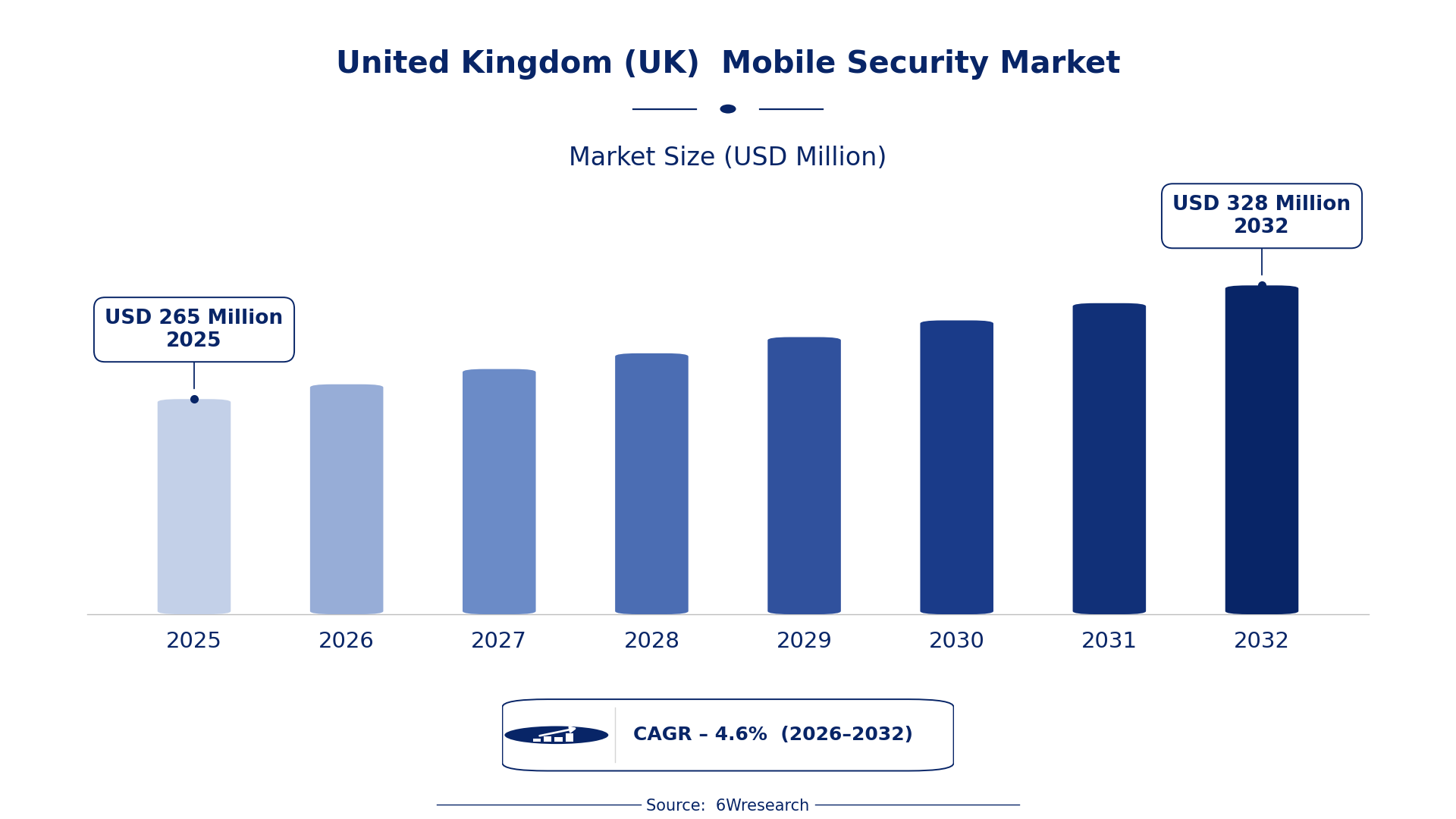
The United Kingdom (UK) Mobile Security Market was estimated at USD 265 Million in 2025 and is projected to reach USD 328 Million by 2032, growing at a CAGR of 4.6% from 2026 to 2032.
United Kingdom (UK) Mobile Security Market Synopsis
A surge in cybersecurity threats is the foremost factor shaping the United Kingdom (UK) Mobile Security Market today. Phishing attacks, ransomware incidents, and data breaches are becoming alarmingly common, driving businesses to invest in robust mobile security solutions. The increasing reliance on mobile devices for both personal and corporate communication further amplifies the urgency for protective measures.
Regulatory compliance is another pivotal force in this market. The UK has stringent requirements like the GDPR and NIS Directive that compel organizations to bolster their mobile security frameworks. This regulatory pressure creates a consistent demand for mobile threat defense, secure application development, and identity management solutions, ultimately shaping investment strategies across sectors.
United Kingdom (UK) Mobile Security Market Year-wise Growth Rate and Key Drivers
This graph illustrates the annual growth rates of the United Kingdom (UK) Mobile Security Market from 2021 to 2032, highlighting a steady upward trajectory and projected expansion over the forecast period.
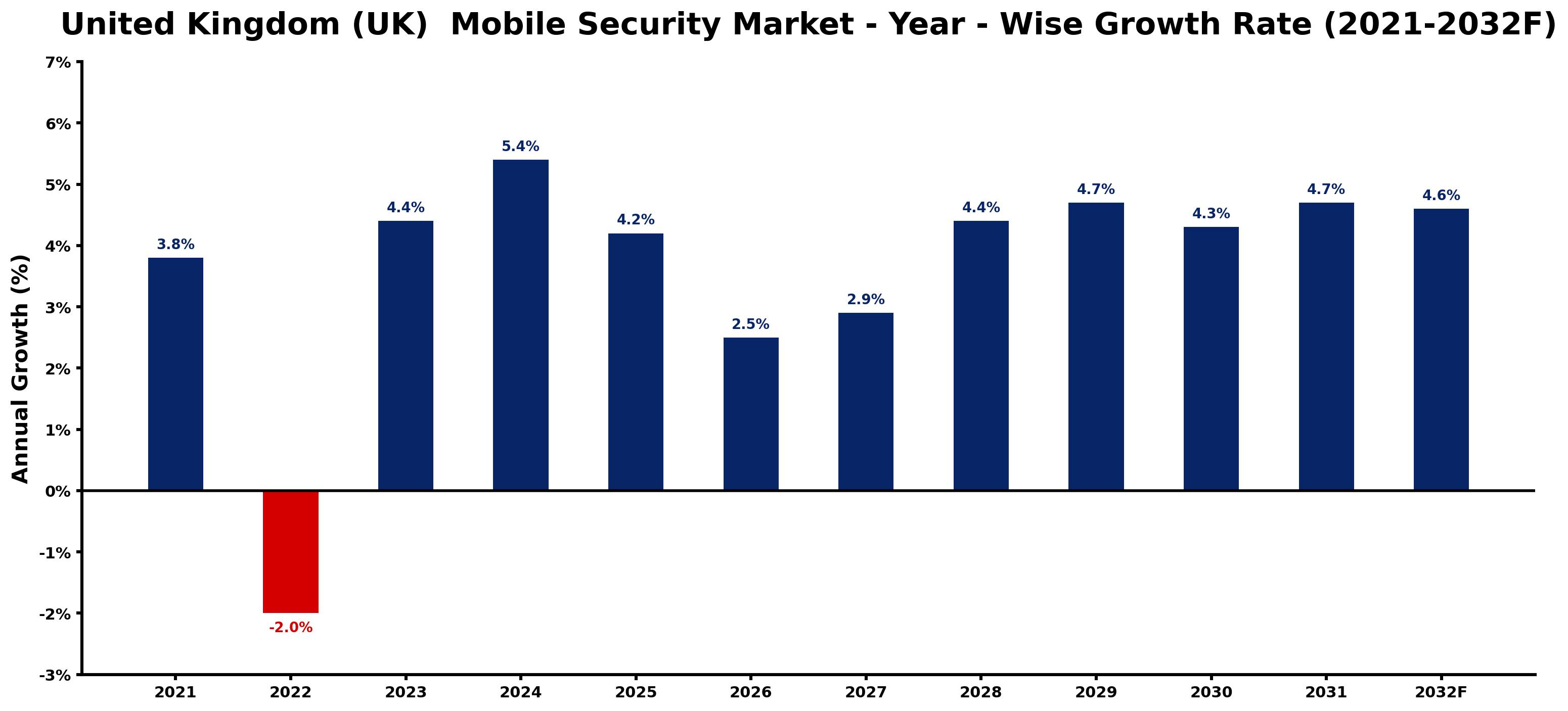
The table below presents the year‑wise growth rates along with the key drivers influencing the market
| Year | Growth Rate | Major Drivers |
| 2021 | 3.8% | UK Cybersecurity Strategy boosting mobile application safety standards |
| 2022 | -2.0% | Increased UK cybersecurity regulations limiting mobile app functionalities. |
| 2023 | 4.4% | Increased regulation on data protection encouraging mobile security adoption |
| 2024 | 5.4% | Rising smartphone penetration driving security solutions need |
| 2025 | 4.2% | Integration of biometric features in mobile devices enhancing demand |
| 2026 | 2.5% | Growing remote working culture increasing vulnerabilities in mobile security |
| 2027 | 2.9% | Government initiatives promoting digital economy boosting security investments |
| 2028 | 4.4% | Surge in cybersecurity incidents prompting mobile security upgrades |
| 2029 | 4.7% | Adoption of EU GDPR fostering compliance-driven mobile security solutions |
| 2030 | 4.3% | Increased online transactions necessitating robust mobile security measures |
| 2031 | 4.7% | Emerging fintech startups prioritizing security in mobile applications |
| 2032 | 4.6% | UK's national digital infrastructure plan emphasizing security protocols |
Note: Market size estimations and growth projections presented in this report are based on 6Wresearch's proprietary forecasting methodology, utilizing the latest available industry data, government publications, and primary research inputs.
United Kingdom (UK) Mobile Security Market Key Takeaways
Below are some of the specific key takeaways from the market, including:
- The demand for mobile security solutions is driven by increasing cyber threats targeting mobile platforms.
- Regulatory compliance, such as GDPR and NIS Directive, is pushing businesses towards enhanced mobile security measures.
- Mobile threat defense platforms and biometric authentication solutions are gaining traction.
- Remote work and BYOD policies are further increasing the need for secure mobile environments.
- Investment in cybersecurity awareness training is becoming vital for organizations to mitigate risks.
Evaluation of Restraints in United Kingdom (UK) Mobile Security Market
A major constraint impacting the United Kingdom (UK) Mobile Security Market is the evolving nature of cyber threats. As attackers continuously develop new tactics, organizations struggle to keep pace with the required defenses. Many businesses also face budget constraints that limit the adoption of comprehensive security solutions. The complex integration of security measures across various mobile platforms adds another layer of difficulty, creating an environment where gaps in protection can remain unaddressed.
United Kingdom (UK) Mobile Security Market Trends
Emerging trends in the United Kingdom (UK) Mobile Security Market indicate a shift towards mobile threat defense platforms that offer real-time protection against advanced threats. Companies are increasingly adopting zero-trust architectures to enhance security postures, focusing on the verification of user identities regardless of device location. Additionally, the incorporation of artificial intelligence in mobile security solutions is paving the way for automated threat detection and response capabilities, further reshaping market dynamics.
United Kingdom (UK) Mobile Security Market Opportunities
The rapid rise in remote work arrangements presents a fertile ground for growth in the mobile security sector. Organizations seeking to support BYOD policies must invest in secure mobile VPNs and mobile device management solutions. Additionally, the increasing importance of data privacy is creating opportunities for vendors to develop and implement advanced encryption technologies that cater to regulatory standards.
Government Initiatives in the United Kingdom (UK) Mobile Security Market
Government policies play a crucial role in shaping the framework for mobile security in the United Kingdom. With a focus on enhancing cybersecurity standards and protecting user data, the government is prioritizing initiatives that enforce strict regulations and promote best practices among organizations. These measures are vital for safeguarding sensitive information against the backdrop of rising cyber threats.
- A recently completed regulatory framework was introduced to enhance mobile app security, mandating encryption standards.
- Currently underway is a national awareness campaign aimed at improving cybersecurity practices among small and medium enterprises.
- A planned initiative set for the next fiscal year aims to develop a comprehensive mobile device security protocol for public sector organizations.
- Ongoing collaboration with industry leaders to create an incident response strategy designed to address mobile security breaches effectively.
- Funding programs initiated to support cybersecurity startups focusing on innovative mobile security solutions.
Future Insights of the United Kingdom (UK) Mobile Security Market
Looking ahead to 2026-2032, the United Kingdom (UK) Mobile Security Market is set to evolve significantly. The increasing sophistication of cyber threats will compel organizations to adopt advanced security technologies. Companies will likely place a greater emphasis on integrating mobile security with overall enterprise security strategies, reflecting the interconnected nature of threats. As regulatory requirements tighten, businesses will have to prioritize compliance and invest in comprehensive mobile security infrastructures.
United Kingdom (UK) Mobile Security Market Latest Developments
The past 12-14 months have seen notable advancements in the United Kingdom (UK) Mobile Security Market as companies strive to meet rising security demands. Firms are actively enhancing their product offerings to adapt to evolving threat landscapes, while partnerships and collaborations are being formed to bolster security measures across various industries.
- A major technology vendor launched a new mobile threat defense platform in Q1 2025, designed specifically for enterprise use.
- A regional operator has implemented an upgrade of its mobile security protocols, an initiative that began in early 2025 and remains underway.
- In mid-2025, a cybersecurity firm unveiled a biometric authentication solution that streamlines user access while enhancing security.
- A partnership between two leading cybersecurity providers to develop an AI-driven threat detection tool is expected to commence by mid-2026.
- Upcoming in late 2026 is a pilot program testing the effectiveness of mobile device management solutions in diverse work environments.
United Kingdom (UK) Mobile Security Market - Key Attractiveness of the Report
- 10 Years of Market Numbers
- Historical Data Starting from 2022 to 2025
- Base Year: 2025
- Forecast Data until 2032
- Key Performance Indicators Impacting the Market
- Major Upcoming Developments and Projects
Companies can capitalize on the demand for secure solutions arising from remote work arrangements and BYOD policies. There’s also a growing need for advanced encryption technologies that meet strict regulatory standards.
Key Highlights of the Report:
- United Kingdom (UK) Mobile Security Market Outlook
- Market Size of United Kingdom (UK) Mobile Security Market, 2025
- Forecast of United Kingdom (UK) Mobile Security Market, 2032
- Historical Data and Forecast of United Kingdom (UK) Mobile Security Revenues & Volume for the Period 2022-2032F
- United Kingdom (UK) Mobile Security Market Trend Evolution
- United Kingdom (UK) Mobile Security Market Drivers and Challenges
- United Kingdom (UK) Mobile Security Price Trends
- United Kingdom (UK) Mobile Security Porter's Five Forces
- United Kingdom (UK) Mobile Security Industry Life Cycle
- Historical Data and Forecast of United Kingdom (UK) Mobile Security Market Revenues & Volume By End User for the Period 2022-2032F
- Historical Data and Forecast of United Kingdom (UK) Mobile Security Market Revenues & Volume By Individual for the Period 2022-2032F
- Historical Data and Forecast of United Kingdom (UK) Mobile Security Market Revenues & Volume By Enterprise (Solution (Authentication, Application Security, & Device Security), Service) for the Period 2022-2032F
- Historical Data and Forecast of United Kingdom (UK) Mobile Security Market Revenues & Volume By Deployment Mode for the Period 2022-2032F
- Historical Data and Forecast of United Kingdom (UK) Mobile Security Market Revenues & Volume By On-premises for the Period 2022-2032F
- Historical Data and Forecast of United Kingdom (UK) Mobile Security Market Revenues & Volume By Cloud for the Period 2022-2032F
- Historical Data and Forecast of United Kingdom (UK) Mobile Security Market Revenues & Volume By Organization Size for the Period 2022-2032F
- Historical Data and Forecast of United Kingdom (UK) Mobile Security Market Revenues & Volume By Small and Medium-Sized Enterprises (SMEs) for the Period 2022-2032F
- Historical Data and Forecast of United Kingdom (UK) Mobile Security Market Revenues & Volume By Large Enterprises for the Period 2022-2032F
- Historical Data and Forecast of United Kingdom (UK) Mobile Security Market Revenues & Volume By Vertical for the Period 2022-2032F
- Historical Data and Forecast of United Kingdom (UK) Mobile Security Market Revenues & Volume By BFSI for the Period 2022-2032F
- Historical Data and Forecast of United Kingdom (UK) Mobile Security Market Revenues & Volume By Telecom & IT for the Period 2022-2032F
- Historical Data and Forecast of United Kingdom (UK) Mobile Security Market Revenues & Volume By Retail for the Period 2022-2032F
- Historical Data and Forecast of United Kingdom (UK) Mobile Security Market Revenues & Volume By Healthcare for the Period 2022-2032F
- Historical Data and Forecast of United Kingdom (UK) Mobile Security Market Revenues & Volume By Government & Defense for the Period 2022-2032F
- Historical Data and Forecast of United Kingdom (UK) Mobile Security Market Revenues & Volume By Manufacturing for the Period 2022-2032F
- Historical Data and Forecast of United Kingdom (UK) Mobile Security Market Revenues & Volume By Others for the Period 2022-2032F
- Historical Data and Forecast of United Kingdom (UK) Mobile Security Market Revenues & Volume By Operating System for the Period 2022-2032F
- Historical Data and Forecast of United Kingdom (UK) Mobile Security Market Revenues & Volume By iOS for the Period 2022-2032F
- Historical Data and Forecast of United Kingdom (UK) Mobile Security Market Revenues & Volume By Android for the Period 2022-2032F
- United Kingdom (UK) Mobile Security Import Export Trade Statistics
- Market Opportunity Assessment By End User
- Market Opportunity Assessment By Deployment Mode
- Market Opportunity Assessment By Organization Size
- Market Opportunity Assessment By Vertical
- Market Opportunity Assessment By Operating System
- United Kingdom (UK) Mobile Security Top Companies Market Share
- United Kingdom (UK) Mobile Security Competitive Benchmarking By Technical and Operational Parameters
- United Kingdom (UK) Mobile Security Company Profiles
- United Kingdom (UK) Mobile Security Key Strategic Recommendations






































