Mexico Non-ferrous Metal Market Summary
The mexico non-ferrous metal market was estimated at USD 131 Million in 2025 and is projected to reach USD 151 Million by 2032, growing at a CAGR of 1.4% from 2026 to 2032.
Mexico Non-ferrous Metal Market Year-wise Growth Rate and Key Drivers
This graph highlights how the Mexico Non-ferrous Metal Market has steadily grown over the past five years, supported by major growth factors.
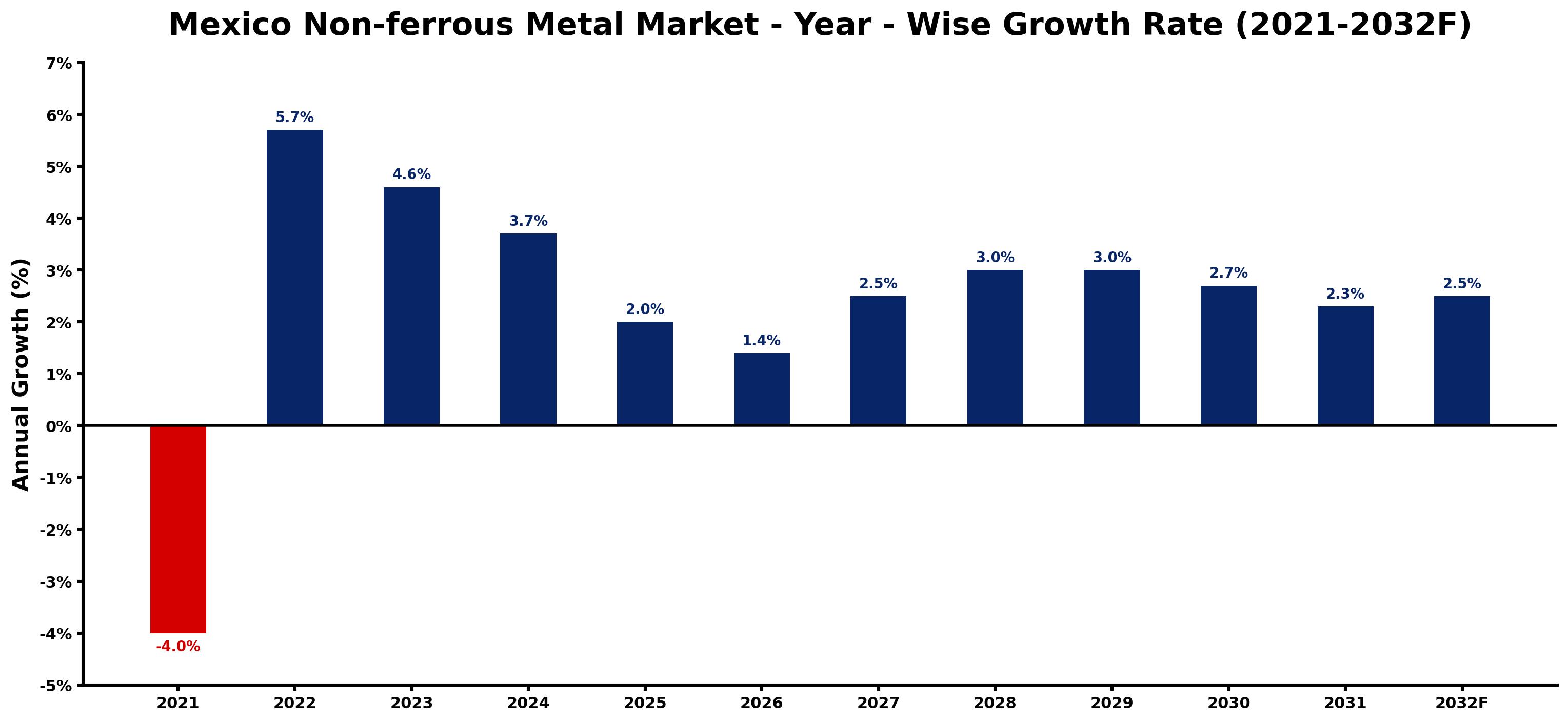
The table below presents the year wise growth rates along with the key drivers influencing the market
| Year | Growth Rate | Major Drivers |
| 2021 | -4.0% | Global supply chain disruptions led to intermittent shortages, hindering production and dampening market performance. |
| 2022 | 5.7% | Local demand for copper wiring surged due to enhanced telecommunications infrastructure projects. |
| 2023 | 4.6% | Sustainable practices gained traction, prompting firms to explore recycling of non-ferrous metals. |
| 2024 | 3.7% | Construction projects expanded, creating a robust demand for aluminum and copper materials. |
| 2025 | 2.0% | Automotive industry transition pushed for lightweight materials, raising aluminum usage significantly. |
| 2026 | 1.4% | Technological advancements in manufacturing efficiency lowered costs, enhancing market competitiveness. |
| 2027 | 2.5% | Infrastructure renovations prompted by urbanization led to increased steel and copper requirements. |
| 2028 | 3.0% | Regional trade agreements facilitated smoother non-ferrous metal exports across North America. |
| 2029 | 3.0% | Investment in renewable energy sources drove demand for specific non-ferrous metals like lithium. |
| 2030 | 2.7% | Electrification of transportation systems significantly influenced copper demand for electric vehicles. |
| 2031 | 2.3% | Emerging technologies necessitated new metal applications, promoting research and development initiatives. |
| 2032 | 2.5% | Consumer preferences shifted towards sustainable products, impacting sourcing strategies in the market. |
Note - Market size estimations and growth projections presented in this report are based on 6Wresearch's advanced forecasting approach, validated with industry datasets as of June 2026.
Mexico Non-ferrous Metal Market Synopsis
The Mexico Non-ferrous Metal Market is projected to reach 1.4% and witness significant growth during the forecast period (2026-2032). This market plays a pivotal role in the global metals industry, driven by the increasing demand for various non-ferrous metals such as aluminum, copper, and zinc. These metals are integral to a plethora of applications across multiple sectors including automotive manufacturing, aerospace, construction, and electronics. The emphasis on innovation in metallurgy, coupled with advances in sustainable practices, underscores the market's relevance in the evolving economic landscape of Mexico.
Mexico Non-ferrous Metal Market Growth Drivers
The growth of the Mexico Non-ferrous Metal Market is significantly influenced by its broad range of applications across diverse industries. As the automotive sector expands, the demand for lightweight and durable materials drives the need for aluminum and other non-ferrous metals. Additionally, the aerospace industry relies heavily on these materials due to their strength-to-weight ratio, enhancing fuel efficiency in aircraft design. Moreover, the electronics sector continues to innovate, creating advanced components that require high conductivity materials such as copper.
- Growth in the automotive manufacturing sector necessitates the use of lightweight materials to improve fuel efficiency and performance.
- The aerospace industry's demand for high-strength alloys contributes to the sustained consumption of non-ferrous metals.
- Technological advancements in electronics manufacturing fuel the need for superior conductive materials like copper.
- Infrastructure development projects create requirements for non-ferrous metals in construction and engineering applications.
- The global shift towards sustainable practices promotes the use of recycled non-ferrous metals, enhancing market growth opportunities.
Mexico Non-ferrous Metal Market Challenges and Restraints
While the Mexico Non-ferrous Metal Market is poised for growth, it faces several challenges that could hinder its potential. Fluctuations in global metal prices can create uncertainty for producers, impacting profitability and investment decisions. Additionally, geopolitical tensions and trade policies may disrupt supply chains, affecting the availability of raw materials. Environmental regulations aimed at minimizing pollution from mining activities further impose compliance costs, which can strain operations. The industry's reliance on non-renewable resources necessitates a shift towards more sustainable practices, increasing the pressure to innovate and adapt.
- Volatile global metal prices lead to unpredictable market conditions, influencing production and investment strategies.
- Geopolitical uncertainties can disrupt international trade, affecting the supply chain and material availability.
- Strict environmental regulations impose higher compliance costs on mining and production operations.
- Competition from alternative materials necessitates ongoing research and development to maintain market viability.
- The demand for sustainable practices compels businesses to invest in eco-friendly technologies, which may require substantial upfront capital.
Mexico Non-ferrous Metal Market Government Investment and Initiatives
The Mexican government is actively engaged in fostering the sustainable growth of the non-ferrous metal market through various policies and initiatives. A focus on minimizing environmental impacts is evident in regulations governing mining operations, which aim to protect natural resources and reduce pollution levels. The government has also been promoting recycling initiatives to enhance resource conservation and reduce waste in the non-ferrous metals production process. Furthermore, incentives are provided to encourage investments in advanced technologies for metal extraction and processing, leading to enhanced efficiencies and reduced ecological footprints. Support for research and development in this sector is also a priority, enabling innovation and adaptation to market demands.
- Government regulations are enforced to minimize the environmental impact of mining processes.
- Incentives are in place to promote recycling efforts and conserve valuable metal resources.
- Investment in advanced technologies for extraction and processing is encouraged to improve production efficiency.
- Research and development initiatives receive governmental support, fostering innovation in the sector.
- Collaborations with industry stakeholders aim to enhance sustainable practices across the non-ferrous metal market.
Mexico Non-ferrous Metal Market Latest Developments (May 2025 - June 2026)
Recent developments in the Mexico Non-ferrous Metal Market indicate a continued emphasis on sustainability and innovation. The industry is witnessing increased attention towards recycling practices, with expanded initiatives to enhance the collection and processing of scrap metals. Technological advancements have led to improvements in processing techniques, reducing energy consumption and waste generation. Regulatory changes are being implemented to further support sustainable mining practices, aligning with international environmental standards. Additionally, investment in local mining infrastructure is underway to bolster production capabilities while adhering to eco-friendly practices.
Mexico Non-ferrous Metal Market - Key Attractiveness of the Report
- 10 Years of Market Numbers
- Historical Data Starting from 2022 to 2025
- Base Year: 2025
- Forecast Data until 2032
- Key Performance Indicators Impacting the Market
- Major Upcoming Developments and Projects
Key Highlights of the Report:
- Mexico Non-ferrous Metal Market Outlook
- Market Size of Mexico Non-ferrous Metal Market, 2025
- Forecast of Mexico Non-ferrous Metal Market, 2032
- Historical Data and Forecast of Mexico Non-ferrous Metal Revenues & Volume for the Period 2022-2032F
- Mexico Non-ferrous Metal Market Trend Evolution
- Mexico Non-ferrous Metal Market Drivers and Challenges
- Mexico Non-ferrous Metal Price Trends
- Mexico Non-ferrous Metal Porter's Five Forces
- Mexico Non-ferrous Metal Industry Life Cycle
- Historical Data and Forecast of Mexico Non-ferrous Metal Market Revenues & Volume By Types for the Period 2022-2032F
- Historical Data and Forecast of Mexico Non-ferrous Metal Market Revenues & Volume By Aluminum for the Period 2022-2032F
- Historical Data and Forecast of Mexico Non-ferrous Metal Market Revenues & Volume By Copper for the Period 2022-2032F
- Historical Data and Forecast of Mexico Non-ferrous Metal Market Revenues & Volume By Lead for the Period 2022-2032F
- Historical Data and Forecast of Mexico Non-ferrous Metal Market Revenues & Volume By Tin for the Period 2022-2032F
- Historical Data and Forecast of Mexico Non-ferrous Metal Market Revenues & Volume By Nickel for the Period 2022-2032F
- Historical Data and Forecast of Mexico Non-ferrous Metal Market Revenues & Volume By Titanium for the Period 2022-2032F
- Historical Data and Forecast of Mexico Non-ferrous Metal Market Revenues & Volume By Zinc for the Period 2022-2032F
- Historical Data and Forecast of Mexico Non-ferrous Metal Market Revenues & Volume By Applications for the Period 2022-2032F
- Historical Data and Forecast of Mexico Non-ferrous Metal Market Revenues & Volume By Automobile Industry for the Period 2022-2032F
- Historical Data and Forecast of Mexico Non-ferrous Metal Market Revenues & Volume By Electronic Power Industry for the Period 2022-2032F
- Historical Data and Forecast of Mexico Non-ferrous Metal Market Revenues & Volume By Construction Industry for the Period 2022-2032F
- Historical Data and Forecast of Mexico Non-ferrous Metal Market Revenues & Volume By Other for the Period 2022-2032F
- Mexico Non-ferrous Metal Import Export Trade Statistics
- Market Opportunity Assessment By Types
- Market Opportunity Assessment By Applications
- Mexico Non-ferrous Metal Top Companies Market Share
- Mexico Non-ferrous Metal Competitive Benchmarking By Technical and Operational Parameters
- Mexico Non-ferrous Metal Company Profiles
- Mexico Non-ferrous Metal Key Strategic Recommendations






































