Brazil Non-ferrous Metal Market Summary
The brazil non-ferrous metal market was estimated at USD 223 Million in 2025 and is projected to reach USD 266 Million by 2032, growing at a CAGR of 2.6% from 2026 to 2032.
Brazil Non-ferrous Metal Market Year-wise Growth Rate and Key Drivers
This graph highlights how the Brazil Non-ferrous Metal Market has steadily grown over the past five years, supported by major growth factors.
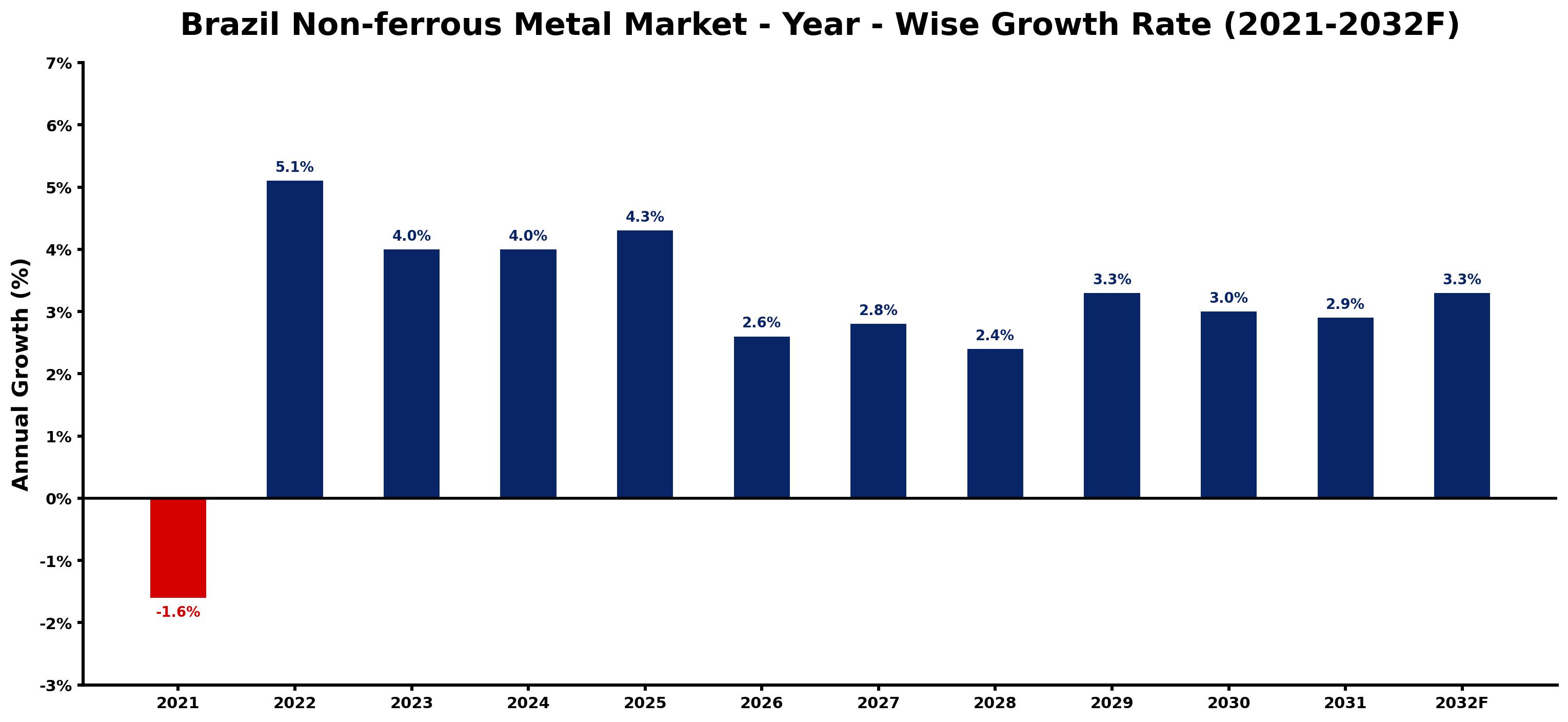
The table below presents the year wise growth rates along with the key drivers influencing the market
| Year | Growth Rate | Major Drivers |
| 2021 | -1.6% | Pandemicinduced supply chain disruptions hindered production capabilities, leading to decreased nonferrous metal availability. |
| 2022 | 5.1% | Local manufacturing initiatives boost the need for copper and aluminum-based products. |
| 2023 | 4.0% | Infrastructure projects across Brazil create opportunities for non-ferrous metals usage. |
| 2024 | 4.0% | Technological innovations enhance the efficiency of metal recycling processes significantly. |
| 2025 | 4.3% | Construction sector expansions necessitate higher volumes of lightweight metal materials. |
| 2026 | 2.6% | Automotive industry's shift toward electric vehicles increases copper demand. |
| 2027 | 2.8% | Urbanization trends lead to enhanced infrastructure requirements and non-ferrous metal consumption. |
| 2028 | 2.4% | Renewable energy projects, especially solar, drive the need for aluminum components. |
| 2029 | 3.3% | Rising consumer electronics production results in increased demand for copper wiring. |
| 2030 | 3.0% | Sustainability initiatives prompt investment in eco-friendly metal production methods. |
| 2031 | 2.9% | Advancements in aerospace technology require specialized non-ferrous metal applications. |
| 2032 | 3.3% | Circular economy principles gain traction, influencing recycling and sourcing strategies. |
Note - Market size estimations and growth projections presented in this report are based on 6Wresearch's advanced forecasting approach, validated with industry datasets as of June 2026.
Brazil Non-ferrous Metal Market Synopsis
The Brazil Non-ferrous Metal Market is projected to reach 2.6% and witness significant growth during the forecast period (2026-2032). This market encompasses various essential metals including aluminum, copper, and zinc, which are integral to numerous industrial applications ranging from aerospace to automotive manufacturing. The trajectory of the non-ferrous metal sector in Brazil is intricately linked to broader economic activities, infrastructure development initiatives, and evolving global commodity trends.
Brazil Non-ferrous Metal Market Growth Drivers
The growth of the Brazil Non-ferrous Metal Market is being propelled by several key factors:
- The aerospace and automotive industries continue to exhibit robust demand for non-ferrous metals, particularly aluminum, due to their lightweight properties and durability, which enhance fuel efficiency and performance.
- Infrastructure projects across Brazil, including transportation and housing developments, are significantly increasing the consumption of non-ferrous metals as essential components in construction and maintenance activities.
- Emerging technological advancements in electronics utilize copper in wiring and circuitry, thereby driving its consumption in the manufacturing of consumer electronics and industrial machinery.
- The global push towards sustainability is enhancing the demand for recycled non-ferrous metals, compelling Brazil to adapt and invest in recycling technologies and facilities.
- International market dynamics, such as rising global commodity prices, are creating favorable export conditions for Brazilian non-ferrous metals, further stimulating local production.
Brazil Non-ferrous Metal Market Challenges and Restraints
Despite its potential for growth, the Brazil Non-ferrous Metal Market faces several challenges that stakeholders must navigate:
- Volatility in global metal prices, particularly for critical non-ferrous metals like aluminum and copper, can severely impact the profitability of domestic producers, creating budgeting uncertainties for manufacturers.
- Trade tensions and the imposition of tariffs in key markets may restrict Brazilian exports, limiting opportunities for local producers and compounding the effects of price fluctuations.
- Environmental regulations are becoming increasingly stringent, necessitating investment in sustainable practices while also presenting challenges for compliance and operational modifications.
- The market is also susceptible to fluctuations in demand caused by economic downturns or shifts in manufacturing trends, which can lead to overcapacity and reduced margins.
- Supply chain disruptions due to geopolitical issues or logistical challenges may impede the timely availability of essential raw materials, impacting production schedules and delivery commitments.
Brazil Non-ferrous Metal Market Government Investment and Initiatives
Government policies play a crucial role in shaping the trajectory of the Brazil Non-ferrous Metal Market. Recent initiatives focus on promoting responsible mining and sustainable practices, ensuring that the environmental impact of metal extraction is minimized. Furthermore, the Brazilian government has committed to enhancing infrastructure, which includes investment in transportation networks that facilitate faster and more efficient metal distribution. Additionally, efforts to streamline regulations around mining operations are being implemented to boost domestic production. The government is also exploring incentives for recycling and innovation in metal production processes, thereby supporting the transition to a circular economy.
Brazil Non-ferrous Metal Market Latest Developments (May 2025 - June 2026)
The period from May 2025 to June 2026 has seen significant developments in the Brazil Non-ferrous Metal Market. The government has announced various programs aimed at enhancing the sustainability of mining operations, including increased funding for research into eco-friendly extraction technologies. Additionally, the rise of electric vehicles has sparked a renewed interest in copper due to its critical role in battery production, leading to strategic partnerships between various stakeholders. Trade discussions have been ongoing, with an emphasis on reducing tariffs to enable better market access. Furthermore, industry players are increasingly focused on expanding recycling capabilities to align with global sustainability goals. Collaboration between government and industry is advancing, particularly around initiatives that promote the use of locally sourced materials in manufacturing processes.
Brazil Non-ferrous Metal Market - Key Attractiveness of the Report
- 10 Years of Market Numbers
- Historical Data Starting from 2022 to 2025
- Base Year: 2025
- Forecast Data until 2032
- Key Performance Indicators Impacting the Market
- Major Upcoming Developments and Projects
Key Highlights of the Report:
- Brazil Non-ferrous Metal Market Outlook
- Market Size of Brazil Non-ferrous Metal Market, 2025
- Forecast of Brazil Non-ferrous Metal Market, 2032
- Historical Data and Forecast of Brazil Non-ferrous Metal Revenues & Volume for the Period 2022-2032F
- Brazil Non-ferrous Metal Market Trend Evolution
- Brazil Non-ferrous Metal Market Drivers and Challenges
- Brazil Non-ferrous Metal Price Trends
- Brazil Non-ferrous Metal Porter's Five Forces
- Brazil Non-ferrous Metal Industry Life Cycle
- Historical Data and Forecast of Brazil Non-ferrous Metal Market Revenues & Volume By Types for the Period 2022-2032F
- Historical Data and Forecast of Brazil Non-ferrous Metal Market Revenues & Volume By Aluminum for the Period 2022-2032F
- Historical Data and Forecast of Brazil Non-ferrous Metal Market Revenues & Volume By Copper for the Period 2022-2032F
- Historical Data and Forecast of Brazil Non-ferrous Metal Market Revenues & Volume By Lead for the Period 2022-2032F
- Historical Data and Forecast of Brazil Non-ferrous Metal Market Revenues & Volume By Tin for the Period 2022-2032F
- Historical Data and Forecast of Brazil Non-ferrous Metal Market Revenues & Volume By Nickel for the Period 2022-2032F
- Historical Data and Forecast of Brazil Non-ferrous Metal Market Revenues & Volume By Titanium for the Period 2022-2032F
- Historical Data and Forecast of Brazil Non-ferrous Metal Market Revenues & Volume By Zinc for the Period 2022-2032F
- Historical Data and Forecast of Brazil Non-ferrous Metal Market Revenues & Volume By Applications for the Period 2022-2032F
- Historical Data and Forecast of Brazil Non-ferrous Metal Market Revenues & Volume By Automobile Industry for the Period 2022-2032F
- Historical Data and Forecast of Brazil Non-ferrous Metal Market Revenues & Volume By Electronic Power Industry for the Period 2022-2032F
- Historical Data and Forecast of Brazil Non-ferrous Metal Market Revenues & Volume By Construction Industry for the Period 2022-2032F
- Historical Data and Forecast of Brazil Non-ferrous Metal Market Revenues & Volume By Other for the Period 2022-2032F
- Brazil Non-ferrous Metal Import Export Trade Statistics
- Market Opportunity Assessment By Types
- Market Opportunity Assessment By Applications
- Brazil Non-ferrous Metal Top Companies Market Share
- Brazil Non-ferrous Metal Competitive Benchmarking By Technical and Operational Parameters
- Brazil Non-ferrous Metal Company Profiles
- Brazil Non-ferrous Metal Key Strategic Recommendations






































