United States Non-Ferrous Metal Market Growth Rate Analysis (2025 - 2031)
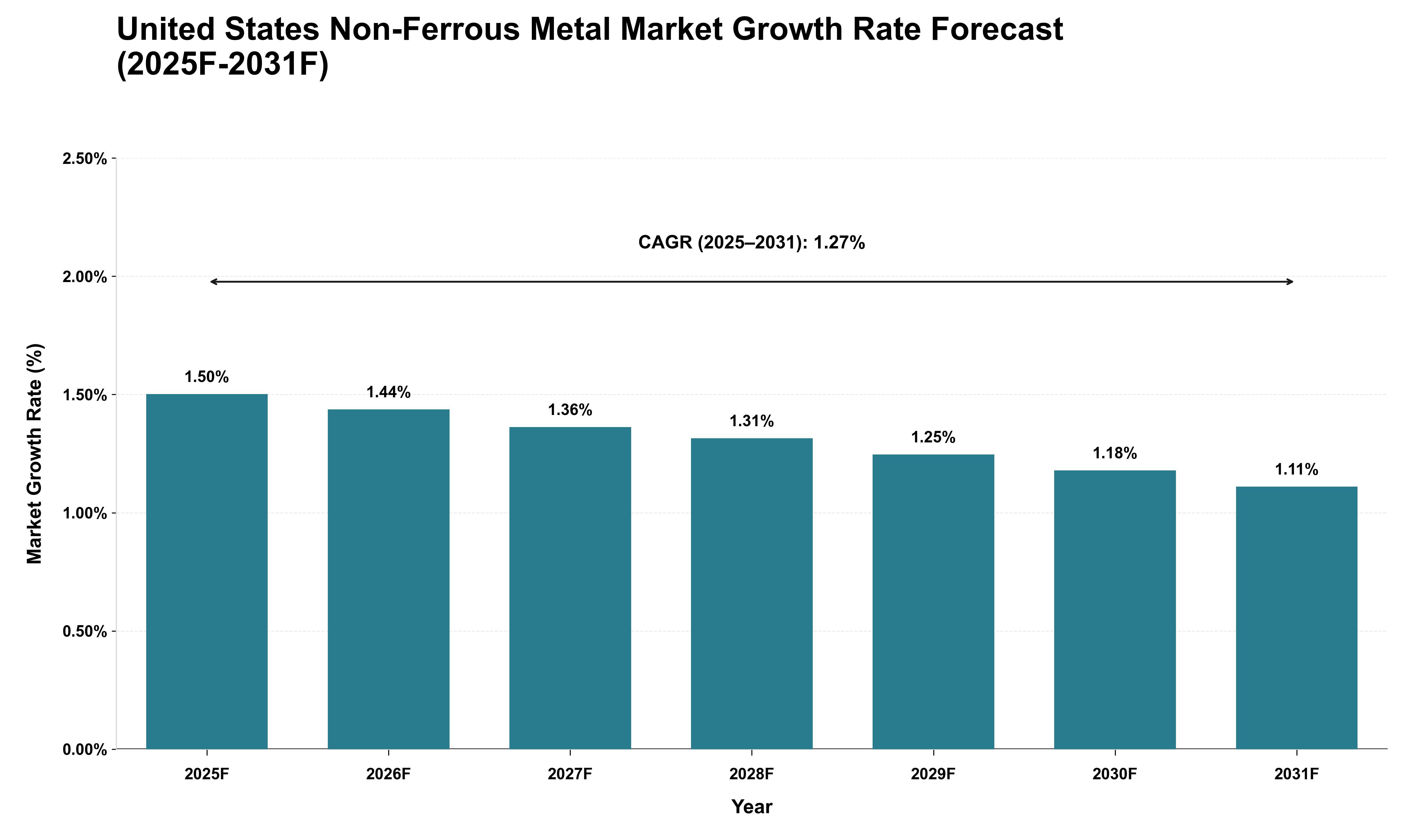
The projected deceleration in the growth rates of the United States non-ferrous metal market, from 1.50% in 2025 to 1.11% by 2031, indicates a gradual cooling of end-use demand driven by several macroeconomic factors. As industries such as automotive and construction increasingly adopt lightweight materials and alternative technologies, the reliance on non-ferrous metals may shift, impacting overall consumption patterns. Additionally, anticipated fluctuations in global supply chains and import dependencies could further influence domestic demand dynamics; for instance, potential trade policy changes or tariffs may alter competitive pricing structures. The forecasted CAGR of 1.27% reflects these evolving market conditions while suggesting that cyclical trends will play a role in shaping demand across sectors reliant on non-ferrous metals, ultimately leading to a more cautious outlook as industries adapt to changing economic landscapes and technological advancements.
Key Highlights of the Report:
- United States (US) Non-ferrous Metal Market Outlook
- Market Size of United States (US) Non-ferrous Metal Market, 2025
- Forecast of United States (US) Non-ferrous Metal Market, 2032
- Historical Data and Forecast of United States (US) Non-ferrous Metal Revenues & Volume for the Period 2022 - 2032F
- United States (US) Non-ferrous Metal Market Trend Evolution
- United States (US) Non-ferrous Metal Market Drivers and Challenges
- United States (US) Non-ferrous Metal Price Trends
- United States (US) Non-ferrous Metal Porter's Five Forces
- United States (US) Non-ferrous Metal Industry Life Cycle
- Historical Data and Forecast of United States (US) Non-ferrous Metal Market Revenues & Volume By Types for the Period 2022 - 2032F
- Historical Data and Forecast of United States (US) Non-ferrous Metal Market Revenues & Volume By Aluminum for the Period 2022 - 2032F
- Historical Data and Forecast of United States (US) Non-ferrous Metal Market Revenues & Volume By Copper for the Period 2022 - 2032F
- Historical Data and Forecast of United States (US) Non-ferrous Metal Market Revenues & Volume By Lead for the Period 2022 - 2032F
- Historical Data and Forecast of United States (US) Non-ferrous Metal Market Revenues & Volume By Tin for the Period 2022 - 2032F
- Historical Data and Forecast of United States (US) Non-ferrous Metal Market Revenues & Volume By Nickel for the Period 2022 - 2032F
- Historical Data and Forecast of United States (US) Non-ferrous Metal Market Revenues & Volume By Titanium for the Period 2022 - 2032F
- Historical Data and Forecast of United States (US) Non-ferrous Metal Market Revenues & Volume By Zinc for the Period 2022 - 2032F
- Historical Data and Forecast of United States (US) Non-ferrous Metal Market Revenues & Volume By Applications for the Period 2022 - 2032F
- Historical Data and Forecast of United States (US) Non-ferrous Metal Market Revenues & Volume By Automobile Industry for the Period 2022 - 2032F
- Historical Data and Forecast of United States (US) Non-ferrous Metal Market Revenues & Volume By Electronic Power Industry for the Period 2022 - 2032F
- Historical Data and Forecast of United States (US) Non-ferrous Metal Market Revenues & Volume By Construction Industry for the Period 2022 - 2032F
- Historical Data and Forecast of United States (US) Non-ferrous Metal Market Revenues & Volume By Other for the Period 2022 - 2032F
- United States (US) Non-ferrous Metal Import Export Trade Statistics
- Market Opportunity Assessment By Types
- Market Opportunity Assessment By Applications
- United States (US) Non-ferrous Metal Top Companies Market Share
- United States (US) Non-ferrous Metal Competitive Benchmarking By Technical and Operational Parameters
- United States (US) Non-ferrous Metal Company Profiles
- United States (US) Non-ferrous Metal Key Strategic Recommendations






































