Mexico Organic Food Market Size, Share & Growth Rate
The Mexico Organic Food Market was estimated at USD 210 Million in 2025 and is projected to reach USD 241 Million by 2032, growing at a CAGR of 2.0% from 2026 to 2032. This growth trajectory is propelled by a rising middle class, increasingly discerning about health and sustainability, who are choosing organic options over conventional products. As consumers become more educated on the benefits of organic food, the demand is further bolstered by government support for organic farming practices.
Mexico Organic Food Market Year-wise Growth Rate and Key Drivers
This graph highlights how the Mexico Organic Food Market has steadily grown over the years, supported by major growth factors.
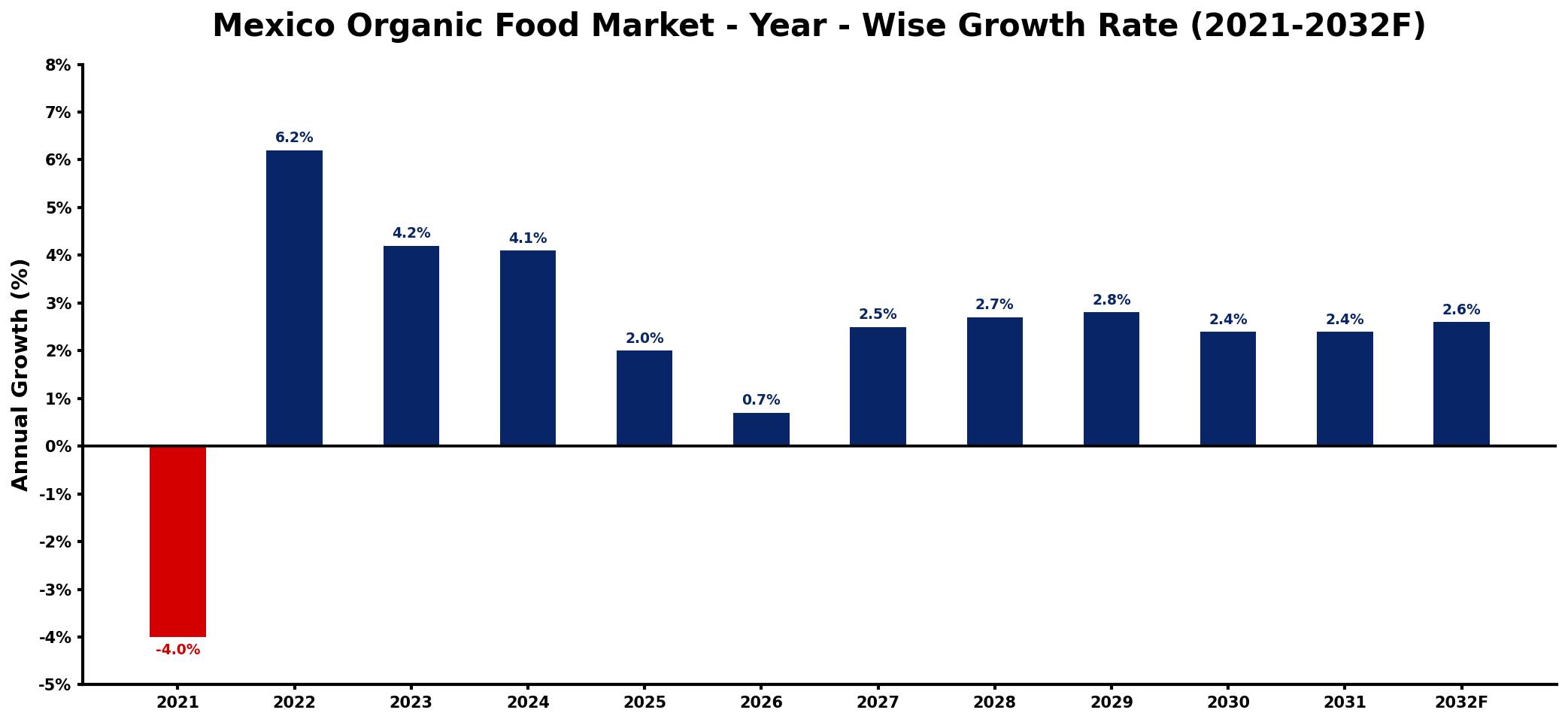
The table below presents the year‑wise growth rates along with the key drivers influencing the market
| Year | Growth Rate | Major Drivers |
| 2021 | -4.0% | market interest in sustainability declines |
| 2022 | 6.2% | consumer awareness of health benefits |
| 2023 | 4.2% | increased retail distribution channels |
| 2024 | 4.1% | expansion of local farming initiatives |
| 2025 | 2.0% | rising popularity of plant-based diets |
| 2026 | 0.7% | growing investment in eco-friendly practices |
| 2027 | 2.5% | enhanced marketing strategies implemented |
| 2028 | 2.7% | stronger partnerships with local producers |
| 2029 | 2.8% | increased online shopping platforms available |
| 2030 | 2.4% | growing demand for clean labels |
| 2031 | 2.4% | expanding manufacturing base activity |
| 2032 | 2.6% | increased consumer loyalty programs launched |
Note: Market size estimations and growth projections presented in this report are based on 6Wresearch's proprietary forecasting methodology, utilizing the latest available industry data, government publications, and primary research inputs.
Mexico Organic Food Market Synopsis
A notable feature of the Mexico Organic Food Market is the increasing preference for local and artisanal organic products. As consumers seek transparency in food sourcing, small-scale producers who prioritize organic methods are gaining traction among health-conscious shoppers. Furthermore, the integration of e-commerce platforms has made organic food more accessible, allowing consumers to discover and purchase products that align with their health values.
The diversity of the market is evident as it encompasses a broad range of products including fresh fruits, vegetables, dairy, meat, and processed goods. Retail channels are evolving; supermarkets are expanding their organic lines, while specialty stores cater to niche preferences. Overall, the growth in the organic sector reflects a shift in consumer priorities towards sustainable and ethically produced food.
Mexico Organic Food Market Key Takeaways
- The market is experiencing steady growth, fueled by consumer awareness of health and sustainability.
- E-commerce has become a vital distribution channel, enhancing access to organic products.
- Government initiatives are supporting the transition towards organic farming practices.
- Local and artisanal offerings are increasingly sought after by consumers prioritizing quality and provenance.
- The rising middle-class population is driving demand for premium organic food options.
Evaluation of Restraints in Mexico Organic Food Market
Despite its positive growth outlook, the Mexico Organic Food Market faces several restraints. Consumer awareness around organic products remains limited, which may lead to lower demand compared to conventional offerings. Moreover, organic foods typically carry a higher price point due to production and certification costs, potentially alienating cost-sensitive consumers. Additionally, inadequate infrastructure for organic product distribution and inconsistent regulatory frameworks can hinder market expansion and create uncertainty among potential investors.
Mexico Organic Food Market Trends
The trend towards organic consumption is being shaped by a growing concern over food safety, environmental impact, and health-related issues. Consumers are increasingly educated about the benefits of avoiding pesticides and genetically modified organisms (GMOs). Notably, the demand for organic fruits and vegetables is surging, along with increased interest in organic dairy and meat. Additionally, social media and health influencers are playing an influential role in promoting organic lifestyles, further driving consumer interest in the category.
Mexico Organic Food Market Opportunities
The Mexico Organic Food Market offers promising investment avenues, particularly in organic farming and distribution channels. As demand for healthy and sustainable food options grows, there are opportunities in food processing, retail, and logistics tailored to the organic sector. Additionally, the favorable climate and agricultural diversity in Mexico present a unique advantage for organic agriculture, positioning it as an attractive option for investors looking to capitalize on the organic trend.
Government Initiatives in the Mexico Organic Food Market
Government policies play a significant role in shaping the Mexico Organic Food Market. The National Service for Agro-Alimentary Public Health, Safety, and Quality (SENASICA) oversees the certification process for organic products, ensuring compliance with safety and quality standards. Additionally, the National Organic Agriculture Program (PRONA) provides resources and support to farmers transitioning to organic practices, thereby promoting sustainable agriculture methods across the country. These initiatives not only foster consumer trust but also bolster the integrity of organic products in the market.
Future Insights of the Mexico Organic Food Market
Looking ahead to 2026-2032, the Mexico Organic Food Market is expected to thrive as consumer priorities increasingly align with health and sustainability. Enhanced education around the benefits of organic foods, coupled with government backing for organic agriculture, will likely stimulate demand. Furthermore, as disposable incomes rise, more consumers will be willing to invest in premium organic options. This evolving landscape will attract both local and international players keen to engage with an increasingly health-conscious consumer base.
Mexico Organic Food Market Latest Developments (2025 - 2026)
Recently, the industry has seen a notable uptick in collaborations between organic producers and major retail chains, enhancing product visibility and availability. Additionally, new organic certification programs have been introduced to streamline compliance processes for farmers. E-commerce platforms are rapidly adopting technology to better cater to consumer preferences, leading to increased online sales of organic products. These developments signify a dynamic shift in the market, responding to consumer demands for accessibility and quality.
Mexico Organic Food Market - Key Attractiveness of the Report
- 10 Years of Market Numbers
- Historical Data Starting from 2022 to 2025
- Base Year: 2025
- Forecast Data until 2032
- Key Performance Indicators Impacting the Market
- Major Upcoming Developments and Projects
Key Highlights of the Report:
- Mexico Organic Food Market Outlook
- Market Size of Mexico Organic Food Market, 2025
- Forecast of Mexico Organic Food Market, 2032
- Historical Data and Forecast of Mexico Organic Food Revenues & Volume for the Period 2022-2032F
- Mexico Organic Food Market Trend Evolution
- Mexico Organic Food Market Drivers and Challenges
- Mexico Organic Food Price Trends
- Mexico Organic Food Porter's Five Forces
- Mexico Organic Food Industry Life Cycle
- Historical Data and Forecast of Mexico Organic Food Market Revenues & Volume By Food Type for the Period 2022-2032F
- Historical Data and Forecast of Mexico Organic Food Market Revenues & Volume By Fruit & Vegetables for the Period 2022-2032F
- Historical Data and Forecast of Mexico Organic Food Market Revenues & Volume By Meat for the Period 2022-2032F
- Historical Data and Forecast of Mexico Organic Food Market Revenues & Volume By Fish & Poultry for the Period 2022-2032F
- Historical Data and Forecast of Mexico Organic Food Market Revenues & Volume By Dairy Products for the Period 2022-2032F
- Historical Data and Forecast of Mexico Organic Food Market Revenues & Volume By Frozen & Processed Foods for the Period 2022-2032F
- Historical Data and Forecast of Mexico Organic Food Market Revenues & Volume By Others for the Period 2022-2032F
- Historical Data and Forecast of Mexico Organic Food Market Revenues & Volume By Application for the Period 2022-2032F
- Historical Data and Forecast of Mexico Organic Food Market Revenues & Volume By Commercial for the Period 2022-2032F
- Historical Data and Forecast of Mexico Organic Food Market Revenues & Volume By Cosmetics & Personal Care for the Period 2022-2032F
- Historical Data and Forecast of Mexico Organic Food Market Revenues & Volume By Households for the Period 2022-2032F
- Historical Data and Forecast of Mexico Organic Food Market Revenues & Volume By Others for the Period 2022-2032F
- Mexico Organic Food Import Export Trade Statistics
- Market Opportunity Assessment By Food Type
- Market Opportunity Assessment By Application
- Mexico Organic Food Top Companies Market Share
- Mexico Organic Food Competitive Benchmarking By Technical and Operational Parameters
- Mexico Organic Food Company Profiles
- Mexico Organic Food Key Strategic Recommendations






































