Mexico Television Broadcasting Market Size, Share & Growth Rate
The Mexico Television Broadcasting Market was estimated at USD 262 Million in 2025 and is projected to reach USD 345 Million by 2032, growing at a CAGR of 4.0% from 2026 to 2032. This upward trajectory is largely driven by the rising disposable incomes among consumers and the growing adoption of digital technologies, which are transforming the viewing experience. Additionally, the increasing competition from Over-the-Top (OTT) platforms is pushing traditional broadcasters to innovate, ensuring a robust market environment.
Mexico Television Broadcasting Market Year-wise Growth Rate and Key Drivers
This graph highlights how the Mexico Television Broadcasting Market has steadily grown over the years, supported by major growth factors.
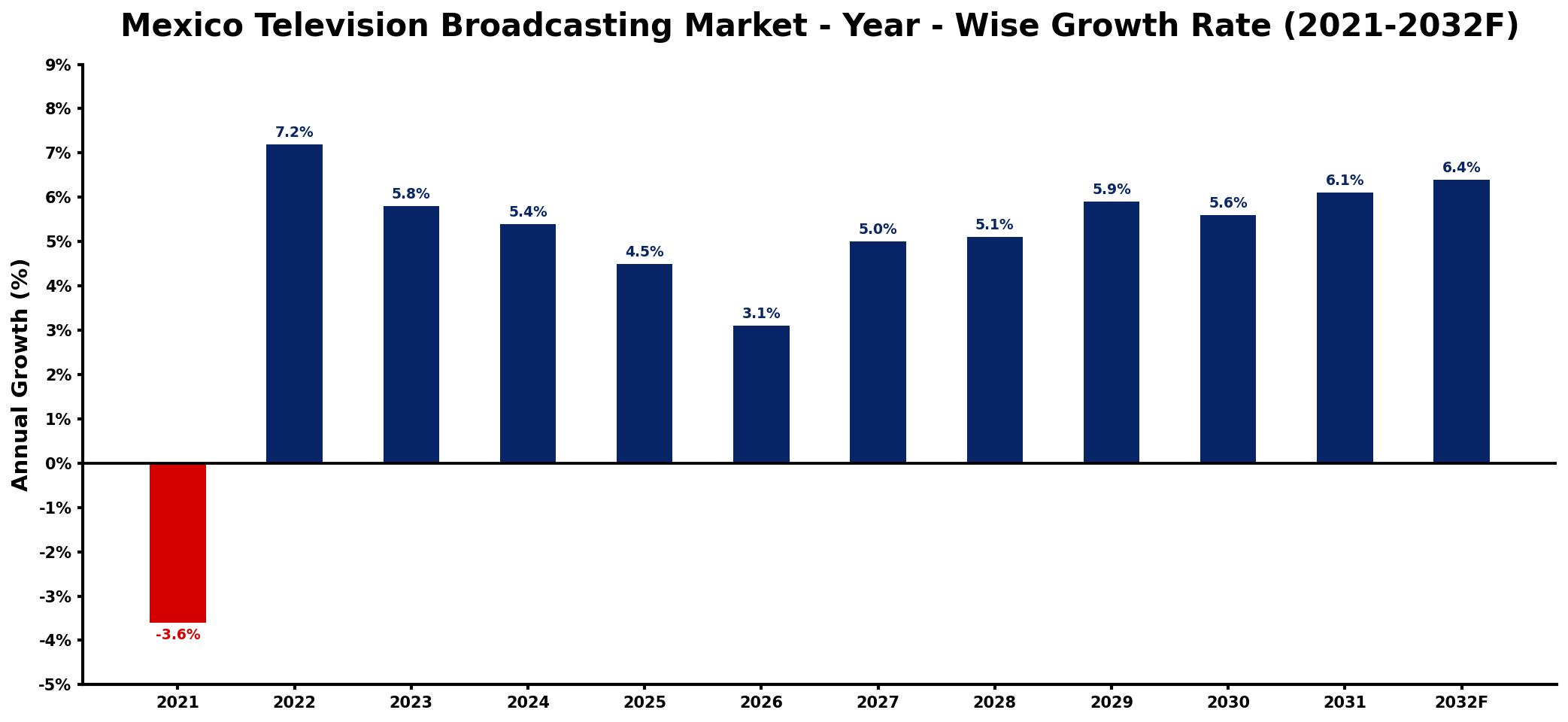
The table below presents the year‑wise growth rates along with the key drivers influencing the market
| Year | Growth Rate | Major Drivers |
| 2021 | -3.6% | decreased advertising revenue from clients |
| 2022 | 7.2% | increased demand for streaming content |
| 2023 | 5.8% | growing interest in local productions |
| 2024 | 5.4% | expansion of digital distribution channels |
| 2025 | 4.5% | rising investments in content creation |
| 2026 | 3.1% | increased viewership among younger demographics |
| 2027 | 5.0% | growing partnerships with tech companies |
| 2028 | 5.1% | enhanced viewer engagement strategies implemented |
| 2029 | 5.9% | growing popularity of original series |
| 2030 | 5.6% | increased focus on audience analytics |
| 2031 | 6.1% | expanding global content collaborations |
| 2032 | 6.4% | growing demand for high-quality productions |
Note: Market size estimations and growth projections presented in this report are based on 6Wresearch's proprietary forecasting methodology, utilizing the latest available industry data, government publications, and primary research inputs.
Mexico Television Broadcasting Market Synopsis
Recent momentum in the Mexico television broadcasting market reflects a blend of resilience and adaptation. With traditional broadcasters facing intense competition from digital platforms, there is a clear shift towards embracing high-definition and original local content. This evolution is setting the stage for a dynamic future where both free-to-air and pay-TV services must continuously evolve to retain and grow their audience base.
Looking ahead, the market is poised for significant transformation as consumer preferences shift towards on-demand content. The introduction of technological advancements, coupled with regulatory reforms aimed at enhancing competition, will redefine content delivery and viewer engagement in the coming years. This presents a unique opportunity for broadcasters willing to innovate.
Mexico Television Broadcasting Market Key Takeaways
- The market is characterized by a blend of free-to-air and pay-TV offerings targeting a diverse audience.
- Digital transformation is a key focus, with significant investment in high-definition content and infrastructure upgrades.
- Local content production is gaining prominence, reflecting the preferences of Mexican viewers.
- Regulatory reforms are aimed at fostering competition and ensuring consumer protection in the broadcasting sector.
- Opportunities abound in niche markets and original programming, especially in response to shifting viewer habits.
Evaluation of Restraints in Mexico Television Broadcasting Market
While the Mexico television broadcasting market is expanding, several factors are constraining its potential. The surge in popularity of streaming services presents a formidable challenge to traditional broadcasters, compelling them to reassess their content strategies. Additionally, regulatory obstacles related to licensing and content distribution can limit operational flexibility. Economic uncertainties also impact advertising revenues, forcing broadcasters to navigate a complex landscape where consumer expectations are continually evolving.
Mexico Television Broadcasting Market Trends
The shift towards digital and high-definition content is a prevailing trend in the Mexico television broadcasting market. Broadcasters are increasingly investing in advanced technologies to enhance viewer experiences and meet rising expectations for quality programming. Moreover, the growth of OTT platforms is prompting traditional media companies to explore new delivery methods and content strategies, emphasizing flexibility and variety. Original programming tailored to local tastes is gaining traction, reflecting the demand for culturally relevant content.
Mexico Television Broadcasting Market Opportunities
Significant investment opportunities are emerging within the Mexico television broadcasting landscape. As online content consumption rises, there is ample scope for growth in digital and streaming services, making investments in these areas particularly promising. Niche markets focused on regional programming and specific demographics present additional avenues for innovation. Collaborating with local production houses to create original content can enhance viewer loyalty and brand engagement, further driving profitability.
Government Initiatives in the Mexico Television Broadcasting Market
In Mexico, government oversight of the television broadcasting sector is conducted by the Federal Telecommunications Institute (IFT), which implements policies aimed at promoting diversity and fair competition. Current initiatives include regulatory frameworks designed to prevent monopolistic practices and protect cultural diversity in broadcasting. Furthermore, the government is advocating for a transition to digital television, enhancing access for underserved communities, thus ensuring that broadcasting services reach a broader audience.
Future Insights of the Mexico Television Broadcasting Market
The outlook for the Mexico television broadcasting market from 2026 to 2032 is optimistic, driven by the convergence of increasing disposable incomes and the expanding middle-class demographic. The market is likely to witness enhanced viewer engagement through advanced broadcasting technologies, including the rise of high-definition content. However, adapting to the fast-paced evolution of viewer habits and competition from digital platforms will be crucial for maintaining growth momentum and market relevance in this dynamic environment.
Mexico Television Broadcasting Market Latest Developments (2025 - 2026)
Recent developments in the Mexico television broadcasting market indicate a surge in investments focused on upgrading broadcasting infrastructure to support high-definition and digital content delivery. Furthermore, there is a notable trend towards strategic partnerships between traditional broadcasters and digital platforms, aimed at expanding content reach and viewer engagement. Regulatory updates are also influencing how broadcasters adapt to an increasingly competitive landscape, focusing on innovation and audience connection.
Mexico Television Broadcasting Market - Key Attractiveness of the Report
- 10 Years of Market Numbers
- Historical Data Starting from 2022 to 2025
- Base Year: 2025
- Forecast Data until 2032
- Key Performance Indicators Impacting the Market
- Major Upcoming Developments and Projects
Key Highlights of the Report:
- Mexico Television Broadcasting Market Outlook
- Market Size of Mexico Television Broadcasting Market, 2025
- Forecast of Mexico Television Broadcasting Market, 2032
- Historical Data and Forecast of Mexico Television Broadcasting Revenues & Volume for the Period 2022-2032F
- Mexico Television Broadcasting Market Trend Evolution
- Mexico Television Broadcasting Market Drivers and Challenges
- Mexico Television Broadcasting Price Trends
- Mexico Television Broadcasting Porter's Five Forces
- Mexico Television Broadcasting Industry Life Cycle
- Historical Data and Forecast of Mexico Television Broadcasting Market Revenues & Volume By Type for the Period 2022-2032F
- Historical Data and Forecast of Mexico Television Broadcasting Market Revenues & Volume By Television Station for the Period 2022-2032F
- Historical Data and Forecast of Mexico Television Broadcasting Market Revenues & Volume By Television Network for the Period 2022-2032F
- Historical Data and Forecast of Mexico Television Broadcasting Market Revenues & Volume By Broadcaster Type for the Period 2022-2032F
- Historical Data and Forecast of Mexico Television Broadcasting Market Revenues & Volume By Public for the Period 2022-2032F
- Historical Data and Forecast of Mexico Television Broadcasting Market Revenues & Volume By Commercial for the Period 2022-2032F
- Historical Data and Forecast of Mexico Television Broadcasting Market Revenues & Volume By Revenue Source for the Period 2022-2032F
- Historical Data and Forecast of Mexico Television Broadcasting Market Revenues & Volume By Subscription-based for the Period 2022-2032F
- Historical Data and Forecast of Mexico Television Broadcasting Market Revenues & Volume By Advertisement-based for the Period 2022-2032F
- Mexico Television Broadcasting Import Export Trade Statistics
- Market Opportunity Assessment By Type
- Market Opportunity Assessment By Broadcaster Type
- Market Opportunity Assessment By Revenue Source
- Mexico Television Broadcasting Top Companies Market Share
- Mexico Television Broadcasting Competitive Benchmarking By Technical and Operational Parameters
- Mexico Television Broadcasting Company Profiles
- Mexico Television Broadcasting Key Strategic Recommendations






































