Mexico Tensile Testing Equipment Market Size, Share & Growth Rate
The Mexico Tensile Testing Equipment Market was estimated at USD 108 Million in 2025 and is projected to reach USD 125 Million by 2032, growing at a CAGR of 2.1% from 2026 to 2032. This growth trajectory is largely fueled by the rising demand for rigorous quality assurance across key industries, particularly in automotive, aerospace, and construction. These sectors are increasingly investing in advanced testing equipment to guarantee the strength and reliability of materials, thereby driving the overall market expansion.
Mexico Tensile Testing Equipment Market Year-wise Growth Rate and Key Drivers
This graph highlights how the Mexico Tensile Testing Equipment Market has steadily grown over the years, supported by major growth factors.
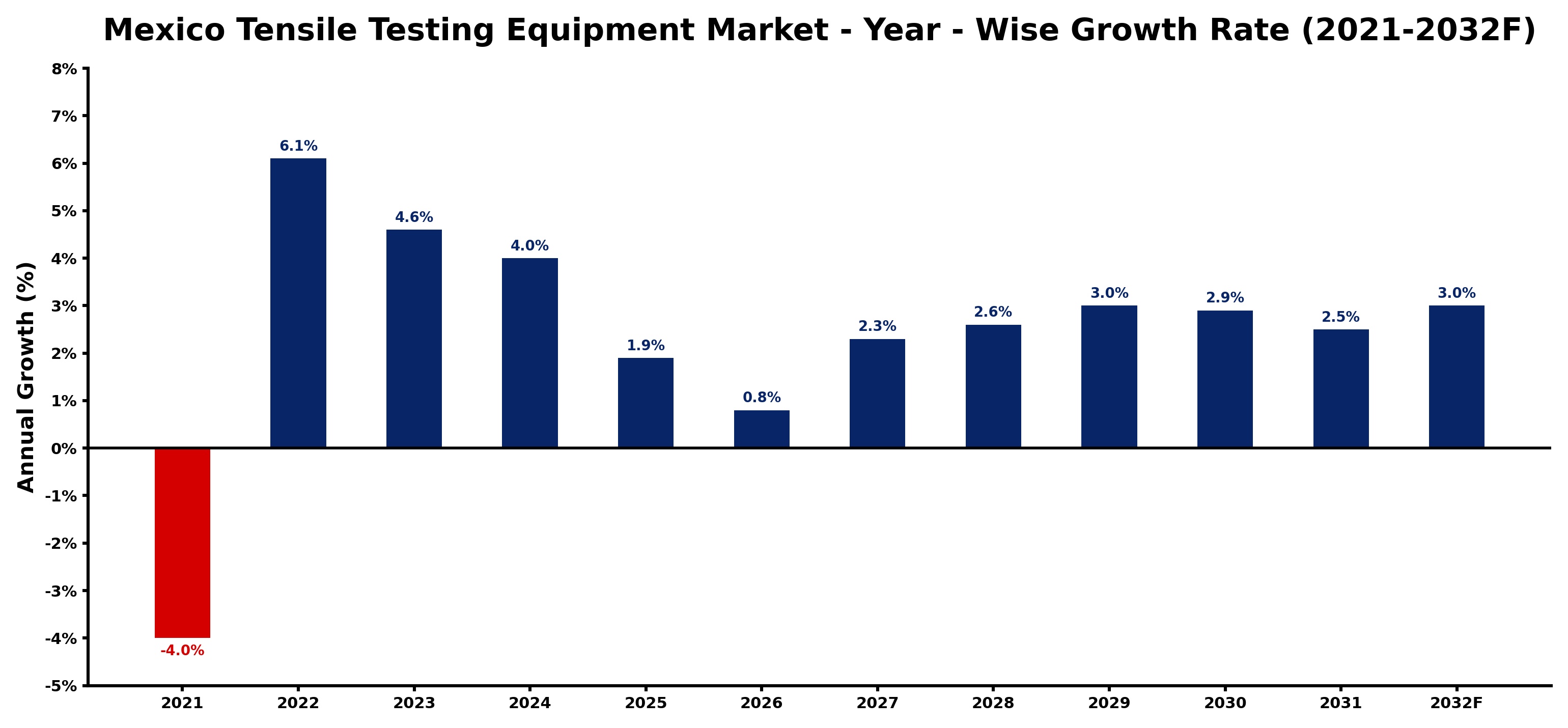
The table below presents the year‑wise growth rates along with the key drivers influencing the market
| Year | Growth Rate | Major Drivers |
| 2021 | -4.0% | Increasing industrial automation investments |
| 2022 | 6.1% | Growing urbanization and commercial development |
| 2023 | 4.6% | Growing urbanization and commercial development |
| 2024 | 4.0% | Increasing adoption of advanced technologies |
| 2025 | 1.9% | Increasing adoption of advanced technologies |
| 2026 | 0.8% | Rapid growth in telecom and data center sectors |
| 2027 | 2.3% | Expansion of commercial construction activities |
| 2028 | 2.6% | Rising electricity demand across industries |
| 2029 | 3.0% | Increasing industrial infrastructure investments |
| 2030 | 2.9% | Expansion of commercial construction activities |
| 2031 | 2.5% | Increasing industrial infrastructure investments |
| 2032 | 3.0% | Expansion of commercial construction activities |
Note - Market size estimations and growth projections presented in this report are based on 6Wresearch's advanced forecasting approach, validated with industry datasets as of June 2026.
Mexico Tensile Testing Equipment Market Synopsis
Currently, the Mexican tensile testing equipment market is witnessing a notable shift towards modernization. As manufacturing processes evolve, industries are prioritizing advanced testing solutions that not only meet stringent quality standards but also enhance productivity.
This market is characterized by a growing emphasis on research and development activities. Companies are continually exploring innovative testing methodologies, which is leading to a greater adoption of automated and versatile tensile testing solutions across various sectors.
Mexico Tensile Testing Equipment Market Key Takeaways
- The market is witnessing an upward trend due to heightened quality control measures across multiple industries.
- Key sectors driving demand include automotive, aerospace, and construction.
- Innovations in technology are fostering the development of automated and customizable testing solutions.
- Government policies are facilitating easier access to advanced testing equipment.
- The market is increasingly adapting to evolving regulations and standards in material testing.
Evaluation of Restraints in Mexico Tensile Testing Equipment Market
While the market is on an upward trajectory, it faces certain restraints that could impact growth. A significant challenge is the need to meet diverse industry specifications, as each sector—be it construction, manufacturing, or materials science—requires specialized testing solutions. Additionally, adapting to ever-changing testing standards while ensuring accuracy remains a formidable hurdle. There's also a rising demand for automation, which may necessitate significant investment in technology upgrades for manufacturers.
Mexico Tensile Testing Equipment Market Trends
One of the notable trends in the Mexico tensile testing equipment market is the increasing integration of automation in testing processes. Automated systems not only streamline operations but also enhance the precision and repeatability of results, making them indispensable in modern manufacturing environments. Furthermore, the emphasis on sustainability is leading to the development of eco-friendly testing solutions that cater to both compliance and corporate responsibility.
Mexico Tensile Testing Equipment Market Opportunities
The market presents lucrative growth and investment opportunities, particularly in the realm of advanced technology. With the push for automation and smart manufacturing, companies that can innovate and offer customizable testing solutions stand to benefit significantly. Moreover, as the Mexican government continues to support industry initiatives, there will be enhanced avenues for investment in both local production capabilities and cutting-edge technologies.
Government Initiatives in the Mexico Tensile Testing Equipment Market
The Mexican government has recognized the critical importance of tensile testing equipment in maintaining quality across various sectors. In response, policies are being enacted to improve accessibility and affordability of such tools for industries. This includes measures to ease the importation of advanced testing technologies and the introduction of incentives for companies adopting these essential testing solutions. Furthermore, ongoing efforts are being made to establish standardized testing protocols, enhancing reliability and consistency.
Future Insights of the Mexico Tensile Testing Equipment Market
Looking forward to the period of 2026 to 2032, the Mexico tensile testing equipment market is poised for progressive growth. The focus on quality control in manufacturing will continue to escalate, along with an increased adoption of automated systems that promise efficiency and reliability. As industries evolve, the demand for specialized and adaptable testing solutions will likely surge, positioning the market for sustained expansion and innovation.
Mexico Tensile Testing Equipment Market Latest Developments (May 2025 - June 2026)
In recent months, there has been a noticeable shift towards more automated tensile testing solutions among manufacturers in Mexico. Industry stakeholders are actively exploring partnerships to leverage cutting-edge technology and improve testing capabilities. Additionally, discussions around standardizing testing procedures have gained momentum, reflecting an industry-wide commitment to ensuring quality and consistency.
Mexico Tensile Testing Equipment Market - Key Attractiveness of the Report
- 10 Years of Market Numbers
- Historical Data Starting from 2022 to 2025
- Base Year: 2025
- Forecast Data until 2032
- Key Performance Indicators Impacting the Market
- Major Upcoming Developments and Projects
Key Highlights of the Report:
- Mexico Tensile Testing Equipment Market Outlook
- Market Size of Mexico Tensile Testing Equipment Market, 2025
- Forecast of Mexico Tensile Testing Equipment Market, 2032
- Historical Data and Forecast of Mexico Tensile Testing Equipment Revenues & Volume for the Period 2022-2032F
- Mexico Tensile Testing Equipment Market Trend Evolution
- Mexico Tensile Testing Equipment Market Drivers and Challenges
- Mexico Tensile Testing Equipment Price Trends
- Mexico Tensile Testing Equipment Porter's Five Forces
- Mexico Tensile Testing Equipment Industry Life Cycle
- Historical Data and Forecast of Mexico Tensile Testing Equipment Market Revenues & Volume By Equipment Type for the Period 2022-2032F
- Historical Data and Forecast of Mexico Tensile Testing Equipment Market Revenues & Volume By Universal Testing Machine for the Period 2022-2032F
- Historical Data and Forecast of Mexico Tensile Testing Equipment Market Revenues & Volume By Hydraulic for the Period 2022-2032F
- Historical Data and Forecast of Mexico Tensile Testing Equipment Market Revenues & Volume By Electromechanical for the Period 2022-2032F
- Historical Data and Forecast of Mexico Tensile Testing Equipment Market Revenues & Volume By Others for the Period 2022-2032F
- Historical Data and Forecast of Mexico Tensile Testing Equipment Market Revenues & Volume By End-User Industry for the Period 2022-2032F
- Historical Data and Forecast of Mexico Tensile Testing Equipment Market Revenues & Volume By Industrial Manufacturing for the Period 2022-2032F
- Historical Data and Forecast of Mexico Tensile Testing Equipment Market Revenues & Volume By Automotive for the Period 2022-2032F
- Historical Data and Forecast of Mexico Tensile Testing Equipment Market Revenues & Volume By Construction for the Period 2022-2032F
- Historical Data and Forecast of Mexico Tensile Testing Equipment Market Revenues & Volume By Others for the Period 2022-2032F
- Mexico Tensile Testing Equipment Import Export Trade Statistics
- Market Opportunity Assessment By Equipment Type
- Market Opportunity Assessment By End-User Industry
- Mexico Tensile Testing Equipment Top Companies Market Share
- Mexico Tensile Testing Equipment Competitive Benchmarking By Technical and Operational Parameters
- Mexico Tensile Testing Equipment Company Profiles
- Mexico Tensile Testing Equipment Key Strategic Recommendations






































