Mexico Workplace Safety Market Size & Growth Rate (2026-2032)
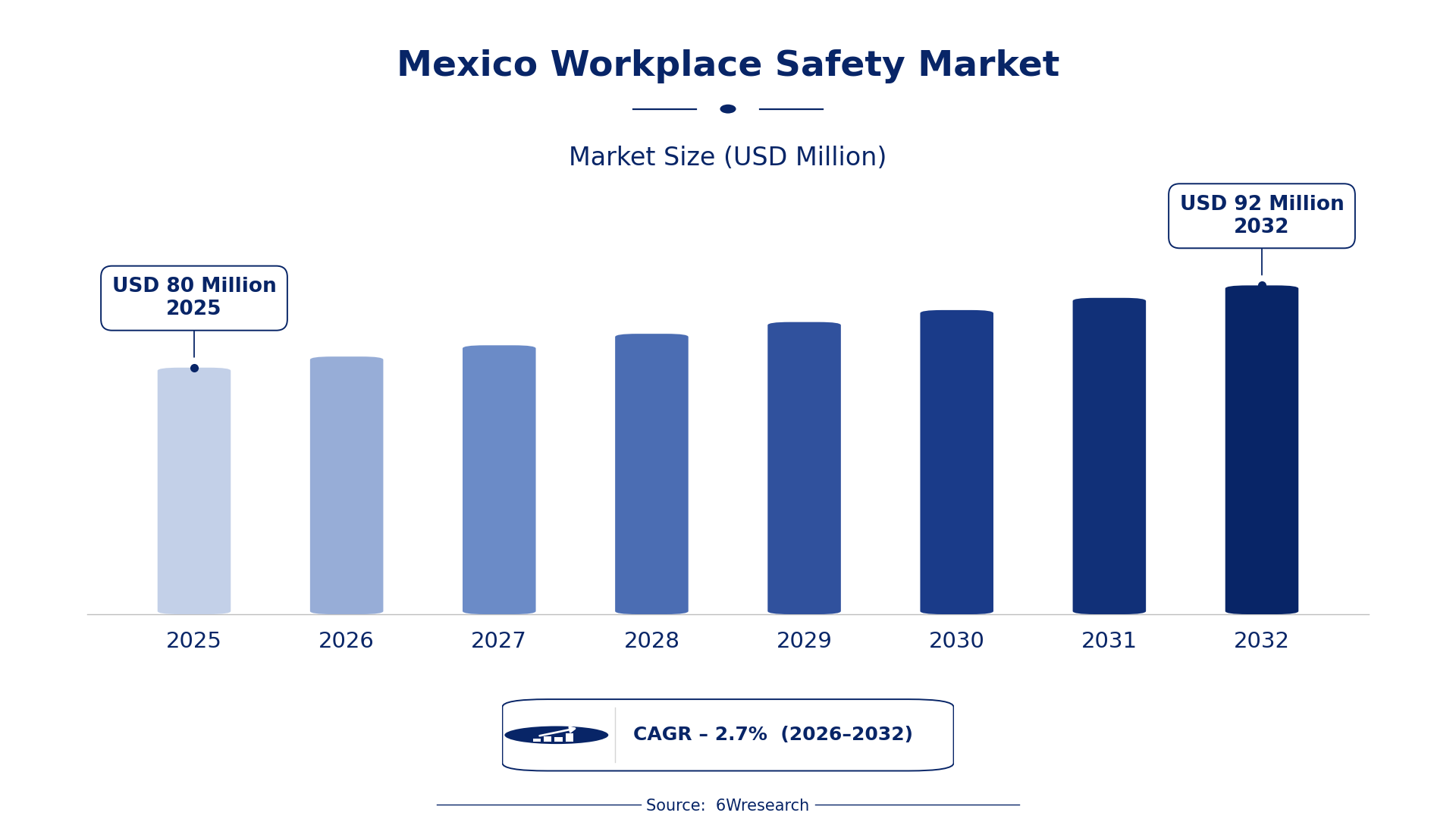
The Mexico Workplace Safety Market was estimated at USD 80 Million in 2025 and is projected to reach USD 92 Million by 2032, growing at a CAGR of 2.7% from 2026 to 2032.
Mexico Workplace Safety Market Synopsis
The demand for workplace safety solutions in Mexico is surging, primarily fueled by regulatory mandates and an increasing awareness of occupational health. Businesses are now prioritizing comprehensive safety strategies, seeing them not only as compliance measures but also as crucial elements in enhancing productivity.
From personal protective equipment (PPE) to innovative safety technologies, the market encompasses a diverse array of products and services aimed at safeguarding workers. As companies evolve in their approach to workplace safety, the integration of advanced technologies, such as IoT and AI, is becoming more common, addressing both traditional and emerging safety challenges.
Mexico Workplace Safety Market Year-wise Growth Rate and Key Drivers
This graph illustrates the annual growth rates of the Mexico Workplace Safety Market from 2021 to 2032, highlighting a steady upward trajectory and projected expansion over the forecast period.
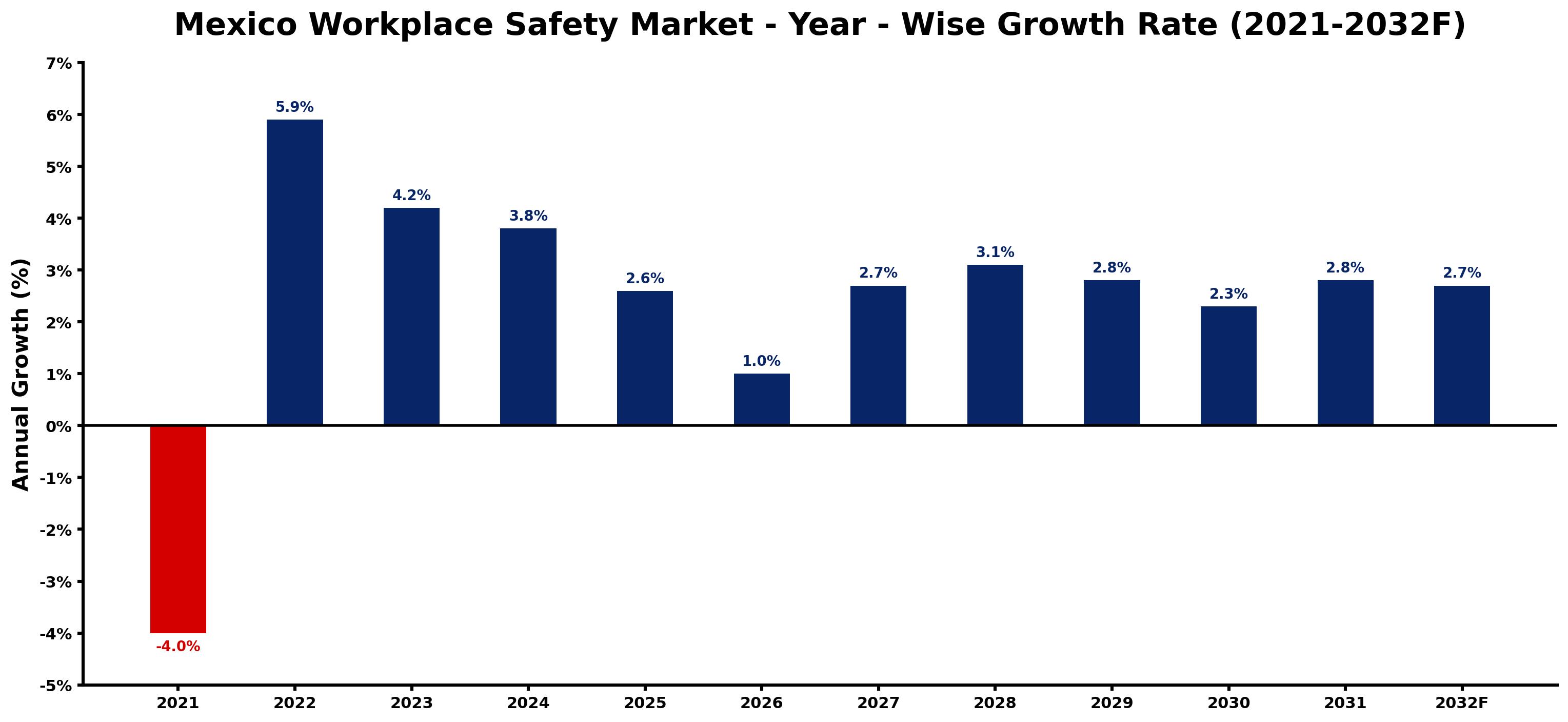
The table below presents the year‑wise growth rates along with the key drivers influencing the market
| Year | Growth Rate | Major Drivers |
| 2021 | -4.0% | Closure of major manufacturing plants during COVID-19 pandemic. |
| 2022 | 5.9% | Increased regulation of workplace safety by STPS. |
| 2023 | 4.2% | Growing awareness of worker rights and safety standards. |
| 2024 | 3.8% | Rise in accidents prompting stricter enforcement measures. |
| 2025 | 2.6% | Government initiatives promoting occupational health education. |
| 2026 | 1.0% | Increased foreign investment prioritizing safety protocols. |
| 2027 | 2.7% | Implementation of ISO 45001 standards across industries. |
| 2028 | 3.1% | Emerging tech adoption for safety monitoring tools. |
| 2029 | 2.8% | Enhanced training programs for safety compliance education. |
| 2030 | 2.3% | Rising emphasis on mental health in workplace policies. |
| 2031 | 2.8% | Supportive labor laws enhancing workplace safety frameworks. |
| 2032 | 2.7% | Collaborations between industries and safety organizations promote compliance. |
Note: Market size estimations and growth projections presented in this report are based on 6Wresearch's proprietary forecasting methodology, utilizing the latest available industry data, government publications, and primary research inputs.
Mexico Workplace Safety Market Key Takeaways
Below are some of the specific key takeaways from the market, including:
- Steady market growth, driven by regulatory compliance and employee safety awareness.
- Increased adoption of IoT and AI technologies for real-time safety monitoring.
- Rising emphasis on mental health initiatives within the workplace.
- Growing investment in safety training and education programs.
- Emerging opportunities in safety consulting services and innovative safety solutions.
Evaluation of Restraints in Mexico Workplace Safety Market
Despite growth, several factors hinder the Mexico Workplace Safety Market. One primary issue is the inconsistent enforcement of safety regulations, which leaves many companies without adequate compliance oversight. Additionally, the informal economy poses a significant challenge, as many workers are unprotected by workplace safety laws.
Many firms are also trapped in a productivity-first mentality, often overlooking necessary safety measures in favor of short-term gains. High turnover rates further complicate the implementation of robust safety protocols, making it imperative for both government and private sectors to prioritize comprehensive strategies to promote a safer working environment.
Mexico Workplace Safety Market Trends
A notable trend is the shift toward integrating IoT for real-time monitoring of workplace conditions and employee health. This technology aids in the proactive identification of potential hazards. Artificial intelligence is also playing a crucial role, utilizing predictive analytics to prevent accidents before they occur.
Furthermore, mental health programs are gaining traction as organizations recognize the importance of supporting employee well-being. Companies are investing heavily in training and educational programs, focusing on raising awareness about safety practices and instilling a culture of safety that permeates throughout the organization.
Mexico Workplace Safety Market Opportunities
With a growing focus on workplace safety, investment opportunities abound, particularly in safety training and advanced safety equipment. There's an increasing demand for innovative solutions, such as personal protective gear and emergency response systems, which can enhance overall safety protocols.
Consulting services are also in high demand, as businesses look for expert guidance to assess and improve their safety practices. As regulations become stricter and businesses recognize the value of a safety-first culture, the market offers ripe opportunities for investment and development.
Government Initiatives in the Mexico Workplace Safety Market
Government policies are instrumental in shaping the Mexico Workplace Safety Market, with a focus on enhancing worker protection through comprehensive regulations. The Federal Labor Law and specific safety guidelines are crucial in establishing clear responsibilities for employers. The government's commitment to enforcing these regulations reinforces the urgency for companies to comply, as non-compliance can lead to severe penalties.
- A recently completed initiative included a nationwide audit of workplace safety practices to ensure compliance with federal standards.
- Current efforts are underway to enhance the training and certification of safety inspectors, aiming for more rigorous enforcement of safety regulations.
- A planned public-private partnership is expected to launch in 2026, focusing on the development of advanced safety training modules for various industries.
- The introduction of a national campaign targeting mental health awareness in workplaces is ongoing, aiming to integrate mental wellness into safety protocols.
- Upcoming legislation is set to be discussed in 2027 that will mandate enhanced safety protocols for high-risk industries.
Future Insights of the Mexico Workplace Safety Market
Looking ahead to 2026-2032, the Mexico Workplace Safety Market is on track for sustained growth. As awareness of occupational health intensifies, the demand for advanced safety solutions will rise correspondingly. The implementation of stricter safety standards by the government will compel businesses to enhance their safety measures further.
Moreover, the development of tailored safety solutions catering to various industry sectors will stimulate market activity. Companies increasingly recognize that a safe workplace is not merely a regulatory necessity, but a key driver of productivity and operational efficiency, underscoring the essential role of workplace safety in the future.
Mexico Workplace Safety Market Latest Developments
In the last year, the Mexico Workplace Safety Market has witnessed a surge in activity as businesses and the government ramp up efforts to bolster safety standards. The integration of advanced technologies has become a focal point, with many organizations actively seeking solutions that enhance workplace safety.
- A major technology vendor launched a comprehensive IoT-based safety monitoring solution in late 2025, aiming to provide real-time data on workplace conditions.
- Several companies initiated partnerships in early 2026 to develop AI-driven predictive analytics tools for accident prevention.
- Workshops focusing on mental health awareness have been rolled out in many firms, currently being implemented throughout 2026.
- A planned expansion of safety training programs is expected to kick off by Q2 2026, addressing the need for enhanced education in high-risk environments.
- The government is currently finalizing new standards for PPE, expected to be released by mid-2026 to ensure better protection for workers.
Mexico Workplace Safety Market - Key Attractiveness of the Report
- 10 Years of Market Numbers
- Historical Data Starting from 2022 to 2025
- Base Year: 2025
- Forecast Data until 2032
- Key Performance Indicators Impacting the Market
- Major Upcoming Developments and Projects
Key Highlights of the Report:
- Mexico Workplace Safety Market Outlook
- Market Size of Mexico Workplace Safety Market, 2025
- Forecast of Mexico Workplace Safety Market, 2032
- Historical Data and Forecast of Mexico Workplace Safety Revenues & Volume for the Period 2022-2032F
- Mexico Workplace Safety Market Trend Evolution
- Mexico Workplace Safety Market Drivers and Challenges
- Mexico Workplace Safety Price Trends
- Mexico Workplace Safety Porter's Five Forces
- Mexico Workplace Safety Industry Life Cycle
- Historical Data and Forecast of Mexico Workplace Safety Market Revenues & Volume By Component for the Period 2022-2032F
- Historical Data and Forecast of Mexico Workplace Safety Market Revenues & Volume By Hardware for the Period 2022-2032F
- Historical Data and Forecast of Mexico Workplace Safety Market Revenues & Volume By Software for the Period 2022-2032F
- Historical Data and Forecast of Mexico Workplace Safety Market Revenues & Volume By Services for the Period 2022-2032F
- Historical Data and Forecast of Mexico Workplace Safety Market Revenues & Volume By Application for the Period 2022-2032F
- Historical Data and Forecast of Mexico Workplace Safety Market Revenues & Volume By Incident for the Period 2022-2032F
- Historical Data and Forecast of Mexico Workplace Safety Market Revenues & Volume By Emergency Management for the Period 2022-2032F
- Historical Data and Forecast of Mexico Workplace Safety Market Revenues & Volume By Asset Tracking for the Period 2022-2032F
- Historical Data and Forecast of Mexico Workplace Safety Market Revenues & Volume By PPE Detection for the Period 2022-2032F
- Historical Data and Forecast of Mexico Workplace Safety Market Revenues & Volume By System for the Period 2022-2032F
- Historical Data and Forecast of Mexico Workplace Safety Market Revenues & Volume By Environmental Health and Safety for the Period 2022-2032F
- Historical Data and Forecast of Mexico Workplace Safety Market Revenues & Volume By Access Control and Surveillance System for the Period 2022-2032F
- Historical Data and Forecast of Mexico Workplace Safety Market Revenues & Volume By Real Time Location Monitoring for the Period 2022-2032F
- Historical Data and Forecast of Mexico Workplace Safety Market Revenues & Volume By Others for the Period 2022-2032F
- Historical Data and Forecast of Mexico Workplace Safety Market Revenues & Volume By Deployment Mode for the Period 2022-2032F
- Historical Data and Forecast of Mexico Workplace Safety Market Revenues & Volume By On-premise for the Period 2022-2032F
- Historical Data and Forecast of Mexico Workplace Safety Market Revenues & Volume By Cloud for the Period 2022-2032F
- Historical Data and Forecast of Mexico Workplace Safety Market Revenues & Volume By End User for the Period 2022-2032F
- Historical Data and Forecast of Mexico Workplace Safety Market Revenues & Volume By Energy and Utilities for the Period 2022-2032F
- Historical Data and Forecast of Mexico Workplace Safety Market Revenues & Volume By Construction and Engineering for the Period 2022-2032F
- Historical Data and Forecast of Mexico Workplace Safety Market Revenues & Volume By Chemical and Materials for the Period 2022-2032F
- Historical Data and Forecast of Mexico Workplace Safety Market Revenues & Volume By Government and Defense for the Period 2022-2032F
- Historical Data and Forecast of Mexico Workplace Safety Market Revenues & Volume By Healthcare for the Period 2022-2032F
- Historical Data and Forecast of Mexico Workplace Safety Market Revenues & Volume By Food and Beverages for the Period 2022-2032F
- Historical Data and Forecast of Mexico Workplace Safety Market Revenues & Volume By Others for the Period 2022-2032F
- Mexico Workplace Safety Import Export Trade Statistics
- Market Opportunity Assessment By Component
- Market Opportunity Assessment By Application
- Market Opportunity Assessment By System
- Market Opportunity Assessment By Deployment Mode
- Market Opportunity Assessment By End User
- Mexico Workplace Safety Top Companies Market Share
- Mexico Workplace Safety Competitive Benchmarking By Technical and Operational Parameters
- Mexico Workplace Safety Company Profiles
- Mexico Workplace Safety Key Strategic Recommendations






































