Morocco Animal Feed Enzymes Market Size, Share & Growth Rate
The Morocco Animal Feed Enzymes Market was estimated at USD 415 Million in 2025 and is projected to reach USD 581 Million by 2032, growing at a CAGR of 4.9% from 2026 to 2032. This growth trajectory is primarily fueled by the increasing demand for high-quality meat products and the rising focus on enhancing animal health through improved nutrition. Additionally, government initiatives promoting sustainable agricultural practices further bolster market expansion, as farmers seek innovative solutions to enhance feed efficiency and lower costs.
Morocco Animal Feed Enzymes Market Year-wise Growth Rate and Key Drivers
This graph highlights how the Morocco Animal Feed Enzymes Market has steadily grown over the years, supported by major growth factors.
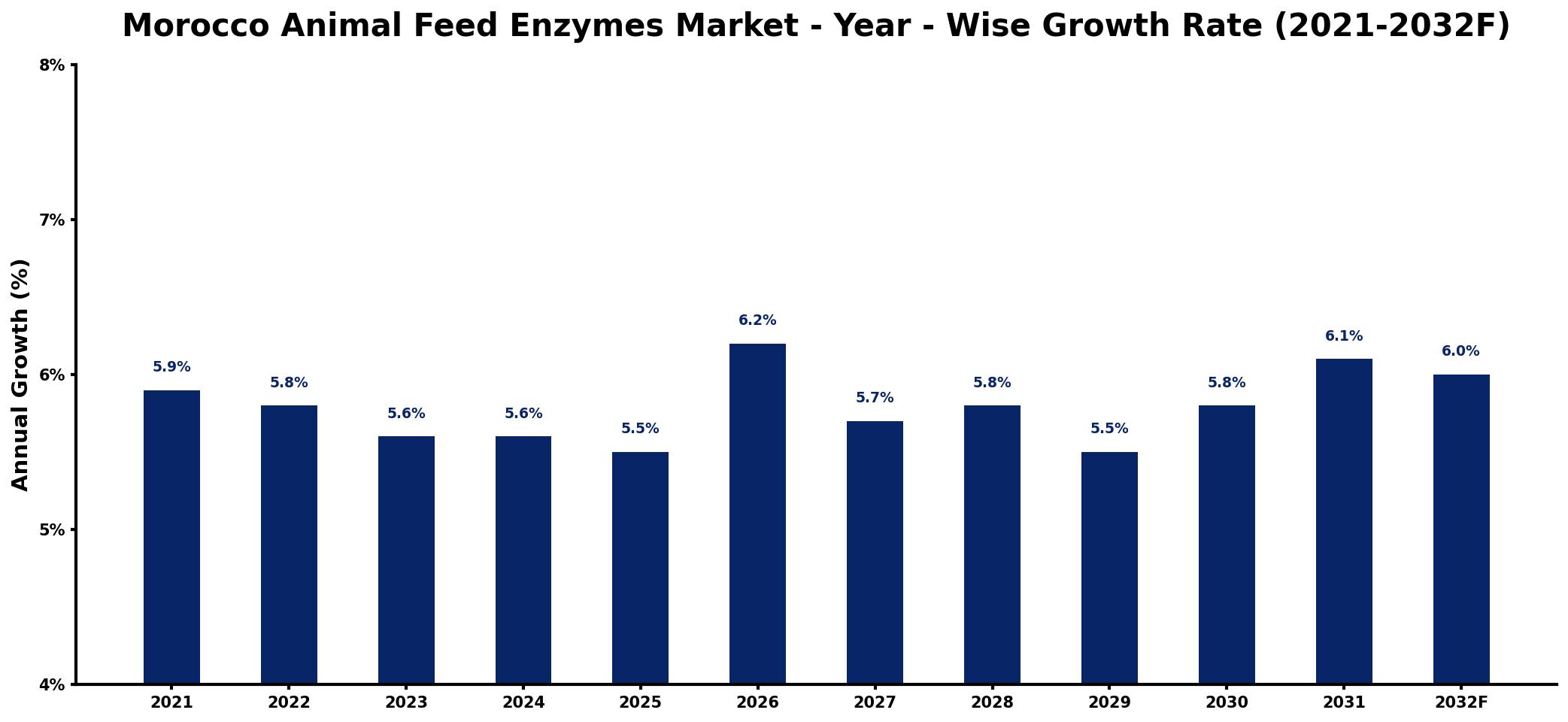
The table below presents the year‑wise growth rates along with the key drivers influencing the market
| Year | Growth Rate | Major Drivers |
| 2021 | 5.9% | Rising livestock production rates |
| 2022 | 5.8% | Increased investment in agriculture |
| 2023 | 5.6% | Growing consumer health awareness |
| 2024 | 5.6% | Expansion of poultry farming sector |
| 2025 | 5.5% | Technological advancements in farming |
| 2026 | 6.2% | Higher demand for organic products |
| 2027 | 5.7% | Strengthening livestock export markets |
| 2028 | 5.8% | Enhanced research and development initiatives |
| 2029 | 5.5% | Emerging trends in sustainable practices |
| 2030 | 5.8% | Improved agricultural infrastructure investments |
| 2031 | 6.1% | Growing popularity of alternative proteins |
| 2032 | 6.0% | Rising demand for quality nutrition |
Note: Market size estimations and growth projections presented in this report are based on 6Wresearch's proprietary forecasting methodology, utilizing the latest available industry data, government publications, and primary research inputs.
Morocco Animal Feed Enzymes Market Synopsis
The Moroccan market for animal feed enzymes is characterized by a significant shift towards quality and performance, particularly in the poultry sector, which remains the dominant segment. This demand is closely linked to the growing consumer preference for nutritious meat and dairy products, pushing farmers to adopt advanced feed solutions.
As farmers gain awareness of the benefits of feed enzymes, the adoption rate is steadily increasing. Enhanced nutrient absorption, increased feed digestibility, and overall animal performance improvements are driving this trend, contributing to a healthier livestock population and a more sustainable agricultural sector.
Morocco Animal Feed Enzymes Market Key Takeaways
- The Morocco Animal Feed Enzymes Market is driven by increasing consumer demand for high-quality meat and dairy products.
- Investments in research and development are leading to innovative enzyme solutions tailored for the local livestock industry.
- Government policies support the safe use and regulatory approval of feed enzymes, enhancing market credibility.
- Challenges related to farmer awareness and enzyme cost continue to influence market dynamics.
- Partnerships with local feed manufacturers present lucrative opportunities for growth in the enzyme sector.
Evaluation of Restraints in Morocco Animal Feed Enzymes Market
While the Morocco Animal Feed Enzymes Market is poised for growth, several restraints limit its potential. Limited awareness among local farmers regarding the benefits of enzyme utilization can hinder widespread adoption, creating a gap between understanding and application. Furthermore, the relatively high cost of certain feed enzymes poses a financial barrier for smaller operations. There is also a lack of comprehensive regulatory frameworks dedicated to enzyme use, which adds uncertainty and complexity for manufacturers seeking to enter the market. Addressing these challenges through targeted educational initiatives and industry collaboration will be crucial for sustained market progress.
Morocco Animal Feed Enzymes Market Trends
The Morocco Animal Feed Enzymes Market is increasingly influenced by trends emphasizing sustainability and efficiency in livestock production. There's a noticeable shift towards enzyme-based additives over traditional chemical supplements, reflecting a broader demand for organic and environmentally friendly farming practices. Moreover, advancements in enzyme technology are paving the way for products that are not only more effective but also customized to meet specific nutritional needs of livestock, further driving market growth. This trend is underpinned by the rising awareness among farmers about the positive impacts of feed enzymes on animal health and productivity.
Morocco Animal Feed Enzymes Market Opportunities
The Moroccan landscape for animal feed enzymes is ripe with investment opportunities. With the agricultural sector expanding and a clear demand for high-quality animal feed, market players can leverage partnerships with local manufacturers to introduce innovative enzyme solutions. Conducting comprehensive market research to identify specific regional needs will also be key. Investment in R&D for new formulations that enhance performance and reduce costs can further position companies favorably in this burgeoning market. Overall, the emphasis on sustainable farming practices offers a significant avenue for growth and innovation.
Government Initiatives in the Morocco Animal Feed Enzymes Market
The Moroccan government is actively supporting the growth of the animal feed enzymes market through various initiatives aimed at enhancing quality and safety standards. Regulatory frameworks have been established by the Ministry of Agriculture and Fisheries to oversee the approval and registration of feed enzymes, ensuring they meet the necessary health and safety requirements. Furthermore, government efforts to promote research and development in this area reflect a commitment to improving agricultural efficiency and sustainability, which is crucial for the long-term growth of the livestock sector in Morocco.
Future Insights of the Morocco Animal Feed Enzymes Market
Looking ahead to 2026-2032, the Morocco Animal Feed Enzymes Market is expected to continue its upward trajectory. The increasing awareness of the nutritional benefits of enzymes, coupled with a growing demand for sustainable farming practices, will drive market evolution. Regulatory advancements and ongoing innovation in enzyme technology will likely facilitate the introduction of more effective and cost-efficient products. As the livestock industry adapts to these changes, market players will need to remain agile and responsive to the needs of farmers, ensuring that their offerings align with evolving agricultural standards.
Morocco Animal Feed Enzymes Market Latest Developments (2025 - 2026)
Recent developments in the Morocco Animal Feed Enzymes Market reflect a growing focus on innovative solutions tailored for the local agricultural landscape. Various stakeholders are increasingly engaging in collaborative efforts to enhance the effectiveness of feed additives, aiming for improved livestock health and productivity. Additionally, educational programs targeting local farmers are being implemented to raise awareness of the benefits associated with enzyme use, which is likely to accelerate market adoption and broaden the customer base for enzyme manufacturers.
Morocco Animal Feed Enzymes Market - Key Attractiveness of the Report
- 10 Years of Market Numbers
- Historical Data Starting from 2022 to 2025
- Base Year: 2025
- Forecast Data until 2032
- Key Performance Indicators Impacting the Market
- Major Upcoming Developments and Projects
Key Highlights of the Report:
- Morocco Animal Feed Enzymes Market Outlook
- Market Size of Morocco Animal Feed Enzymes Market, 2025
- Forecast of Morocco Animal Feed Enzymes Market, 2032
- Historical Data and Forecast of Morocco Animal Feed Enzymes Revenues & Volume for the Period 2022-2032F
- Morocco Animal Feed Enzymes Market Trend Evolution
- Morocco Animal Feed Enzymes Market Drivers and Challenges
- Morocco Animal Feed Enzymes Price Trends
- Morocco Animal Feed Enzymes Porter's Five Forces
- Morocco Animal Feed Enzymes Industry Life Cycle
- Historical Data and Forecast of Morocco Animal Feed Enzymes Market Revenues & Volume By Formulation for the Period 2022-2032F
- Historical Data and Forecast of Morocco Animal Feed Enzymes Market Revenues & Volume By Dry for the Period 2022-2032F
- Historical Data and Forecast of Morocco Animal Feed Enzymes Market Revenues & Volume By Liquid for the Period 2022-2032F
- Historical Data and Forecast of Morocco Animal Feed Enzymes Market Revenues & Volume By Product for the Period 2022-2032F
- Historical Data and Forecast of Morocco Animal Feed Enzymes Market Revenues & Volume By Phytase for the Period 2022-2032F
- Historical Data and Forecast of Morocco Animal Feed Enzymes Market Revenues & Volume By Carbohydrase for the Period 2022-2032F
- Historical Data and Forecast of Morocco Animal Feed Enzymes Market Revenues & Volume By Protease for the Period 2022-2032F
- Historical Data and Forecast of Morocco Animal Feed Enzymes Market Revenues & Volume By Non starch polysaccharides for the Period 2022-2032F
- Historical Data and Forecast of Morocco Animal Feed Enzymes Market Revenues & Volume By Livestock for the Period 2022-2032F
- Historical Data and Forecast of Morocco Animal Feed Enzymes Market Revenues & Volume By Poultry for the Period 2022-2032F
- Historical Data and Forecast of Morocco Animal Feed Enzymes Market Revenues & Volume By Swine for the Period 2022-2032F
- Historical Data and Forecast of Morocco Animal Feed Enzymes Market Revenues & Volume By Ruminant for the Period 2022-2032F
- Historical Data and Forecast of Morocco Animal Feed Enzymes Market Revenues & Volume By Aquaculture for the Period 2022-2032F
- Historical Data and Forecast of Morocco Animal Feed Enzymes Market Revenues & Volume By Others for the Period 2022-2032F
- Morocco Animal Feed Enzymes Import Export Trade Statistics
- Market Opportunity Assessment By Formulation
- Market Opportunity Assessment By Product
- Market Opportunity Assessment By Livestock
- Morocco Animal Feed Enzymes Top Companies Market Share
- Morocco Animal Feed Enzymes Competitive Benchmarking By Technical and Operational Parameters
- Morocco Animal Feed Enzymes Company Profiles
- Morocco Animal Feed Enzymes Key Strategic Recommendations






































