Morocco Carbon Credit Market Size, Share & Growth Rate
The Morocco Carbon Credit Market was estimated at USD 241 Million in 2025 and is projected to reach USD 320 Million by 2032, growing at a CAGR of 4.1% from 2026 to 2032. This growth is primarily driven by Morocco's robust commitment to expanding its renewable energy capacity, particularly in solar and wind sectors, as well as increased corporate investments in carbon offsetting to enhance sustainability practices. Furthermore, the implementation of supportive policies and financial mechanisms is expected to bolster market confidence and drive further investment.
Morocco Carbon Credit Market Year-wise Growth Rate and Key Drivers
This graph highlights how the Morocco Carbon Credit Market has steadily grown over the years, supported by major growth factors.
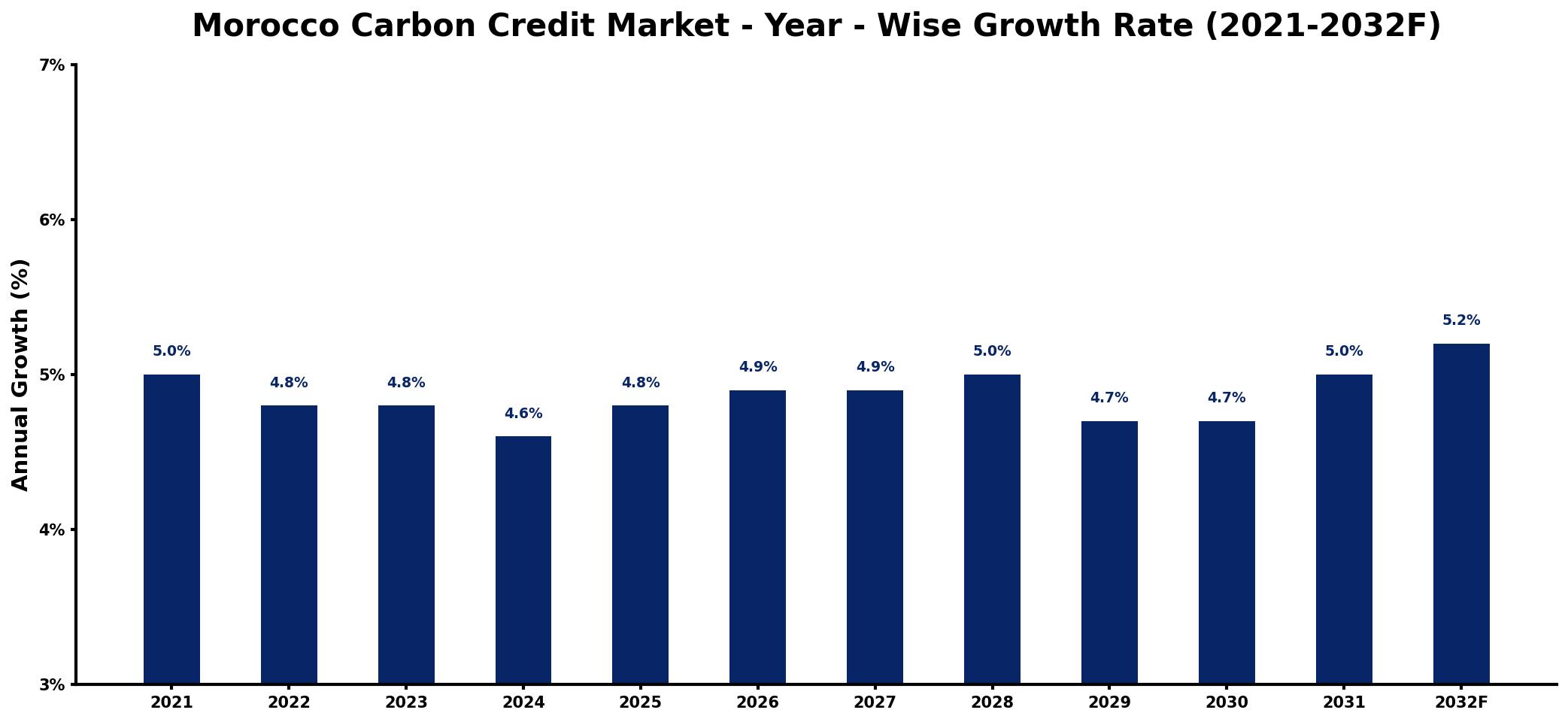
The table below presents the year‑wise growth rates along with the key drivers influencing the market
| Year | Growth Rate | Major Drivers |
| 2021 | 5.0% | Rising interest in sustainability initiatives |
| 2022 | 4.8% | Increased investment in renewable technologies |
| 2023 | 4.8% | Growing awareness of climate impacts |
| 2024 | 4.6% | Expansion of regulatory frameworks supporting |
| 2025 | 4.8% | Higher corporate sustainability commitments |
| 2026 | 4.9% | Emergence of innovative financing solutions |
| 2027 | 4.9% | Development of local environmental projects |
| 2028 | 5.0% | Strengthened partnerships with NGOs |
| 2029 | 4.7% | Boost in green technology adoption |
| 2030 | 4.7% | Enhanced public-private collaboration efforts |
| 2031 | 5.0% | Wider acceptance of environmental standards |
| 2032 | 5.2% | Surge in international funding opportunities |
Note: Market size estimations and growth projections presented in this report are based on 6Wresearch's proprietary forecasting methodology, utilizing the latest available industry data, government publications, and primary research inputs.
Morocco Carbon Credit Market Synopsis
The Morocco Carbon Credit Market is emerging as a significant player in the global carbon trading landscape. As a proactive signatory of the Paris Agreement, Morocco is taking meaningful steps toward reducing its greenhouse gas emissions and fostering a sustainable economic environment through renewable energy initiatives.
Recent developments in the market highlight a growing interest from both domestic and international entities in purchasing carbon credits. The focus on clean energy projects and enhanced financing options is set to create a thriving ecosystem that supports sustainable development while offering attractive investment opportunities.
Morocco Carbon Credit Market Key Takeaways
- The Morocco Carbon Credit Market is projected to grow from USD 241 Million in 2025 to USD 320 Million by 2032.
- A significant increase in renewable energy projects is fueling demand for carbon credits.
- Corporate entities are increasingly seeking carbon credits to demonstrate their commitment to sustainability.
- Efforts are underway to enhance transparency and standardization in carbon credit certification processes.
- Morocco's strategic geographical position offers an avenue for international investments in carbon offset projects.
Evaluation of Restraints in Morocco Carbon Credit Market
Despite its promising outlook, the Morocco Carbon Credit Market faces several challenges that could impede its growth. The absence of clear regulatory frameworks creates an environment of uncertainty, which may deter potential investors and project developers. Additionally, awareness surrounding the benefits of carbon credits remains limited, requiring concerted efforts in education and outreach to fully realize their potential in sustainable development. Access to financing and technology for carbon reduction projects also remains a barrier, complicating the landscape for stakeholders. Addressing these issues is essential for maximizing the market's impact on emissions reduction.
Morocco Carbon Credit Market Trends
The Morocco Carbon Credit Market is characterized by several emerging trends shaping its future. The rise of innovative renewable energy projects, particularly in solar and wind, is driving an increasing demand for carbon credits as these projects seek to capitalize on their sustainable practices. Additionally, as corporate social responsibility takes center stage, more businesses are engaging in carbon credit purchases as part of their environmental strategies. The market is also trending toward improved transparency and standardization in carbon credit certification, which is vital for ensuring trust and credibility among stakeholders.
Morocco Carbon Credit Market Opportunities
Investors are presented with substantial opportunities in the Morocco Carbon Credit Market, particularly as the nation continues its transition to a greener economy. The demand for carbon credits is poised to grow, driven by projects focused on renewable energy, energy efficiency, and sustainable agriculture. Furthermore, Morocco's unique positioning as a conduit between Europe and Africa enhances its appeal as an investment destination. The market is ripe for investments that not only promise financial returns but also contribute to significant environmental benefits.
Government Initiatives in the Morocco Carbon Credit Market
The Moroccan government has initiated various programs to foster the growth of the Carbon Credit Market. Policies such as the National Strategy for Sustainable Development are designed to reduce greenhouse gas emissions while promoting renewable energy sources. As a signatory of the Paris Agreement, Morocco remains committed to implementing strategies that align with global climate goals. Additionally, the establishment of the Moroccan Agency for Energy Efficiency aims to oversee and promote clean technology projects. The National Fund for Climate Change further supports initiatives that enhance carbon reduction efforts, showcasing the government's dedication to a sustainable future.
Future Insights of the Morocco Carbon Credit Market
Looking ahead to 2026-2032, the Morocco Carbon Credit Market is expected to witness significant growth driven by ongoing advancements in renewable energy initiatives and increasing corporate responsibility toward emissions reductions. With ambitious goals for expanding renewable energy capacity, particularly in solar and wind, the demand for carbon credits is likely to rise. Furthermore, Morocco's strategic location is anticipated to attract international investments, positioning the market favorably in the broader context of global carbon trading.
Morocco Carbon Credit Market Latest Developments (2025 - 2026)
Recent industry trends indicate that Morocco is actively enhancing its carbon credit trading mechanisms. Efforts are being made to streamline the certification processes for carbon credits, ensuring a more transparent and standardized approach. Additionally, various renewable energy projects are being launched, further supporting the market's growth and bolstering investor confidence. Corporate entities are showing increased interest in carbon offsetting strategies, aligning their business objectives with sustainability goals.
Morocco Carbon Credit Market - Key Attractiveness of the Report
- 10 Years of Market Numbers
- Historical Data Starting from 2022 to 2025
- Base Year: 2025
- Forecast Data until 2032
- Key Performance Indicators Impacting the Market
- Major Upcoming Developments and Projects
Key Highlights of the Report:
- Morocco Carbon Credit Market Outlook
- Market Size of Morocco Carbon Credit Market, 2025
- Forecast of Morocco Carbon Credit Market, 2032
- Historical Data and Forecast of Morocco Carbon Credit Revenues & Volume for the Period 2022-2032F
- Morocco Carbon Credit Market Trend Evolution
- Morocco Carbon Credit Market Drivers and Challenges
- Morocco Carbon Credit Price Trends
- Morocco Carbon Credit Porter's Five Forces
- Morocco Carbon Credit Industry Life Cycle
- Historical Data and Forecast of Morocco Carbon Credit Market Revenues & Volume By Sector for the Period 2022-2032F
- Historical Data and Forecast of Morocco Carbon Credit Market Revenues & Volume By Energy for the Period 2022-2032F
- Historical Data and Forecast of Morocco Carbon Credit Market Revenues & Volume By Transportation for the Period 2022-2032F
- Historical Data and Forecast of Morocco Carbon Credit Market Revenues & Volume By Residential And Commercial Buildings for the Period 2022-2032F
- Historical Data and Forecast of Morocco Carbon Credit Market Revenues & Volume By Industry for the Period 2022-2032F
- Historical Data and Forecast of Morocco Carbon Credit Market Revenues & Volume By Agriculture for the Period 2022-2032F
- Historical Data and Forecast of Morocco Carbon Credit Market Revenues & Volume By Forestry for the Period 2022-2032F
- Historical Data and Forecast of Morocco Carbon Credit Market Revenues & Volume By Water And Wastewater for the Period 2022-2032F
- Morocco Carbon Credit Import Export Trade Statistics
- Market Opportunity Assessment By Sector
- Morocco Carbon Credit Top Companies Market Share
- Morocco Carbon Credit Competitive Benchmarking By Technical and Operational Parameters
- Morocco Carbon Credit Company Profiles
- Morocco Carbon Credit Key Strategic Recommendations






































