Morocco Cargo Shipping Market Size, Share & Growth Rate
The Morocco Cargo Shipping Market was estimated at USD 1081 Million in 2025 and is projected to reach USD 1541 Million by 2032, growing at a CAGR of 5.2% from 2026 to 2032. This positive trajectory is largely attributed to Morocco's advantageous geographical position, which facilitates efficient trade routes between Europe, Africa, and the Americas. Coupled with significant investments in port infrastructure and the rising demand from various industries, the market is poised for robust expansion over the next several years.
Morocco Cargo Shipping Market Year-wise Growth Rate and Key Drivers
This graph highlights how the Morocco Cargo Shipping Market has steadily grown over the years, supported by major growth factors.
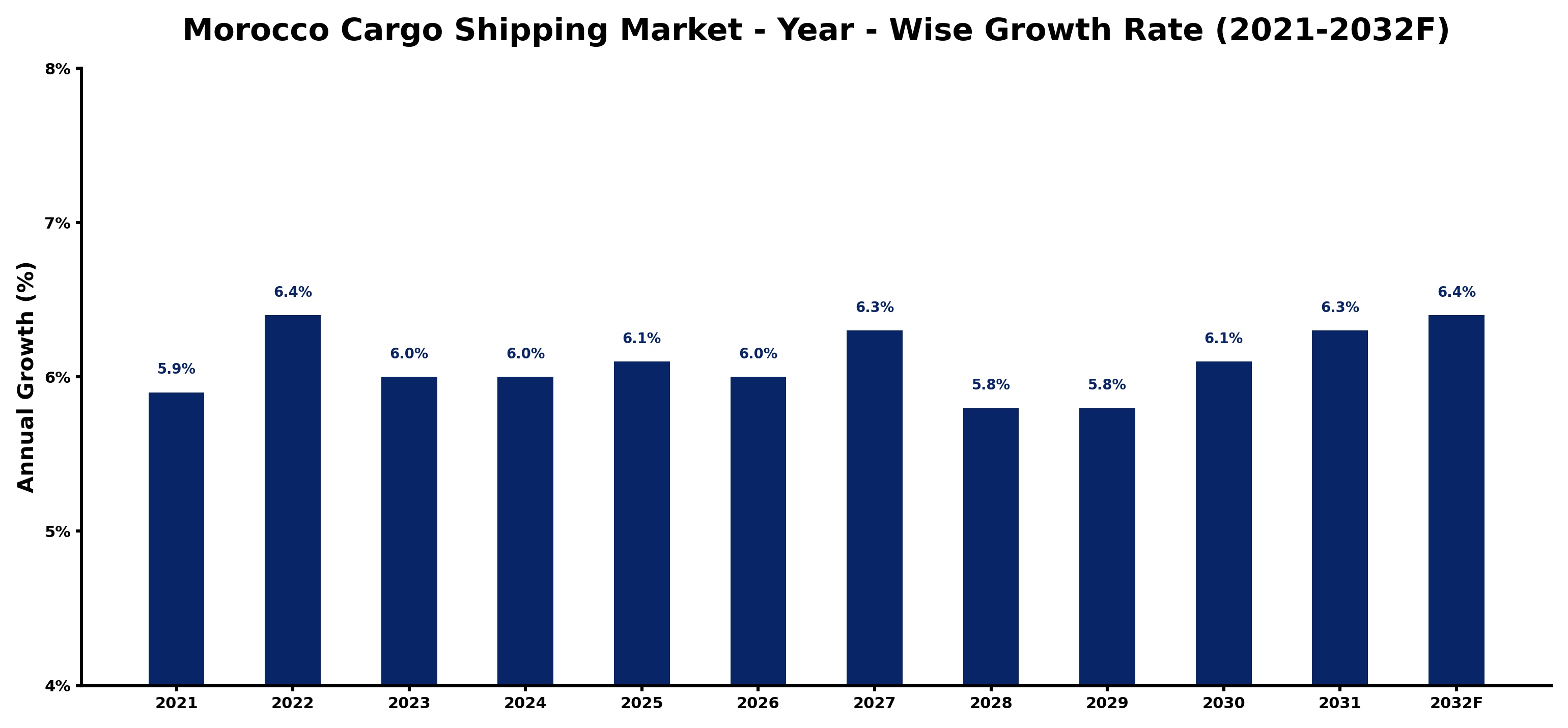
The table below presents the year‑wise growth rates along with the key drivers influencing the market
| Year | Growth Rate | Major Drivers |
| 2021 | 5.9% | Increasing industrial infrastructure investments |
| 2022 | 6.4% | Increasing smart city development projects |
| 2023 | 6.0% | Expansion of manufacturing activities |
| 2024 | 6.0% | Rising electricity demand across industries |
| 2025 | 6.1% | Increasing adoption of advanced technologies |
| 2026 | 6.0% | Rapid growth in telecom and data center sectors |
| 2027 | 6.3% | Increasing adoption of advanced technologies |
| 2028 | 5.8% | Increasing adoption of advanced technologies |
| 2029 | 5.8% | Increasing smart city development projects |
| 2030 | 6.1% | Expansion of commercial construction activities |
| 2031 | 6.3% | Expansion of commercial construction activities |
| 2032 | 6.4% | Rising electricity demand across industries |
Note - Market size estimations and growth projections presented in this report are based on 6Wresearch's advanced forecasting approach, validated with industry datasets as of June 2026.
Morocco Cargo Shipping Market Synopsis
The Morocco cargo shipping market has gained considerable momentum in recent years, driven by increasing trade volumes and strategic governmental initiatives. However, despite the positive growth indicators, there remain concerns about infrastructure bottlenecks and competitive pressures from neighboring ports. With ongoing investments and strategic planning, the market appears set to navigate these challenges successfully.
As a crucial logistics hub in Africa, Morocco is making strides to enhance its cargo shipping capabilities. Current trends suggest a focus on modernizing port facilities and improving customs procedures, which are essential for sustaining market growth and attracting international shipping lines.
Morocco Cargo Shipping Market Key Takeaways
- Strategic geographic location enhances Morocco's role as a key logistics hub.
- Significant government investments in port infrastructure are underway to boost capacity.
- Growing e-commerce sector is driving demand for efficient cargo shipping services.
- Regulatory frameworks are evolving to streamline customs procedures and compliance.
- Competitive pressures require continuous innovation and improvement in logistics services.
Evaluation of Restraints in Morocco Cargo Shipping Market
Despite its promising growth, the Morocco cargo shipping market faces notable restraints that could limit its potential. Key among these is the inadequate capacity of existing port infrastructure, which can create delays and inefficiencies in cargo movement. Additionally, fierce competition from neighboring ports, each vying for international shipping traffic, presents another layer of complexity. Regulatory compliance adds to the operational burden, requiring companies to invest in technological solutions and staff training to meet international standards.
Morocco Cargo Shipping Market Trends
The cargo shipping market in Morocco is experiencing trends that emphasize technological innovation and sustainability. Increased adoption of digital solutions, such as blockchain for enhanced transparency in shipping operations, is gaining traction. Moreover, a growing emphasis on environmentally-friendly practices is pushing shipping companies to explore greener technologies and alternative fuels, aligning with global trends towards sustainability.
Morocco Cargo Shipping Market Opportunities
Significant opportunities lie ahead in the Morocco cargo shipping market, particularly in expanding free trade agreements that facilitate smoother cross-border transactions. The rise of the e-commerce sector offers a compelling growth avenue, as businesses seek reliable shipping solutions to meet consumer demand. Additionally, continued modernization of port facilities presents investment opportunities for private companies looking to capitalize on the evolving logistics landscape.
Government Initiatives in the Morocco Cargo Shipping Market
The Moroccan government has implemented several initiatives aimed at bolstering the cargo shipping market. Key policies focus on enhancing port infrastructure and modernizing facilities to accommodate larger vessels and increased cargo volumes. Regulatory frameworks have also been streamlined to expedite customs processes, reducing turnaround times for shipping companies. Incentives such as tax breaks and subsidies are being offered to encourage shipping companies to utilize Moroccan ports, promoting economic growth and trade.
Future Insights of the Morocco Cargo Shipping Market
Looking forward to 2026-2032, the Morocco cargo shipping market is set to experience sustained growth, driven by increasing international trade and strategic government initiatives. The focus on upgrading port facilities will enhance capacity and efficiency, addressing current infrastructural challenges. As Morocco continues to position itself as a logistics hub, the integration of innovative technologies and greener practices will likely redefine operational efficiencies and sustainability in the sector, attracting further investment and fostering growth.
Morocco Cargo Shipping Market Latest Developments (May 2025 - June 2026)
Recent developments in the Morocco cargo shipping market have focused on infrastructure upgrades and the adoption of advanced technologies. The government has announced several modernization projects targeting major ports, aiming to enhance their capacity and operational efficiency. Additionally, shipping companies are increasingly exploring collaborations with technology providers to implement digital solutions that streamline logistics processes and improve service delivery. These efforts reflect a commitment to positioning Morocco as a competitive player in the global shipping landscape.
Morocco Cargo Shipping Market - Key Attractiveness of the Report
- 10 Years of Market Numbers
- Historical Data Starting from 2022 to 2025
- Base Year: 2025
- Forecast Data until 2032
- Key Performance Indicators Impacting the Market
- Major Upcoming Developments and Projects
Key Highlights of the Report:
- Morocco Cargo Shipping Market Outlook
- Market Size of Morocco Cargo Shipping Market, 2025
- Forecast of Morocco Cargo Shipping Market, 2032
- Historical Data and Forecast of Morocco Cargo Shipping Revenues & Volume for the Period 2022-2032F
- Morocco Cargo Shipping Market Trend Evolution
- Morocco Cargo Shipping Market Drivers and Challenges
- Morocco Cargo Shipping Price Trends
- Morocco Cargo Shipping Porter's Five Forces
- Morocco Cargo Shipping Industry Life Cycle
- Historical Data and Forecast of Morocco Cargo Shipping Market Revenues & Volume By Cargo Infrastructure for the Period 2022-2032F
- Historical Data and Forecast of Morocco Cargo Shipping Market Revenues & Volume By Port Developments in Asia for the Period 2022-2032F
- Historical Data and Forecast of Morocco Cargo Shipping Market Revenues & Volume By Port Developments in Europe for the Period 2022-2032F
- Historical Data and Forecast of Morocco Cargo Shipping Market Revenues & Volume By Port Developments in North America for the Period 2022-2032F
- Historical Data and Forecast of Morocco Cargo Shipping Market Revenues & Volume By Port Developments in South America for the Period 2022-2032F
- Historical Data and Forecast of Morocco Cargo Shipping Market Revenues & Volume By Port Developments in Africa for the Period 2022-2032F
- Historical Data and Forecast of Morocco Cargo Shipping Market Revenues & Volume By Cargo Type for the Period 2022-2032F
- Historical Data and Forecast of Morocco Cargo Shipping Market Revenues & Volume By Container Cargo for the Period 2022-2032F
- Historical Data and Forecast of Morocco Cargo Shipping Market Revenues & Volume By Bulk Cargo for the Period 2022-2032F
- Historical Data and Forecast of Morocco Cargo Shipping Market Revenues & Volume By General Cargo for the Period 2022-2032F
- Historical Data and Forecast of Morocco Cargo Shipping Market Revenues & Volume By Oil & Gas for the Period 2022-2032F
- Historical Data and Forecast of Morocco Cargo Shipping Market Revenues & Volume By Industry Type for the Period 2022-2032F
- Historical Data and Forecast of Morocco Cargo Shipping Market Revenues & Volume By Food, Manufacturing for the Period 2022-2032F
- Historical Data and Forecast of Morocco Cargo Shipping Market Revenues & Volume By Oil & Ores for the Period 2022-2032F
- Historical Data and Forecast of Morocco Cargo Shipping Market Revenues & Volume By Electrical & Electronics for the Period 2022-2032F
- Morocco Cargo Shipping Import Export Trade Statistics
- Market Opportunity Assessment By Cargo Infrastructure
- Market Opportunity Assessment By Cargo Type
- Market Opportunity Assessment By Industry Type
- Morocco Cargo Shipping Top Companies Market Share
- Morocco Cargo Shipping Competitive Benchmarking By Technical and Operational Parameters
- Morocco Cargo Shipping Company Profiles
- Morocco Cargo Shipping Key Strategic Recommendations






































