Morocco Certificate Authority Market Size & Growth Rate (2026-2032)
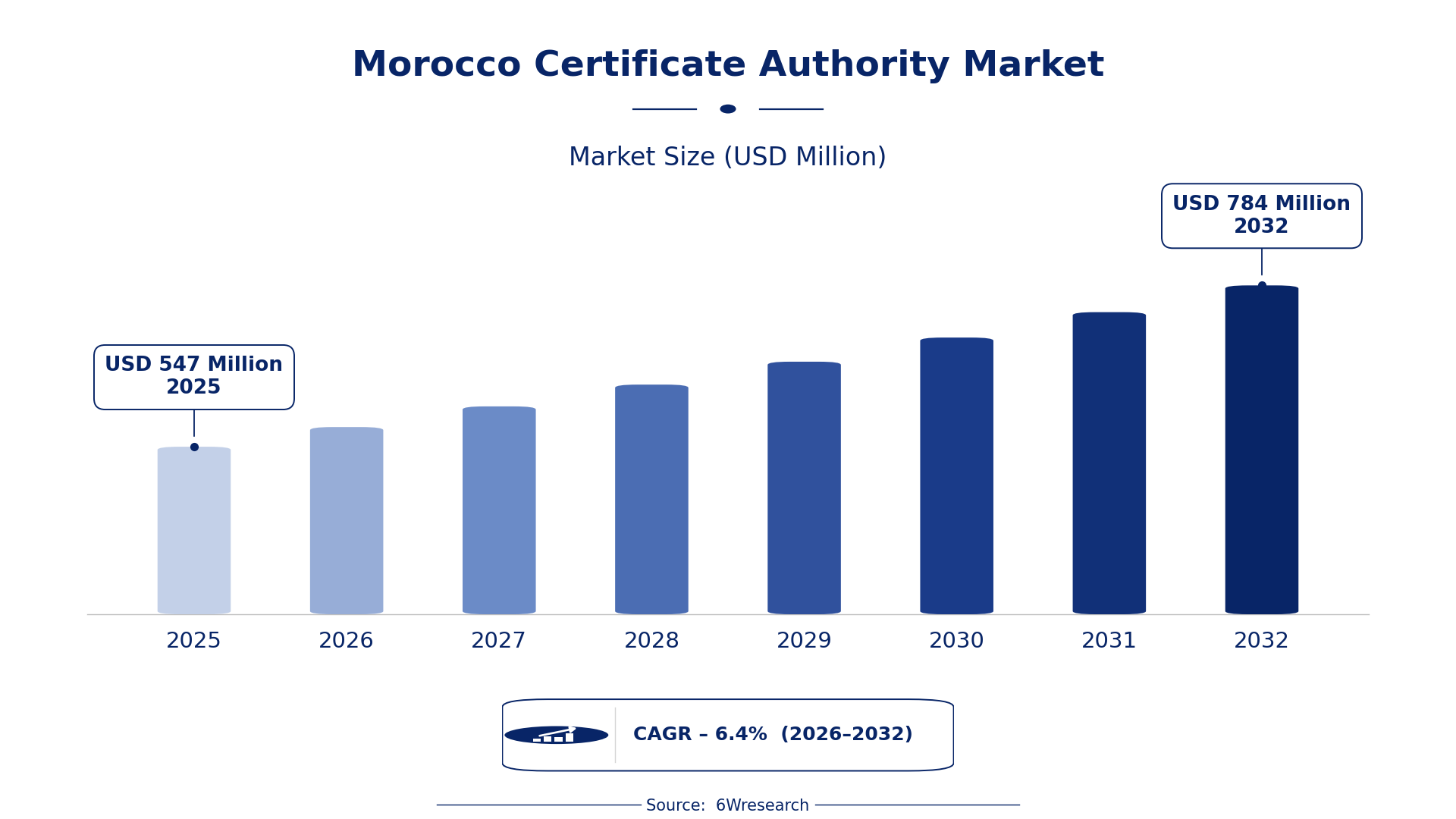
The Morocco Certificate Authority Market was estimated at USD 547 Million in 2025 and is projected to reach USD 784 Million by 2032, growing at a CAGR of 6.4% from 2026 to 2032.
Morocco Certificate Authority Market Synopsis
The surge in digital transactions and an increasing focus on cybersecurity are the primary forces currently shaping the Morocco Certificate Authority market. As businesses and consumers alike move toward online services, the demand for digital certificates to secure identities and transactions has never been more critical.
In this environment, the role of Certificate Authorities becomes indispensable. They ensure the authenticity of digital interactions, thereby building trust in e-commerce and online banking. The rise of government digital services only amplifies this demand, driving market growth as organizations seek reliable solutions to meet evolving security expectations.
Morocco Certificate Authority Market Year-wise Growth Rate and Key Drivers
This graph illustrates the annual growth rates of the Morocco Certificate Authority Market from 2021 to 2032, highlighting a steady upward trajectory and projected expansion over the forecast period.
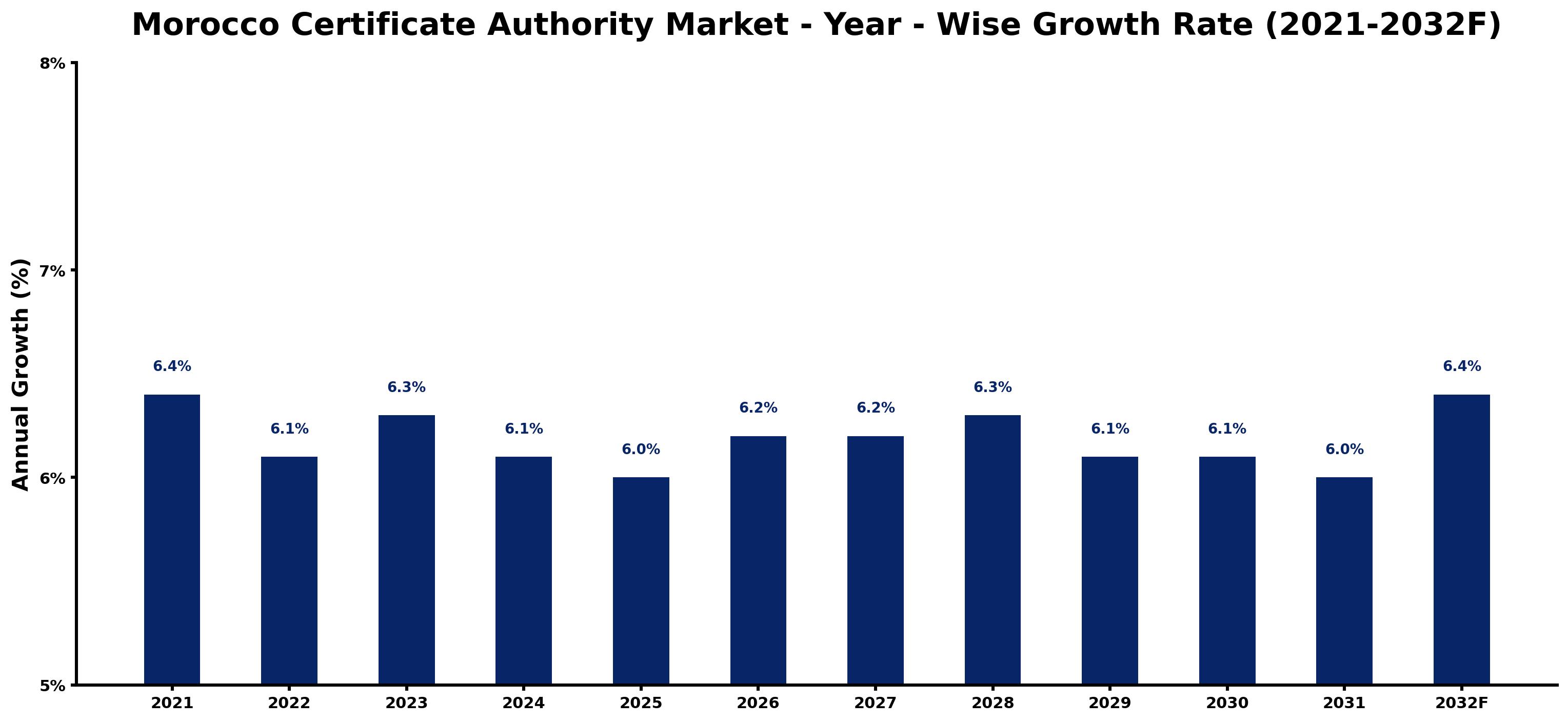
The table below presents the year‑wise growth rates along with the key drivers influencing the market
| Year | Growth Rate | Major Drivers |
| 2021 | 6.4% | National cybersecurity strategy boosts trust in digital transactions. |
| 2022 | 6.1% | Public sector digitalization initiative calls for secure identities. |
| 2023 | 6.3% | Rise in e-commerce drives need for secure online transactions. |
| 2024 | 6.1% | Increased smartphone penetration leads to online identity management. |
| 2025 | 6.0% | Awareness campaigns promote digital certificates in businesses. |
| 2026 | 6.2% | Government mandates compliance for electronic document verification. |
| 2027 | 6.2% | Growth in remote work accelerates demand for cybersecurity solutions. |
| 2028 | 6.3% | Increased foreign investment necessitates secure digital transactions. |
| 2029 | 6.1% | Educational institutions adopting secure online assessment platforms. |
| 2030 | 6.1% | Local startups require compliance for digital identity management. |
| 2031 | 6.0% | Regulatory push for stronger digital identity verification methods. |
| 2032 | 6.4% | Expanding digital services necessitate robust certificate authorities. |
Note: Market size estimations and growth projections presented in this report are based on 6Wresearch's proprietary forecasting methodology, utilizing the latest available industry data, government publications, and primary research inputs.
Morocco Certificate Authority Market Key Takeaways
Below are some of the specific key takeaways from the market, including:
- The market is experiencing an increasing need for digital certificates, particularly due to the growth of e-commerce.
- Advanced security solutions like Extended Validation certificates are becoming more sought after for enhancing online transaction safety.
- Compliance with strict data protection regulations is driving higher demand for SSL/TLS certificates.
- Investment in cybersecurity is prioritizing data privacy, leading to market expansion opportunities.
- Continuous innovation in digital certificate offerings is vital to meet specific business requirements.
Evaluation of Restraints in Morocco Certificate Authority Market
Despite promising growth, the Morocco Certificate Authority market is not without its challenges. Heightened competition from domestic and international entities is pushing providers to innovate continually. Additionally, evolving regulatory requirements demand that Certificate Authorities stay agile while maintaining compliance with data protection laws. Building trust in this relatively nascent market remains a hurdle, particularly as customers become increasingly cautious about online security. Coupled with escalating cyber threats, these factors create an environment where Certificate Authorities must constantly adapt to survive and thrive.
Morocco Certificate Authority Market Trends
A shift toward sophisticated security solutions is markedly impacting the Morocco Certificate Authority market. Extended Validation certificates are gaining traction, driven by organizations seeking to enhance customer trust in digital interactions. on top of that, regulatory compliance is becoming a dominant force, with many businesses prioritizing SSL/TLS certificates to protect sensitive data during online transactions. There’s also a growing trend towards offering customized solutions, such as multi-domain and wildcard certificates, which align with the unique needs of enterprises.
Morocco Certificate Authority Market Opportunities
Investment prospects in the Morocco Certificate Authority market are robust. With an increasing reliance on digital platforms, businesses are actively seeking reliable authentication solutions. The burgeoning e-commerce sector, coupled with governmental pushes for digital transformation, provides fertile ground for growth. Opportunities exist not only in providing traditional certificates but also in developing tailored services that address specific client needs. By fostering partnerships with local firms and focusing on technological enhancements, businesses can capitalize on this expanding market.
Government Initiatives in the Morocco Certificate Authority Market
Government policies in Morocco are pivotal in shaping the Certificate Authority market, driving efforts to enhance security and build public trust in digital transactions. The Agence Nationale de Réglementation des Télécommunications (ANRT) oversees the issuance of licenses for Certificate Authorities, ensuring that they adhere to rigorous security standards and data protection laws. As Morocco pursues digital transformation, these regulations play a vital role in fortifying the cybersecurity framework.
- A regulatory framework established in 2025 mandates strict compliance for Certificate Authorities to align with international security standards.
- A national digital infrastructure upgrade program is currently underway, aimed at enhancing the overall cybersecurity landscape.
- The government has launched an initiative in early 2026 to promote public awareness around cybersecurity, crucial for increasing trust in digital services.
- A planned review of data protection regulations is expected by mid-2027, which will further refine the operational frameworks for Certificate Authorities.
Future Insights of the Morocco Certificate Authority Market
The Morocco Certificate Authority market is on a trajectory toward significant growth in the coming years. As the digital economy flourishes, the need for secure online communications will escalate, fueling demand for digital certificates. Regulatory advancements aimed at enhancing cybersecurity practices across both public and private sectors will further galvanize market expansion. With e-commerce, online banking, and digital services continuing to evolve, Certificate Authorities will find ample opportunities for innovation and growth.
Morocco Certificate Authority Market Latest Developments
Recent months have witnessed dynamic activity within the Morocco Certificate Authority market, reflecting a landscape that prioritizes innovation and security. As businesses and government entities adapt to new digital realities, Certificate Authorities are stepping up their efforts to deliver reliable services. This trend is marked by new partnerships, technology upgrades, and expanded offerings aimed at meeting the evolving needs of clients.
- A major technology vendor initiated a service upgrade in Q1 2026, enhancing the security features of their SSL/TLS certificates.
- An ongoing collaboration between a regional operator and a cybersecurity firm aims to deliver advanced multi-domain certificates by late 2026.
- A recent certificate issuance protocol was launched in early 2025, streamlining processes for digital certificates in public sector transactions.
- A planned rollout of enhanced authentication services is expected to commence in the second half of 2026, targeting the needs of e-commerce businesses.
Morocco Certificate Authority Market - Key Attractiveness of the Report
- 10 Years of Market Numbers
- Historical Data Starting from 2022 to 2025
- Base Year: 2025
- Forecast Data until 2032
- Key Performance Indicators Impacting the Market
- Major Upcoming Developments and Projects
Key Highlights of the Report:
- Morocco Certificate Authority Market Outlook
- Market Size of Morocco Certificate Authority Market, 2025
- Forecast of Morocco Certificate Authority Market, 2032
- Historical Data and Forecast of Morocco Certificate Authority Revenues & Volume for the Period 2022-2032F
- Morocco Certificate Authority Market Trend Evolution
- Morocco Certificate Authority Market Drivers and Challenges
- Morocco Certificate Authority Price Trends
- Morocco Certificate Authority Porter's Five Forces
- Morocco Certificate Authority Industry Life Cycle
- Historical Data and Forecast of Morocco Certificate Authority Market Revenues & Volume By Component for the Period 2022-2032F
- Historical Data and Forecast of Morocco Certificate Authority Market Revenues & Volume By Certificate Types for the Period 2022-2032F
- Historical Data and Forecast of Morocco Certificate Authority Market Revenues & Volume By Services for the Period 2022-2032F
- Historical Data and Forecast of Morocco Certificate Authority Market Revenues & Volume By SSL Certification Validation Type for the Period 2022-2032F
- Historical Data and Forecast of Morocco Certificate Authority Market Revenues & Volume By Domain Validation for the Period 2022-2032F
- Historical Data and Forecast of Morocco Certificate Authority Market Revenues & Volume By Organization Validation for the Period 2022-2032F
- Historical Data and Forecast of Morocco Certificate Authority Market Revenues & Volume By Extended Validation for the Period 2022-2032F
- Historical Data and Forecast of Morocco Certificate Authority Market Revenues & Volume By Organization Size for the Period 2022-2032F
- Historical Data and Forecast of Morocco Certificate Authority Market Revenues & Volume By Large Enterprises for the Period 2022-2032F
- Historical Data and Forecast of Morocco Certificate Authority Market Revenues & Volume By SMEs for the Period 2022-2032F
- Historical Data and Forecast of Morocco Certificate Authority Market Revenues & Volume By Vertical for the Period 2022-2032F
- Historical Data and Forecast of Morocco Certificate Authority Market Revenues & Volume By BFSI for the Period 2022-2032F
- Historical Data and Forecast of Morocco Certificate Authority Market Revenues & Volume By Retail and eCommerce for the Period 2022-2032F
- Historical Data and Forecast of Morocco Certificate Authority Market Revenues & Volume By Government and Defense for the Period 2022-2032F
- Historical Data and Forecast of Morocco Certificate Authority Market Revenues & Volume By Healthcare and Life Sciences for the Period 2022-2032F
- Historical Data and Forecast of Morocco Certificate Authority Market Revenues & Volume By IT and Telecom for the Period 2022-2032F
- Historical Data and Forecast of Morocco Certificate Authority Market Revenues & Volume By Travel and Hospitality for the Period 2022-2032F
- Historical Data and Forecast of Morocco Certificate Authority Market Revenues & Volume By Education for the Period 2022-2032F
- Historical Data and Forecast of Morocco Certificate Authority Market Revenues & Volume By Other verticals (transportation and logistics, media and entertainment, and manufacturing) for the Period 2022-2032F
- Morocco Certificate Authority Import Export Trade Statistics
- Market Opportunity Assessment By Component
- Market Opportunity Assessment By SSL Certification Validation Type
- Market Opportunity Assessment By Organization Size
- Market Opportunity Assessment By Vertical
- Morocco Certificate Authority Top Companies Market Share
- Morocco Certificate Authority Competitive Benchmarking By Technical and Operational Parameters
- Morocco Certificate Authority Company Profiles
- Morocco Certificate Authority Key Strategic Recommendations






































