Morocco Cigarette Market Size, Share & Growth Rate
The Morocco Cigarette Market was estimated at USD 176 Million in 2025 and is projected to reach USD 233 Million by 2032, growing at a CAGR of 4.1% from 2026 to 2032. This growth trajectory is primarily driven by an increasing consumer demand for premium and flavored cigarettes, alongside a steady population of smokers who maintain their habits despite rising regulatory pressures. Additionally, the market's resilience is buoyed by a still-significant presence of illicit trade, which complicates the competitive landscape but also highlights the ongoing demand for tobacco products.
Morocco Cigarette Market Year-wise Growth Rate and Key Drivers
This graph highlights how the Morocco Cigarette Market has steadily grown over the years, supported by major growth factors.
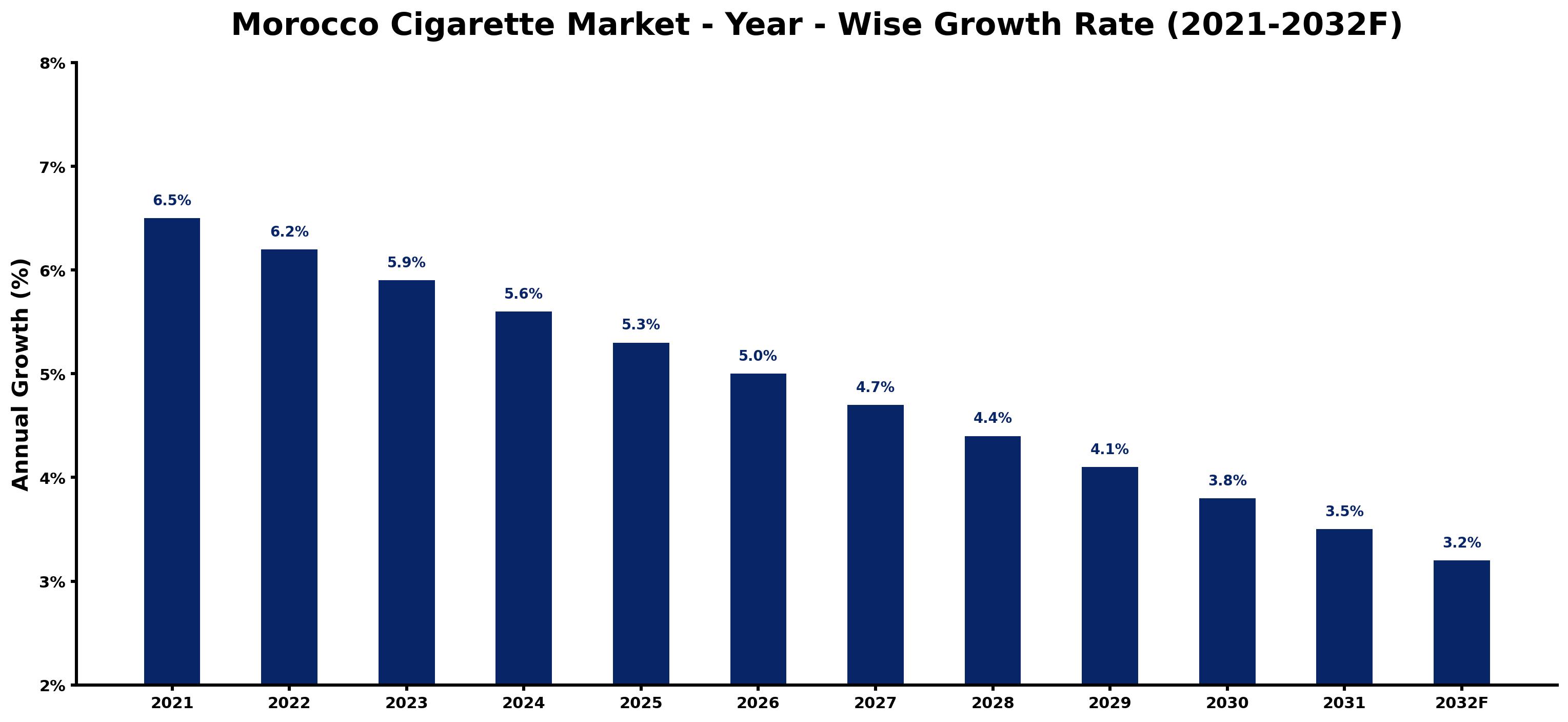
The table below presents the year‑wise growth rates along with the key drivers influencing the market
| Year | Growth Rate | Major Drivers |
| 2021 | 6.5% | Growing urbanization and commercial development |
| 2022 | 6.2% | Growing renewable energy integration projects |
| 2023 | 5.9% | Increasing industrial infrastructure investments |
| 2024 | 5.6% | Growing renewable energy integration projects |
| 2025 | 5.3% | Expansion of transportation and logistics networks |
| 2026 | 5.0% | Technology transition toward sustainable alternatives |
| 2027 | 4.7% | Increasing shift toward cleaner alternatives |
| 2028 | 4.4% | Declining investments in legacy infrastructure |
| 2029 | 4.1% | Environmental regulations reducing traditional demand |
| 2030 | 3.8% | Increasing shift toward cleaner alternatives |
| 2031 | 3.5% | Increasing shift toward cleaner alternatives |
| 2032 | 3.2% | Environmental regulations reducing traditional demand |
Note - Market size estimations and growth projections presented in this report are based on 6Wresearch’s advanced forecasting approach, validated with industry datasets as of June 2026.
Morocco Cigarette Market Synopsis
In recent years, the Moroccan cigarette market has witnessed a dynamic interplay of consumer preferences and regulatory interventions. While consumers increasingly gravitate towards premium offerings, the government has ramped up efforts to diminish tobacco use through stringent regulations and health campaigns.
This evolving environment signals a transformation, with tobacco companies adapting their strategies to navigate both consumer demands and regulatory challenges. The market is becoming more segmented, catering to diverse preferences while facing the complexities of the illicit tobacco trade.
Morocco Cigarette Market Key Takeaways
- The Moroccan cigarette market shows a clear trend toward premium and flavored products, reshaping the competitive landscape.
- Government regulations are increasingly focusing on public health, impacting advertising and consumption patterns.
- Illicit cigarette sales pose a notable challenge, affecting legitimate manufacturers' revenues.
- The market's anticipated growth reflects both resilience and adaptability amid changing consumer behaviors.
- Investors may find promising opportunities in niche segments and alternative tobacco products.
Evaluation of Restraints in Morocco Cigarette Market
Despite its potential for growth, the Morocco cigarette market is grappling with several key restraints. Heightened government regulations, particularly regarding advertising and smoking in public spaces, are significant factors. These measures aim to reduce smoking rates but also lead to a decline in consumption, directly impacting sales figures. The growing awareness of health risks associated with smoking has further influenced consumer choices, pushing many towards healthier alternatives and reducing overall cigarette demand. The flourishing black market for cigarettes complicates these challenges, undermining legitimate sales and eroding market confidence for established companies.
Morocco Cigarette Market Trends
Current trends within the Morocco cigarette market reveal a shift towards more sophisticated product offerings. Premium and flavored cigarettes are becoming more popular, reflecting changing lifestyles and increasing disposable incomes among consumers. The focus on unique smoking experiences is prompting tobacco companies to innovate in their product lines, enhancing packaging and branding strategies to appeal to a broader audience. Additionally, there is a noticeable interest in low-nicotine and electronic alternatives as consumers become more health-conscious.
Morocco Cigarette Market Opportunities
The Morocco cigarette market holds several lucrative investment opportunities, particularly in premium and niche segments. As consumers continue to seek innovative products, there is scope for manufacturers to introduce unique flavors and premium brands. Targeting specific demographics, such as young adults and women, can further enhance market share. Additionally, as the global trend shifts towards alternative tobacco products, investments in e-cigarettes and heat-not-burn devices may open new revenue streams for forward-thinking investors.
Government Initiatives in the Morocco Cigarette Market
The Moroccan government has enacted various initiatives aimed at regulating tobacco consumption and promoting public health. Stricter advertising regulations, graphic health warnings on packaging, and increased taxation on tobacco products are among the measures taken to discourage smoking. In alignment with international health frameworks, the government has committed to comprehensive tobacco control strategies, reflecting a broader effort to create a tobacco-free environment. These initiatives are expected to continue shaping market dynamics in the coming years.
Future Insights of the Morocco Cigarette Market
Looking ahead to 2026-2032, the Morocco cigarette market is likely to navigate a challenging landscape characterized by stringent health regulations and evolving consumer preferences. While a gradual decline in traditional cigarette consumption is anticipated, the market may witness some resilience in premium and flavored segments. The potential growth of alternative tobacco products also presents a noteworthy avenue for expansion, as health consciousness among consumers drives interest in these innovative solutions. Overall, while challenges persist, opportunities for adaptation and growth are evident.
Morocco Cigarette Market Latest Developments (May 2025 - June 2026)
Recent developments in the Moroccan cigarette market indicate a continued focus on innovation and regulatory compliance. Companies are increasingly prioritizing the introduction of unique flavors and premium products to attract discerning consumers. Concurrently, efforts to curb illicit tobacco trade remain a critical focus for regulators, with ongoing initiatives aimed at enhancing enforcement and transparency in the legal market. The overall direction suggests a gradual adaptation to both consumer demands and regulatory environments.
Morocco Cigarette Market - Key Attractiveness of the Report
- 10 Years of Market Numbers
- Historical Data Starting from 2022 to 2025
- Base Year: 2025
- Forecast Data until 2032
- Key Performance Indicators Impacting the Market
- Major Upcoming Developments and Projects
Key Highlights of the Report:
- Morocco Cigarette? Market Outlook
- Market Size of Morocco Cigarette? Market, 2025
- Forecast of Morocco Cigarette? Market, 2032
- Historical Data and Forecast of Morocco Cigarette? Revenues & Volume for the Period 2022-2032F
- Morocco Cigarette? Market Trend Evolution
- Morocco Cigarette? Market Drivers and Challenges
- Morocco Cigarette? Price Trends
- Morocco Cigarette? Porter's Five Forces
- Morocco Cigarette? Industry Life Cycle
- Historical Data and Forecast of Morocco Cigarette? Market Revenues & Volume By Type for the Period 2022-2032F
- Historical Data and Forecast of Morocco Cigarette? Market Revenues & Volume By Light for the Period 2022-2032F
- Historical Data and Forecast of Morocco Cigarette? Market Revenues & Volume By Medium for the Period 2022-2032F
- Historical Data and Forecast of Morocco Cigarette? Market Revenues & Volume By Others for the Period 2022-2032F
- Historical Data and Forecast of Morocco Cigarette? Market Revenues & Volume By Distribution Channel for the Period 2022-2032F
- Historical Data and Forecast of Morocco Cigarette? Market Revenues & Volume By Tobacco Shops for the Period 2022-2032F
- Historical Data and Forecast of Morocco Cigarette? Market Revenues & Volume By Supermarket and Hypermarkets for the Period 2022-2032F
- Historical Data and Forecast of Morocco Cigarette? Market Revenues & Volume By Convenience Stores for the Period 2022-2032F
- Historical Data and Forecast of Morocco Cigarette? Market Revenues & Volume By Online Stores for the Period 2022-2032F
- Historical Data and Forecast of Morocco Cigarette? Market Revenues & Volume By Others for the Period 2022-2032F
- Morocco Cigarette? Import Export Trade Statistics
- Market Opportunity Assessment By Type
- Market Opportunity Assessment By Distribution Channel
- Morocco Cigarette? Top Companies Market Share
- Morocco Cigarette? Competitive Benchmarking By Technical and Operational Parameters
- Morocco Cigarette? Company Profiles
- Morocco Cigarette? Key Strategic Recommendations






































