Morocco Cybersecurity Market Growth Rate
According to 6Wresearch internal databases and industry insights, the Morocco Cybersecurity Market is projected to expand at a steady compound annual growth rate (CAGR) of 8.7% during the forecast period 2026–2032.
Morocco Cybersecurity Market Year-wise Growth Rate and Key Drivers (2022–2032)
This graph illustrates the annual growth rates of the Morocco Cybersecurity Market from 2022 to 2032, highlighting a steady upward trajectory and projected market expansion over the forecast period.
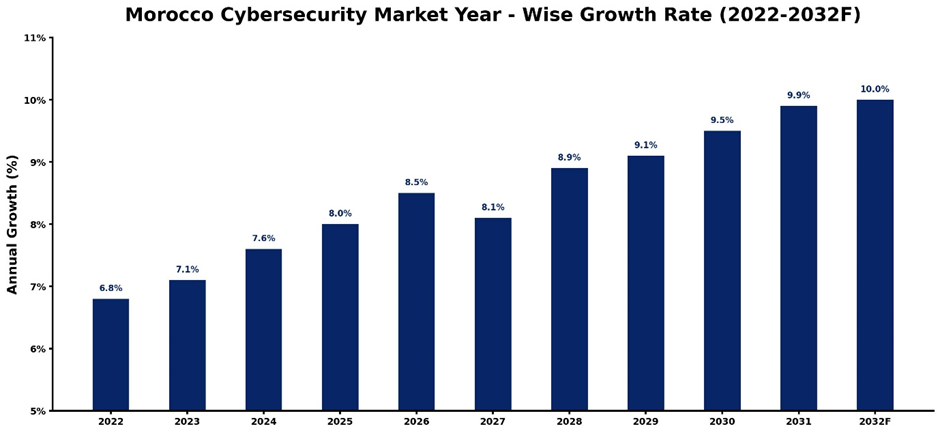
The following table summarizes the historical and forecasted growth rates of the Morocco Cybersecurity Market, along with the rationale behind each year’s performance.
| Year | Estimated Growth (%) | Market Rationale |
| 2022 | 6.8% | Growth was supported by increasing adoption of digital banking, remote working models, and initial cybersecurity upgrades among enterprises. |
| 2023 | 7.1% | Rising ransomware threats and increased awareness of data protection encouraged organizations to invest in network security solutions. |
| 2024 | 7.6% | Expansion of cloud adoption, e-government services, and cybersecurity compliance requirements accelerated market demand. |
| 2025 | 8% | Organizations increased spending on advanced security platforms, threat intelligence, and managed security services. |
| 2026 | 8.5% | Growth is driven by stronger cybersecurity requirements in BFSI, government, and telecommunications sectors. |
| 2027 | 8.1% | Increased adoption of AI-powered security tools and identity access management solutions supports market expansion. |
| 2028 | 8.9% | Enterprise digital transformation and rising IoT deployment contribute to higher cybersecurity investments. |
| 2029 | 9.1% | Demand for cloud security and infrastructure protection solutions increases due to expanding digital ecosystems. |
| 2030 | 9.5% | Cyber resilience initiatives and compliance-driven security spending strengthen market growth. |
| 2031 | 9.9% | Advanced threat detection, automation, and managed security services gain wider adoption. |
| 2032 | 10% | Mature cybersecurity adoption across industries sustains long-term market growth. |
Topics Covered in the Morocco Cybersecurity Market Report
The Morocco Cybersecurity Industry Report provides a detailed assessment of market development by security type, deployment, and end-user. The report evaluates cybersecurity adoption trends, investment opportunities, regulatory developments, emerging technologies, and key growth areas influencing future market expansion.
Morocco Cybersecurity Market Highlights
| Report Name | Morocco Cybersecurity Market |
| Forecast period | 2026-2032 |
| CAGR | 8.7% |
| Growing Sector | Cloud Security |
· Morocco Cybersecurity Market Synopsis
The Morocco Cybersecurity Market is experiencing steady growth due to increasing digital transformation initiatives, rising cyber threats, and the growing adoption of cloud computing, IoT, and connected technologies across industries. Organizations in Morocco are investing in advanced cybersecurity solutions to protect sensitive data, strengthen network security, and comply with evolving data protection regulations. Government initiatives focused on digitalization, cybersecurity frameworks, and critical infrastructure protection are further supporting Morocco cybersecurity market growth.
Evaluation of Growth Drivers in Morocco Cybersecurity Market (2026–2032)
Below are some major drivers influencing the Morocco Cybersecurity Market:
| Drivers | Primary Segment Affected | Why It Matters (Evidence) |
| Expansion of Digital Government Services | Government and Defence | With more public services being online, the need to protect citizen data and government networks increases rapidly. |
| Rising Cyber Threat Occurrences | BFSI & Enterprises | Ransomware, phishing and data breaches are rising in number, which is driving more investment in cybersecurity. |
| Cloud Adoption Across Businesses | Cloud Security | With workloads shifting to cloud platforms, the demand for cloud monitoring and protection solutions is growing. |
| Increasing Data Protection Requirements | Data Security | Companies are accelerating encryption and compliance systems to protect sensitive data. |
| Growth of Managed Security Services | IT & Telecommunications | A shortage of skilled security professionals is forcing companies to outsource their cybersecurity operations. |
The Morocco Cybersecurity Market is projected to grow at a CAGR of 8.7% during the forecast period of 2026–2032, driven by an increased cyber risk exposure, digital transformation programs, and rising adoption of advanced security technologies. Government agencies, financial institutions, and telecom operators are expected to be the key contributors of the market expansion, owing to their critical infrastructure requirements.
Evaluation of Restraints in Morocco Cybersecurity Market
Below are some major restraints and their influence on the market dynamics:
| Restraints | Primary Segment Affected | What This Means (Evidence) |
| Shortage of Skilled Professionals | Workforce Development | Limited availability of trained cybersecurity experts affects implementation and monitoring capabilities. |
| High Cost of Developed Security Solutions | SMEs & Enterprises | Small- scale enterprises face difficulties in adopting premium cybersecurity platforms due to budget restrictions. |
| Limited Cybersecurity Awareness | SMEs & Consumers | Lack of awareness increases the possibilities of phishing and social engineering attacks. |
| Dependency on Imported Technologies | Government & Commercial Users | Reliance on international cybersecurity vendors result in surging costs and implementation complexity. |
| Integration Challenges with Legacy Systems | BFSI & Manufacturing | Traditional IT infrastructure creates difficulties in deploying modern security solutions. |
Morocco Cybersecurity Market Challenges
There are several challenges that the Morocco cybersecurity market growth faces, such as sophisticated threats, lack of adequately skilled cybersecurity specialists, and inconsistent adoption among small and medium-sized firms. Majority of firms continue to conduct their business without a proper and adequate cybersecurity budget allocations, which makes it difficult for them to adopt some of the advanced measures, like artificial intelligence-based threat detection and zero trust approach. Furthermore, companies that are operating in legacy environments struggle to integrate their current systems with the cybersecurity software.
Morocco Cybersecurity Market Trends
Major trends influencing the Morocco Cybersecurity market include the following:
- Increased Adoption of Cloud Security Solutions: Companies are shifting towards cloud environment to create high demands for cloud workload protection, and access control solutions.
- Growing Usage of AI in Cybersecurity: AI-based tools are being rapidly adopted for automated threat detection, anomaly identification, and faster incident response.
- Expansion of Managed Security Services: Businesses are progressively outsourcing cybersecurity operations to specialized providers due to skill shortages.
- Rise of Zero Trust Security Models: Enterprises are moving towards identity-based security frameworks to protect distributed digital environments.
Investment Opportunities in the Morocco Cybersecurity Market
Strategic investment opportunities in the Morocco Cybersecurity market include the following:
- Cloud Security Platforms: Cloud security platforms provide lucrative business opportunities, due to surging use of cloud by corporations.
- Managed Security Services Providers (MSSPs): Outsourcing of cybersecurity services creates opportunities for providers that provide continuous security services.
- Security Skills and Training Programs: Owing to a lack of cybersecurity experts, there is an urgent need for training institutes to train experts.
- AI-powered Threat Intelligence Platforms: Organizations require solutions that can automatically detect and respond to cybersecurity threats.
- Government Security Infrastructure Projects: Modernization projects of the government creates positive opportunities for cybersecurity companies.
Top Players in Morocco Cybersecurity Market
The following includes major players operating in the Morocco Cybersecurity market:
1. Orange Cyberdefense
| Company Name | Orange Cyberdefense |
|---|---|
| Established Year | 2006 |
| Headquarters | Paris, France |
| Official Website | Click Here |
Orange Cyberdefense provides cybersecurity consulting, managed security services, threat intelligence, and incident response solutions for enterprises and government organizations.
2. Cisco Systems
| Company Name | Cisco Systems |
|---|---|
| Established Year | 1984 |
| Headquarters | San Jose, California, United States |
| Official Website | Click Here |
Cisco Systems delivers cybersecurity solutions including network security, secure access, endpoint protection, and threat intelligence platforms.
3. Fortinet
| Company Name | Fortinet |
|---|---|
| Established Year | 2000 |
| Headquarters | Sunnyvale, California, United States |
| Official Website | Click Here |
Fortinet offers cybersecurity products such as next-generation firewalls, secure networking solutions, endpoint security, and cloud protection platforms.
4. IBM
| Company Name | IBM |
|---|---|
| Established Year | 1911 |
| Headquarters | Armonk, New York, United States |
| Official Website | Click Here |
IBM provides cybersecurity services covering security intelligence, identity management, data protection, and incident response.
5. Kaspersky
| Company Name | Kaspersky |
|---|---|
| Established Year | 1997 |
| Headquarters | Moscow, Russia |
| Official Website | Click Here |
Kaspersky provides endpoint security, anti-malware solutions, threat intelligence, and cybersecurity software for businesses and consumers.
Government Initiatives Being Implemented in the Morocco Cybersecurity Market
The government of Morocco has been taking steps to develop its national cybersecurity capabilities, by using the framework of digital transformation and cybersecurity governance. Morocco created the Moroccan Directorate General of Information Systems Security (DGSSI), which is responsible for formulating cybersecurity policies, safeguarding information infrastructure, and ensuring cyber resilience of Morocco.
Additionally, cybersecurity plans, that include development of secure government networks, incident response capabilities, and cybersecurity awareness of governmental and commercial organizations, have been implemented by the government. Moreover, the digital transformation plan of the government aims to secure adoption of e-government platforms, cloud computing and digital identities.
Future Insights of the Morocco Cybersecurity Market
Morocco Cybersecurity Market is predicted to exhibit continuous growth during the forecast period of 2026 to 2032, owing to the increasing emphasis on making digital security investments. On account of a growing trend towards cloud computing, an increase in the number of connections, and surge in cyber security risks, has increased the demand for advanced cybersecurity solutions. Cloud security, identity access management, and managed security services are projected to be the major growth drivers, due to the increasing shift towards distributed digital environments.
Market Segmentation Analysis
This report presents a detailed analysis of the market segments along with their leading categories:
By Security Type – Cloud Security Leads Market Growth
According to Vasudha, Senior Research Analyst, 6Wresearch, cloud security is accounted for approximately 26.8% of the Morocco Cybersecurity Market share in 2025, making it the leading security type segment. It is projected to grow at a CAGR of 10.4% during the forecast period (2026–2032), driven by an increasing enterprise migration towards cloud platforms, adoption of software-as-a-service applications, and rising demand for secure remote access environments. Organizations across BFSI, government, and telecommunications sectors are investing in cloud workload protection, cloud access security brokers (CASB), and cloud monitoring solutions to reduce security risks.
By Deployment – Cloud Deployment Leads Market Growth
The Cloud Deployment segment captured around 58.5% market share in 2025, and is expected to expand at a CAGR of 10.1% during the forecast period (2026-2032), due to lower infrastructure costs, scalability, faster implementation, and increasing adoption of hybrid work environments. Domestic enterprises are increasingly selecting cloud security platforms, to improve flexibility and access advanced protection capabilities, without maintaining extensive internal security infrastructure.
By End-User – BFSI Sector Dominates
The BFSI sector represented almost 24.6% of the Morocco Cybersecurity Market share in 2025 and is forecasted to grow at a CAGR of 9.5% during the forecast period (2026–2032), determined by banks and financial institutions, that are among the largest cybersecurity investors, due to a growing digital banking adoption, mobile payment growth, and strict requirements for protecting customer information. Additionally, financial institutes are deploying advanced security solutions, including fraud detection systems, identity access management, encryption technologies, and security monitoring platforms.
Note: Market size estimations and growth projections presented in this report are based on 6Wresearch's proprietary forecasting methodology, utilizing the latest available industry data, government publications, and primary research inputs.
Key Attractiveness of the Report:
- 10 Years of Market Numbers
- Historical Data Starting from 2022 to 2025
- Base Year: 2025
- Forecast Data until 2032
- Key Performance Indicators Impacting the Market
- Major Upcoming Developments and Projects
Key Highlights of the Report:
- Market Size of Morocco Cybersecurity Market, 2025
- Forecast of Morocco Cybersecurity Market, 2032
- Historical Data and Forecast of Morocco Cybersecurity Revenues & Volume for the Period 2022- 2032
- Morocco Cybersecurity Market Trend Evolution
- Morocco Cybersecurity Market Drivers and Challenges
- Morocco Cybersecurity Price Trends
- Morocco Cybersecurity Porter's Five Forces
- Morocco Cybersecurity Industry Life Cycle
- Historical Data and Forecast of Morocco Cybersecurity Market Revenues & Volume By Security Type for the Period 2022- 2032
- Historical Data and Forecast of Morocco Cybersecurity Market Revenues & Volume By Cloud Security for the Period 2022- 2032
- Historical Data and Forecast of Morocco Cybersecurity Market Revenues & Volume By Data Security for the Period 2022- 2032
- Historical Data and Forecast of Morocco Cybersecurity Market Revenues & Volume By Identity Access Management for the Period 2022- 2032
- Historical Data and Forecast of Morocco Cybersecurity Market Revenues & Volume By Network Security for the Period 2022- 2032
- Historical Data and Forecast of Morocco Cybersecurity Market Revenues & Volume By Consumer Security for the Period 2022- 2032
- Historical Data and Forecast of Morocco Cybersecurity Market Revenues & Volume By Infrastructure Protection for the Period 2022- 2032
- Historical Data and Forecast of Morocco Cybersecurity Market Revenues & Volume By Others for the Period 2022- 2032
- Historical Data and Forecast of Morocco Cybersecurity Market Revenues & Volume By Deployment for the Period 2022- 2032
- Historical Data and Forecast of Morocco Cybersecurity Market Revenues & Volume By Cloud for the Period 2022- 2032
- Historical Data and Forecast of Morocco Cybersecurity Market Revenues & Volume By On-Premise for the Period 2022- 2032
- Historical Data and Forecast of Morocco Cybersecurity Market Revenues & Volume By End-User for the Period 2022- 2032
- Historical Data and Forecast of Morocco Cybersecurity Market Revenues & Volume By BFSI for the Period 2022- 2032
- Historical Data and Forecast of Morocco Cybersecurity Market Revenues & Volume By Healthcare for the Period 2022- 2032
- Historical Data and Forecast of Morocco Cybersecurity Market Revenues & Volume By Manufacturing for the Period 2022- 2032
- Historical Data and Forecast of Morocco Cybersecurity Market Revenues & Volume By Government and Defence for the Period 2022- 2032
- Historical Data and Forecast of Morocco Cybersecurity Market Revenues & Volume By IT and Telecommunication for the Period 2022- 2032
- Historical Data and Forecast of Morocco Cybersecurity Market Revenues & Volume By Others for the Period 2022- 2032
- Morocco Cybersecurity Import Export Trade Statistics
- Market Opportunity Assessment By Security Type
- Market Opportunity Assessment By Deployment
- Market Opportunity Assessment By End-User
- Morocco Cybersecurity Top Companies Market Share
- Morocco Cybersecurity Competitive Benchmarking By Technical and Operational Parameters
- Morocco Cybersecurity Company Profiles
- Morocco Cybersecurity Key Strategic Recommendations
Market Covered
The report offers an extensive study of the following market segments:
By Security Type
- Cloud Security
- Data Security
- Identity Access Management
- Network Security
- Consumer Security
- Infrastructure Protection
- Others
By Deployment
- Cloud
- On-Premise
By End-User
- BFSI
- Healthcare
- Manufacturing
- Government and Defence
- IT and Telecommunication
- Others






































