Morocco Disposable Razor Blades Market Size, Share & Growth Rate
The Morocco Disposable Razor Blades Market was estimated at USD 335 Million in 2025 and is projected to reach USD 443 Million by 2032, growing at a CAGR of 4.1% from 2026 to 2032. This growth trajectory is fueled by a rising disposable income among consumers, alongside evolving grooming habits that prioritize convenience and efficiency. As more Moroccans embrace personal hygiene and grooming as integral parts of their daily routines, the demand for disposable razor blades is expected to grow significantly.
Morocco Disposable Razor Blades Market Year-wise Growth Rate and Key Drivers
This graph highlights how the Morocco Disposable Razor Blades Market has steadily grown over the years, supported by major growth factors.
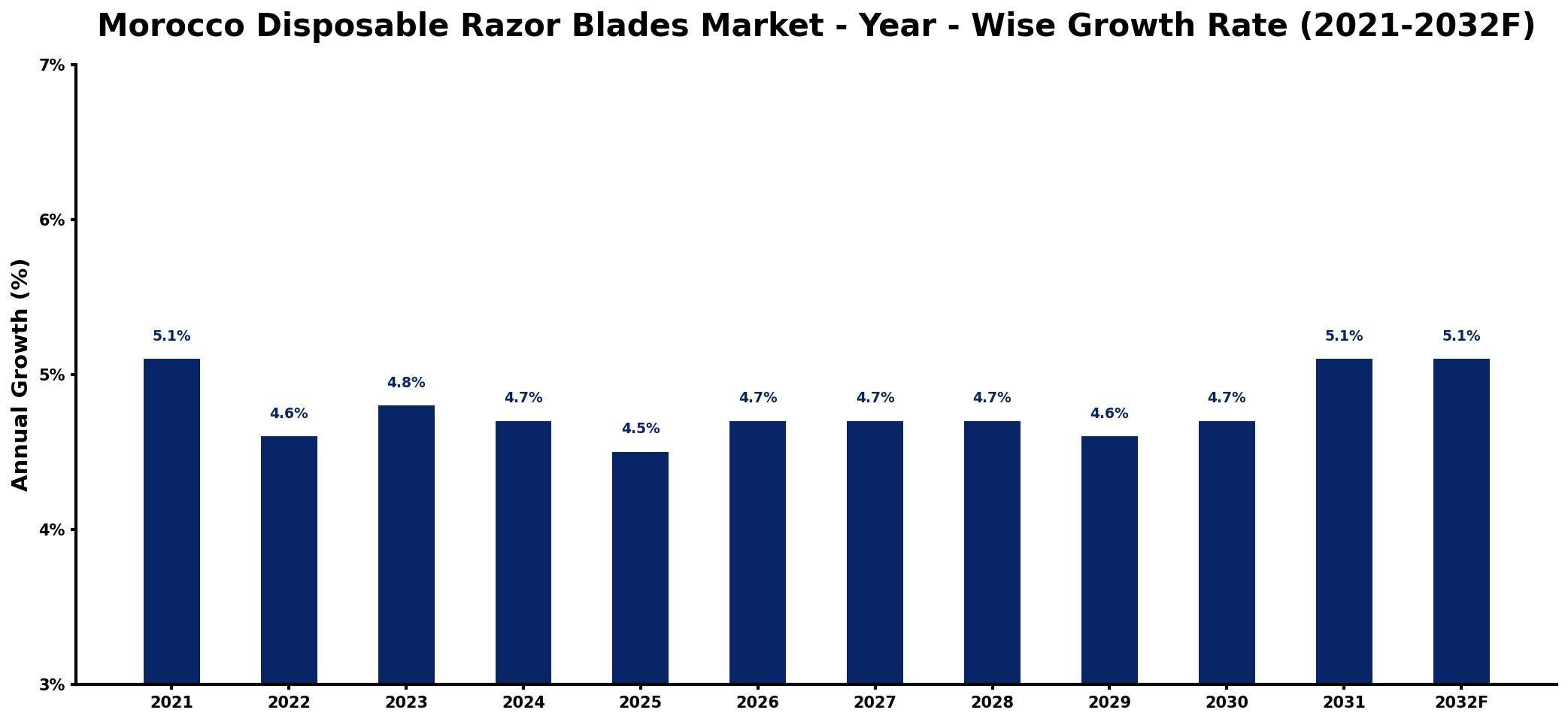
The table below presents the year‑wise growth rates along with the key drivers influencing the market
| Year | Growth Rate | Major Drivers |
| 2021 | 5.1% | Increased consumer grooming awareness |
| 2022 | 4.6% | Rising demand for convenience products |
| 2023 | 4.8% | Growth in e-commerce platforms |
| 2024 | 4.7% | Expansion of retail distribution channels |
| 2025 | 4.5% | Boost in personal care spending |
| 2026 | 4.7% | Surge in online shopping trends |
| 2027 | 4.7% | Innovations in packaging solutions |
| 2028 | 4.7% | Growing popularity of subscription services |
| 2029 | 4.6% | Increased focus on sustainability practices |
| 2030 | 4.7% | expanding manufacturing base activity |
| 2031 | 5.1% | increased production capacity utilization |
| 2032 | 5.1% | increased overall sector activity |
Note: Market size estimations and growth projections presented in this report are based on 6Wresearch's proprietary forecasting methodology, utilizing the latest available industry data, government publications, and primary research inputs.
Morocco Disposable Razor Blades Market Synopsis
In recent years, the Morocco Disposable Razor Blades Market has experienced notable momentum, driven by changing consumer preferences towards affordable and convenient grooming solutions. As we look ahead, this market is positioned for growth, shaped by an increasing inclination towards eco-friendly products and the convenience of online shopping, which appeals to younger demographics.
Despite the robust market dynamics, the future will likely feature a competitive landscape that demands innovation and differentiation. The emergence of subscription-based services and advanced technology in disposable razors suggests a market adapting to both consumer demands and environmental considerations, offering a rich field for development.
Morocco Disposable Razor Blades Market Key Takeaways
- The Morocco Disposable Razor Blades Market is expected to grow steadily due to rising disposable income and changing grooming habits.
- There is a significant trend towards sustainable and eco-friendly disposable razor options that cater to environmentally conscious consumers.
- Subscription-based services are becoming increasingly popular, providing convenience and cost savings for consumers.
- Strong competition necessitates continuous innovation and effective marketing strategies to stand out in the market.
- Distribution channels are evolving, with an emphasis on online sales reflecting the growth of e-commerce in Morocco.
Evaluation of Restraints in Morocco Disposable Razor Blades Market
Despite the promising growth, the Morocco Disposable Razor Blades Market faces several restraints. Strong competition from both local and international brands creates price pressure, making it challenging for manufacturers to maintain margins. Economic fluctuations also play a role, as variations in disposable incomes can impact consumer spending on grooming products. Moreover, the diverse cultural practices surrounding grooming could require tailored marketing approaches, adding an extra layer of complexity for companies aiming to engage consumers effectively.
Morocco Disposable Razor Blades Market Trends
The market is witnessing a significant shift towards eco-friendly and sustainable options, driven by consumer awareness of environmental issues. Manufacturers are increasingly introducing biodegradable materials, which resonate well with the growing number of environmentally conscious consumers. Additionally, advancements in technology are influencing product design, with features like lubricating strips and ergonomic handles enhancing user experience. The rise of subscription-based services also reflects changing consumer behaviors, making it easier to maintain grooming routines while offering potential savings.
Morocco Disposable Razor Blades Market Opportunities
Investment opportunities abound in the Morocco Disposable Razor Blades Market, particularly for businesses focusing on high-quality, affordable products. The increasing demand for sustainable and eco-friendly razors presents a clear avenue for innovation. Collaborating with local retailers and leveraging e-commerce platforms can further enhance market reach, capitalizing on the growing trend of online shopping. As consumer grooming habits evolve, brands that prioritize convenience and sustainability are poised for success.
Government Initiatives in the Morocco Disposable Razor Blades Market
The Moroccan government implements various policies that impact the disposable razor blades market, focusing on regulating imports and ensuring product quality. Tariffs are levied on imports to protect local manufacturers, maintaining a level playing field within the industry. Additionally, safety and quality control measures are strictly enforced to protect consumer health. By fostering fair competition and protecting consumer interests, government initiatives are supporting the overall growth of the market.
Future Insights of the Morocco Disposable Razor Blades Market
The future of the Morocco Disposable Razor Blades Market looks bright, with sustained growth anticipated through 2032. Key drivers include an ongoing focus on personal grooming and increasing awareness of hygiene among the population. The rise of disposable income and evolving lifestyles will likely propel demand for disposable razors. Furthermore, manufacturers are expected to invest in innovations, creating products that cater to modern consumer preferences, thereby enhancing market accessibility and attractiveness.
Morocco Disposable Razor Blades Market Latest Developments (2025 - 2026)
Recent industry developments have focused on enhancing product offerings, with many brands introducing innovative features to differentiate their disposable razors. Eco-friendly initiatives are gaining traction as manufacturers strive to align with global sustainability trends. Additionally, companies are exploring strategic partnerships with online retailers to capitalize on the growing e-commerce market, thus improving accessibility and distribution efficiency across the region.
Morocco Disposable Razor Blades Market - Key Attractiveness of the Report
- 10 Years of Market Numbers
- Historical Data Starting from 2022 to 2025
- Base Year: 2025
- Forecast Data until 2032
- Key Performance Indicators Impacting the Market
- Major Upcoming Developments and Projects
Key Highlights of the Report:
- Morocco Disposable Razor Blades Market Outlook
- Market Size of Morocco Disposable Razor Blades Market, 2025
- Forecast of Morocco Disposable Razor Blades Market, 2032
- Historical Data and Forecast of Morocco Disposable Razor Blades Revenues & Volume for the Period 2022-2032F
- Morocco Disposable Razor Blades Market Trend Evolution
- Morocco Disposable Razor Blades Market Drivers and Challenges
- Morocco Disposable Razor Blades Price Trends
- Morocco Disposable Razor Blades Porter's Five Forces
- Morocco Disposable Razor Blades Industry Life Cycle
- Historical Data and Forecast of Morocco Disposable Razor Blades Market Revenues & Volume By Blade Count for the Period 2022-2032F
- Historical Data and Forecast of Morocco Disposable Razor Blades Market Revenues & Volume By 1 & 2 Blades for the Period 2022-2032F
- Historical Data and Forecast of Morocco Disposable Razor Blades Market Revenues & Volume By 3 & 4 Blades for the Period 2022-2032F
- Historical Data and Forecast of Morocco Disposable Razor Blades Market Revenues & Volume By 5 & More Blades for the Period 2022-2032F
- Historical Data and Forecast of Morocco Disposable Razor Blades Market Revenues & Volume By End-user for the Period 2022-2032F
- Historical Data and Forecast of Morocco Disposable Razor Blades Market Revenues & Volume By Men for the Period 2022-2032F
- Historical Data and Forecast of Morocco Disposable Razor Blades Market Revenues & Volume By Women for the Period 2022-2032F
- Historical Data and Forecast of Morocco Disposable Razor Blades Market Revenues & Volume By Distribution Channel for the Period 2022-2032F
- Historical Data and Forecast of Morocco Disposable Razor Blades Market Revenues & Volume By Hypermarkets/Supermarkets for the Period 2022-2032F
- Historical Data and Forecast of Morocco Disposable Razor Blades Market Revenues & Volume By Pharmacies for the Period 2022-2032F
- Historical Data and Forecast of Morocco Disposable Razor Blades Market Revenues & Volume By Online for the Period 2022-2032F
- Historical Data and Forecast of Morocco Disposable Razor Blades Market Revenues & Volume By Others for the Period 2022-2032F
- Morocco Disposable Razor Blades Import Export Trade Statistics
- Market Opportunity Assessment By Blade Count
- Market Opportunity Assessment By End-user
- Market Opportunity Assessment By Distribution Channel
- Morocco Disposable Razor Blades Top Companies Market Share
- Morocco Disposable Razor Blades Competitive Benchmarking By Technical and Operational Parameters
- Morocco Disposable Razor Blades Company Profiles
- Morocco Disposable Razor Blades Key Strategic Recommendations






































