Morocco Electrical and electronics Market Summary
The morocco electrical and electronics market was estimated at USD 230 Million in 2025 and is projected to reach USD 324 Million by 2032, growing at a CAGR of 6.0% from 2026 to 2032.
Morocco Electrical and electronics Market Year-wise Growth Rate and Key Drivers
This graph highlights how the Morocco Electrical and electronics Market has steadily grown over the past five years, supported by major growth factors.
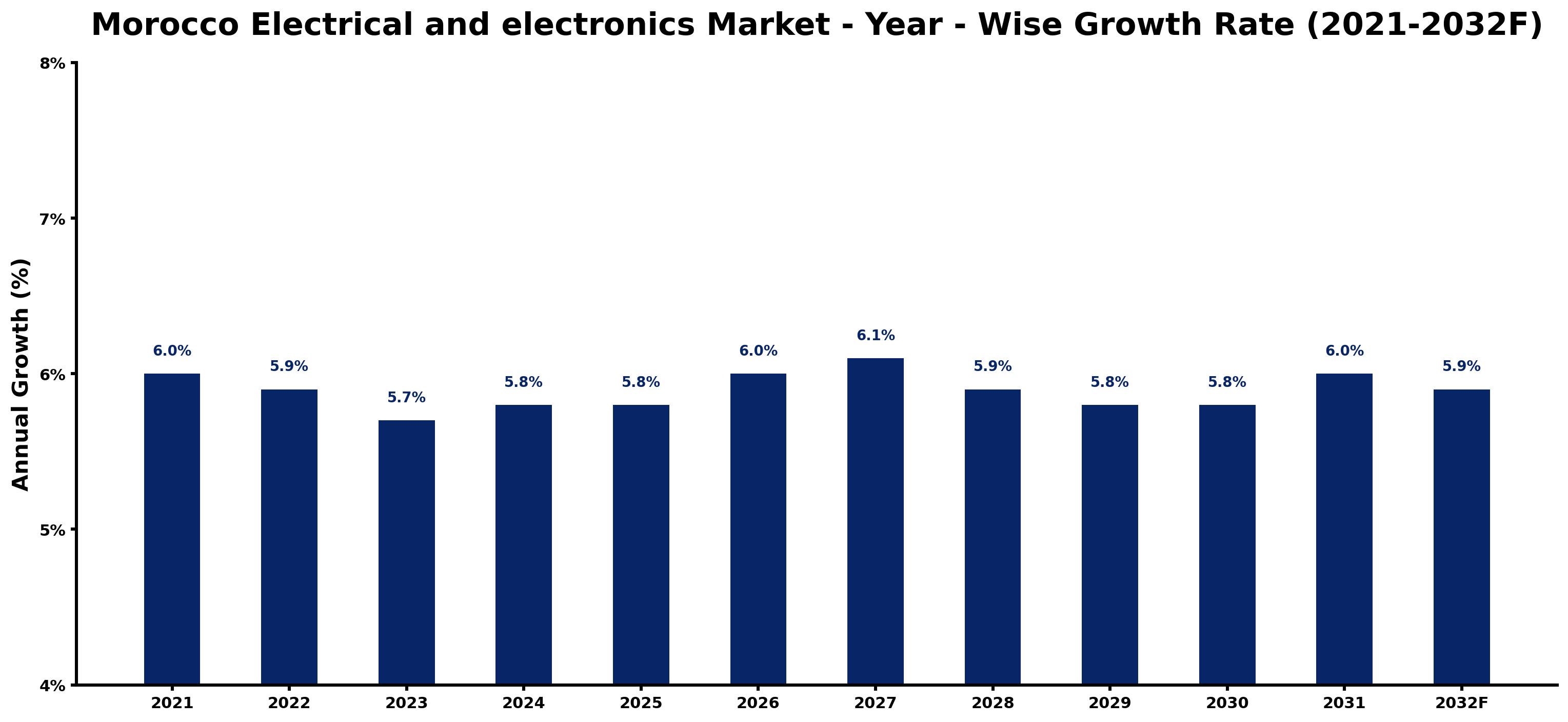
The table below presents the year wise growth rates along with the key drivers influencing the market
| Year | Growth Rate | Major Drivers |
| 2021 | 6.0% | Post-lockdown retail projects significantly increased consumer electronics purchases across urban centers. |
| 2022 | 5.9% | Emerging brands launched innovative home appliances tailored to Moroccan consumer preferences. |
| 2023 | 5.7% | Market competition intensified as international firms expanded their presence in Morocco. |
| 2024 | 5.8% | Urbanization trends fueled the demand for smart home technology and connectivity solutions. |
| 2025 | 5.8% | Local manufacturers leveraged global supply chains to enhance production efficiency and reduce costs. |
| 2026 | 6.0% | Consumer awareness around energy-efficient products influenced purchasing decisions significantly. |
| 2027 | 6.1% | Major construction projects in urban areas led to increased electricity demand and infrastructure upgrades. |
| 2028 | 5.9% | Shifts in consumer behavior toward sustainable products encouraged new market entrants and innovations. |
| 2029 | 5.8% | Investment in renewable energy sources reshaped the electrical landscape, boosting solar panel sales. |
| 2030 | 5.8% | Digital transformation initiatives increased the integration of IoT devices in everyday life. |
| 2031 | 6.0% | Developments in e-commerce expanded market reach for electronics, accessing remote consumers effectively. |
| 2032 | 5.9% | Partnerships between local firms and tech giants facilitated advanced product offerings and consumer education. |
Note - Market size estimations and growth projections presented in this report are based on 6Wresearch's advanced forecasting approach, validated with industry datasets as of June 2026.
Morocco Electrical and electronics Market Synopsis
The Morocco Electrical and electronics Market is projected to reach 6.0% and witness significant growth during the forecast period (2026-2032). This growth is driven by a combination of factors including urbanization, an increase in disposable incomes, and governmental initiatives aimed at advancing digitalization and technological progress. As the demand for consumer electronics, home appliances, and electrical equipment intensifies, there is an increasing emphasis on energy-efficient products and sustainability within the market.
Morocco Electrical and electronics Market Growth Drivers
Several key growth drivers are propelling the Morocco Electrical and electronics Market forward. The urbanization rate in Morocco is on the rise, leading to increased demand for modern electrical solutions and electronics. Additionally, rising disposable incomes among the middle-class population contribute to greater expenditure on consumer electronics and advanced home appliances. Government initiatives that support technological advancements and infrastructure development foster a conducive environment for market expansion. Furthermore, the growing awareness surrounding energy efficiency and sustainability is motivating consumers to invest in eco-friendly electrical products, leading to increased market opportunities.
Morocco Electrical and electronics Market Trends and Opportunities
The Morocco Electrical and electronics Market is characterized by emerging trends that present numerous opportunities for growth. One major trend is the increasing adoption of energy-efficient technologies, as consumers and businesses alike prioritize sustainability in their purchasing decisions. The shift towards smart home technologies demonstrates the growing interest in automation and IoT devices, which enhance convenience and security for users. Additionally, the burgeoning renewable energy sector, particularly in solar and wind energy solutions, is witnessing investment and innovation. The automotive and telecommunications sectors are also experiencing demand for electronic components, further broadening market opportunities.
Morocco Electrical and electronics Market Challenges and Restraints
Despite the positive growth trajectory, the Morocco Electrical and electronics Market faces significant challenges. The proliferation of a large informal sector creates intense competition, leading to price undercutting and market instability. Furthermore, the issue of counterfeit products poses threats not only to the reputation of legitimate brands but also to consumer safety. Infrastructure limitations, such as inconsistent power supply and inadequate internet connectivity in various regions, also hinder market development. Regulatory barriers and import restrictions can complicate the introduction of new products and technologies, making it essential for businesses to navigate these complexities with strategic foresight.
Morocco Electrical and electronics Market Investment Opportunities
Investment opportunities within the Morocco Electrical and electronics Market are abundant, particularly in sectors aligned with the national development agenda. The renewable energy sector stands out as a focus for investment, given the country's commitment to enhancing its energy mix with sustainable sources. The demand for smart home technologies is also on the rise, driven by expanding urban areas and a growing middle class willing to adopt advanced solutions. Infrastructure developments in power transmission and distribution systems offer long-term growth potential, creating a favorable environment for investment. Establishing collaborations with local manufacturers or utilizing free trade zones can further provide strategic advantages to investors in this dynamic market.
Morocco Electrical and electronics Market Government Investment and Initiatives
The Moroccan government is actively implementing policies that bolster the growth of the electrical and electronics market through various initiatives and investments. The National Strategy for the Development of the Electricity Sector, for example, aims to enhance the country's renewable energy capacity and improve energy efficiency standards. Incentives, such as tax breaks and subsidies for businesses in the energy-efficient product space, are being introduced to attract foreign and domestic investment. The National Plan for the Development of the Digital Economy will also play a critical role in advancing innovation and technological adoption, thereby stimulating growth in the electronics sector. Furthermore, partnerships with international organizations are being fostered to enhance compliance with technical and regulatory standards, creating an enabling environment for market players.
Morocco Electrical and electronics Market Latest Developments (May 2025 - June 2026)
Recent developments in the Morocco Electrical and electronics Market reflect an ongoing commitment to innovation and sustainability. Industry players are increasingly focusing on integrating smart technologies and energy-efficient products into their offerings, responding to evolving consumer demand. There is notable growth in the deployment of renewable energy solutions, particularly solar energy, as the government intensifies initiatives to meet its renewable energy targets. Collaborations among stakeholders in the sector are also becoming more prevalent, aimed at pooling resources and expertise to advance technological capabilities. Additionally, the market is witnessing significant investment in infrastructure to support the growing need for reliable power and connectivity solutions.
Morocco Electrical and electronics Market - Key Attractiveness of the Report
- 10 Years of Market Numbers
- Historical Data Starting from 2022 to 2025
- Base Year: 2025
- Forecast Data until 2032
- Key Performance Indicators Impacting the Market
- Major Upcoming Developments and Projects
Key Highlights of the Report:
- Morocco Electrical and electronics Market Outlook
- Market Size of Morocco Electrical and electronics Market, 2025
- Forecast of Morocco Electrical and electronics Market, 2032F
- Historical Data and Forecast of Morocco Electrical and electronics Revenues & Volume for the Period 2022-2032F
- Morocco Electrical and electronics Market Trend Evolution
- Morocco Electrical and electronics Market Drivers and Challenges
- Morocco Electrical and electronics Price Trends
- Morocco Electrical and electronics Porter's Five Forces
- Morocco Electrical and electronics Industry Life Cycle
- Historical Data and Forecast of Morocco Electrical and electronics Market Revenues & Volume By Type for the Period 2022-2032F
- Historical Data and Forecast of Morocco Electrical and electronics Market Revenues & Volume By Electric Motors for the Period 2022-2032F
- Historical Data and Forecast of Morocco Electrical and electronics Market Revenues & Volume By Primary And Storage Batteries for the Period 2022-2032F
- Historical Data and Forecast of Morocco Electrical and electronics Market Revenues & Volume By Generators for the Period 2022-2032F
- Historical Data and Forecast of Morocco Electrical and electronics Market Revenues & Volume By Semiconductors for the Period 2022-2032F
- Historical Data and Forecast of Morocco Electrical and electronics Market Revenues & Volume By Household Appliances for the Period 2022-2032F
- Historical Data and Forecast of Morocco Electrical and electronics Market Revenues & Volume By Applications for the Period 2022-2032F
- Historical Data and Forecast of Morocco Electrical and electronics Market Revenues & Volume By Online for the Period 2022-2032F
- Historical Data and Forecast of Morocco Electrical and electronics Market Revenues & Volume By Offline for the Period 2022-2032F
- Morocco Electrical and electronics Import Export Trade Statistics
- Market Opportunity Assessment By Type
- Market Opportunity Assessment By Applications
- Morocco Electrical and electronics Top Companies Market Share
- Morocco Electrical and electronics Competitive Benchmarking By Technical and Operational Parameters
- Morocco Electrical and electronics Company Profiles
- Morocco Electrical and electronics Key Strategic Recommendations






































