Morocco Food Service Equipment Market Summary
The morocco food service equipment market was estimated at USD 468 Million in 2025 and is projected to reach USD 641 Million by 2032, growing at a CAGR of 5.3% from 2026 to 2032.
Morocco Food Service Equipment Market Year-wise Growth Rate and Key Drivers
This graph highlights how the Morocco Food Service Equipment Market has steadily grown over the past five years, supported by major growth factors.
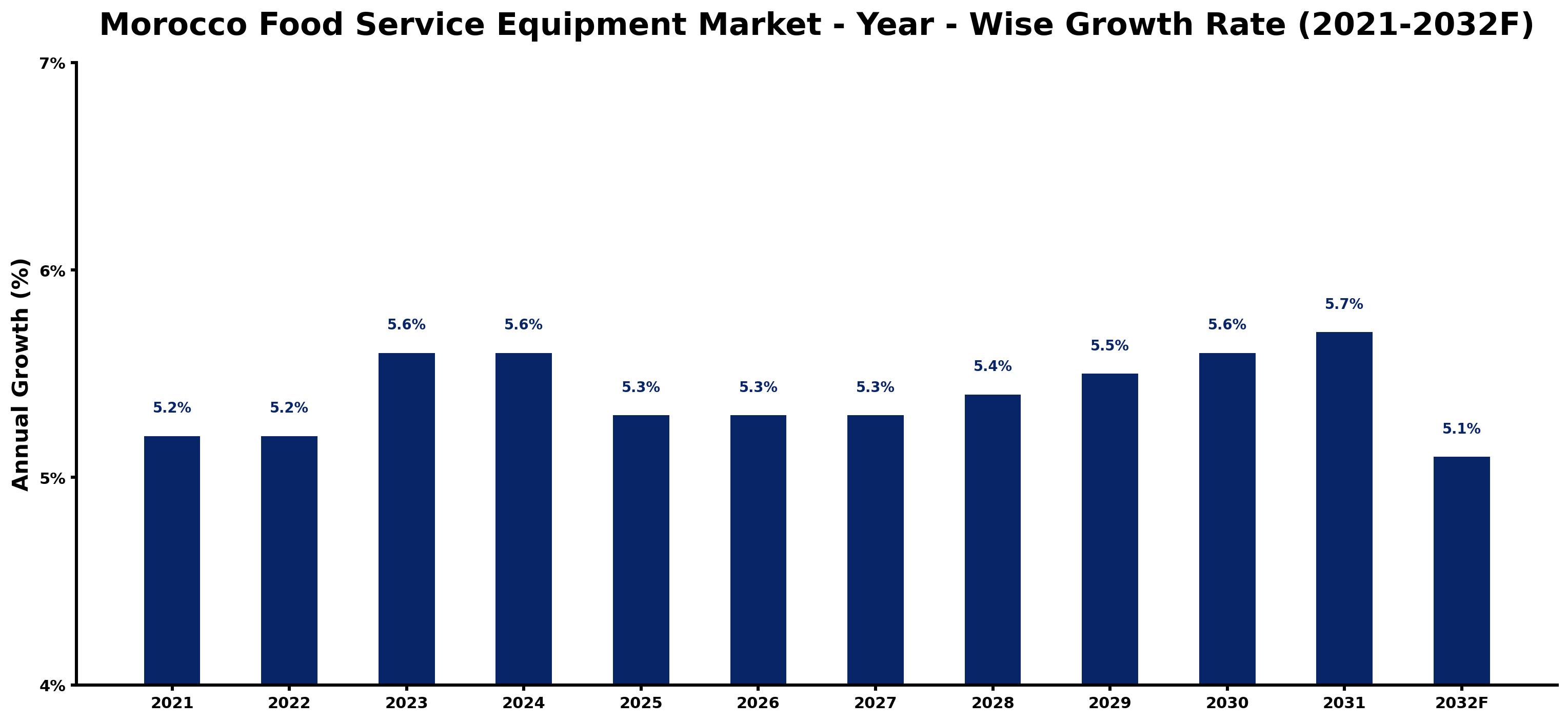
The table below presents the year wise growth rates along with the key drivers influencing the market
| Year | Growth Rate | Major Drivers |
| 2021 | 5.2% | Recovery from the pandemic spurred increased investments in food service equipment. |
| 2022 | 5.2% | Local culinary trends led to a higher demand for specialized kitchen appliances. |
| 2023 | 5.6% | Tourism rebound contributed to greater needs for robust food service infrastructure. |
| 2024 | 5.6% | Increased urbanization encouraged the establishment of new restaurants and cafes. |
| 2025 | 5.3% | Sustainability practices became essential, prompting a shift towards eco-friendly equipment. |
| 2026 | 5.3% | Technological integration saw more establishments adopting smart kitchen solutions. |
| 2027 | 5.3% | Culinary innovation drove the demand for versatile, high-performance cooking devices. |
| 2028 | 5.4% | Rising disposable incomes supported consumer spending in upscale dining experiences. |
| 2029 | 5.5% | Food delivery services expanded, requiring new equipment for efficient meal preparation. |
| 2030 | 5.6% | Health consciousness among consumers increased demand for equipment supporting clean cooking. |
| 2031 | 5.7% | Catering services flourished, boosting the market for large-scale food preparation tools. |
| 2032 | 5.1% | Government support for the hospitality sector encouraged investment in modern food service solutions. |
Note - Market size estimations and growth projections presented in this report are based on 6Wresearch's advanced forecasting approach, validated with industry datasets as of June 2026.
Morocco Food Service Equipment Market Synopsis
The Morocco Food Service Equipment Market is projected to reach 5.3% and witness significant growth during the forecast period (2026-2032). This dynamic market is being driven by factors such as an increase in the number of dining establishments, the rising tourism sector, and evolving consumer preferences. The demand for essential food service equipment encompasses a diverse range of tools, including cooking appliances, refrigeration systems, storage solutions, and food preparation tools designed to meet the needs of restaurants, cafes, and hotels. Urbanization and a growing middle-class population are stimulating expenditure on dining out, further enhancing the market's prospects.
Morocco Food Service Equipment Market Growth Drivers
Several key factors are contributing to the advancement of the Morocco Food Service Equipment Market. The notable drivers include:
- The surge in the hospitality sector with new restaurants and hotels opening across the country creates a substantial demand for food service equipment.
- An increase in disposable income among consumers leads to a shift in dining habits, with more individuals opting to eat out rather than preparing meals at home.
- The flourishing tourism industry markedly affects the market, as hotel chains and dining establishments seek modern equipment to cater to international visitors.
- Changing consumer preferences towards diverse and quality dining experiences necessitates investment in advanced kitchen technologies and processes.
- A focus on food safety and hygiene standards ensures that establishments are equipped with the best tools to maintain compliance, thus driving demand for specialized equipment.
Morocco Food Service Equipment Market Trends and Opportunities
Current trends in the Morocco Food Service Equipment Market suggest a shifting landscape characterized by innovation and sustainability. Noteworthy trends include:
- The demand for energy-efficient equipment is escalating, driven by a growing awareness of sustainability and operational cost-reduction strategies.
- Automation and technology integration are becoming standard in food service operations, enhancing efficiency and customer interaction.
- Compact and versatile equipment is gaining traction, accommodating smaller kitchen spaces as urbanization influences restaurant layouts.
- Increased emphasis on food safety drives the adoption of advanced sanitation features in equipment, aligning with health regulations.
- There is a notable increase in demand for local sourcing of food service equipment, creating opportunities for domestic manufacturers.
Morocco Food Service Equipment Market Challenges and Restraints
The Morocco Food Service Equipment Market faces several challenges that could hinder its growth. Major constraints include:
- High import tariffs and taxes on food service equipment result in increased costs, making it difficult for businesses to invest in modern solutions.
- Limited access to financing options poses a significant barrier, especially for small and medium-sized enterprises looking to upgrade their equipment.
- An underdeveloped supply chain in certain regions complicates the procurement processes, leading to delays in equipment delivery and maintenance.
- The lack of professional training programs in the food service sector can affect the operational efficacy of new equipment and technologies.
- Maintaining compliance with stringent food safety and hygiene regulations requires ongoing investment in suitable equipment and training.
Morocco Food Service Equipment Market Investment Opportunities
Investment opportunities within the Morocco Food Service Equipment Market are promising, driven by the increasing consumer preference for dining out and a thriving hospitality sector. Key areas targeted for investment include:
- Commercial kitchen equipment, particularly refrigeration units and cooking appliances, to renovate existing infrastructure and improve service delivery.
- Food preparation machinery that offers efficiency and enhances food safety, capitalizing on the growing focus on hygiene.
- Restaurant furniture and serving supplies that prioritize ergonomics and aesthetic appeal, aligning with consumer expectations for dining environments.
- Innovative technology solutions that streamline service operations and enhance customer experiences in the increasingly competitive dining landscape.
- Partnerships with local manufacturers to develop customized equipment that suits the specific needs of Moroccan food service establishments.
Morocco Food Service Equipment Market Government Investment and Initiatives
Government policies regarding the Morocco Food Service Equipment Market are focused on promoting food safety and supporting local industries. Significant initiatives include:
- Regulations ensuring that all food service equipment aligns with established quality and safety standards, thus protecting consumer welfare.
- Encouragement of energy-efficient equipment adoption through incentives aimed at reducing environmental impact across the food service sector.
- Support for local manufacturers via subsidies to stimulate domestic production and enhance competitiveness against imports.
- Investment in training programs that focus on food safety and operational best practices to improve the overall standards within the industry.
- Development plans for infrastructure improvements that facilitate efficient distribution and supply chain management for food service equipment.
Morocco Food Service Equipment Market Latest Developments (May 2025 - June 2026)
Recent developments in the Morocco Food Service Equipment Market from May 2025 to June 2026 indicate a shift towards innovative solutions and automation. The focus has been on enhancing operational efficiency and food safety protocols in response to growing consumer expectations. Investments in smart kitchen technologies are emerging, aligning with global trends in the food service sector. Furthermore, there has been increased collaboration between local suppliers and international manufacturers to localize production and reduce import dependencies. The government has continued to promote sustainability through initiatives aimed at encouraging the use of eco-friendly materials and energy-efficient solutions in food service establishments.
Morocco Food Service Equipment Market - Key Attractiveness of the Report
- 10 Years of Market Numbers
- Historical Data Starting from 2022 to 2025
- Base Year: 2025
- Forecast Data until 2032
- Key Performance Indicators Impacting the Market
- Major Upcoming Developments and Projects
Key Highlights of the Report:
- Morocco Food Service Equipment Market Outlook
- Market Size of Morocco Food Service Equipment Market, 2025
- Forecast of Morocco Food Service Equipment Market, 2032F
- Historical Data and Forecast of Morocco Food Service Equipment Revenues & Volume for the Period 2022-2032F
- Morocco Food Service Equipment Market Trend Evolution
- Morocco Food Service Equipment Market Drivers and Challenges
- Morocco Food Service Equipment Price Trends
- Morocco Food Service Equipment Porter's Five Forces
- Morocco Food Service Equipment Industry Life Cycle
- Historical Data and Forecast of Morocco Food Service Equipment Market Revenues & Volume By Type for the Period 2022-2032F
- Historical Data and Forecast of Morocco Food Service Equipment Market Revenues & Volume By Cooking Equipment for the Period 2022-2032F
- Historical Data and Forecast of Morocco Food Service Equipment Market Revenues & Volume By Storage & Handling Equipment for the Period 2022-2032F
- Historical Data and Forecast of Morocco Food Service Equipment Market Revenues & Volume By Ware washing Equipment for the Period 2022-2032F
- Historical Data and Forecast of Morocco Food Service Equipment Market Revenues & Volume By Food & Beverage Preparation Equipment for the Period 2022-2032F
- Historical Data and Forecast of Morocco Food Service Equipment Market Revenues & Volume By Serving Equipment for the Period 2022-2032F
- Historical Data and Forecast of Morocco Food Service Equipment Market Revenues & Volume By End-Use for the Period 2022-2032F
- Historical Data and Forecast of Morocco Food Service Equipment Market Revenues & Volume By Full-service Restaurants & Hotels for the Period 2022-2032F
- Historical Data and Forecast of Morocco Food Service Equipment Market Revenues & Volume By Quick-service Restaurants & Pubs for the Period 2022-2032F
- Historical Data and Forecast of Morocco Food Service Equipment Market Revenues & Volume By Catering for the Period 2022-2032F
- Morocco Food Service Equipment Import Export Trade Statistics
- Market Opportunity Assessment By Type
- Market Opportunity Assessment By End-Use
- Morocco Food Service Equipment Top Companies Market Share
- Morocco Food Service Equipment Competitive Benchmarking By Technical and Operational Parameters
- Morocco Food Service Equipment Company Profiles
- Morocco Food Service Equipment Key Strategic Recommendations






































