Morocco Industrial Flooring Market Size, Share & Growth Rate
The Morocco Industrial Flooring Market was estimated at USD 188 Million in 2025 and is projected to reach USD 207 Million by 2032, growing at a CAGR of 1.4% from 2026 to 2032. This growth trajectory is propelled by the increasing demand for robust flooring solutions in industrial settings, driven by enhanced safety and hygiene regulations. The expanding construction sector in Morocco further amplifies the need for durable and maintenance-friendly flooring alternatives.
Morocco Industrial Flooring Market Year-wise Growth Rate and Key Drivers
This graph highlights how the Morocco Industrial Flooring Market has steadily grown over the years, supported by major growth factors.
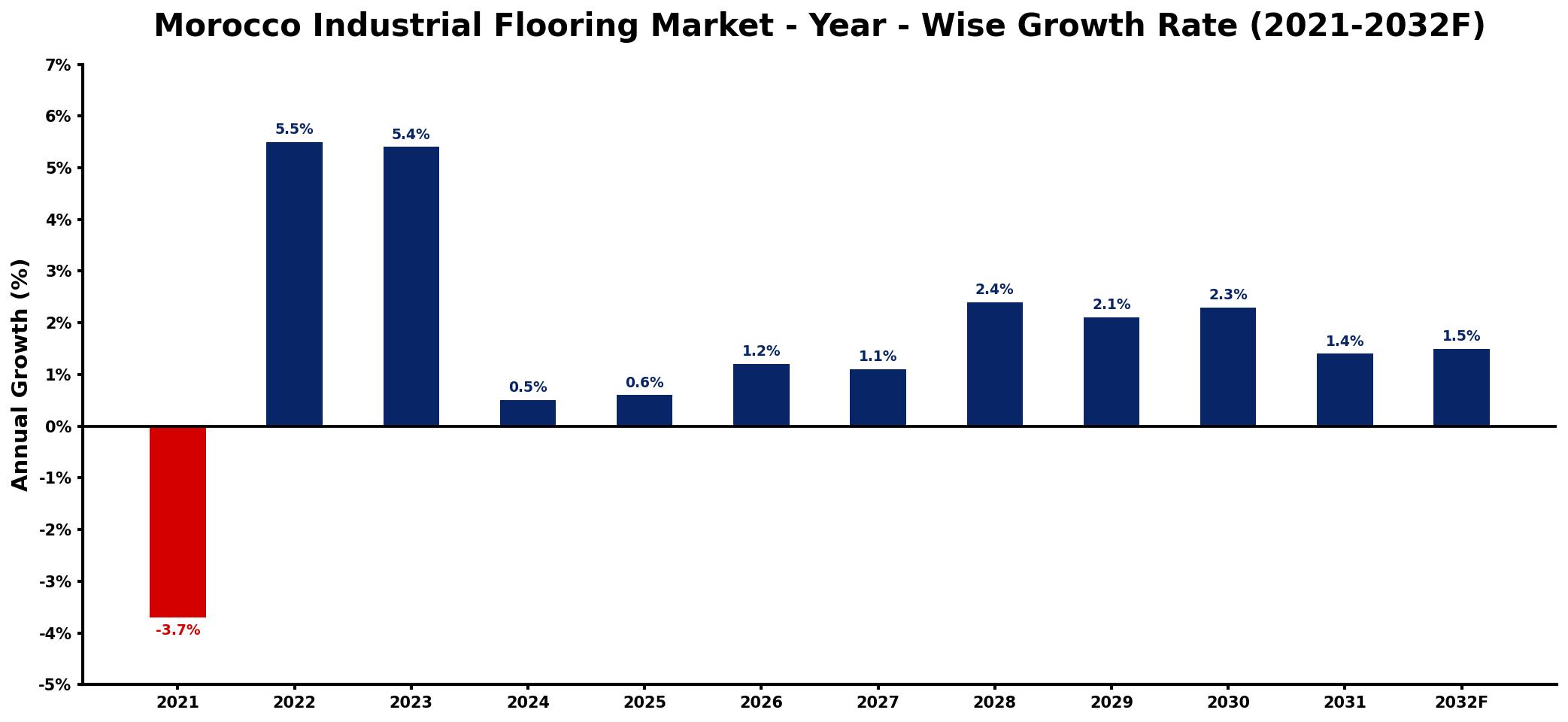
The table below presents the year‑wise growth rates along with the key drivers influencing the market
| Year | Growth Rate | Major Drivers |
| 2021 | -3.7% | decreased construction project investments |
| 2022 | 5.5% | rising demand from manufacturing sector |
| 2023 | 5.4% | expansion in logistics facilities |
| 2024 | 0.5% | increased government infrastructure spending |
| 2025 | 0.6% | growing adoption of sustainable practices |
| 2026 | 1.2% | surge in retail sector renovations |
| 2027 | 1.1% | growth in automotive industry projects |
| 2028 | 2.4% | enhanced focus on safety standards |
| 2029 | 2.1% | development of new commercial spaces |
| 2030 | 2.3% | increased foreign direct investments |
| 2031 | 1.4% | expansion of healthcare facilities projects |
| 2032 | 1.5% | rising interest in eco-friendly solutions |
Note: Market size estimations and growth projections presented in this report are based on 6Wresearch's proprietary forecasting methodology, utilizing the latest available industry data, government publications, and primary research inputs.
Morocco Industrial Flooring Market Synopsis
The Morocco Industrial Flooring Market is currently experiencing positive momentum, as various industries seek to optimize their operational environments. This shift is primarily motivated by the rising awareness of workplace safety and the necessity for hygienic conditions across industrial facilities.
As the market progresses, the focus on sustainable and high-performance materials, including epoxy and polyurethane coatings, is set to redefine industry standards. This trend underscores a broader shift towards enhancing both functionality and aesthetics within industrial spaces in Morocco.
Morocco Industrial Flooring Market Key Takeaways
- Strong growth forecast driven by construction activities and demand for durable flooring solutions.
- Increasing preference for materials with superior chemical and slip resistance characteristics.
- Focus on safety, hygiene, and operational efficiency in industrial environments.
- Emerging challenges related to environmental concerns and material competition.
- Government initiatives aimed at promoting sustainable flooring practices.
Evaluation of Restraints in Morocco Industrial Flooring Market
Despite a promising outlook, the Morocco Industrial Flooring Market faces certain limitations. Key among these are challenges in meeting stringent durability and safety standards, which require continuous innovation from manufacturers. Environmental regulations are increasingly impacting the choice of materials, pushing for greener alternatives. Additionally, the competition from alternative flooring options, such as tiles and vinyl, may restrain market growth as end-users weigh costs against performance attributes.
Morocco Industrial Flooring Market Trends
Current trends indicate a significant shift towards the adoption of advanced flooring materials that offer both functional benefits and aesthetic appeal. The rise of smart manufacturing and automation in industrial spaces is driving demand for flooring that can withstand heavy machinery and high foot traffic. Furthermore, there's a growing emphasis on eco-friendly solutions, leading to innovations in the development of sustainable flooring options that meet environmental standards without compromising performance.
Morocco Industrial Flooring Market Opportunities
The Morocco Industrial Flooring Market presents substantial growth opportunities, particularly in sectors such as logistics and warehousing, where flooring durability and safety are paramount. Investment in green building initiatives provides a fertile ground for companies developing sustainable flooring solutions. Moreover, as the country continues to develop its infrastructure, there is an ongoing need for high-performance flooring in new industrial facilities, offering a lucrative landscape for market participants.
Government Initiatives in the Morocco Industrial Flooring Market
Government policies are increasingly shaping the Morocco Industrial Flooring Market, focusing on the development of standards and certification requirements. Initiatives aim to promote the use of durable, slip-resistant, and chemical-resistant flooring materials in industrial environments. Additionally, various incentives are being introduced to encourage manufacturers to invest in sustainable flooring technologies, enhancing workplace safety and operational efficiency.
Future Insights of the Morocco Industrial Flooring Market
Looking ahead to 2026-2032, the Morocco Industrial Flooring Market is poised for steady growth, driven by evolving consumer preferences and regulatory demands. The emphasis on high-quality and sustainable flooring solutions will likely intensify as industries adapt to changing operational standards. Furthermore, technological advancements in flooring materials and their applications will shape future market dynamics, presenting opportunities for innovation and enhanced product offerings.
Morocco Industrial Flooring Market Latest Developments (2025 - 2026)
Recent developments in the Morocco Industrial Flooring Market reflect a robust commitment to innovation and sustainability. Key trends include the launch of eco-friendly flooring products and the adoption of advanced technologies aimed at improving flooring durability and maintenance. Additionally, industry stakeholders are focusing on enhancing customer education regarding the benefits of high-quality flooring solutions, ensuring that end-users are well-informed about their options as market demands continue to evolve.
Morocco Industrial Flooring Market - Key Attractiveness of the Report
- 10 Years of Market Numbers
- Historical Data Starting from 2022 to 2025
- Base Year: 2025
- Forecast Data until 2032
- Key Performance Indicators Impacting the Market
- Major Upcoming Developments and Projects
Key Highlights of the Report:
- Morocco Industrial Flooring Market Outlook
- Market Size of Morocco Industrial Flooring Market, 2025
- Forecast of Morocco Industrial Flooring Market, 2032
- Historical Data and Forecast of Morocco Industrial Flooring Revenues & Volume for the Period 2022-2032F
- Morocco Industrial Flooring Market Trend Evolution
- Morocco Industrial Flooring Market Drivers and Challenges
- Morocco Industrial Flooring Price Trends
- Morocco Industrial Flooring Porter's Five Forces
- Morocco Industrial Flooring Industry Life Cycle
- Historical Data and Forecast of Morocco Industrial Flooring Market Revenues & Volume By End User Industry for the Period 2022-2032F
- Historical Data and Forecast of Morocco Industrial Flooring Market Revenues & Volume By Chemical for the Period 2022-2032F
- Historical Data and Forecast of Morocco Industrial Flooring Market Revenues & Volume By Food and Beverages for the Period 2022-2032F
- Historical Data and Forecast of Morocco Industrial Flooring Market Revenues & Volume By Healthcare for the Period 2022-2032F
- Historical Data and Forecast of Morocco Industrial Flooring Market Revenues & Volume By Transportation and Aviation for the Period 2022-2032F
- Historical Data and Forecast of Morocco Industrial Flooring Market Revenues & Volume By Others for the Period 2022-2032F
- Historical Data and Forecast of Morocco Industrial Flooring Market Revenues & Volume By Thickness for the Period 2022-2032F
- Historical Data and Forecast of Morocco Industrial Flooring Market Revenues & Volume By Light duty for the Period 2022-2032F
- Historical Data and Forecast of Morocco Industrial Flooring Market Revenues & Volume By Medium Duty for the Period 2022-2032F
- Historical Data and Forecast of Morocco Industrial Flooring Market Revenues & Volume By Heavy Duty for the Period 2022-2032F
- Historical Data and Forecast of Morocco Industrial Flooring Market Revenues & Volume By Material Type for the Period 2022-2032F
- Historical Data and Forecast of Morocco Industrial Flooring Market Revenues & Volume By Epoxy for the Period 2022-2032F
- Historical Data and Forecast of Morocco Industrial Flooring Market Revenues & Volume By Polyaspartic for the Period 2022-2032F
- Historical Data and Forecast of Morocco Industrial Flooring Market Revenues & Volume By Polyurethane for the Period 2022-2032F
- Historical Data and Forecast of Morocco Industrial Flooring Market Revenues & Volume By Anhydrite for the Period 2022-2032F
- Historical Data and Forecast of Morocco Industrial Flooring Market Revenues & Volume By Others for the Period 2022-2032F
- Morocco Industrial Flooring Import Export Trade Statistics
- Market Opportunity Assessment By End User Industry
- Market Opportunity Assessment By Thickness
- Market Opportunity Assessment By Material Type
- Morocco Industrial Flooring Top Companies Market Share
- Morocco Industrial Flooring Competitive Benchmarking By Technical and Operational Parameters
- Morocco Industrial Flooring Company Profiles
- Morocco Industrial Flooring Key Strategic Recommendations






































