Morocco Leather Market Summary
The morocco leather market was estimated at USD 229 Million in 2025 and is projected to reach USD 309 Million by 2032, growing at a CAGR of 5.4% from 2026 to 2032.
Morocco Leather Market Year-wise Growth Rate and Key Drivers
This graph highlights how the Morocco Leather Market has steadily grown over the past five years, supported by major growth factors.
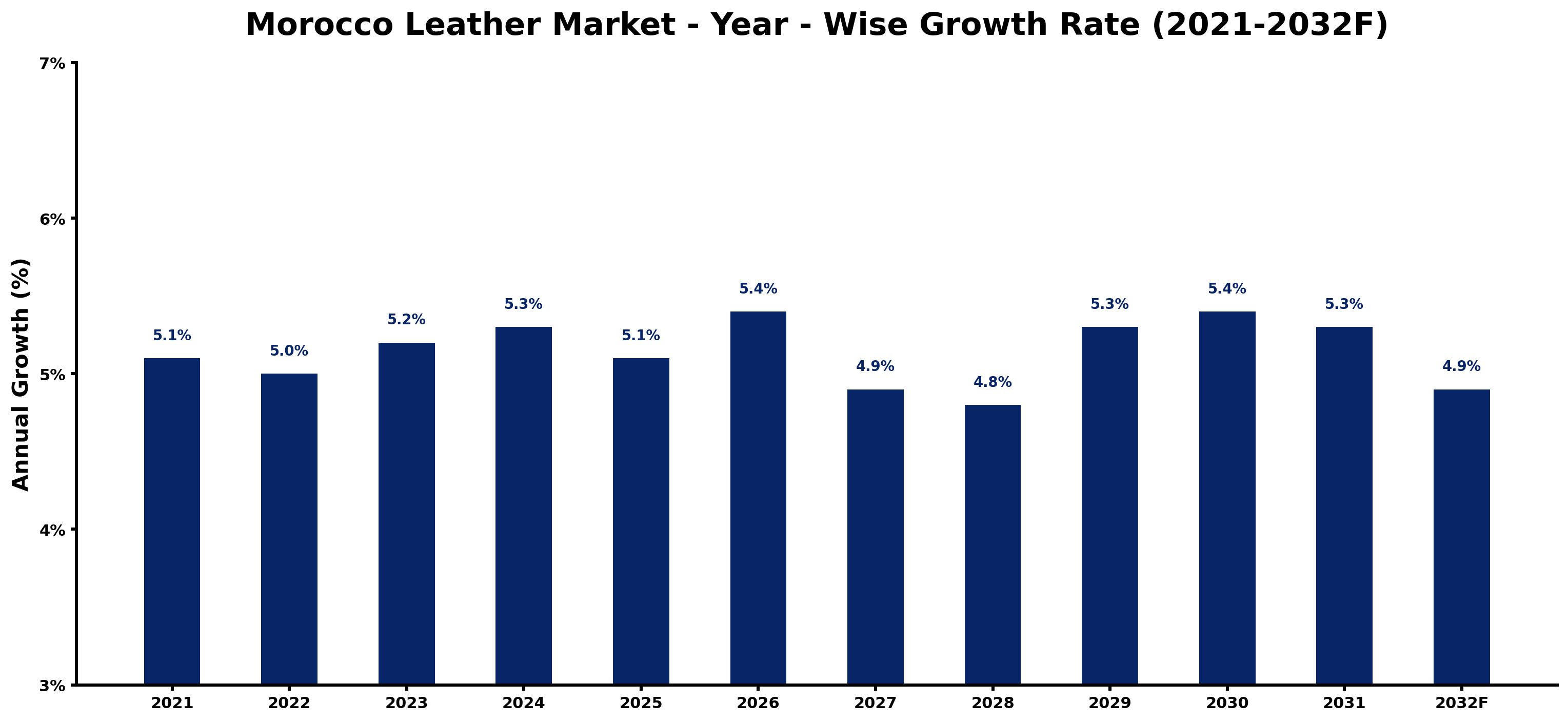
The table below presents the year wise growth rates along with the key drivers influencing the market
| Year | Growth Rate | Major Drivers |
| 2021 | 5.1% | Moroccan artisans showcase intricate leatherwork, attracting local and international consumers. |
| 2022 | 5.0% | E-commerce platforms facilitate access to authentic Moroccan leather across global markets. |
| 2023 | 5.2% | Craftsmanship workshops gain popularity; tourists seek unique, handcrafted leather goods. |
| 2024 | 5.3% | Cultural festivals emphasize traditional leather production, boosting brand visibility and sales. |
| 2025 | 5.1% | Sustainable practices emerge, appealing to eco-conscious consumers within the leather sector. |
| 2026 | 5.4% | Local production networks strengthen, reducing reliance on imported leather products. |
| 2027 | 4.9% | Investment in design innovation enhances product appeal, attracting younger demographics. |
| 2028 | 4.8% | Cross-border trade agreements simplify export processes, expanding market reach significantly. |
| 2029 | 5.3% | Collaborations with fashion influencers elevate the status of Moroccan leather goods. |
| 2030 | 5.4% | Technological advancements streamline production, increasing efficiency and product variety. |
| 2031 | 5.3% | Luxury brands incorporate Moroccan leather, enhancing its reputation on a global scale. |
| 2032 | 4.9% | Emerging markets show increased interest, diversifying consumer base for Moroccan leather. |
Note - Market size estimations and growth projections presented in this report are based on 6Wresearch's advanced forecasting approach, validated with industry datasets as of June 2026.
Morocco Leather Market Synopsis
The Morocco Leather Market is projected to reach 5.4% and witness significant growth during the forecast period (2026-2032). The market is anticipated to grow at a compounded annual growth rate (CAGR) of 5.3%, driven by multiple factors including the rising demand for leather apparel and footwear, enhanced infrastructure, and active government initiatives aimed at promoting the leather sector. In addition, foreign investments are progressively flowing into Morocco, further stimulating growth in this market.
Morocco Leather Market Growth Drivers
Several key factors are propelling the expansion of the Morocco leather market. One of the primary drivers is the increasing consumer demand for leather goods, particularly in the apparel and footwear segments. As lifestyles evolve, consumers are gravitating towards high-quality and durable materials such as leather.
- The improving infrastructure in Morocco is pivotal. Investments in transportation, logistics, and trade facilities are enhancing supply chain efficiencies, making it easier for leather manufacturers to distribute their products.
- Government initiatives aimed at bolstering the leather industry are also vital. The Moroccan government is actively promoting policies that encourage local production and innovation within the sector.
- Foreign investments are on the rise, with international players recognizing Morocco's strategic position and its potential as a leather manufacturing hub. This influx of capital facilitates technology transfer and enhances production capabilities.
- The demand for sustainable practices is transforming the industry. Eco-friendly tanning methods are increasingly being adopted, further stimulating innovation and market growth as consumers seek ethically produced products.
- Lastly, the availability of raw materials is a significant factor. Morocco's access to high-quality hides enables manufacturers to produce a range of premium leather products, catering to both domestic and international markets.
Morocco Leather Market Trends and Opportunities
The Morocco leather market is witnessing several trends that present unique opportunities for growth. The shift towards sustainable and environmentally friendly practices is one of the most notable trends, with more companies adopting innovative tanning technologies that reduce chemical usage and waste.
- Digital transformation within the leather industry is another significant trend. Automation and advanced manufacturing techniques are gaining traction, enhancing efficiency and reducing production costs.
- The rising trend of customization in leather goods is also noteworthy. Consumers are increasingly looking for personalized products, prompting manufacturers to provide tailored solutions.
- In addition, the focus on export-oriented growth is emerging. Moroccan leather products are gaining popularity in global markets, driven by their quality and craftsmanship.
- Lastly, collaborations with fashion designers and brands are becoming more prevalent, allowing local producers to showcase their offerings on larger platforms and reach wider audiences.
Morocco Leather Market Challenges and Restraints
Despite the positive outlook, there are certain challenges that could potentially hinder the growth of the Morocco leather market. One major concern is the competition from cheaper imports, which can impact the pricing strategies of local manufacturers.
- Environmental regulations are tightening globally, and while this may drive innovation, it also necessitates significant investments in compliance for local manufacturers.
- Skill shortages in specialized areas of leather production and craftsmanship represent another challenge. Training and upskilling the workforce are crucial to maintaining a competitive edge.
- Market saturation in certain segments, especially in low-end leather products, could also constrain growth, necessitating a shift towards high-end, niche markets.
- Lastly, fluctuating raw material prices can pose a risk. An increase in the cost of hides due to supply chain disruptions could ultimately affect profit margins for producers.
Morocco Leather Market Government Investment and Initiatives
The Moroccan government has been proactive in supporting the leather sector through various investment initiatives and development plans. Policies designed to enhance the competitiveness of the leather industry include funding for research and development, as well as incentives for companies adopting sustainable practices.
- Investment in vocational training programs is being prioritized to address skill shortages in the leather industry, thereby improving craftsmanship and production capabilities.
- The government is facilitating access to international markets through trade agreements, which benefit Moroccan leather exporters and enhance the global presence of Moroccan leather goods.
- Infrastructure projects designed to improve transport and logistics capabilities are being implemented, enabling more efficient distribution of leather products within and outside Morocco.
- Collaboration initiatives between governmental bodies and local industry stakeholders are being fostered to promote innovation and ensure sustainable practices within the leather sector.
- Financial incentives for companies investing in advanced technologies and eco-friendly production processes are also part of the government's strategy to modernize the industry.
Morocco Leather Market Latest Developments (May 2025 - June 2026)
In the recent months between May 2025 and June 2026, the Morocco leather market has seen a number of noteworthy developments. The focus on sustainability has intensified as several manufacturers have started adopting eco-friendly practices, reaping the benefits of both consumer preferences and regulatory compliance.
- Technological advancements have been evident, with more companies integrating digital solutions into their manufacturing processes to enhance efficiency and product quality.
- The export of Moroccan leather products has been on the rise, with market players successfully navigating global supply chain challenges to maintain their presence in international markets.
- Government support has been instrumental in encouraging local businesses to innovate, leading to increased collaboration between brands and artisans.
- Trade fairs and exhibitions focusing on Moroccan leather have gained traction, allowing local producers to showcase their offerings and connect with global buyers.
- Overall, the market is aligning with global trends towards sustainability and quality, positioning itself favorably for future growth.
Morocco Leather Market - Key Attractiveness of the Report
- 10 Years of Market Numbers
- Historical Data Starting from 2022 to 2025
- Base Year: 2025
- Forecast Data until 2032
- Key Performance Indicators Impacting the Market
- Major Upcoming Developments and Projects
Key Highlights of the Report:
- Morocco Leather Market Outlook
- Market Size of Morocco Leather Market, 2025
- Forecast of Morocco Leather Market, 2032F
- Historical Data and Forecast of Morocco Leather Revenues & Volume for the Period 2022-2032F
- Morocco Leather Market Trend Evolution
- Morocco Leather Market Drivers and Challenges
- Morocco Leather Price Trends
- Morocco Leather Porter's Five Forces
- Morocco Leather Industry Life Cycle
- Historical Data and Forecast of Morocco Leather Market Revenues & Volume By Type for the Period 2022-2032F
- Historical Data and Forecast of Morocco Leather Market Revenues & Volume By Luggage for the Period 2022-2032F
- Historical Data and Forecast of Morocco Leather Market Revenues & Volume By Footwear for the Period 2022-2032F
- Historical Data and Forecast of Morocco Leather Market Revenues & Volume By Accessories for the Period 2022-2032F
- Historical Data and Forecast of Morocco Leather Market Revenues & Volume By Distribution Channel for the Period 2022-2032F
- Historical Data and Forecast of Morocco Leather Market Revenues & Volume By Online for the Period 2022-2032F
- Historical Data and Forecast of Morocco Leather Market Revenues & Volume By Offline for the Period 2022-2032F
- Morocco Leather Import Export Trade Statistics
- Market Opportunity Assessment By Type
- Market Opportunity Assessment By Distribution Channel
- Morocco Leather Top Companies Market Share
- Morocco Leather Competitive Benchmarking By Technical and Operational Parameters
- Morocco Leather Company Profiles
- Morocco Leather Key Strategic Recommendations






































