Morocco Paints & varnishes Market Summary
The morocco paints & varnishes market was estimated at USD 1099 Million in 2025 and is projected to reach USD 1843 Million by 2032, growing at a CAGR of 8.8% from 2026 to 2032.
Morocco Paints & varnishes Market Year-wise Growth Rate and Key Drivers
This graph highlights how the Morocco Paints & varnishes Market has steadily grown over the past five years, supported by major growth factors.
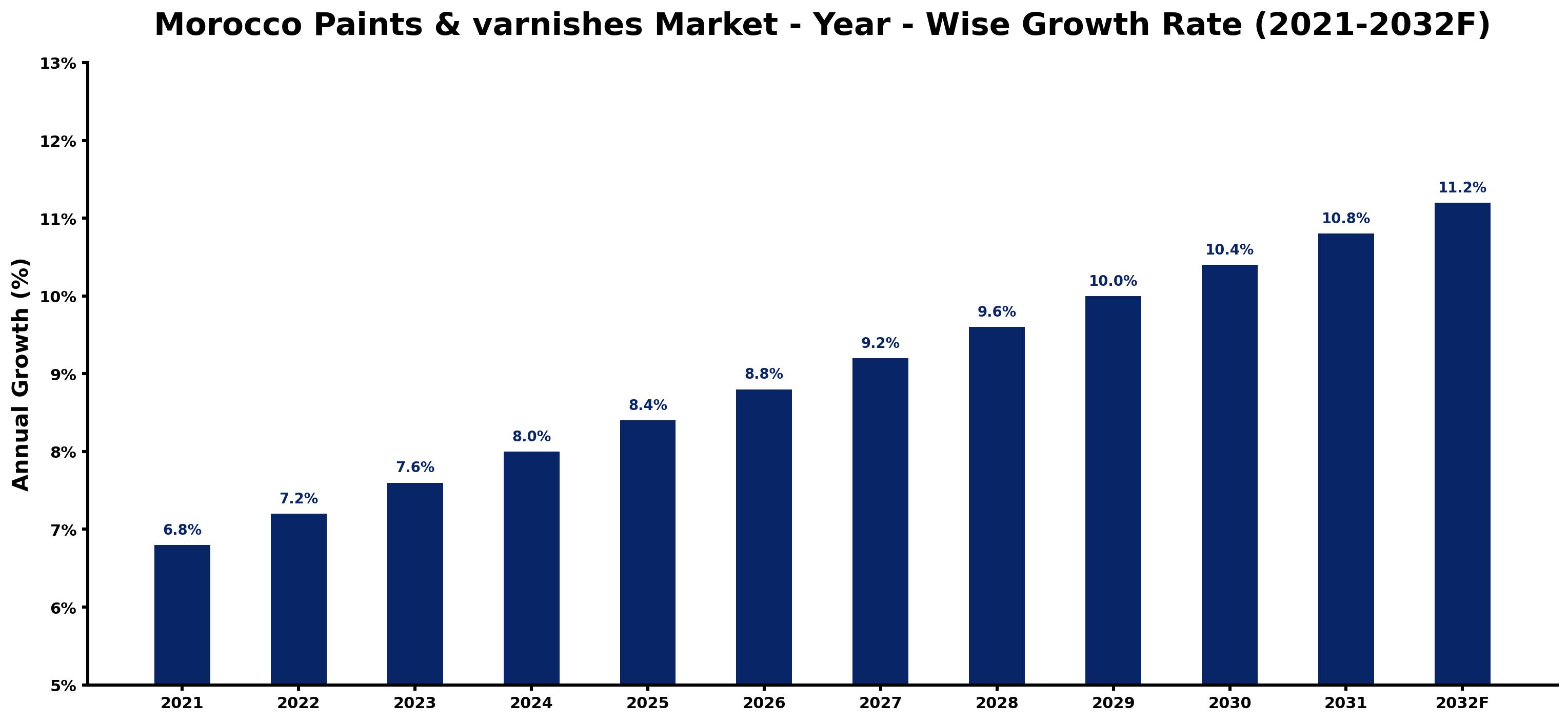
The table below presents the year wise growth rates along with the key drivers influencing the market
| Year | Growth Rate | Major Drivers |
| 2021 | 6.8% | Paint manufacturers focused on eco-friendly options as sustainability gained importance. |
| 2022 | 7.2% | Local construction projects expanded rapidly, boosting demand for interior and exterior paints. |
| 2023 | 7.6% | Increased investment in infrastructure development spurred a steady rise in varnish consumption. |
| 2024 | 8.0% | The construction sector saw a significant uptick, further driving paint sales throughout Morocco. |
| 2025 | 8.4% | Emerging trends in home improvement fueled consumer interest in premium paint products. |
| 2026 | 8.8% | Urbanization trends prompted a surge in residential and commercial painting requirements. |
| 2027 | 9.2% | Technological innovations improved product quality, attracting more consumers to premium offerings. |
| 2028 | 9.6% | Rising disposable incomes allowed households to spend more on decorative paint options. |
| 2029 | 10.0% | The tourism industry revitalized, with hotels requiring aesthetic enhancements in renovations. |
| 2030 | 10.4% | Green building materials became mainstream, influencing paint formulations and consumer choices. |
| 2031 | 10.8% | Increased awareness of health impacts led to higher demand for low-VOC paints. |
| 2032 | 11.2% | Market players expanded distribution channels, enhancing accessibility to various paint products. |
Note - Market size estimations and growth projections presented in this report are based on 6Wresearch's advanced forecasting approach, validated with industry datasets as of June 2026.
Morocco Paints & varnishes Market Synopsis
The Morocco Paints varnishes Market is projected to reach 8.8% and witness significant growth during the forecast period (2026-2032). The anticipated compound annual growth rate (CAGR) of approximately 5.1% reflects the increasing demand for high-quality finishes in both commercial and residential sectors. Key factors fueling this market include governmental initiatives aimed at infrastructure improvement, a surge in construction activities, and heightened consumer focus on energy efficiency within buildings. Additionally, advancements in product technology are expected to further stimulate market growth in the coming years.
Morocco Paints & varnishes Market Growth Drivers
Several factors are driving the expansion of the Morocco Paints & varnishes Market. Firstly, the growing construction sector, supported by urbanization trends, is leading to a higher demand for quality paints and varnishes for various applications. Secondly, government-led infrastructure projects are paving the way for increased consumption in both public and private construction endeavors. Likewise, a shift towards eco-friendly and energy-efficient building materials is driving demand for innovative and sustainable painting solutions. Thirdly, the rising popularity of superior finish products is prompting consumers to prioritize quality, thereby creating opportunities for manufacturers to innovate and diversify their product lines. Finally, the flourishing do-it-yourself (DIY) trend is encouraging individual homeowners to engage in painting projects, thereby broadening the market scope.
Morocco Paints & varnishes Market Challenges and Restraints
Despite the positive growth trajectory, the Morocco Paints & varnishes Market faces considerable challenges. The volatility of raw material prices poses a significant risk to manufacturers, impacting product pricing and profit margins. Additionally, stringent regulations imposed by environmental authorities regarding the composition and emissions of paints and varnishes may result in compliance costs that can hinder market entry for smaller players. Moreover, the potential for supply chain disruptions, especially in sourcing key raw materials, can impede timely production and distribution processes. Finally, the fluctuating consumer preferences and economic uncertainties may affect overall market demand.
Morocco Paints & varnishes Market Trends and Opportunities
The Morocco Paints & varnishes Market is witnessing several notable trends that present new opportunities for growth. One significant trend is the increasing demand for eco-friendly and low-VOC (volatile organic compounds) products, which resonate with the growing environmental awareness among consumers. Manufacturers are increasingly focusing on formulating sustainable alternatives that appeal to both environmentally-conscious consumers and regulatory requirements. Additionally, advancements in technology are leading to the development of paints that offer improved durability, ease of application, and enhanced aesthetic appeal. Furthermore, the digitalization of sales channels, including e-commerce platforms, is making products more accessible to consumers, particularly DIY enthusiasts. This convergence of trends is expected to provide a fertile ground for innovative product offerings, particularly in the decorative segment.
Morocco Paints & varnishes Market Government Investment and Initiatives
The Moroccan government has been proactive in initiating several policies and investments that bolster the paints and varnishes market. Infrastructure development projects are receiving substantial funding, which translates into increased demand for construction materials, including paints and coatings. Initiatives aimed at improving urban environments, such as public housing and commercial development, are also spurring demand. Furthermore, the government's commitment to promoting sustainable building practices has led to the introduction of incentives for manufacturers to produce environmentally-friendly products. These initiatives not only aim at enhancing market growth but also stress the importance of sustainability in the building and construction industry.
Morocco Paints & varnishes Market Latest Developments (May 2025 - June 2026)
Recent developments within the Morocco Paints & varnishes Market highlight a dynamic landscape driven by innovation and regulatory considerations. In an effort to enhance product sustainability, several manufacturers have begun to adopt cleaner production processes and lower-VOC formulations in response to regulatory directives. Additionally, there has been a noticeable increase in collaboration between manufacturers and construction firms to develop tailored solutions that meet the specific requirements of various projects. The DIY segment has also seen an uptick in product launches targeting amateur painters, with easy-to-use kits that simplify the painting process. Market players are also exploring digital marketing strategies to better reach consumers, reflecting the industry's growing emphasis on e-commerce.
Morocco Paints & varnishes Market - Key Attractiveness of the Report
- 10 Years of Market Numbers
- Historical Data Starting from 2022 to 2025
- Base Year: 2025
- Forecast Data until 2032
- Key Performance Indicators Impacting the Market
- Major Upcoming Developments and Projects
Key Highlights of the Report:
- Morocco Paints & varnishes Market Outlook
- Market Size of Morocco Paints & varnishes Market, 2025
- Forecast of Morocco Paints & varnishes Market, 2032F
- Historical Data and Forecast of Morocco Paints & varnishes Revenues & Volume for the Period 2022-2032F
- Morocco Paints & varnishes Market Trend Evolution
- Morocco Paints & varnishes Market Drivers and Challenges
- Morocco Paints & varnishes Price Trends
- Morocco Paints & varnishes Porter's Five Forces
- Morocco Paints & varnishes Industry Life Cycle
- Historical Data and Forecast of Morocco Paints & varnishes Market Revenues & Volume By Type for the Period 2022-2032F
- Historical Data and Forecast of Morocco Paints & varnishes Market Revenues & Volume By Water-borne paints and varnishes for the Period 2022-2032F
- Historical Data and Forecast of Morocco Paints & varnishes Market Revenues & Volume By Solvent-borne paints and varnishes for the Period 2022-2032F
- Historical Data and Forecast of Morocco Paints & varnishes Market Revenues & Volume By Others for the Period 2022-2032F
- Historical Data and Forecast of Morocco Paints & varnishes Market Revenues & Volume By Applications for the Period 2022-2032F
- Historical Data and Forecast of Morocco Paints & varnishes Market Revenues & Volume By Transportations paints and varnishes for the Period 2022-2032F
- Historical Data and Forecast of Morocco Paints & varnishes Market Revenues & Volume By Industrial paints and varnishes for the Period 2022-2032F
- Historical Data and Forecast of Morocco Paints & varnishes Market Revenues & Volume By Construction paints and varnishes for the Period 2022-2032F
- Morocco Paints & varnishes Import Export Trade Statistics
- Market Opportunity Assessment By Type
- Market Opportunity Assessment By Applications
- Morocco Paints & varnishes Top Companies Market Share
- Morocco Paints & varnishes Competitive Benchmarking By Technical and Operational Parameters
- Morocco Paints & varnishes Company Profiles
- Morocco Paints & varnishes Key Strategic Recommendations






































