Morocco Power Generation Market Size, Share & Growth Rate
The Morocco Power Generation Market was estimated at USD 198 Million in 2025 and is projected to reach USD 270 Million by 2032, growing at a CAGR of 4.5% from 2026 to 2032. This growth trajectory is largely propelled by the government's strong commitment to increasing the share of renewable energy in the energy mix, with an ambitious goal of achieving 52% by 2030. The ongoing investments in large-scale solar and wind projects, alongside efforts to modernize existing infrastructure, are expected to be key drivers of market expansion.
Morocco Power Generation Market Year-wise Growth Rate and Key Drivers
This graph highlights how the Morocco Power Generation Market has steadily grown over the years, supported by major growth factors.
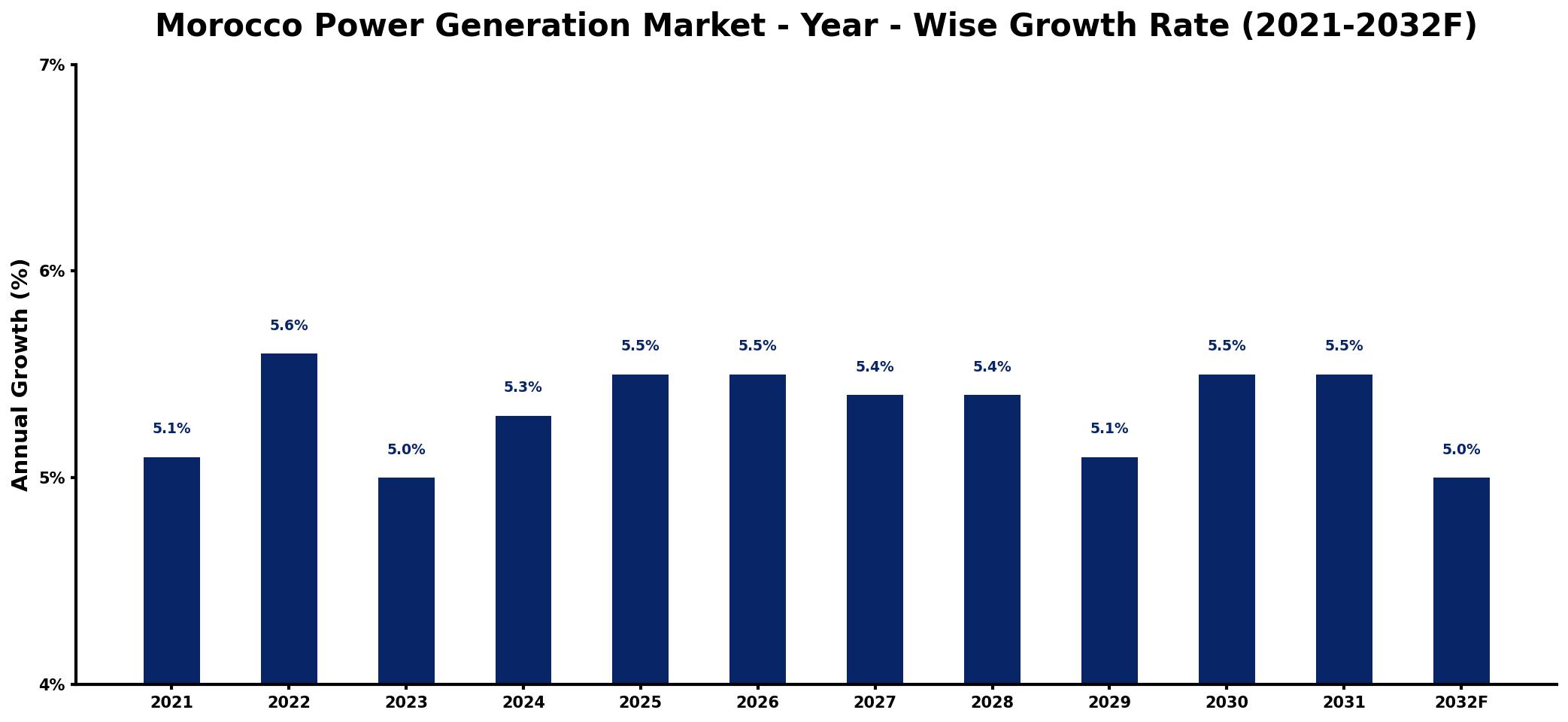
The table below presents the year‑wise growth rates along with the key drivers influencing the market
| Year | Growth Rate | Major Drivers |
| 2021 | 5.1% | Increased renewable energy investments |
| 2022 | 5.6% | Rising industrial electricity demand |
| 2023 | 5.0% | Growing urbanization and infrastructure |
| 2024 | 5.3% | Expansion of solar energy projects |
| 2025 | 5.5% | Boost in residential energy consumption |
| 2026 | 5.5% | Higher foreign direct investments |
| 2027 | 5.4% | Emergence of new energy technologies |
| 2028 | 5.4% | Increased energy efficiency initiatives |
| 2029 | 5.1% | Development of energy storage solutions |
| 2030 | 5.5% | Growing interest in green technologies |
| 2031 | 5.5% | Strengthened regional energy cooperation |
| 2032 | 5.0% | Rising demand for electric vehicles |
Note: Market size estimations and growth projections presented in this report are based on 6Wresearch's proprietary forecasting methodology, utilizing the latest available industry data, government publications, and primary research inputs.
Morocco Power Generation Market Synopsis
In recent years, Morocco has made substantial progress in diversifying its energy portfolio, pivoting towards renewable energy sources to bolster energy security and reduce dependence on imports. As the country continues to expand its capacity in solar and wind generation, the market is anticipated to see accelerated growth, reinforcing its commitment to sustainability.
However, the path forward involves navigating a landscape characterized by infrastructural challenges and the need for financing. The government's proactive policies and regulatory frameworks are essential in overcoming these barriers, ensuring the market not only grows but thrives in the face of emerging global energy demands.
Morocco Power Generation Market Key Takeaways
- The market is witnessing a significant shift towards renewable energy sources, aligning with national sustainability goals.
- Investments in solar and wind power are expected to lead the way in market growth, supported by favorable government policies.
- Public-private partnerships are emerging as crucial mechanisms for financing new energy projects.
- Challenges remain, including infrastructure development and financing complexities, that must be addressed to sustain market momentum.
- The Moroccan governments commitment to modernizing the energy sector is expected to enhance reliability and energy efficiency.
Evaluation of Restraints in Morocco Power Generation Market
While the Morocco Power Generation Market is poised for growth, several restraints could impede progress. The need for significant investment in infrastructure modernization and expansion of renewable sources presents a formidable challenge. Additionally, limited access to financing avenues can stifle project initiation and execution. Regulatory complexities may deter potential investors, complicating the landscape further. Moreover, the intermittent nature of solar and wind energy necessitates robust energy storage solutions to maintain a consistent and reliable power supply, a challenge that the market must address. Political and social dynamics may also play a role, impacting public acceptance and investment enthusiasm.
Morocco Power Generation Market Trends
Emerging trends in the Morocco Power Generation Market are significantly shaped by the global emphasis on sustainability and energy efficiency. The rapid deployment of smart grid technologies is enhancing the management of energy distribution and consumption. Furthermore, there is an increasing focus on energy storage solutions, vital for addressing the variability associated with renewable energy sources. Collaborative efforts between public and private sectors are becoming commonplace, allowing for innovative financing models and shared risk in developing new infrastructure projects.
Morocco Power Generation Market Opportunities
The Morocco Power Generation Market presents numerous avenues for growth and investment, particularly in renewable sectors. With an abundance of natural resources, the country is well-positioned to attract foreign investments aimed at solar and wind power projects. The government's incentives, including tax breaks and power purchase agreements, create a favorable investment climate. Moreover, the shift towards energy efficiency opens up opportunities for advanced technologies that enhance grid management and energy storage capabilities, presenting lucrative prospects for technology providers.
Government Initiatives in the Morocco Power Generation Market
The Moroccan government has laid a robust framework to promote renewable energy sources, significantly reducing reliance on fossil fuels. Through the National Energy Strategy, which targets a 52% renewable energy share by 2030, the government has created an environment conducive to investment. Legal frameworks and financial incentives, such as support for major projects like the Noor Solar Power Plant, demonstrate the commitment to achieving these targets. Additional regulations promoting energy efficiency and clean technologies further reinforce Moroccos dedication to sustainable energy development.
Future Insights of the Morocco Power Generation Market
Looking ahead to the period between 2026 and 2032, the Morocco Power Generation Market is expected to continue its trajectory of growth, driven by the government's steadfast resolve to expand the renewable energy sector. With ongoing investments in infrastructure and an increasing number of strategic partnerships, the market is likely to see enhanced capacity and efficiency. The focus on cleaner energy sources, driven by both regulatory support and public demand, will shape the landscape of power generation in Morocco, positioning the country as a leader in renewable energy within the region.
Morocco Power Generation Market Latest Developments (2025 - 2026)
Recent developments in the Morocco Power Generation Market reflect a concerted effort towards expanding renewable energy capabilities. The government has engaged in various international partnerships to enhance technology transfer and investment in renewable projects. Additionally, there has been a noticeable increase in community-based renewable initiatives, aimed at fostering local engagement and acceptance of new energy solutions. These trends indicate a strong alignment with the global movement towards sustainable energy, further embedding Morocco's role as a rising player in the renewable energy sector.
Morocco Power Generation Market - Key Attractiveness of the Report
- 10 Years of Market Numbers
- Historical Data Starting from 2022 to 2025
- Base Year: 2025
- Forecast Data until 2032
- Key Performance Indicators Impacting the Market
- Major Upcoming Developments and Projects
Key Highlights of the Report:
- Morocco Power Generation Market Outlook
- Market Size of Morocco Power Generation Market, 2025
- Forecast of Morocco Power Generation Market, 2032
- Historical Data and Forecast of Morocco Power Generation Revenues & Volume for the Period 2022-2032F
- Morocco Power Generation Market Trend Evolution
- Morocco Power Generation Market Drivers and Challenges
- Morocco Power Generation Price Trends
- Morocco Power Generation Porter's Five Forces
- Morocco Power Generation Industry Life Cycle
- Historical Data and Forecast of Morocco Power Generation Market Revenues & Volume By Application for the Period 2022-2032F
- Historical Data and Forecast of Morocco Power Generation Market Revenues & Volume By Commercial for the Period 2022-2032F
- Historical Data and Forecast of Morocco Power Generation Market Revenues & Volume By Industrial for the Period 2022-2032F
- Historical Data and Forecast of Morocco Power Generation Market Revenues & Volume By Residential for the Period 2022-2032F
- Historical Data and Forecast of Morocco Power Generation Market Revenues & Volume By Source for the Period 2022-2032F
- Historical Data and Forecast of Morocco Power Generation Market Revenues & Volume By Non-Renewable for the Period 2022-2032F
- Historical Data and Forecast of Morocco Power Generation Market Revenues & Volume By Renewable for the Period 2022-2032F
- Morocco Power Generation Import Export Trade Statistics
- Market Opportunity Assessment By Application
- Market Opportunity Assessment By Source
- Morocco Power Generation Top Companies Market Share
- Morocco Power Generation Competitive Benchmarking By Technical and Operational Parameters
- Morocco Power Generation Company Profiles
- Morocco Power Generation Key Strategic Recommendations






































