Morocco Recycled Plastics Market Size, Share & Growth Rate
The Morocco Recycled Plastics Market was estimated at USD 982 Million in 2025 and is projected to reach USD 1421 Million by 2032, growing at a CAGR of 5.4% from 2026 to 2032. This growth trajectory is largely fueled by heightened environmental awareness and regulatory measures aimed at increasing recycling rates across the nation. The rising demand from sectors such as packaging and automotive is driving innovations in processing technologies, further strengthening market prospects.
Morocco Recycled Plastics Market Year-wise Growth Rate and Key Drivers
This graph highlights how the Morocco Recycled Plastics Market has steadily grown over the years, supported by major growth factors.
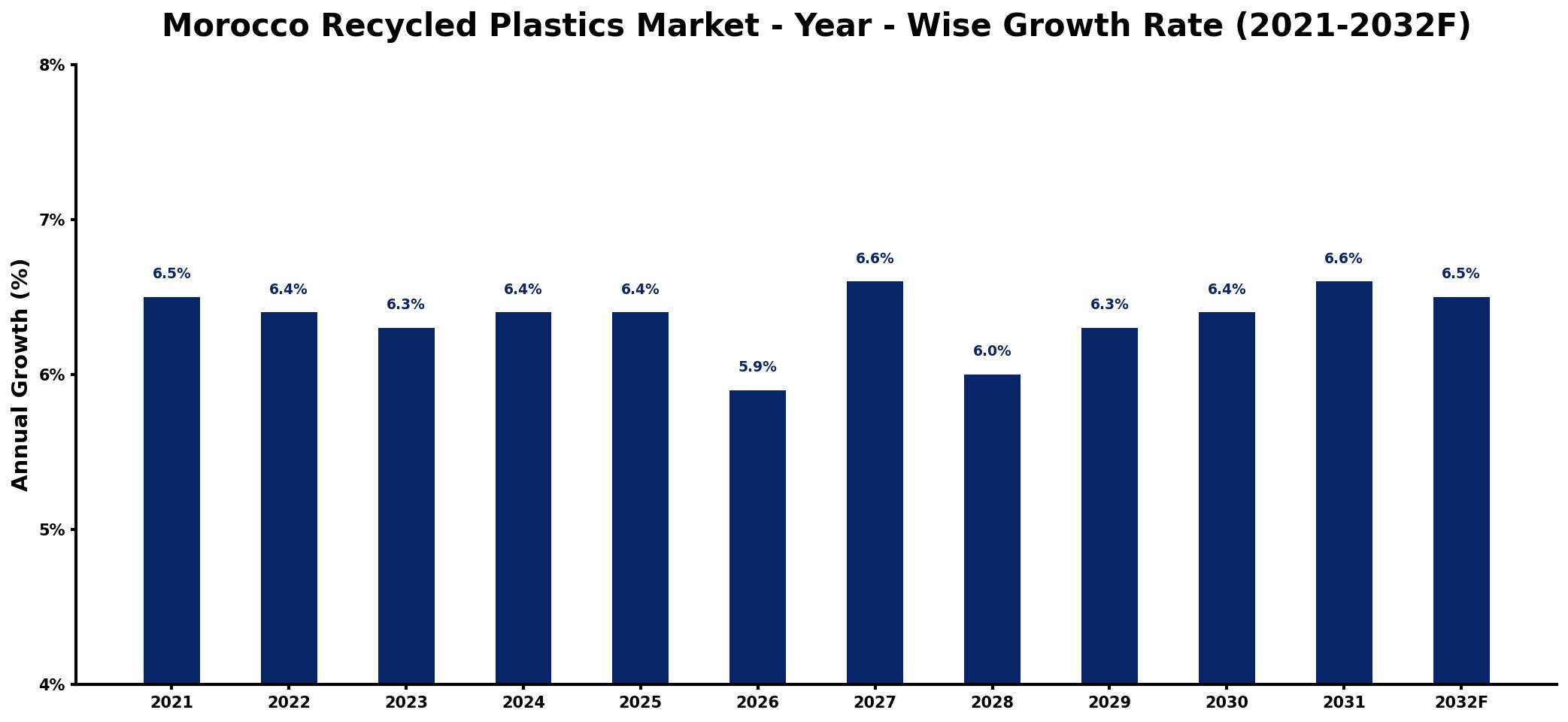
The table below presents the year‑wise growth rates along with the key drivers influencing the market
| Year | Growth Rate | Major Drivers |
| 2021 | 6.5% | Rising consumer environmental awareness |
| 2022 | 6.4% | Government incentives for sustainability |
| 2023 | 6.3% | Investment in waste management infrastructure |
| 2024 | 6.4% | Increased demand from packaging industry |
| 2025 | 6.4% | Growth in eco-friendly product offerings |
| 2026 | 5.9% | Expansion of recycling technologies |
| 2027 | 6.6% | Collaborations with green startups |
| 2028 | 6.0% | Emergence of circular economy initiatives |
| 2029 | 6.3% | Enhanced public recycling education programs |
| 2030 | 6.4% | Development of biodegradable alternatives |
| 2031 | 6.6% | Support for local recycling businesses |
| 2032 | 6.5% | Rising global sustainability regulations |
Note: Market size estimations and growth projections presented in this report are based on 6Wresearch's proprietary forecasting methodology, utilizing the latest available industry data, government publications, and primary research inputs.
Morocco Recycled Plastics Market Synopsis
The most significant force shaping the Morocco Recycled Plastics Market currently is the increasing governmental push towards environmental sustainability. Initiatives aimed at curbing single-use plastics and promoting recycling are pivotal in driving growth. Furthermore, the adoption of circular economy practices is being embraced by both industries and consumers alike, reinforcing the demand for recycled materials.
In addition to regulatory support, consumer awareness regarding the importance of sustainable practices is escalating. This shift is motivating industries such as construction and packaging to integrate recycled plastics into their supply chains. The combined effect of these factors is creating a robust framework for market expansion.
Morocco Recycled Plastics Market Key Takeaways
- Steady market growth driven by environmental sustainability initiatives.
- Increased demand for recycled plastics from sectors like packaging and automotive.
- Technological advancements are enhancing the quality of recycled materials.
- Government regulations are playing a crucial role in promoting recycling practices.
- Collaboration between public and private sectors is improving recycling infrastructure.
Evaluation of Restraints in Morocco Recycled Plastics Market
Despite the positive market outlook, several restraints continue to hinder growth in the Morocco Recycled Plastics Market. Chief among them is the inadequate infrastructure for the efficient collection and processing of plastic waste. This gap complicates recyclers' efforts to source quality materials, ultimately affecting the overall market quality. Additionally, there is a pressing need for consumer education regarding the benefits of recycling, which remains a barrier to maximizing participation in recycling programs. Without standardized regulations, the market also experiences uncertainty, deterring potential investors from fully engaging in this promising sector.
Morocco Recycled Plastics Market Trends
The current trends in the Morocco Recycled Plastics Market reflect a robust shift towards sustainability. Companies are increasingly adopting innovative technologies for waste collection and processing, which enhances the recycling efficiency. Furthermore, there is a notable trend towards utilizing recycled plastics in manufacturing processes, reducing the reliance on virgin materials. Collaborative efforts between industry stakeholders and government entities are also on the rise, focusing on developing a more efficient recycling infrastructure and establishing a circular economy.
Morocco Recycled Plastics Market Opportunities
Investment opportunities within the Morocco Recycled Plastics Market are abundant. The increasing demand for eco-friendly products presents lucrative prospects for setting up facilities dedicated to the collection and processing of recyclable plastics. Furthermore, strategic partnerships with municipalities and private enterprises can enhance material sourcing capabilities. Innovating recycling technologies also offers avenues for differentiation and elevated market presence. As Morocco enhances its recycling initiatives, aligning investments with these goals promises substantial long-term growth potential.
Government Initiatives in the Morocco Recycled Plastics Market
The Moroccan government has enacted several policies aimed at bolstering plastic recycling efforts nationwide. Key among these is the National Waste Management Strategy, which seeks to improve recycling rates significantly. Regulations mandating the incorporation of recycled plastics into various industries and promoting sustainable packaging solutions are also in place. Additionally, initiatives like the National Program for Waste Recovery and Recycling are designed to create a circular economy by providing incentives for efficient waste collection and processing.
Future Insights of the Morocco Recycled Plastics Market
Looking ahead to 2026-2032, the future of the Morocco Recycled Plastics Market appears promising. Growing environmental consciousness among consumers and strict regulations aimed at reducing plastic waste are expected to stimulate demand further. Technological advancements will continue to enhance recycling processes, ensuring a higher quality of recycled plastics. As the market transitions toward a more circular economy, opportunities for both domestic and international investment are likely to expand, positioning Morocco as a key player in the global recycled plastics arena.
Morocco Recycled Plastics Market Latest Developments (2025 - 2026)
Recent developments in the Morocco Recycled Plastics Market indicate a concerted effort towards strengthening recycling capabilities. Companies are increasingly investing in advanced processing technologies to improve the quality and efficiency of recycled materials. Collaborative projects between public institutions and private sectors are being initiated to enhance collection infrastructure, directly addressing previous challenges. This focused direction aims to solidify Morocco's standing in sustainable plastics and support the countrys broader environmental goals.
Morocco Recycled Plastics Market - Key Attractiveness of the Report
- 10 Years of Market Numbers
- Historical Data Starting from 2022 to 2025
- Base Year: 2025
- Forecast Data until 2032
- Key Performance Indicators Impacting the Market
- Major Upcoming Developments and Projects
Key Highlights of the Report:
- Morocco Recycled Plastics Market Outlook
- Market Size of Morocco Recycled Plastics Market, 2025
- Forecast of Morocco Recycled Plastics Market, 2032
- Historical Data and Forecast of Morocco Recycled Plastics Revenues & Volume for the Period 2022-2032F
- Morocco Recycled Plastics Market Trend Evolution
- Morocco Recycled Plastics Market Drivers and Challenges
- Morocco Recycled Plastics Price Trends
- Morocco Recycled Plastics Porter's Five Forces
- Morocco Recycled Plastics Industry Life Cycle
- Historical Data and Forecast of Morocco Recycled Plastics Market Revenues & Volume By Plastic Type for the Period 2022-2032F
- Historical Data and Forecast of Morocco Recycled Plastics Market Revenues & Volume By Polyethylene Terephthalate (Pet) for the Period 2022-2032F
- Historical Data and Forecast of Morocco Recycled Plastics Market Revenues & Volume By High Density Polyethylene (Hdpe) for the Period 2022-2032F
- Historical Data and Forecast of Morocco Recycled Plastics Market Revenues & Volume By Polypropylene (Pp) for the Period 2022-2032F
- Historical Data and Forecast of Morocco Recycled Plastics Market Revenues & Volume By Low Density Polyethylene (Ldpe) for the Period 2022-2032F
- Historical Data and Forecast of Morocco Recycled Plastics Market Revenues & Volume By Others for the Period 2022-2032F
- Historical Data and Forecast of Morocco Recycled Plastics Market Revenues & Volume By Application for the Period 2022-2032F
- Historical Data and Forecast of Morocco Recycled Plastics Market Revenues & Volume By Non-food Contact Packaging for the Period 2022-2032F
- Historical Data and Forecast of Morocco Recycled Plastics Market Revenues & Volume By Food Contact Packaging for the Period 2022-2032F
- Historical Data and Forecast of Morocco Recycled Plastics Market Revenues & Volume By Construction for the Period 2022-2032F
- Historical Data and Forecast of Morocco Recycled Plastics Market Revenues & Volume By Automotive for the Period 2022-2032F
- Historical Data and Forecast of Morocco Recycled Plastics Market Revenues & Volume By Others for the Period 2022-2032F
- Historical Data and Forecast of Morocco Recycled Plastics Market Revenues & Volume By Raw Material for the Period 2022-2032F
- Historical Data and Forecast of Morocco Recycled Plastics Market Revenues & Volume By Plastic Bottles for the Period 2022-2032F
- Historical Data and Forecast of Morocco Recycled Plastics Market Revenues & Volume By Plastic Films for the Period 2022-2032F
- Historical Data and Forecast of Morocco Recycled Plastics Market Revenues & Volume By Rigid Plastic And Foam for the Period 2022-2032F
- Historical Data and Forecast of Morocco Recycled Plastics Market Revenues & Volume By Fibres for the Period 2022-2032F
- Historical Data and Forecast of Morocco Recycled Plastics Market Revenues & Volume By Others for the Period 2022-2032F
- Morocco Recycled Plastics Import Export Trade Statistics
- Market Opportunity Assessment By Plastic Type
- Market Opportunity Assessment By Application
- Market Opportunity Assessment By Raw Material
- Morocco Recycled Plastics Top Companies Market Share
- Morocco Recycled Plastics Competitive Benchmarking By Technical and Operational Parameters
- Morocco Recycled Plastics Company Profiles
- Morocco Recycled Plastics Key Strategic Recommendations






































