Morocco Retail And Wholesale Market Size, Share & Growth Rate
The Morocco Retail And Wholesale Market was estimated at USD 755 Million in 2025 and is projected to reach USD 1352 Million by 2032, growing at a CAGR of 8.7% from 2026 to 2032. This promising trajectory is primarily fueled by increasing urbanization, a burgeoning middle class, and enhanced consumer spending power, which collectively signify a transformative phase for the sector.
Morocco Retail And Wholesale Market Year-wise Growth Rate and Key Drivers
This graph highlights how the Morocco Retail And Wholesale Market has steadily grown over the years, supported by major growth factors.
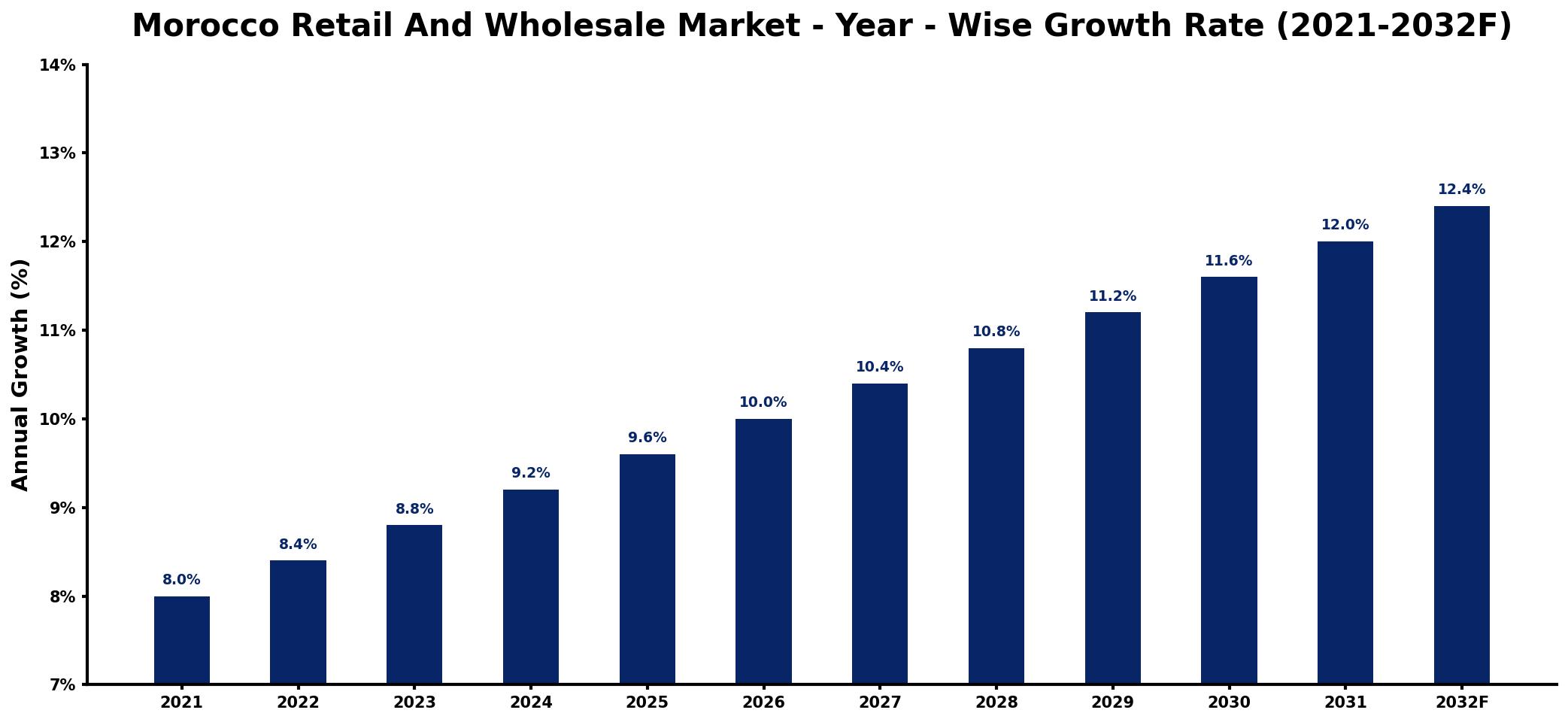
The table below presents the year‑wise growth rates along with the key drivers influencing the market
| Year | Growth Rate | Major Drivers |
| 2021 | 8.0% | Rising consumer spending power |
| 2022 | 8.4% | Expansion of e-commerce platforms |
| 2023 | 8.8% | Increased foreign direct investment |
| 2024 | 9.2% | Growth in urban population density |
| 2025 | 9.6% | Development of logistics infrastructure |
| 2026 | 10.0% | Emergence of new market players |
| 2027 | 10.4% | Technological advancements in supply chain |
| 2028 | 10.8% | Diversification of product offerings |
| 2029 | 11.2% | Strengthening of local manufacturing |
| 2030 | 11.6% | Enhanced distribution network efficiency |
| 2031 | 12.0% | Growing demand for sustainable practices |
| 2032 | 12.4% | Rise in digital payment solutions |
Note: Market size estimations and growth projections presented in this report are based on 6Wresearch's proprietary forecasting methodology, utilizing the latest available industry data, government publications, and primary research inputs.
Morocco Retail And Wholesale Market Synopsis
The retail and wholesale landscape in Morocco is undergoing a notable evolution, blending traditional commerce with modern retail innovations. This market is characterized by a vibrant mix of traditional souks, contemporary shopping malls, and the rapid rise of e-commerce, catering to a diverse array of consumer preferences.
At the forefront of this transformation is a growing middle class, which is redefining consumer behavior and expectations. Key sectors, including food and beverages, clothing, electronics, and home goods, are thriving as foreign investments pour into the market, further invigorating the competition.
Morocco Retail And Wholesale Market Key Takeaways
- The retail and wholesale market is projected to reach USD 1352 Million by 2032, indicating strong growth potential.
- A significant shift towards online shopping is reshaping consumer purchasing habits in Morocco.
- Government initiatives are fostering a competitive and transparent business environment for both local and international players.
- Sustainability and ethical consumerism are driving demand for eco-friendly products.
- Investment opportunities abound in logistics and distribution networks to support the evolving market.
Evaluation of Restraints in Morocco Retail And Wholesale Market
Despite its growth potential, the Morocco retail and wholesale market faces several challenges that could impede progress. Intense competition from both local and international players presents constant pressure on pricing and service quality. Moreover, fluctuating economic conditions, including currency exchange rates, can directly affect consumer purchasing power, complicating market dynamics.
Regulatory hurdles and bureaucratic red tape often create barriers for new entrants, while inadequate infrastructure, particularly in transportation and logistics, further complicates distribution efforts. To navigate these challenges effectively, businesses must remain agile and proactive, employing innovative strategies and technologies to optimize their operations.
Morocco Retail And Wholesale Market Trends
Current trends shaping the Morocco retail and wholesale market reflect a marked shift towards digitalization, with online shopping gaining traction among consumers who value convenience and variety. This evolution is coupled with a rising demand for sustainability, as more consumers actively seek out eco-friendly and socially responsible products.
Furthermore, the rise of experiential retail highlights consumers' desire for engaging shopping experiences, prompting retailers to rethink their strategies. Omnichannel approaches are also gaining prevalence, as businesses integrate their online and offline operations to deliver a seamless shopping experience, thereby catering to the multifaceted needs of modern consumers.
Morocco Retail And Wholesale Market Opportunities
The evolving landscape of Morocco's retail and wholesale market offers numerous investment opportunities. The burgeoning e-commerce sector stands out, driven by increased internet penetration and a tech-savvy population seeking convenience. Traditional retail remains robust, particularly in food, apparel, and household goods, providing ample room for growth and diversification.
Investments in logistics and distribution are increasingly critical, as they can significantly enhance operational efficiencies and market reach. As the consumer base continues to evolve, so too does the potential for innovative products and services designed to meet changing preferences, presenting an attractive avenue for investors.
Government Initiatives in the Morocco Retail And Wholesale Market
The Moroccan government plays a pivotal role in shaping the retail and wholesale landscape through various policies aimed at bolstering economic development. Initiatives to support small and medium-sized enterprises, such as financial assistance and technical resources, enhance the competitive landscape, particularly for local businesses.
Regulations ensuring fair competition help create a transparent business environment. Additionally, efforts to improve infrastructure are vital for facilitating smoother logistics and distribution channels, underscoring the government's commitment to fostering a sustainable retail ecosystem.
Future Insights of the Morocco Retail And Wholesale Market
Looking ahead to 2026-2032, the Morocco retail and wholesale market is positioned for substantial growth, driven by persistent urbanization, economic stability, and an increasingly confident consumer base. Modern retail formats, including shopping malls and e-commerce platforms, are expected to gain further traction, reshaping the shopping landscape.
However, businesses will need to remain vigilant in adapting to regulatory changes and emerging consumer preferences. By fostering innovation and embracing digital transformation, market players can seize the numerous opportunities ahead while navigating potential challenges on the horizon.
Morocco Retail And Wholesale Market Latest Developments (2025 - 2026)
In recent months, the Morocco retail and wholesale market has seen a surge in digital initiatives as retailers increasingly adopt e-commerce platforms to meet evolving consumer demands. Experiential retail concepts are gaining ground, leading to the introduction of interactive shopping environments within physical stores. Furthermore, the government's continued investment in infrastructure aims to enhance transportation networks, facilitating smoother operations for retail businesses.
Morocco Retail And Wholesale Market - Key Attractiveness of the Report
- 10 Years of Market Numbers
- Historical Data Starting from 2022 to 2025
- Base Year: 2025
- Forecast Data until 2032
- Key Performance Indicators Impacting the Market
- Major Upcoming Developments and Projects
Key Highlights of the Report:
- Morocco Retail And Wholesale Market Outlook
- Market Size of Morocco Retail And Wholesale Market, 2025
- Forecast of Morocco Retail And Wholesale Market, 2032
- Historical Data and Forecast of Morocco Retail And Wholesale Revenues & Volume for the Period 2022-2032F
- Morocco Retail And Wholesale Market Trend Evolution
- Morocco Retail And Wholesale Market Drivers and Challenges
- Morocco Retail And Wholesale Price Trends
- Morocco Retail And Wholesale Porter's Five Forces
- Morocco Retail And Wholesale Industry Life Cycle
- Historical Data and Forecast of Morocco Retail And Wholesale Market Revenues & Volume By Type for the Period 2022-2032F
- Historical Data and Forecast of Morocco Retail And Wholesale Market Revenues & Volume By Retail for the Period 2022-2032F
- Historical Data and Forecast of Morocco Retail And Wholesale Market Revenues & Volume By Wholesale for the Period 2022-2032F
- Historical Data and Forecast of Morocco Retail And Wholesale Market Revenues & Volume By Ownership for the Period 2022-2032F
- Historical Data and Forecast of Morocco Retail And Wholesale Market Revenues & Volume By Retail Chain/Wholesale Chain for the Period 2022-2032F
- Historical Data and Forecast of Morocco Retail And Wholesale Market Revenues & Volume By Independent Retailer/Independent Wholesalers for the Period 2022-2032F
- Historical Data and Forecast of Morocco Retail And Wholesale Market Revenues & Volume By Price Range for the Period 2022-2032F
- Historical Data and Forecast of Morocco Retail And Wholesale Market Revenues & Volume By Premium for the Period 2022-2032F
- Historical Data and Forecast of Morocco Retail And Wholesale Market Revenues & Volume By Mid-Range for the Period 2022-2032F
- Historical Data and Forecast of Morocco Retail And Wholesale Market Revenues & Volume By Economy for the Period 2022-2032F
- Historical Data and Forecast of Morocco Retail And Wholesale Market Revenues & Volume By Distribution Channel for the Period 2022-2032F
- Historical Data and Forecast of Morocco Retail And Wholesale Market Revenues & Volume By Supermarkets/Hypermarkets for the Period 2022-2032F
- Historical Data and Forecast of Morocco Retail And Wholesale Market Revenues & Volume By Convenience Stores for the Period 2022-2032F
- Historical Data and Forecast of Morocco Retail And Wholesale Market Revenues & Volume By Department Stores for the Period 2022-2032F
- Historical Data and Forecast of Morocco Retail And Wholesale Market Revenues & Volume By Specialty Stores for the Period 2022-2032F
- Morocco Retail And Wholesale Import Export Trade Statistics
- Market Opportunity Assessment By Type
- Market Opportunity Assessment By Ownership
- Market Opportunity Assessment By Price Range
- Market Opportunity Assessment By Distribution Channel
- Morocco Retail And Wholesale Top Companies Market Share
- Morocco Retail And Wholesale Competitive Benchmarking By Technical and Operational Parameters
- Morocco Retail And Wholesale Company Profiles
- Morocco Retail And Wholesale Key Strategic Recommendations






































