Morocco Secondhand Apparel Market Size, Share & Growth Rate
The Morocco Secondhand Apparel Market was estimated at USD 470 Million in 2025 and is projected to reach USD 638 Million by 2032, growing at a CAGR of 4.5% from 2026 to 2032. This robust growth trajectory is primarily driven by a burgeoning awareness of sustainability, with consumers increasingly opting for eco-friendly clothing alternatives. Additionally, the rising popularity of vintage fashion and unique styles is encouraging Moroccan shoppers to explore secondhand options that offer both affordability and individuality.
Morocco Secondhand Apparel Market Year-wise Growth Rate and Key Drivers
This graph highlights how the Morocco Secondhand Apparel Market has steadily grown over the years, supported by major growth factors.
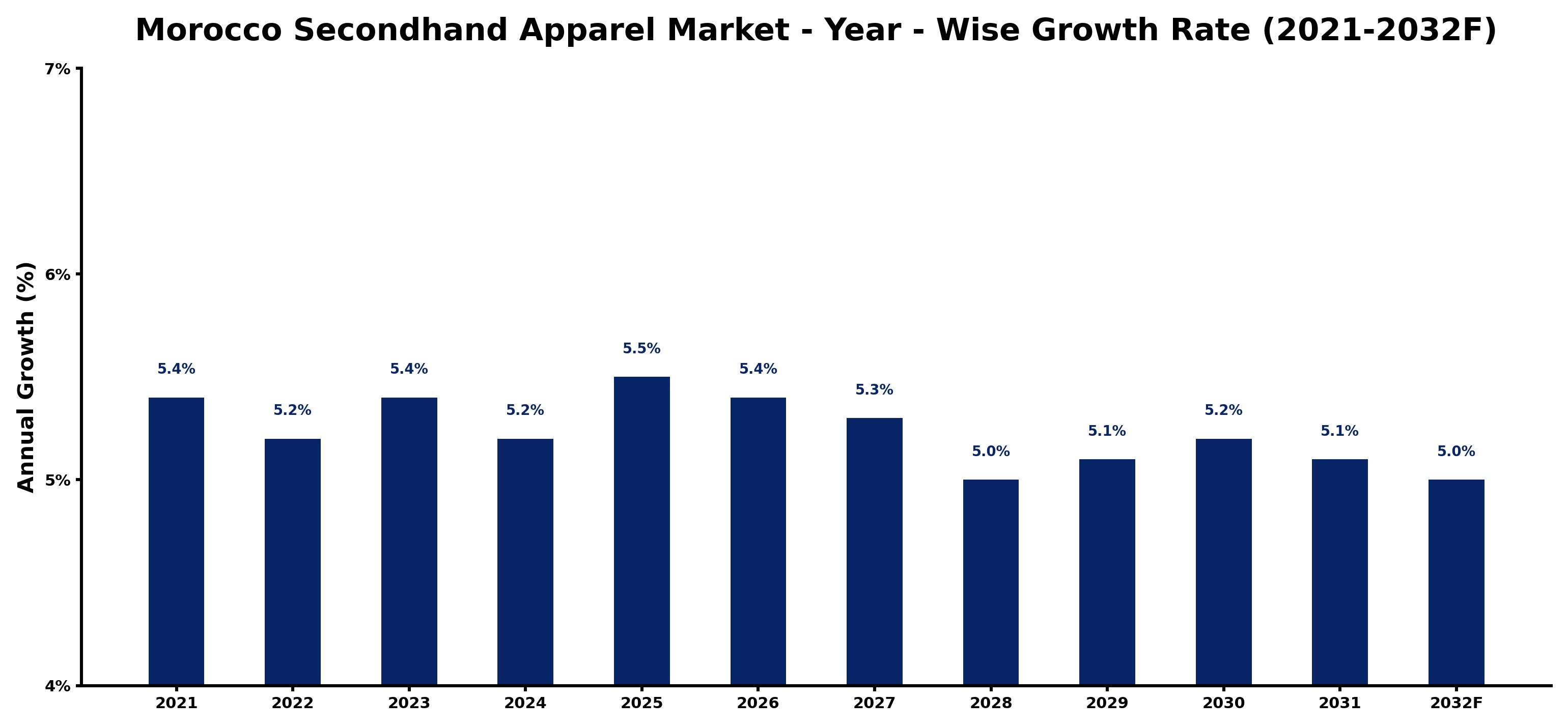
The table below presents the year‑wise growth rates along with the key drivers influencing the market
| Year | Growth Rate | Major Drivers |
| 2021 | 5.4% | Increasing adoption of advanced technologies |
| 2022 | 5.2% | Rising electricity demand across industries |
| 2023 | 5.4% | Rapid growth in telecom and data center sectors |
| 2024 | 5.2% | Growing urbanization and commercial development |
| 2025 | 5.5% | Increasing adoption of advanced technologies |
| 2026 | 5.4% | Government infrastructure modernization initiatives |
| 2027 | 5.3% | Growing urbanization and commercial development |
| 2028 | 5.0% | Rapid growth in telecom and data center sectors |
| 2029 | 5.1% | Expansion of transportation and logistics networks |
| 2030 | 5.2% | Growing renewable energy integration projects |
| 2031 | 5.1% | Expansion of transportation and logistics networks |
| 2032 | 5.0% | Government infrastructure modernization initiatives |
Note - Market size estimations and growth projections presented in this report are based on 6Wresearch’s advanced forecasting approach, validated with industry datasets as of June 2026.
Morocco Secondhand Apparel Market Synopsis
The most significant force currently shaping the Morocco Secondhand Apparel Market is the growing consumer awareness of sustainable fashion practices. As environmental consciousness rises, shoppers are actively seeking alternatives to fast fashion, turning to secondhand apparel for its cost-effectiveness and reduced environmental impact.
In parallel, social media influencers are playing a pivotal role in promoting thrift shopping as a trendy and stylish choice. With curated thrift stores and online marketplaces becoming more prominent, the market is evolving, catering to a diverse audience eager for quality pre-loved garments.
Morocco Secondhand Apparel Market Key Takeaways
- The market is on a positive growth trajectory due to increasing sustainability awareness among consumers.
- Online platforms and social media significantly enhance market visibility and accessibility.
- Curated thrift stores are emerging, offering high-quality secondhand apparel to discerning shoppers.
- The stigma surrounding secondhand clothing is gradually diminishing, with more consumers embracing eco-friendly options.
- Investment opportunities exist in both online marketplaces and traditional retail spaces focusing on quality secondhand items.
Evaluation of Restraints in Morocco Secondhand Apparel Market
Despite the growth potential, the Morocco Secondhand Apparel Market faces several restraints. A notable challenge is the prevalence of counterfeit products, exacerbated by a lack of regulation and oversight in the secondhand sector. Additionally, social stigma persists in certain demographics, limiting acceptance of secondhand clothing. Access to quality apparel is also unequal, with rural areas facing significant shortages as most retail options concentrate in urban centers. This imbalance necessitates a concerted effort to educate consumers on the benefits of secondhand clothing while enhancing quality and availability in underserved regions.
Morocco Secondhand Apparel Market Trends
Several trends are shaping the Morocco Secondhand Apparel Market. One prominent trend is the rising inclination toward unique and vintage clothing, spurred by consumer desires for individuality and self-expression. Additionally, online platforms and mobile apps are facilitating the ease of buying and selling secondhand apparel, attracting a younger, tech-savvy audience. Furthermore, as sustainability becomes a central theme in fashion, there is an increasing shift towards circular economies, where secondhand clothing plays a vital role in sustainable consumption.
Morocco Secondhand Apparel Market Opportunities
Opportunities for growth and investment in the Morocco Secondhand Apparel Market are promising. The rising trend of sustainable fashion opens doors for new entrants, particularly those focusing on online platforms that connect sellers with a broader audience. Investors might also find potential in partnering with local thrift stores to enhance their offerings and promote sustainable practices. Engaging with social media influencers could amplify brand visibility and attract a growing customer base interested in eco-friendly fashion alternatives.
Government Initiatives in the Morocco Secondhand Apparel Market
The Moroccan government has implemented policies regarding the importation and trade of secondhand clothing, primarily aimed at protecting the local textile industry. Tariffs and duties are imposed on imported secondhand items to encourage domestic production while ensuring consumer safety through quality control measures. Such regulations reflect a balanced approach to supporting local industries while addressing the growing demand for affordable clothing options.
Future Insights of the Morocco Secondhand Apparel Market
Looking ahead to 2026-2032, the Morocco Secondhand Apparel Market is well-positioned for sustained growth. A collective shift towards ethical consumption, coupled with increasing interest in vintage fashion, is set to boost market dynamics. As more consumers embrace the benefits of circular fashion, the proliferation of online platforms dedicated to secondhand apparel is likely to enhance accessibility, catering to a broader audience eager for sustainable and affordable fashion options.
Morocco Secondhand Apparel Market Latest Developments (May 2025 - June 2026)
Recent developments in the Morocco Secondhand Apparel Market indicate a growing alignment with global sustainability trends. Numerous local initiatives have emerged, focusing on raising awareness about the benefits of secondhand clothing. Additionally, community events centered on thrift shopping and sustainable fashion are gaining traction, promoting a cultural shift toward eco-friendly consumer habits. The rise of social media campaigns further emphasizes the importance of supporting local businesses and embracing pre-loved fashion.
Morocco Secondhand Apparel Market - Key Attractiveness of the Report
- 10 Years of Market Numbers
- Historical Data Starting from 2022 to 2025
- Base Year: 2025
- Forecast Data until 2032
- Key Performance Indicators Impacting the Market
- Major Upcoming Developments and Projects
Key Highlights of the Report:
- Morocco Secondhand Apparel Market Outlook
- Market Size of Morocco Secondhand Apparel Market, 2025
- Forecast of Morocco Secondhand Apparel Market, 2032
- Historical Data and Forecast of Morocco Secondhand Apparel Revenues & Volume for the Period 2022-2032F
- Morocco Secondhand Apparel Market Trend Evolution
- Morocco Secondhand Apparel Market Drivers and Challenges
- Morocco Secondhand Apparel Price Trends
- Morocco Secondhand Apparel Porter's Five Forces
- Morocco Secondhand Apparel Industry Life Cycle
- Historical Data and Forecast of Morocco Secondhand Apparel Market Revenues & Volume By Sector for the Period 2022-2032F
- Historical Data and Forecast of Morocco Secondhand Apparel Market Revenues & Volume By Resale for the Period 2022-2032F
- Historical Data and Forecast of Morocco Secondhand Apparel Market Revenues & Volume By Traditional Thrift Stores and Donations for the Period 2022-2032F
- Historical Data and Forecast of Morocco Secondhand Apparel Market Revenues & Volume By Product Type for the Period 2022-2032F
- Historical Data and Forecast of Morocco Secondhand Apparel Market Revenues & Volume By Dresses & Tops for the Period 2022-2032F
- Historical Data and Forecast of Morocco Secondhand Apparel Market Revenues & Volume By Shirts & T-shirts for the Period 2022-2032F
- Historical Data and Forecast of Morocco Secondhand Apparel Market Revenues & Volume By Sweaters, Coats & Jackets for the Period 2022-2032F
- Historical Data and Forecast of Morocco Secondhand Apparel Market Revenues & Volume By Jeans & Pants for the Period 2022-2032F
- Historical Data and Forecast of Morocco Secondhand Apparel Market Revenues & Volume By Others for the Period 2022-2032F
- Historical Data and Forecast of Morocco Secondhand Apparel Market Revenues & Volume By Target Population for the Period 2022-2032F
- Historical Data and Forecast of Morocco Secondhand Apparel Market Revenues & Volume By Men for the Period 2022-2032F
- Historical Data and Forecast of Morocco Secondhand Apparel Market Revenues & Volume By Women for the Period 2022-2032F
- Historical Data and Forecast of Morocco Secondhand Apparel Market Revenues & Volume By Kids for the Period 2022-2032F
- Historical Data and Forecast of Morocco Secondhand Apparel Market Revenues & Volume By Sales Channel for the Period 2022-2032F
- Historical Data and Forecast of Morocco Secondhand Apparel Market Revenues & Volume By Wholesalers/Distributors for the Period 2022-2032F
- Historical Data and Forecast of Morocco Secondhand Apparel Market Revenues & Volume By Hypermarkets/Supermarkets for the Period 2022-2032F
- Historical Data and Forecast of Morocco Secondhand Apparel Market Revenues & Volume By Multi-brand Stores for the Period 2022-2032F
- Historical Data and Forecast of Morocco Secondhand Apparel Market Revenues & Volume By Independent Small Stores for the Period 2022-2032F
- Historical Data and Forecast of Morocco Secondhand Apparel Market Revenues & Volume By Departmental Stores for the Period 2022-2032F
- Historical Data and Forecast of Morocco Secondhand Apparel Market Revenues & Volume By Online Retailers for the Period 2022-2032F
- Historical Data and Forecast of Morocco Secondhand Apparel Market Revenues & Volume By Others for the Period 2022-2032F
- Morocco Secondhand Apparel Import Export Trade Statistics
- Market Opportunity Assessment By Sector
- Market Opportunity Assessment By Product Type
- Market Opportunity Assessment By Target Population
- Market Opportunity Assessment By Sales Channel
- Morocco Secondhand Apparel Top Companies Market Share
- Morocco Secondhand Apparel Competitive Benchmarking By Technical and Operational Parameters
- Morocco Secondhand Apparel Company Profiles
- Morocco Secondhand Apparel Key Strategic Recommendations






































