Morocco Two Wheeler Market Summary
The morocco two wheeler market was estimated at USD 419 Million in 2025 and is projected to reach USD 575 Million by 2032, growing at a CAGR of 5.4% from 2026 to 2032.
Morocco Two Wheeler Market Year-wise Growth Rate and Key Drivers
This graph highlights how the Morocco Two Wheeler Market has steadily grown over the past five years, supported by major growth factors.
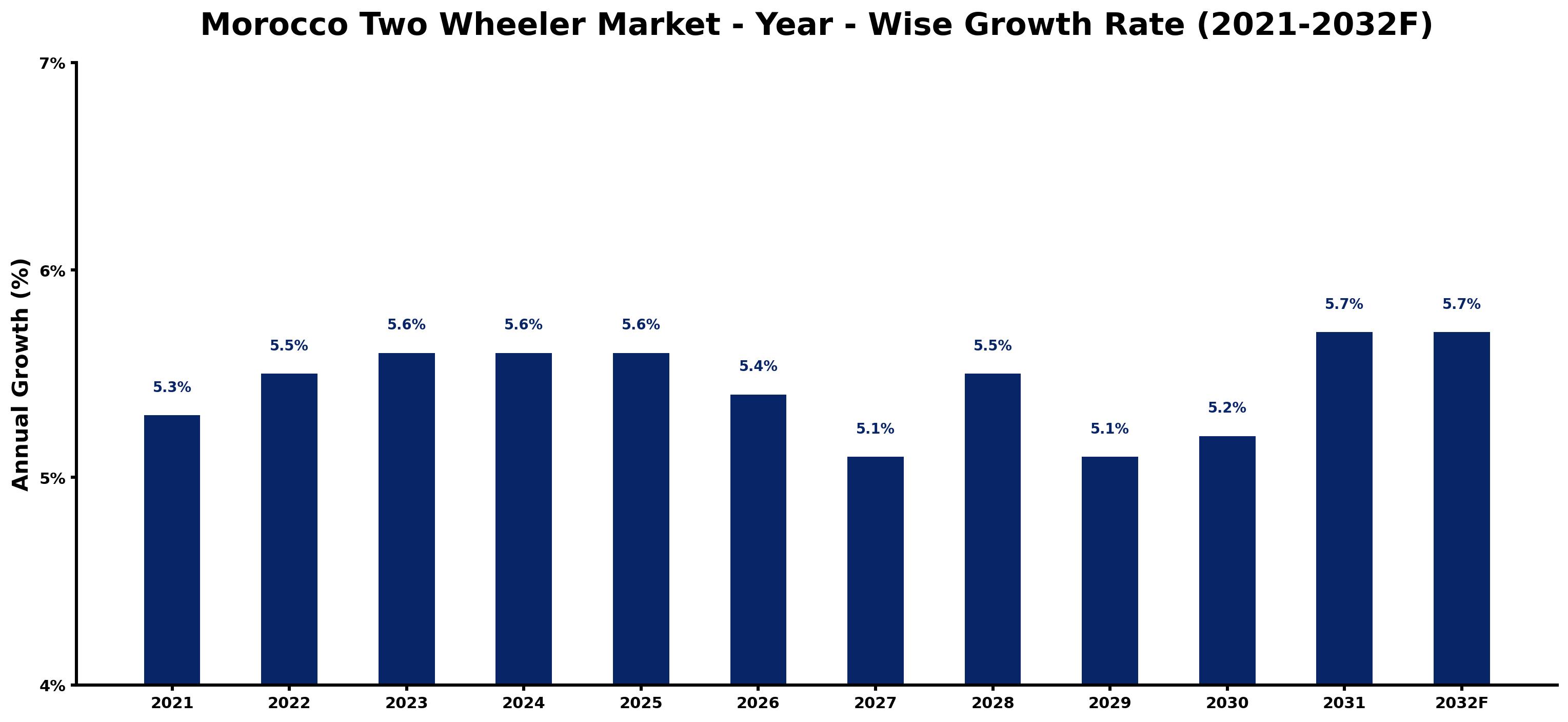
The table below presents the year wise growth rates along with the key drivers influencing the market
| Year | Growth Rate | Major Drivers |
| 2021 | 5.3% | Market recovery post-pandemic showcases increased consumer interest in two-wheelers. |
| 2022 | 5.5% | Urban congestion pushes commuters to seek more efficient transportation solutions. |
| 2023 | 5.6% | Rising fuel prices shift preferences towards electric two-wheelers among Moroccan riders. |
| 2024 | 5.6% | Expanded distribution networks improve accessibility for various two-wheeler brands. |
| 2025 | 5.6% | Local manufacturers adapt designs to meet Moroccan climate and terrain demands. |
| 2026 | 5.4% | Innovations in battery technology enhance performance and range of electric scooters. |
| 2027 | 5.1% | Rising middle-class population boosts discretionary spending on personal mobility options. |
| 2028 | 5.5% | Increased youth population drives interest in affordable and trendy two-wheeler models. |
| 2029 | 5.1% | Fuel scarcity prompts the government to promote electric vehicle infrastructure development. |
| 2030 | 5.2% | Rural electrification projects stimulate demand for two-wheelers as essential transport. |
| 2031 | 5.7% | Technological advancements lead to smarter, more connected two-wheeler solutions for users. |
| 2032 | 5.7% | Sustainability trends encourage consumers to prioritize environmentally friendly two-wheeler options. |
Note - Market size estimations and growth projections presented in this report are based on 6Wresearch's advanced forecasting approach, validated with industry datasets as of June 2026.
Morocco Two Wheeler Market Synopsis
The Morocco Two Wheeler Market is projected to reach 5.4% and witness significant growth during the forecast period (2026-2032). This growth can be attributed to factors such as a rapidly growing population, increasing disposable incomes, and the ongoing trend of urbanization across the country. The rising demand for two-wheelers is further stimulated by government initiatives promoting electric vehicles, alongside encouraging private sector innovation aimed at developing new product offerings tailored to local market preferences.
Morocco Two Wheeler Market Growth Drivers
Several prominent factors are driving the expansion of the Morocco Two Wheeler Market. Firstly, the demographic shift towards a younger population that prioritizes mobility solutions has created a solid demand base for two-wheelers. Secondly, as urban areas continue to modernize, the preference for compact and fuel-efficient vehicles like scooters becomes increasingly appealing. Additionally, the affordability of these vehicles, in contrast to cars, enhances their market penetration.
- The trend of rising disposable incomes allows consumers to invest in two-wheelers, further expanding the market.
- Urbanization is leading to the development of road infrastructure that supports two-wheeler usage.
- Government policies promoting sustainable transport options, including electric scooters, are gaining traction.
- The convenience and fuel efficiency of two-wheelers are significant selling points, especially in congested urban environments.
- Technological advancements, such as enhanced fuel efficiency and safety features, are attracting more consumers to consider two-wheelers.
Morocco Two Wheeler Market Trends and Opportunities
The Morocco Two Wheeler Market is witnessing several transformative trends. The shift towards electric two-wheelers is poised to reshape the industry, as consumers increasingly seek eco-friendly alternatives to traditional gasoline-powered vehicles. This transition is not only supported by consumer preferences but is also a response to government incentives aimed at reducing carbon emissions.
- There is a noticeable trend towards vehicles equipped with advanced safety features, such as ABS braking systems.
- Consumer demand is shifting towards higher performance motorcycles, reflecting a growing interest in leisure riding along with daily commuting.
- Innovations in battery technology for electric two-wheelers are emerging, which may increase adoption rates.
- Companies are focusing on product differentiation by offering unique design features and increased customization options.
- The rise in online platforms for sales and service is changing how consumers interact with the two-wheeler market.
Morocco Two Wheeler Market Government Investment and Initiatives
The Moroccan government has implemented various initiatives aimed at bolstering the two-wheeler market, particularly in the domain of electric vehicles. These initiatives include incentives for both manufacturers and consumers to embrace greener options. Policies aimed at reducing import tariffs on electric two-wheelers further support market growth. Furthermore, infrastructure development for electric vehicle charging stations is underway, making it more convenient for consumers to switch to electric models.
- Government programs aimed at reducing emissions provide incentives for consumers who purchase electric two-wheelers.
- Public investment in road safety initiatives is expected to enhance user confidence in two-wheelers.
- The government is facilitating partnerships between local manufacturers and foreign companies to boost product innovation.
- Educational programs are being developed to raise awareness about the benefits of electric two-wheelers.
- Infrastructure upgrades, including better road networks, will support the increasing number of two-wheelers on the roads.
Morocco Two Wheeler Market Latest Developments (May 2025 - June 2026)
Recent developments in the Morocco Two Wheeler Market highlight a significant shift towards sustainable practices. Companies have initiated the launch of new models emphasizing electric mobility. Consumer feedback has been increasingly focused on the desire for modern designs and advanced technology integration. Moreover, collaborations among various stakeholders are becoming common to enhance product reliability and customer satisfaction. This period has also seen an uptick in promotional campaigns aimed at educating potential buyers about the advantages of transitioning to two-wheelers, particularly electric models.
Morocco Two Wheeler Market - Key Attractiveness of the Report
- 10 Years of Market Numbers
- Historical Data Starting from 2022 to 2025
- Base Year: 2025
- Forecast Data until 2032
- Key Performance Indicators Impacting the Market
- Major Upcoming Developments and Projects
Key Highlights of the Report:
- Morocco Two Wheeler Market Outlook
- Market Size of Morocco Two Wheeler Market, 2025
- Forecast of Morocco Two Wheeler Market, 2032F
- Historical Data and Forecast of Morocco Two Wheeler Revenues & Volume for the Period 2022-2032F
- Morocco Two Wheeler Market Trend Evolution
- Morocco Two Wheeler Market Drivers and Challenges
- Morocco Two Wheeler Price Trends
- Morocco Two Wheeler Porter's Five Forces
- Morocco Two Wheeler Industry Life Cycle
- Historical Data and Forecast of Morocco Two Wheeler Market Revenues & Volume By Vehicle Type for the Period 2022-2032F
- Historical Data and Forecast of Morocco Two Wheeler Market Revenues & Volume By Motorcycle for the Period 2022-2032F
- Historical Data and Forecast of Morocco Two Wheeler Market Revenues & Volume By Scooter/Moped for the Period 2022-2032F
- Historical Data and Forecast of Morocco Two Wheeler Market Revenues & Volume By Engine Capacity for the Period 2022-2032F
- Historical Data and Forecast of Morocco Two Wheeler Market Revenues & Volume By Up to 125cc for the Period 2022-2032F
- Historical Data and Forecast of Morocco Two Wheeler Market Revenues & Volume By 126-250cc for the Period 2022-2032F
- Historical Data and Forecast of Morocco Two Wheeler Market Revenues & Volume By 251-500cc for the Period 2022-2032F
- Historical Data and Forecast of Morocco Two Wheeler Market Revenues & Volume By Above 500cc for the Period 2022-2032F
- Morocco Two Wheeler Import Export Trade Statistics
- Market Opportunity Assessment By Vehicle Type
- Market Opportunity Assessment By Engine Capacity
- Morocco Two Wheeler Top Companies Market Share
- Morocco Two Wheeler Competitive Benchmarking By Technical and Operational Parameters
- Morocco Two Wheeler Company Profiles
- Morocco Two Wheeler Key Strategic Recommendations






































