Morocco Yarn Market Size, Share & Growth Rate
The Morocco Yarn Market was estimated at USD 411 Million in 2025 and is projected to reach USD 536 Million by 2032, growing at a CAGR of 3.9% from 2026 to 2032. This upward trend is fueled by a robust demand for textiles and apparel, primarily in the fast-fashion sector, which is becoming increasingly influential in the region. Alongside this growth, government initiatives that encourage local production and innovation are expected to strengthen the market further.
Morocco Yarn Market Growth Rate Analysis (2021-2032)
The Morocco Yarn market has displayed a stable growth pattern over the past few years, with growth rates of 4.3% in 2021 and a steady increase to 4.8% in 2023. This upward trend is largely driven by expanding consumer demand for textiles, bolstered by investments in local manufacturing capabilities and advancements in production technology. In 2024, a slight dip to 4.3% can be attributed to short-term supply chain disruptions; however, growth resumes at 4.4% in 2025 as infrastructure improvements enhance distribution efficiency. By 2029 and 2030, the market is projected to maintain a robust 4.8% and 4.6% growth, reflecting ongoing innovations and favorable policy support that align with global energy transition initiatives.
Morocco Yarn Market Year-wise Growth Rate and Key Drivers
This graph highlights how the Morocco Yarn Market has steadily grown over the past five years, supported by major growth factors.
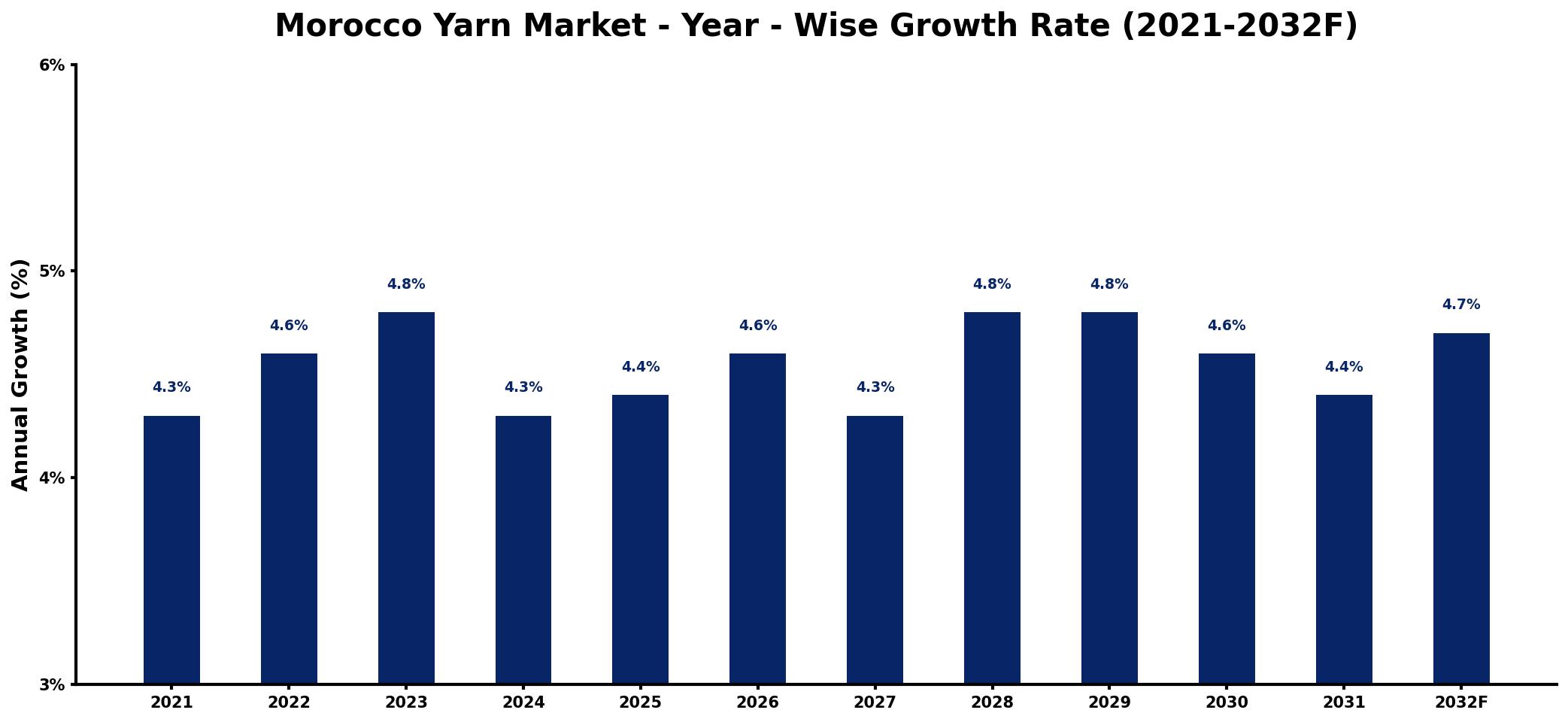
The table below presents the year‑wise growth rates along with the key drivers influencing the market
| Year | Growth Rate | Major Drivers |
| 2021 | 4.3% | Rising textile manufacturing investments |
| 2022 | 4.6% | Growing demand for sustainable materials |
| 2023 | 4.8% | Expansion in fashion industry trends |
| 2024 | 4.3% | Increase in export opportunities abroad |
| 2025 | 4.4% | Boost in local craftsmanship initiatives |
| 2026 | 4.6% | Advancements in production technology |
| 2027 | 4.3% | Growing consumer interest in quality |
| 2028 | 4.8% | Surge in eco-friendly practices adoption |
| 2029 | 4.8% | Increased collaboration with global brands |
| 2030 | 4.6% | Focus on innovative design solutions |
| 2031 | 4.4% | Strengthening supply chain networks |
| 2032 | 4.7% | Rising popularity of customized products |
Note: Market size estimations and growth projections presented in this report are based on 6Wresearch's proprietary forecasting methodology, utilizing the latest available industry data, government publications, and primary research inputs.
Morocco Yarn Market Synopsis
The Morocco yarn market is currently in a dynamic phase characterized by both domestic production and substantial imports. As the textile industry gains momentum, the demand for cotton yarn remains strong, making it the most sought-after type in the country. In addition to cotton, there is notable consumption of synthetic and blended yarns, reflecting a diverse market landscape.
In response to evolving consumer preferences, the market is increasingly embracing sustainable and eco-friendly yarn options. The confluence of local manufacturing and international imports has created a competitive environment that is poised for expansion, particularly with the influx of innovative textile practices and technology enhancements.
Morocco Yarn Market Key Takeaways
- The Morocco yarn market is significantly driven by the fast-fashion industry, indicating a shift toward rapid textile production.
- Increasing consumer preference for sustainable and eco-friendly yarn options is reshaping the market landscape.
- Local manufacturers face challenges from low-cost imports, making competitive differentiation essential.
- Government initiatives are aimed at boosting domestic production and enhancing market competitiveness.
- The market is witnessing a notable shift towards online retailing, improving access for both consumers and producers.
Evaluation of Restraints in Morocco Yarn Market
The Morocco yarn market faces significant challenges that could impede its growth trajectory. One of the primary concerns is the intense competition from low-cost yarn imports, particularly from countries with cheaper production capabilities. This influx can pressure local manufacturers to reduce prices, impacting their profitability. Fluctuations in raw material costs, especially for cotton and synthetic fibers, also contribute to an unstable financial environment for producers. Moreover, many local manufacturers still operate with outdated machinery and production techniques, limiting their ability to scale up operations and respond to market demands effectively. Therefore, strategic investments in technology and modernization are crucial to overcoming these hurdles.
Morocco Yarn Market Trends
Several notable trends are emerging within the Morocco yarn market, particularly driven by heightened consumer consciousness regarding sustainability. Natural fibers such as cotton, wool, and bamboo are becoming increasingly popular, aligning with the shift towards biodegradable materials. Furthermore, there is a growing interest in specialty yarns that offer unique textures and colors, catering to a market that values personalization and distinctive products. Online sales platforms are expanding, allowing retailers and manufacturers to reach a broader audience while accommodating the evolving shopping habits of consumers.
Morocco Yarn Market Opportunities
The Morocco yarn market is ripe with investment opportunities, particularly as the textile industry continues to flourish. Focused investments in sustainable yarn production will likely attract environmentally conscious consumers and capitalize on the rising demand for eco-friendly products. The country's strategic geographical location also offers advantages for exporting yarn products to European and African markets. By modernizing manufacturing facilities and embracing innovative production methodologies, investors can drive growth while ensuring operational efficiency. Furthermore, forming partnerships with local textile manufacturers and leveraging government incentives will enhance market penetration and foster a competitive edge in this evolving sector.
Government Initiatives in the Morocco Yarn Market
The Moroccan government has introduced various initiatives to bolster the yarn market, aiming to foster a more competitive textile sector. These policies include financial incentives for domestic manufacturers, such as tax breaks and subsidies aimed at encouraging local production. The government is also committed to enhancing overall investment in the textile industry, which serves to boost the quality and international competitiveness of Moroccan yarn products. Furthermore, regulations are being implemented to ensure that locally produced yarn meets international quality standards, contributing to the sector's credibility on a global scale.
Future Insights of the Morocco Yarn Market
Looking ahead to 2026-2032, the Morocco yarn market is positioned for steady growth. This positive outlook is supported by increasing demand for textiles and apparel both domestically and abroad. The strategic location of Morocco, acting as a gateway between Europe and Africa, alongside competitive labor costs, will continue to attract international textile manufacturers. The rising awareness of sustainability among consumers will further propel market growth, as businesses adapt to meet these evolving expectations. Nevertheless, potential challenges, including raw material price volatility and stiff competition from other textile-producing nations, necessitate careful market navigation.
Morocco Yarn Market Latest Developments (2025 - 2026)
Recent industry developments indicate a growing focus on sustainability in yarn production practices. Manufacturers are increasingly adopting eco-friendly methods to appeal to conscious consumers. The expansion of online sales channels is also notable, with many companies enhancing their digital platforms to better engage customers. Additionally, partnerships between local producers and international suppliers are on the rise, aiming to diversify product offerings and enhance market presence. Such trends reflect the evolving dynamics of the market as it adapts to consumer demands and technological advancements.
Morocco Yarn Market - Key Attractiveness of the Report
- 10 Years of Market Numbers
- Historical Data Starting from 2022 to 2025
- Base Year: 2025
- Forecast Data until 2032
- Key Performance Indicators Impacting the Market
- Major Upcoming Developments and Projects
Key Highlights of the Report:
- Morocco Yarn Market Outlook
- Market Size of Morocco Yarn Market, 2025
- Forecast of Morocco Yarn Market, 2032
- Historical Data and Forecast of Morocco Yarn Revenues & Volume for the Period 2022-2032F
- Morocco Yarn Market Trend Evolution
- Morocco Yarn Market Drivers and Challenges
- Morocco Yarn Price Trends
- Morocco Yarn Porter's Five Forces
- Morocco Yarn Industry Life Cycle
- Historical Data and Forecast of Morocco Yarn Market Revenues & Volume By Source for the Period 2022-2032F
- Historical Data and Forecast of Morocco Yarn Market Revenues & Volume By Animal for the Period 2022-2032F
- Historical Data and Forecast of Morocco Yarn Market Revenues & Volume By Chemical for the Period 2022-2032F
- Historical Data and Forecast of Morocco Yarn Market Revenues & Volume By Plant for the Period 2022-2032F
- Historical Data and Forecast of Morocco Yarn Market Revenues & Volume By Material for the Period 2022-2032F
- Historical Data and Forecast of Morocco Yarn Market Revenues & Volume By Natural Fiber for the Period 2022-2032F
- Historical Data and Forecast of Morocco Yarn Market Revenues & Volume By Synthetic Fiber for the Period 2022-2032F
- Historical Data and Forecast of Morocco Yarn Market Revenues & Volume By Material for the Period 2022-2032F
- Historical Data and Forecast of Morocco Yarn Market Revenues & Volume By Natural Fiber for the Period 2022-2032F
- Historical Data and Forecast of Morocco Yarn Market Revenues & Volume By Synthetic Fiber for the Period 2022-2032F
- Historical Data and Forecast of Morocco Yarn Market Revenues & Volume By Application for the Period 2022-2032F
- Historical Data and Forecast of Morocco Yarn Market Revenues & Volume By Apparel for the Period 2022-2032F
- Historical Data and Forecast of Morocco Yarn Market Revenues & Volume By Home Textile for the Period 2022-2032F
- Historical Data and Forecast of Morocco Yarn Market Revenues & Volume By Industrial for the Period 2022-2032F
- Morocco Yarn Import Export Trade Statistics
- Market Opportunity Assessment By Source
- Market Opportunity Assessment By Material
- Market Opportunity Assessment By Material
- Market Opportunity Assessment By Application
- Morocco Yarn Top Companies Market Share
- Morocco Yarn Competitive Benchmarking By Technical and Operational Parameters
- Morocco Yarn Company Profiles
- Morocco Yarn Key Strategic Recommendations






































