Myanmar Advertising Market Size, Share & Growth Rate
The Myanmar Advertising Market was estimated at USD 393 Million in 2025 and is projected to reach USD 537 Million by 2032, growing at a CAGR of 4.6% from 2026 to 2032. This growth trajectory is being fueled by a notable increase in internet penetration and a vibrant shift towards digital advertising platforms. As more consumers gain access to smartphones and the internet, brands are compelled to adopt innovative marketing strategies to engage a tech-savvy population.
Myanmar Advertising Market Year-wise Growth Rate and Key Drivers
This graph highlights how the Myanmar Advertising Market has steadily grown over the years, supported by major growth factors.
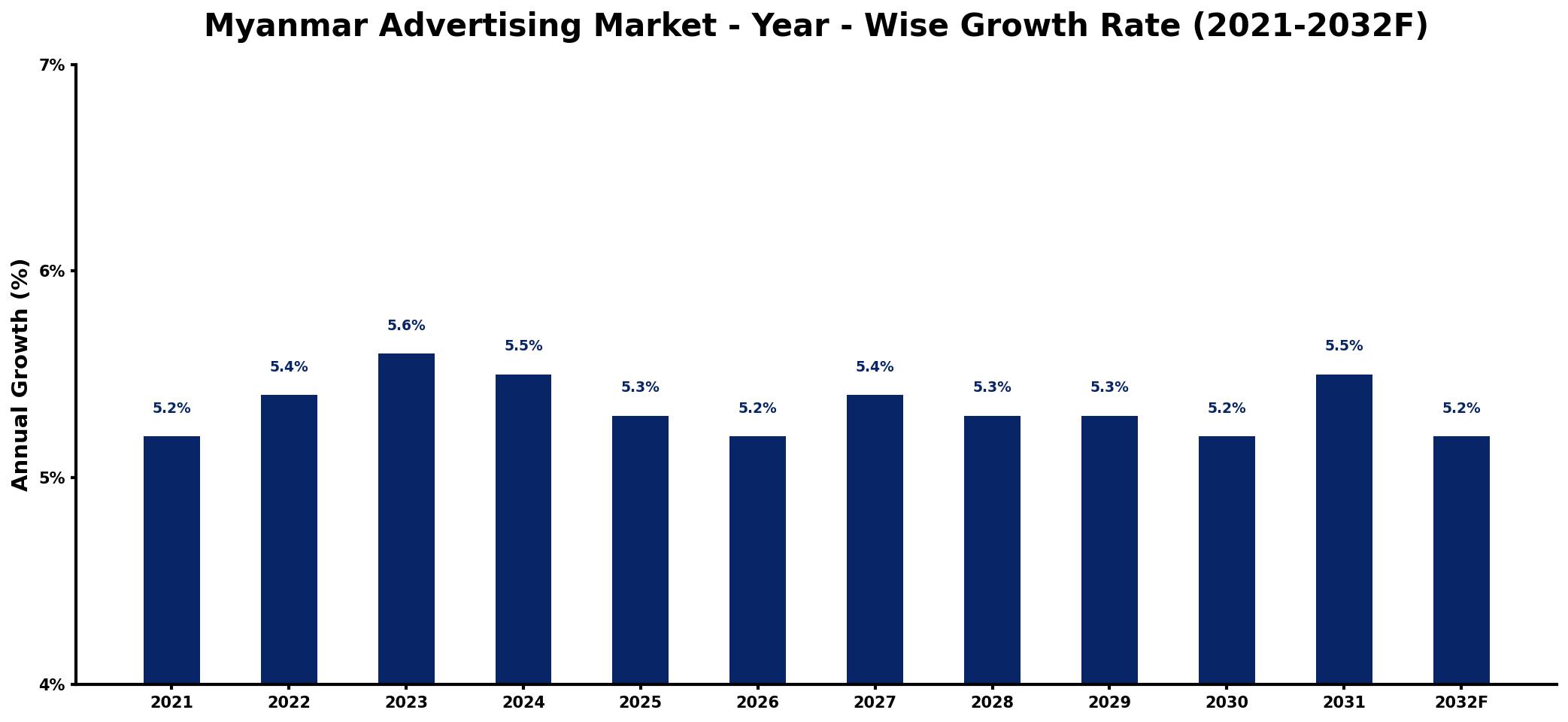
The table below presents the year‑wise growth rates along with the key drivers influencing the market
| Year | Growth Rate | Major Drivers |
| 2021 | 5.2% | Rising digital media consumption |
| 2022 | 5.4% | Increased foreign investment influx |
| 2023 | 5.6% | Expansion of mobile internet access |
| 2024 | 5.5% | Growing e-commerce sector demand |
| 2025 | 5.3% | Emerging local startup ecosystem |
| 2026 | 5.2% | Strengthening regional trade agreements |
| 2027 | 5.4% | Boost in consumer spending power |
| 2028 | 5.3% | Innovations in content creation |
| 2029 | 5.3% | Higher demand for local content |
| 2030 | 5.2% | Adoption of social media platforms |
| 2031 | 5.5% | Development of influencer marketing |
| 2032 | 5.2% | Increased focus on digital platforms |
Note: Market size estimations and growth projections presented in this report are based on 6Wresearch's proprietary forecasting methodology, utilizing the latest available industry data, government publications, and primary research inputs.
Myanmar Advertising Market Synopsis
The Myanmar advertising landscape is characterized by its youthful dynamism, as local and international brands alike explore new avenues to connect with an expanding consumer base. Traditional media forms such as television and print still hold relevance; however, digital channels are rapidly gaining traction as the preferred method of outreach.
As the country embraces a digital future, advertisers are increasingly focusing on social media platforms, influencer marketing, and mobile advertising. The unique challenges of limited infrastructure and fluctuating regulatory frameworks necessitate a tailored approach, allowing advertisers to maximize their impact in this burgeoning market.
Myanmar Advertising Market Key Takeaways
- The Myanmar advertising market is projected to grow from USD 393 Million in 2025 to USD 537 Million by 2032.
- Digital advertising is on the rise, fueled by increasing internet access and a preference for social media engagement.
- Traditional advertising mediums like television and print continue to play a significant role, particularly in rural areas.
- Advertisers are leveraging influencer partnerships to resonate with younger, tech-oriented demographics.
- Despite promising growth, challenges such as infrastructural limitations and regulatory nuances remain prevalent.
Evaluation of Restraints in Myanmar Advertising Market
Several real restraints hinder the growth of the Myanmar advertising market. A significant challenge is the country's limited infrastructure, which affects the delivery and effectiveness of campaigns. Moreover, a lack of reliable data and audience measurement tools complicates advertisers' ability to target their messaging accurately. The diverse linguistic landscape poses additional barriers to effectively reaching specific demographic segments. Furthermore, the ongoing political landscape and evolving regulatory environment add layers of uncertainty that can deter investment and complicate advertising strategies.
Myanmar Advertising Market Trends
Several trends are shaping the Myanmar advertising market today. A pronounced shift towards digital advertising is evident as brands prioritize online platforms to engage with an increasingly connected audience. Social media, particularly Facebook and Instagram, is becoming a vital tool for reaching younger consumers. The rise of influencer marketing is notable as brands seek authentic connections through local personalities who resonate with the audience. Additionally, mobile advertising is growing rapidly, driven by the widespread adoption of smartphones.
Myanmar Advertising Market Opportunities
The Myanmar advertising market holds numerous investment opportunities. The ongoing economic growth and rising consumer spending make it an attractive landscape for advertisers across multiple sectors, including FMCG, telecommunications, and e-commerce. The expanding digital footprint offers ample opportunities for targeted online advertising campaigns and collaborations with influencers. Furthermore, traditional media remains a crucial channel for brand messaging, especially in reaching wider audiences outside urban centers. Investing in local advertising agencies or digital marketing firms can provide critical insights and facilitate growth in this dynamic environment.
Government Initiatives in the Myanmar Advertising Market
The government of Myanmar has enacted regulations to ensure ethical advertising practices within the market. The Advertising Law of Myanmar prohibits misleading claims and aims to uphold public morality in advertising content. Compliance with ethical standards is mandatory, and specific products such as alcohol and tobacco face additional advertising restrictions. These policies are intended to foster a responsible advertising environment that prioritizes consumer protection and societal values.
Future Insights of the Myanmar Advertising Market
Looking ahead to 2026-2032, the Myanmar advertising market is set for substantial evolution, driven by increased internet penetration and urbanization. As more businesses recognize the value of digital platforms, investment in online advertising is expected to soar. Traditional media will still play a role, particularly in engaging demographics that rely on these channels. The anticipated political reforms and economic advancements may attract further foreign investment, further enhancing the growth potential of the advertising sector. Nevertheless, addressing infrastructural and regulatory challenges will be key to unlocking the market's full potential.
Myanmar Advertising Market Latest Developments (2025 - 2026)
In the latest developments, there has been a noticeable uptick in digital marketing initiatives as brands pivot toward more engaging online content. The rise of e-commerce has also driven advertising strategies that focus on user experience and online customer engagement. Local agencies are increasingly collaborating with international firms to bring innovative advertising solutions to the forefront, enhancing the overall landscape of the Myanmar advertising market. Additionally, discussions around regulatory reforms are gaining traction, promising to reshape advertising practices in the near future.
Myanmar Advertising Market - Key Attractiveness of the Report
- 10 Years of Market Numbers
- Historical Data Starting from 2022 to 2025
- Base Year: 2025
- Forecast Data until 2032
- Key Performance Indicators Impacting the Market
- Major Upcoming Developments and Projects
Key Highlights of the Report:
- Myanmar Advertising Market Outlook
- Market Size of Myanmar Advertising Market, 2025
- Forecast of Myanmar Advertising Market, 2032
- Historical Data and Forecast of Myanmar Advertising Revenues & Volume for the Period 2022-2032F
- Myanmar Advertising Market Trend Evolution
- Myanmar Advertising Market Drivers and Challenges
- Myanmar Advertising Price Trends
- Myanmar Advertising Porter's Five Forces
- Myanmar Advertising Industry Life Cycle
- Historical Data and Forecast of Myanmar Advertising Market Revenues & Volume By Type for the Period 2022-2032F
- Historical Data and Forecast of Myanmar Advertising Market Revenues & Volume By Television for the Period 2022-2032F
- Historical Data and Forecast of Myanmar Advertising Market Revenues & Volume By Print (Newspaper and Magazine) for the Period 2022-2032F
- Historical Data and Forecast of Myanmar Advertising Market Revenues & Volume By Radio for the Period 2022-2032F
- Historical Data and Forecast of Myanmar Advertising Market Revenues & Volume By Outdoor for the Period 2022-2032F
- Historical Data and Forecast of Myanmar Advertising Market Revenues & Volume By Internet (Search, Display, Classified, Video) for the Period 2022-2032F
- Historical Data and Forecast of Myanmar Advertising Market Revenues & Volume By Mobile for the Period 2022-2032F
- Historical Data and Forecast of Myanmar Advertising Market Revenues & Volume By Cinema for the Period 2022-2032F
- Myanmar Advertising Import Export Trade Statistics
- Market Opportunity Assessment By Type
- Myanmar Advertising Top Companies Market Share
- Myanmar Advertising Competitive Benchmarking By Technical and Operational Parameters
- Myanmar Advertising Company Profiles
- Myanmar Advertising Key Strategic Recommendations






































