Myanmar AI in Telecommunication Market Size & Growth Rate (2026-2032)
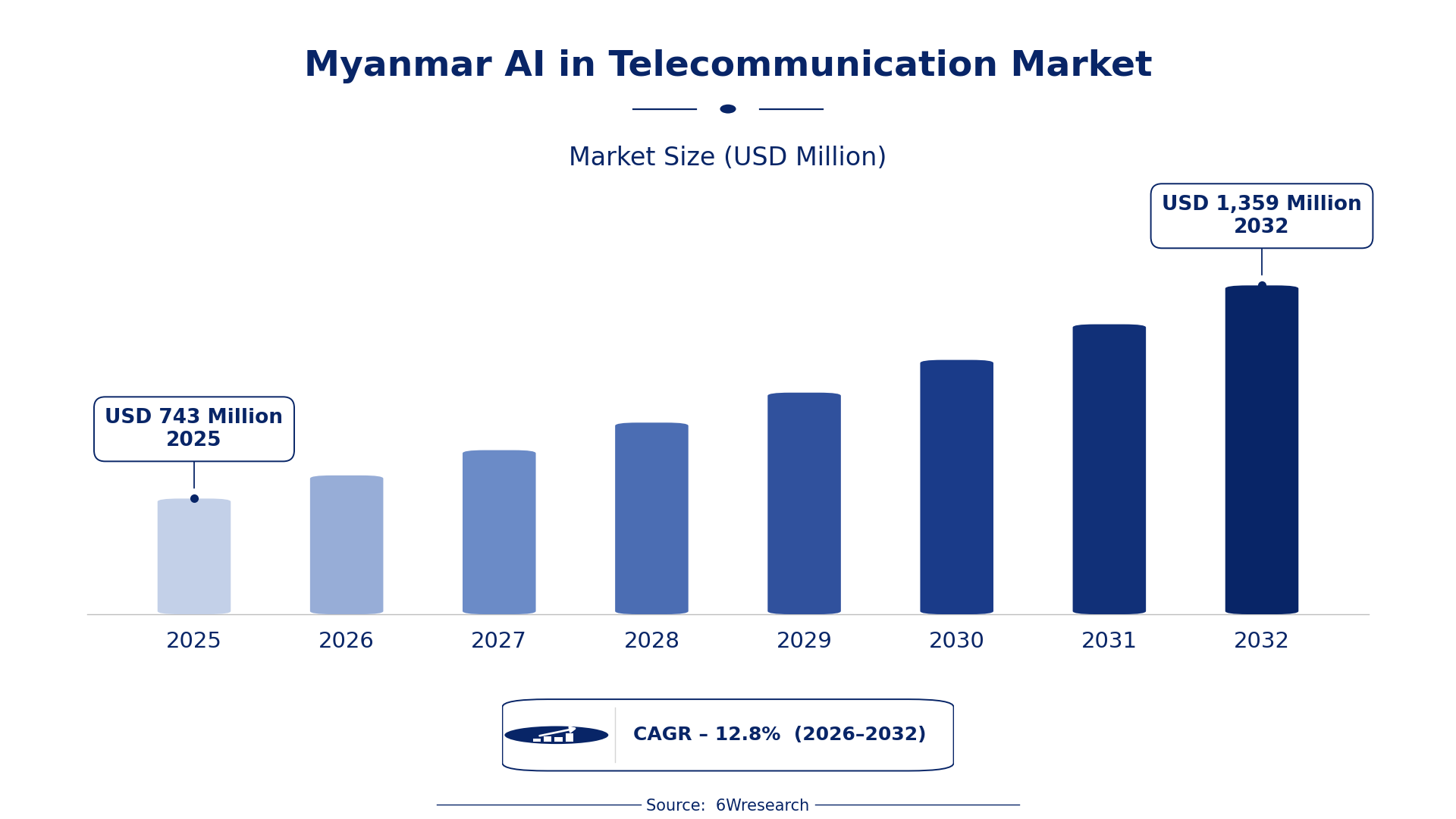
The Myanmar AI in Telecommunication Market was estimated at USD 743 Million in 2025 and is projected to reach USD 1359 Million by 2032, growing at a CAGR of 12.8% from 2026 to 2032.
Myanmar AI in Telecommunication Market Synopsis
The Myanmar AI in Telecommunication Market is currently experiencing a surge in growth, driven by increasing technological adoption among telecom companies. As operators seek to enhance customer experiences and optimize their networks, the integration of AI technologies becomes crucial for staying competitive.
Looking ahead, the market is set to evolve further, with a strong emphasis on AI-powered applications aimed at predictive maintenance and network optimization. As internet penetration continues to rise and government support solidifies, the potential for significant advancements in this sector is evident.
Myanmar AI in Telecommunication Market Year-wise Growth Rate and Key Drivers
This graph illustrates the annual growth rates of the Myanmar AI in Telecommunication Market from 2021 to 2032, highlighting a steady upward trajectory and projected expansion over the forecast period.
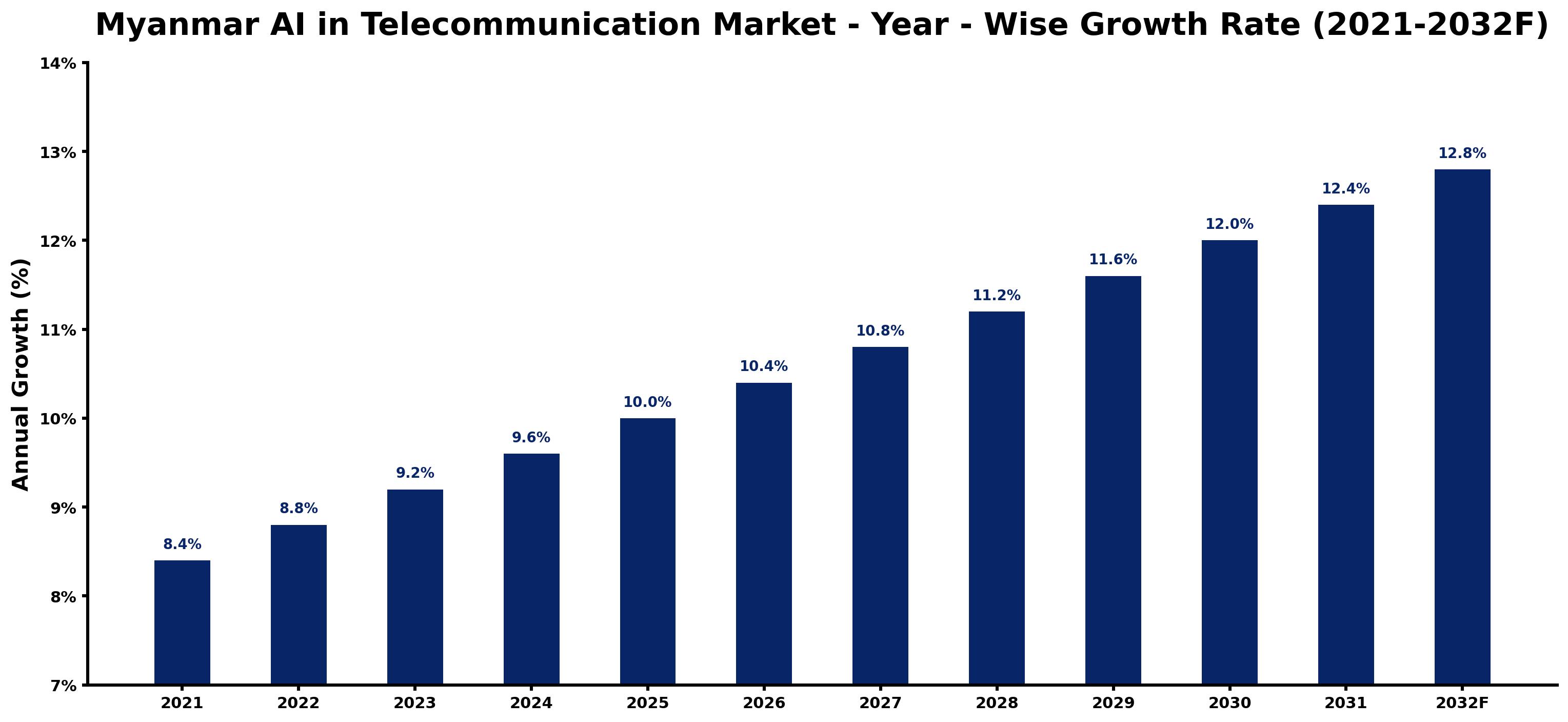
The table below presents the year‑wise growth rates along with the key drivers influencing the market
| Year | Growth Rate | Major Drivers |
| 2021 | 8.4% | Government investment in national digital transformation initiatives. |
| 2022 | 8.8% | Telecom operators adopting AI for customer service optimization. |
| 2023 | 9.2% | Increased smartphone penetration boosting AI service utilization. |
| 2024 | 9.6% | Local startups leveraging AI for innovative telecom solutions. |
| 2025 | 10.0% | Partnerships enhancing AI capabilities in telecommunications industry. |
| 2026 | 10.4% | Regulatory support for AI-driven telecommunications innovation. |
| 2027 | 10.8% | Growing consumer preference for personalized telecom services. |
| 2028 | 11.2% | Investment in AI analytics improving network performance. |
| 2029 | 11.6% | Emerging competition driving AI advancements in telecom sector. |
| 2030 | 12.0% | Rising necessity for data security enhancing AI implementations. |
| 2031 | 12.4% | Telecom infrastructure upgrades facilitating advanced AI applications. |
| 2032 | 12.8% | Workforce training programs focused on AI in telecom. |
Note: Market size estimations and growth projections presented in this report are based on 6Wresearch's proprietary forecasting methodology, utilizing the latest available industry data, government publications, and primary research inputs.
Myanmar AI in Telecommunication Market Key Takeaways
Below are some of the specific key takeaways from the market, including:
- AI applications are transforming customer service through enhanced personalization and support systems.
- The integration of AI with 5G technology is set to drive innovative solutions in the telecommunications sector.
- Regulatory support from the government is fostering an environment conducive to AI technology adoption.
- Investment opportunities are emerging, particularly in predictive analytics and network optimization solutions.
- Telecom operators are prioritizing partnerships with AI technology providers to enhance their service offerings.
Evaluation of Restraints in Myanmar AI in Telecommunication Market
The Myanmar AI in Telecommunication Market faces several barriers that could hinder its growth trajectory. Primarily, inadequate infrastructure and technological limitations restrict the effective deployment of AI systems. The shortage of skilled professionals in both AI and telecom sectors further complicates the situation. Additionally, evolving data privacy regulations pose challenges for operators aiming to comply while implementing AI solutions. Smaller companies may struggle with the high costs associated with advanced AI technologies, limiting their competitiveness.
Myanmar AI in Telecommunication Market Trends
Several key trends are shaping the Myanmar AI in Telecommunication Market. The adoption of AI-driven chatbots for customer service is rapidly increasing, allowing operators to provide efficient support. Predictive analytics is gaining traction for network maintenance, enabling operators to anticipate issues before they escalate. Furthermore, machine learning is being utilized for tailored marketing campaigns that resonate with users on a personal level. The convergence of AI and 5G technology is anticipated to yield unprecedented innovations in service delivery.
Myanmar AI in Telecommunication Market Opportunities
The Myanmar AI in Telecommunication Market is ripe with investment opportunities, particularly in areas addressing the demand for enhanced communication technology. The widespread adoption of smartphones and increased internet access are fueling the need for sophisticated AI solutions. Investors should focus on AI-driven network optimization and predictive maintenance tools, as these will be critical in improving operational efficiency. Collaborating with local telecom firms and technology startups can also yield innovative solutions tailored to the specific needs of the market.
Government Initiatives in the Myanmar AI in Telecommunication Market
Government initiatives are instrumental in shaping the Myanmar AI in Telecommunication Market. The administration has prioritized digital transformation, aiming to enhance connectivity and support infrastructure growth. This proactive stance provides a solid foundation for AI technology adoption, directly impacting the telecom sector.
- A national digital infrastructure upgrade programme launched recently aims to enhance broadband connectivity across urban and rural areas.
- Ongoing regulatory support initiatives focus on fostering collaboration between telecom operators and technology providers to drive AI integration.
- Planned public-private partnerships expected to roll out by mid-2026 will aim to boost AI research and development in telecommunications.
- The government has introduced policies emphasizing data security measures to safeguard consumer information in AI applications.
- Recent efforts include training programs for local professionals in AI and telecommunications, addressing the skills gap in the industry.
Future Insights of the Myanmar AI in Telecommunication Market
From 2026 to 2032, the Myanmar AI in Telecommunication Market is set to flourish, driven by increased demand for advanced communication services. AI applications, particularly in customer service and network management, will be crucial for operators looking to enhance efficiency. As infrastructure improvements unfold and government backing strengthens, companies will likely leverage AI technologies to redefine service offerings, ensuring they remain competitive in a rapidly changing environment.
Myanmar AI in Telecommunication Market Latest Developments
Recent months have witnessed notable advancements within the Myanmar AI in Telecommunication Market. Operators are increasingly investing in AI technologies, signaling a shift towards innovative solutions that enhance service quality and operational efficiency.
- A major technology vendor announced a partnership with a local telecom operator in early 2025, aimed at developing AI-powered network management tools.
- In Q3 2025, a leading regional operator launched a predictive maintenance system designed to reduce operational downtimes through AI analytics.
- Upcoming initiatives in late 2026 include the deployment of AI-based customer service platforms that leverage chatbots for improved user engagement.
- Current collaborations between telecom firms and AI startups are focused on developing tailored cybersecurity solutions, enhancing data protection.
- By mid-2025, the rollout of AI-driven analytics for marketing campaigns is anticipated, allowing operators to refine targeting strategies.
Myanmar AI in Telecommunication Market - Key Attractiveness of the Report
- 10 Years of Market Numbers
- Historical Data Starting from 2022 to 2025
- Base Year: 2025
- Forecast Data until 2032
- Key Performance Indicators Impacting the Market
- Major Upcoming Developments and Projects
Key Highlights of the Report:
- Myanmar AI in Telecommunication Market Outlook
- Market Size of Myanmar AI in Telecommunication Market, 2025
- Forecast of Myanmar AI in Telecommunication Market, 2032
- Historical Data and Forecast of Myanmar AI in Telecommunication Revenues & Volume for the Period 2022-2032F
- Myanmar AI in Telecommunication Market Trend Evolution
- Myanmar AI in Telecommunication Market Drivers and Challenges
- Myanmar AI in Telecommunication Price Trends
- Myanmar AI in Telecommunication Porter's Five Forces
- Myanmar AI in Telecommunication Industry Life Cycle
- Historical Data and Forecast of Myanmar AI in Telecommunication Market Revenues & Volume By Application for the Period 2022-2032F
- Historical Data and Forecast of Myanmar AI in Telecommunication Market Revenues & Volume By Customer analytics for the Period 2022-2032F
- Historical Data and Forecast of Myanmar AI in Telecommunication Market Revenues & Volume By Network security for the Period 2022-2032F
- Historical Data and Forecast of Myanmar AI in Telecommunication Market Revenues & Volume By Network optimization for the Period 2022-2032F
- Historical Data and Forecast of Myanmar AI in Telecommunication Market Revenues & Volume By Self-diagnostics for the Period 2022-2032F
- Historical Data and Forecast of Myanmar AI in Telecommunication Market Revenues & Volume By Virtual assistance for the Period 2022-2032F
- Historical Data and Forecast of Myanmar AI in Telecommunication Market Revenues & Volume By Others (contact center analytics and marketing campaign analytics) for the Period 2022-2032F
- Historical Data and Forecast of Myanmar AI in Telecommunication Market Revenues & Volume By Component for the Period 2022-2032F
- Historical Data and Forecast of Myanmar AI in Telecommunication Market Revenues & Volume By Solutions for the Period 2022-2032F
- Historical Data and Forecast of Myanmar AI in Telecommunication Market Revenues & Volume By Services for the Period 2022-2032F
- Historical Data and Forecast of Myanmar AI in Telecommunication Market Revenues & Volume By Deployment Mode for the Period 2022-2032F
- Historical Data and Forecast of Myanmar AI in Telecommunication Market Revenues & Volume By Cloud for the Period 2022-2032F
- Historical Data and Forecast of Myanmar AI in Telecommunication Market Revenues & Volume By On-premises for the Period 2022-2032F
- Historical Data and Forecast of Myanmar AI in Telecommunication Market Revenues & Volume By Technology for the Period 2022-2032F
- Historical Data and Forecast of Myanmar AI in Telecommunication Market Revenues & Volume By Machine learning and deep learning for the Period 2022-2032F
- Historical Data and Forecast of Myanmar AI in Telecommunication Market Revenues & Volume By Natural Language Processing (NLP) for the Period 2022-2032F
- Myanmar AI in Telecommunication Import Export Trade Statistics
- Market Opportunity Assessment By Application
- Market Opportunity Assessment By Component
- Market Opportunity Assessment By Deployment Mode
- Market Opportunity Assessment By Technology
- Myanmar AI in Telecommunication Top Companies Market Share
- Myanmar AI in Telecommunication Competitive Benchmarking By Technical and Operational Parameters
- Myanmar AI in Telecommunication Company Profiles
- Myanmar AI in Telecommunication Key Strategic Recommendations






































