Myanmar Animal Feed Enzymes Market Size, Share & Growth Rate
The Myanmar Animal Feed Enzymes Market was estimated at USD 383 Million in 2025 and is projected to reach USD 504 Million by 2032, growing at a CAGR of 4.0% from 2026 to 2032. This upward trajectory is primarily fueled by a burgeoning demand for high-quality animal feed, as farmers increasingly recognize the role of feed enzymes in improving livestock productivity. Additionally, a growing focus on sustainable farming practices is leading to greater adoption of enzyme-based solutions, enhancing both animal health and environmental stewardship.
Myanmar Animal Feed Enzymes Market Year-wise Growth Rate and Key Drivers
This graph highlights how the Myanmar Animal Feed Enzymes Market has steadily grown over the years, supported by major growth factors.
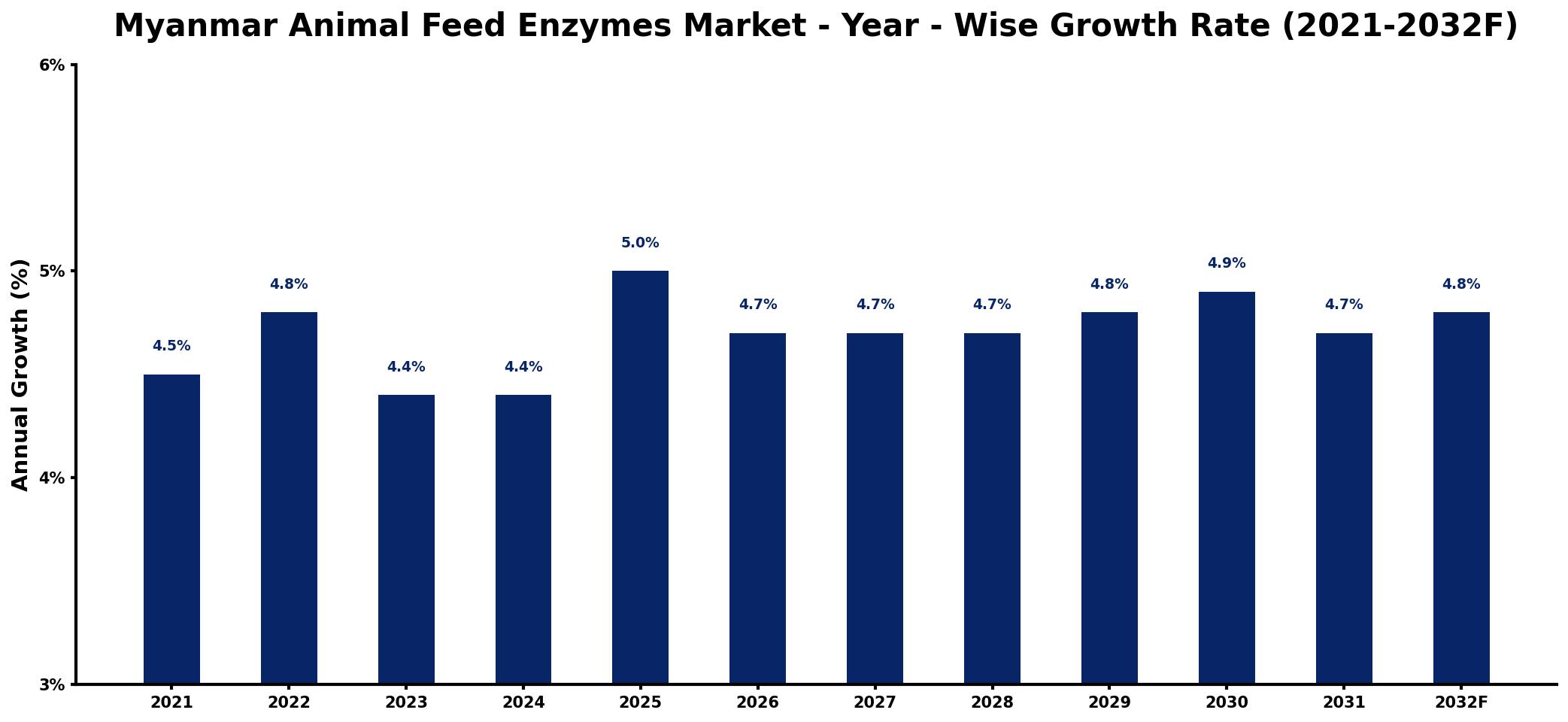
The table below presents the year‑wise growth rates along with the key drivers influencing the market
| Year | Growth Rate | Major Drivers |
| 2021 | 4.5% | Rising livestock production levels |
| 2022 | 4.8% | Increasing consumer health awareness |
| 2023 | 4.4% | Growth in poultry industry demand |
| 2024 | 4.4% | Expansion of aquaculture practices |
| 2025 | 5.0% | Investment in agricultural technology |
| 2026 | 4.7% | growing automotive sector requirements |
| 2027 | 4.7% | Enhanced nutritional standards adoption |
| 2028 | 4.7% | Growing organic farming initiatives |
| 2029 | 4.8% | Development of sustainable practices |
| 2030 | 4.9% | Rising demand for protein sources |
| 2031 | 4.7% | Strengthening of supply chain networks |
| 2032 | 4.8% | Improvement in livestock management techniques |
Note: Market size estimations and growth projections presented in this report are based on 6Wresearch's proprietary forecasting methodology, utilizing the latest available industry data, government publications, and primary research inputs.
Myanmar Animal Feed Enzymes Market Synopsis
The demand for feed enzymes in Myanmar is on the rise, driven by farmers seeking to enhance feed efficiency and reduce costs. Enzymes such as phytases and proteases are gaining traction, as they significantly improve nutrient utilization in livestock, thereby optimizing overall animal health.
Additionally, a shift towards natural and sustainable feed additives is apparent in the market, as both local farmers and feed manufacturers prioritize environmentally friendly options. This trend not only improves productivity but also aligns with global standards of sustainable agriculture.
Myanmar Animal Feed Enzymes Market Key Takeaways
- The market is witnessing growing adoption of enzymes for improved nutrient absorption in livestock.
- Phytases, proteases, and carbohydrases are the most sought-after enzyme types in the market.
- Farmers are increasingly focused on sustainable farming practices, driving demand for enzyme-based feed solutions.
- Investment in research and development is essential for creating innovative enzyme products tailored to local needs.
- A collaborative approach with local distributors will be crucial for effective market penetration.
Evaluation of Restraints in Myanmar Animal Feed Enzymes Market
Despite the positive market outlook, several limitations hinder growth in the Myanmar Animal Feed Enzymes Market. A significant barrier is the limited awareness regarding the benefits of enzyme products among local farmers and manufacturers. This knowledge gap leads to hesitancy in adopting new technologies. Furthermore, challenges with the consistent availability of high-quality enzymes at competitive prices can restrict market development. The regulatory environment also poses difficulties, as inconsistent enforcement can compromise product quality and safety, making it vital for companies to navigate these complexities effectively.
Myanmar Animal Feed Enzymes Market Trends
Current trends in the Myanmar Animal Feed Enzymes Market reveal a growing preference for natural feed additives, driven by a rising consumer demand for safe and nutritious animal products. The increasing awareness about animal welfare and environmental sustainability also promotes the use of enzyme-based solutions. Technologically, advancements in enzyme formulation and application are enabling better performance in livestock nutrition, thereby expanding the scope of their usage in the industry.
Myanmar Animal Feed Enzymes Market Opportunities
The landscape of opportunities in the Myanmar Animal Feed Enzymes Market is promising. As livestock production expands, there is a pressing need for effective feed solutions that enhance productivity and health. Investment in the local production and distribution of tailored enzyme products can yield lucrative returns. Moreover, developing partnerships with local agricultural entities will facilitate broader market access and solidify a company's position within this growing segment.
Government Initiatives in the Myanmar Animal Feed Enzymes Market
Government policies aimed at promoting sustainable agriculture practices are increasingly impacting the Myanmar Animal Feed Enzymes Market. Authorities encourage the integration of enzyme additives in livestock feed to enhance feed efficiency while mitigating environmental effects. Furthermore, regulations have been instituted to oversee the quality and safety of feed enzymes, safeguarding animal health and supporting food safety initiatives. With ongoing support for research and innovation, the government is positioning itself as a key player in fostering a robust and responsible animal feed sector.
Future Insights of the Myanmar Animal Feed Enzymes Market
Looking ahead to 2026-2032, the Myanmar Animal Feed Enzymes Market is set to evolve significantly, driven by increasing demands for high-quality protein and efficient production methods. As the country's population and disposable income continue to rise, the necessity for effective feed solutions will grow. Adoption of enzyme technologies will not only enhance feed conversion efficiencies but also promote healthier livestock, leading to a more sustainable farming framework. Despite existing awareness challenges, the shift towards comprehensive education and outreach will likely bolster market acceptance and growth.
Myanmar Animal Feed Enzymes Market Latest Developments (2025 - 2026)
Recent developments in the Myanmar Animal Feed Enzymes Market reflect an increasing focus on innovation and product diversification. Companies are actively working on formulating new enzyme blends to address specific nutritional deficiencies prevalent in local livestock. Initiatives aimed at educating farmers about the efficacy of these enzymes are also gaining traction, fostering a deeper understanding of their benefits. Additionally, collaborations between research institutions and feed manufacturers are emerging, aimed at enhancing product offerings and market presence.
Myanmar Animal Feed Enzymes Market - Key Attractiveness of the Report
- 10 Years of Market Numbers
- Historical Data Starting from 2022 to 2025
- Base Year: 2025
- Forecast Data until 2032
- Key Performance Indicators Impacting the Market
- Major Upcoming Developments and Projects
Key Highlights of the Report:
- Myanmar Animal Feed Enzymes Market Outlook
- Market Size of Myanmar Animal Feed Enzymes Market, 2025
- Forecast of Myanmar Animal Feed Enzymes Market, 2032
- Historical Data and Forecast of Myanmar Animal Feed Enzymes Revenues & Volume for the Period 2022-2032F
- Myanmar Animal Feed Enzymes Market Trend Evolution
- Myanmar Animal Feed Enzymes Market Drivers and Challenges
- Myanmar Animal Feed Enzymes Price Trends
- Myanmar Animal Feed Enzymes Porter's Five Forces
- Myanmar Animal Feed Enzymes Industry Life Cycle
- Historical Data and Forecast of Myanmar Animal Feed Enzymes Market Revenues & Volume By Formulation for the Period 2022-2032F
- Historical Data and Forecast of Myanmar Animal Feed Enzymes Market Revenues & Volume By Dry for the Period 2022-2032F
- Historical Data and Forecast of Myanmar Animal Feed Enzymes Market Revenues & Volume By Liquid for the Period 2022-2032F
- Historical Data and Forecast of Myanmar Animal Feed Enzymes Market Revenues & Volume By Product for the Period 2022-2032F
- Historical Data and Forecast of Myanmar Animal Feed Enzymes Market Revenues & Volume By Phytase for the Period 2022-2032F
- Historical Data and Forecast of Myanmar Animal Feed Enzymes Market Revenues & Volume By Carbohydrase for the Period 2022-2032F
- Historical Data and Forecast of Myanmar Animal Feed Enzymes Market Revenues & Volume By Protease for the Period 2022-2032F
- Historical Data and Forecast of Myanmar Animal Feed Enzymes Market Revenues & Volume By Non starch polysaccharides for the Period 2022-2032F
- Historical Data and Forecast of Myanmar Animal Feed Enzymes Market Revenues & Volume By Livestock for the Period 2022-2032F
- Historical Data and Forecast of Myanmar Animal Feed Enzymes Market Revenues & Volume By Poultry for the Period 2022-2032F
- Historical Data and Forecast of Myanmar Animal Feed Enzymes Market Revenues & Volume By Swine for the Period 2022-2032F
- Historical Data and Forecast of Myanmar Animal Feed Enzymes Market Revenues & Volume By Ruminant for the Period 2022-2032F
- Historical Data and Forecast of Myanmar Animal Feed Enzymes Market Revenues & Volume By Aquaculture for the Period 2022-2032F
- Historical Data and Forecast of Myanmar Animal Feed Enzymes Market Revenues & Volume By Others for the Period 2022-2032F
- Myanmar Animal Feed Enzymes Import Export Trade Statistics
- Market Opportunity Assessment By Formulation
- Market Opportunity Assessment By Product
- Market Opportunity Assessment By Livestock
- Myanmar Animal Feed Enzymes Top Companies Market Share
- Myanmar Animal Feed Enzymes Competitive Benchmarking By Technical and Operational Parameters
- Myanmar Animal Feed Enzymes Company Profiles
- Myanmar Animal Feed Enzymes Key Strategic Recommendations






































