Myanmar Asphalt Market Summary
The myanmar asphalt market was estimated at USD 446 Million in 2025 and is projected to reach USD 615 Million by 2032, growing at a CAGR of 5.2% from 2026 to 2032.
Myanmar Asphalt Market Year-wise Growth Rate and Key Drivers
This graph highlights how the Myanmar Asphalt Market has steadily grown over the past five years, supported by major growth factors.
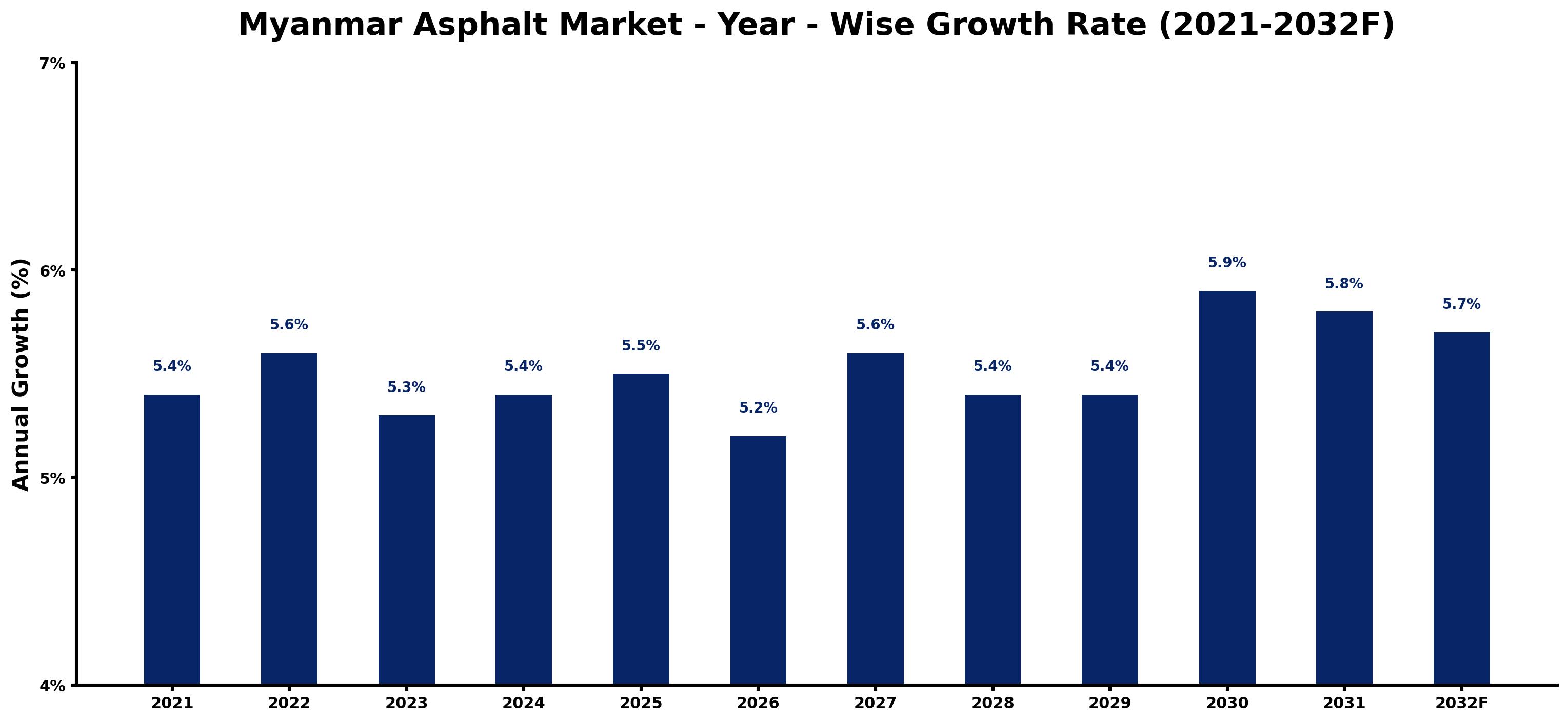
The table below presents the year wise growth rates along with the key drivers influencing the market
| Year | Growth Rate | Major Drivers |
| 2021 | 5.4% | Post-coup reconstruction efforts emphasize critical infrastructure development, boosting asphalt needs. |
| 2022 | 5.6% | Rural connectivity projects gain traction, enhancing asphalt demand in remote areas. |
| 2023 | 5.3% | Foreign investments increase, with construction firms seeking reliable asphalt suppliers. |
| 2024 | 5.4% | Urbanization accelerates, creating a need for better road networks and asphalt solutions. |
| 2025 | 5.5% | Technological improvements in asphalt production enhance quality and reduce costs significantly. |
| 2026 | 5.2% | Regional trade partnerships expand, facilitating imported raw materials for asphalt manufacturing. |
| 2027 | 5.6% | Public-private partnerships emerge, focusing on sustainable infrastructure and asphalt innovation. |
| 2028 | 5.4% | Infrastructure spending rises as economic recovery stabilizes post-pandemic market conditions. |
| 2029 | 5.4% | Green construction trends influence asphalt manufacturers to explore eco-friendly materials. |
| 2030 | 5.9% | Increased vehicle ownership correlates with heightened road maintenance and asphalt resurfacing. |
| 2031 | 5.8% | Urban planning initiatives prioritize sustainable transport corridors, further driving asphalt demand. |
| 2032 | 5.7% | Technological shifts toward smart materials are reshaping the asphalt landscape significantly. |
Note - Market size estimations and growth projections presented in this report are based on 6Wresearch's advanced forecasting approach, validated with industry datasets as of June 2026.
Myanmar Asphalt Market Synopsis
The Myanmar Asphalt Market is projected to reach 5.2% and witness significant growth during the forecast period (2026-2032). This growth is primarily driven by robust infrastructure development initiatives undertaken by the government, aimed at enhancing transportation networks across the country. As various projects related to road construction and maintenance gain momentum, the demand for asphalt products continues to rise, offering various investment opportunities for both local and international stakeholders.
Myanmar Asphalt Market Growth Drivers
The growth trajectory of the Myanmar Asphalt Market is influenced by multiple factors that collectively enhance its demand. Key drivers include:
- The government's commitment to infrastructure development fosters a conducive environment for the rapid expansion of the asphalt market, with significant funding directed towards new road and bridge projects.
- An upsurge in urbanization and population growth necessitates improved transportation infrastructure, further boosting the demand for asphalt in road and pavement applications.
- The evolving real estate sector is driving the requirement for asphalt in road access and parking solutions, ultimately increasing the market's size.
- Rising preferences for high-performance and modified asphalt products cater to these new demands, enhancing durability and performance in challenging climatic conditions.
- The push towards more sustainable construction practices encourages investments in eco-friendly asphalt technologies, aligning with global sustainability trends.
Myanmar Asphalt Market Trends and Opportunities
The Myanmar Asphalt Market is currently undergoing transformative trends that present numerous opportunities for growth. Key trends include:
- There is an increasing preference for modified asphalt solutions which provide superior durability and better performance under varied climatic conditions, making them ideal for a developing infrastructure landscape.
- Investments in research and development are yielding innovative asphalt products that incorporate advanced technologies, appealing to modern construction needs.
- Increased government focus on enhancing transportation connectivity and infrastructure quality creates a favorable environment for investment in asphalt production capabilities.
- The growing awareness and regulatory push towards sustainable practices in road construction are leading to an uptick in the adoption of eco-friendly asphalt alternatives.
- Strategic partnerships between construction firms and asphalt manufacturers are emerging to ensure long-term supply contracts, enhancing stability in the market.
Myanmar Asphalt Market Challenges and Restraints
While the Myanmar Asphalt Market exhibits substantial growth potential, it is not without its challenges. Key issues include:
- Inconsistent quality of asphalt products impedes market growth, as quality variations lead to project delays and increased costs for contractors.
- Limited local availability of raw materials necessary for asphalt production results in dependency on imports, leading to price fluctuations and supply chain issues.
- Inadequate infrastructure for transportation and logistics affects the timely delivery of asphalt products, further complicating project execution timelines.
- The lack of standardized regulations and quality control measures creates an uneven playing field for asphalt manufacturers and suppliers, inhibiting healthy competition.
- Competition from alternative paving materials like concrete poses a threat to market share stability and profitability for asphalt providers in Myanmar.
Myanmar Asphalt Market Investment Opportunities
The potential for investment in the Myanmar Asphalt Market is considerable, with several promising avenues available for stakeholders. Opportunities include:
- Setting up asphalt manufacturing facilities to meet the burgeoning demand driven by government infrastructure projects presents a viable investment path.
- Importing advanced technology and machinery can enhance production efficiency, allowing companies to cater to high-quality product requirements.
- Forming strategic alliances with local construction firms ensures consistent demand and fosters long-term relationships that benefit both parties.
- Investing in the development of innovative asphalt solutions tailored to Myanmar's unique climate and geological conditions can provide a competitive advantage.
- Capitalizing on the trend towards sustainability by investing in eco-friendly asphalt technologies may not only align with regulatory expectations but appeal to environmentally conscious consumers.
Myanmar Asphalt Market Government Investment and Initiatives
The landscape of the Myanmar Asphalt Market is significantly shaped by government policies and investment strategies. The government is focused on promoting sustainable infrastructure development through multiple initiatives. Key investments include:
- Increased public spending on road construction and maintenance projects aims to enhance transportation networks and connectivity across the nation.
- Regulatory measures have been implemented to ensure the quality and standards of asphalt used in public works, thereby enhancing the longevity of infrastructure.
- Initiatives encouraging the adoption of innovative technologies within the asphalt industry are being promoted to heighten production efficiency and lower environmental impact.
- Programs aimed at training local professionals in asphalt production and application are being established to counteract the challenge of limited technical expertise.
- The government is advocating for collaborations between private investors and public entities to foster infrastructure improvements that mutually benefit both sectors.
Myanmar Asphalt Market Latest Developments (May 2025 - June 2026)
Between May 2025 and June 2026, the Myanmar Asphalt Market has seen notable developments that reflect its dynamic nature. Key trends during this period include an acceleration in infrastructure projects, driven by an increase in governmental funding and private investment. Efforts to improve the quality of asphalt products through stricter regulations have gained traction, aimed at ensuring consistency and durability in construction. Additionally, there has been a significant push towards adopting sustainable practices in asphalt production, aligning with global environmental standards. Moreover, collaborative projects between governmental bodies and private sectors are expected to evolve, further enhancing the market landscape.
Myanmar Asphalt Market - Key Attractiveness of the Report
- 10 Years of Market Numbers
- Historical Data Starting from 2022 to 2025
- Base Year: 2025
- Forecast Data until 2032
- Key Performance Indicators Impacting the Market
- Major Upcoming Developments and Projects
Key Highlights of the Report:
- Myanmar Asphalt Market Outlook
- Market Size of Myanmar Asphalt Market, 2025
- Forecast of Myanmar Asphalt Market, 2032F
- Historical Data and Forecast of Myanmar Asphalt Revenues & Volume for the Period 2022-2032F
- Myanmar Asphalt Market Trend Evolution
- Myanmar Asphalt Market Drivers and Challenges
- Myanmar Asphalt Price Trends
- Myanmar Asphalt Porter's Five Forces
- Myanmar Asphalt Industry Life Cycle
- Historical Data and Forecast of Myanmar Asphalt Market Revenues & Volume By Type for the Period 2022-2032F
- Historical Data and Forecast of Myanmar Asphalt Market Revenues & Volume By Paving Petroleum Asphalt for the Period 2022-2032F
- Historical Data and Forecast of Myanmar Asphalt Market Revenues & Volume By Industrial Petroleum Asphalt for the Period 2022-2032F
- Historical Data and Forecast of Myanmar Asphalt Market Revenues & Volume By Others for the Period 2022-2032F
- Historical Data and Forecast of Myanmar Asphalt Market Revenues & Volume By Application for the Period 2022-2032F
- Historical Data and Forecast of Myanmar Asphalt Market Revenues & Volume By Paving for the Period 2022-2032F
- Historical Data and Forecast of Myanmar Asphalt Market Revenues & Volume By Roofing for the Period 2022-2032F
- Historical Data and Forecast of Myanmar Asphalt Market Revenues & Volume By Others for the Period 2022-2032F
- Myanmar Asphalt Import Export Trade Statistics
- Market Opportunity Assessment By Type
- Market Opportunity Assessment By Application
- Myanmar Asphalt Top Companies Market Share
- Myanmar Asphalt Competitive Benchmarking By Technical and Operational Parameters
- Myanmar Asphalt Company Profiles
- Myanmar Asphalt Key Strategic Recommendations






































