Myanmar BBQ Charcoal Market Size, Share & Growth Rate
The Myanmar BBQ Charcoal Market was estimated at USD 209 Million in 2025 and is projected to reach USD 274 Million by 2032, growing at a CAGR of 3.9% from 2026 to 2032. This upward trajectory is fueled by the country's deep-rooted outdoor cooking culture, coupled with increasing tourism that enhances demand for barbecue food. As more restaurants and street vendors emerge, the need for high-quality charcoal continues to rise, further solidifying the market's robust growth.
Myanmar BBQ Charcoal Market Year-wise Growth Rate and Key Drivers
This graph highlights how the Myanmar BBQ Charcoal Market has steadily grown over the years, supported by major growth factors.
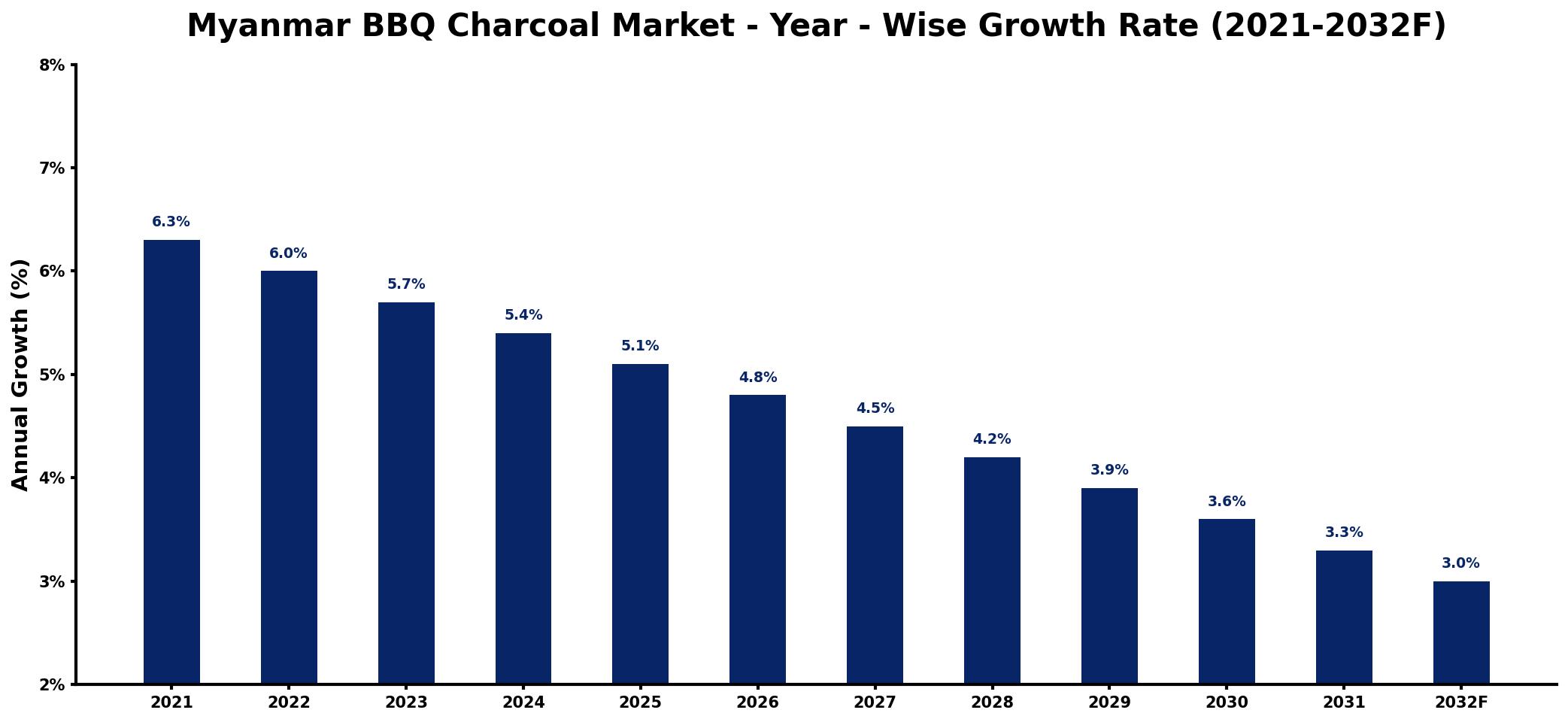
The table below presents the year‑wise growth rates along with the key drivers influencing the market
| Year | Growth Rate | Major Drivers |
| 2021 | 6.3% | Rising outdoor cooking popularity |
| 2022 | 6.0% | Increased tourism and hospitality growth |
| 2023 | 5.7% | Expansion of local restaurants market |
| 2024 | 5.4% | Growing demand for grilling events |
| 2025 | 5.1% | Surge in disposable income levels |
| 2026 | 4.8% | Investment in renewable energy sources |
| 2027 | 4.5% | Emerging urbanization and infrastructure |
| 2028 | 4.2% | Enhanced distribution network efficiency |
| 2029 | 3.9% | rising export shipment volumes |
| 2030 | 3.6% | Growing interest in traditional cuisine |
| 2031 | 3.3% | Increased awareness of sustainability practices |
| 2032 | 3.0% | Rise of culinary tourism experiences |
Note: Market size estimations and growth projections presented in this report are based on 6Wresearch's proprietary forecasting methodology, utilizing the latest available industry data, government publications, and primary research inputs.
Myanmar BBQ Charcoal Market Synopsis
In Myanmar, the allure of outdoor grilling is palpable, with barbecue gatherings becoming increasingly popular among both locals and tourists. The demand for BBQ charcoal is buoyed not only by cultural traditions but also by a burgeoning culinary tourism sector that embraces local flavors. This vibrant scene highlights the essential role of charcoal as a preferred cooking fuel.
Moreover, the market is witnessing a shift towards eco-friendly practices, with producers exploring sustainable production methods to reduce environmental impacts. As consumer awareness about sustainability grows, there is a marked interest in charcoal products that are both high-quality and environmentally responsible.
Myanmar BBQ Charcoal Market Key Takeaways
- The market thrives on the cultural significance of outdoor cooking and barbecued food.
- Tourism is a major driver, with an increasing number of establishments offering barbecue options.
- Local production of charcoal complements the preference for traditional cooking in rural areas.
- Awareness of eco-friendly charcoal production methods is growing among consumers and producers.
- Government regulations promote sustainable charcoal production, aiming to mitigate environmental damage.
Evaluation of Restraints in Myanmar BBQ Charcoal Market
The Myanmar BBQ Charcoal Market faces significant hurdles that hinder its potential growth. The environmental impact of traditional charcoal production methods poses a considerable challenge, often leading to deforestation and ecological degradation. Furthermore, inconsistent quality and availability of charcoal can adversely affect both local consumption and export opportunities. A lack of widespread adoption of innovative, eco-friendly production technologies further exacerbates these issues. Regulatory hurdles related to sustainable forest management only add layers of complexity to an already challenging landscape.
Myanmar BBQ Charcoal Market Trends
Emerging trends within the Myanmar BBQ Charcoal Market indicate a pivot towards sustainability, with many producers adopting practices that lessen their environmental footprint. Innovations in production techniques are gaining traction, as manufacturers seek to enhance the efficiency and quality of charcoal. Additionally, as the popularity of grilling increases, more consumers are becoming interested in specialty charcoals that offer unique flavor profiles, thus diversifying the market offering.
Myanmar BBQ Charcoal Market Opportunities
Opportunities abound in the Myanmar BBQ Charcoal Market, particularly in developing sustainable production methods and expanding the availability of high-quality charcoal. Producers who invest in eco-friendly technologies and practices can capture a growing consumer segment that values sustainability. Moreover, tapping into the burgeoning tourism sector can lead to increased demand, particularly for premium charcoal products that cater to discerning customers seeking authentic grilling experiences.
Government Initiatives in the Myanmar BBQ Charcoal Market
The Myanmar government actively regulates the charcoal production industry to promote sustainable practices. Licensing requirements ensure that producers adhere to guidelines aimed at reducing environmental impacts. Additionally, incentives are in place for those who adopt eco-friendly methods, while initiatives to enhance the export of high-quality BBQ charcoal help position Myanmar competitively in the global market.
Future Insights of the Myanmar BBQ Charcoal Market
Looking ahead to 2026-2032, the Myanmar BBQ Charcoal Market is poised for continued growth, bolstered by rising consumer interest in outdoor cooking and the increasingly popular barbecue culture. The ongoing evolution towards sustainable practices will likely play a pivotal role in shaping the industry's landscape, fostering innovation and improving product offerings. As tourism flourishes and culinary trends evolve, the market will benefit from heightened demand for quality charcoal products that enhance the grilling experience.
Myanmar BBQ Charcoal Market Latest Developments (2025 - 2026)
Recent developments in the Myanmar BBQ Charcoal Market have indicated a strong focus on sustainability, with multiple initiatives encouraging the adoption of eco-friendly production methods. Producers are increasingly collaborating with environmental organizations to enhance their practices and ensure compliance with regulations. Moreover, there has been a noticeable uptick in consumer interest for premium and flavored charcoal products, reflecting changing tastes and preferences.
Myanmar BBQ Charcoal Market - Key Attractiveness of the Report
- 10 Years of Market Numbers
- Historical Data Starting from 2022 to 2025
- Base Year: 2025
- Forecast Data until 2032
- Key Performance Indicators Impacting the Market
- Major Upcoming Developments and Projects
Key Highlights of the Report:
- Myanmar BBQ Charcoal Market Outlook
- Market Size of Myanmar BBQ Charcoal Market, 2025
- Forecast of Myanmar BBQ Charcoal Market, 2032
- Historical Data and Forecast of Myanmar BBQ Charcoal Revenues & Volume for the Period 2022-2032F
- Myanmar BBQ Charcoal Market Trend Evolution
- Myanmar BBQ Charcoal Market Drivers and Challenges
- Myanmar BBQ Charcoal Price Trends
- Myanmar BBQ Charcoal Porter's Five Forces
- Myanmar BBQ Charcoal Industry Life Cycle
- Historical Data and Forecast of Myanmar BBQ Charcoal Market Revenues & Volume By Form for the Period 2022-2032F
- Historical Data and Forecast of Myanmar BBQ Charcoal Market Revenues & Volume By Briquettes BBQ Charcoal for the Period 2022-2032F
- Historical Data and Forecast of Myanmar BBQ Charcoal Market Revenues & Volume By Lump Wood BBQ Charcoal for the Period 2022-2032F
- Historical Data and Forecast of Myanmar BBQ Charcoal Market Revenues & Volume By Sales Channel for the Period 2022-2032F
- Historical Data and Forecast of Myanmar BBQ Charcoal Market Revenues & Volume By Direct BBQ Charcoal Sales for the Period 2022-2032F
- Historical Data and Forecast of Myanmar BBQ Charcoal Market Revenues & Volume By Retail BBQ Charcoal Sales for the Period 2022-2032F
- Historical Data and Forecast of Myanmar BBQ Charcoal Market Revenues & Volume By End User for the Period 2022-2032F
- Historical Data and Forecast of Myanmar BBQ Charcoal Market Revenues & Volume By BBQ Charcoal for Hotels, Restaurants and Catering (HoReCa) for the Period 2022-2032F
- Historical Data and Forecast of Myanmar BBQ Charcoal Market Revenues & Volume By BBQ Charcoal for Households for the Period 2022-2032F
- Historical Data and Forecast of Myanmar BBQ Charcoal Market Revenues & Volume By Source for the Period 2022-2032F
- Historical Data and Forecast of Myanmar BBQ Charcoal Market Revenues & Volume By BBQ Charcoal made from Agricultural Waste for the Period 2022-2032F
- Historical Data and Forecast of Myanmar BBQ Charcoal Market Revenues & Volume By BBQ Charcoal made from Coconut Shells for the Period 2022-2032F
- Historical Data and Forecast of Myanmar BBQ Charcoal Market Revenues & Volume By BBQ Charcoal made from Nutshells for the Period 2022-2032F
- Historical Data and Forecast of Myanmar BBQ Charcoal Market Revenues & Volume By BBQ Charcoal made from Hardwood for the Period 2022-2032F
- Historical Data and Forecast of Myanmar BBQ Charcoal Market Revenues & Volume By BBQ Charcoal made from Bamboo for the Period 2022-2032F
- Myanmar BBQ Charcoal Import Export Trade Statistics
- Market Opportunity Assessment By Form
- Market Opportunity Assessment By Sales Channel
- Market Opportunity Assessment By End User
- Market Opportunity Assessment By Source
- Myanmar BBQ Charcoal Top Companies Market Share
- Myanmar BBQ Charcoal Competitive Benchmarking By Technical and Operational Parameters
- Myanmar BBQ Charcoal Company Profiles
- Myanmar BBQ Charcoal Key Strategic Recommendations






































