Myanmar Cloud Database and DBaaS Market Size & Growth Rate (2026-2032)
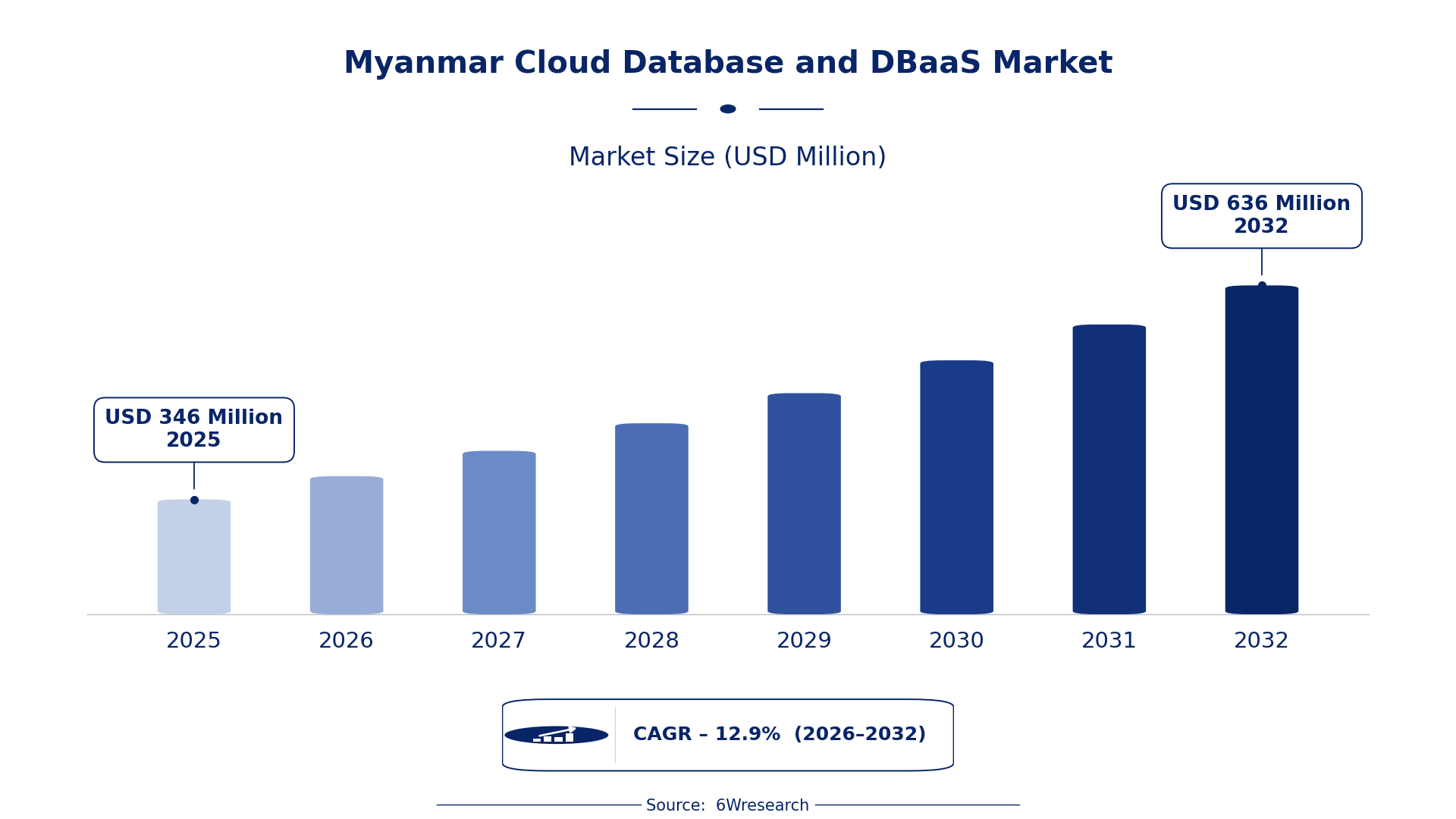
The Myanmar Cloud Database and DBaaS Market was estimated at USD 346 Million in 2025 and is projected to reach USD 636 Million by 2032, growing at a CAGR of 12.9% from 2026 to 2032.
Myanmar Cloud Database and DBaaS Market Synopsis
The primary force shaping the Myanmar Cloud Database and DBaaS market is the increasing migration of businesses to cloud solutions. Companies are recognizing the tangible benefits of enhanced efficiency and reduced operational costs, prompting a shift from traditional on-premises databases.
This trend is bolstered by a growing emphasis on data security and scalability. As organizations increasingly rely on data-driven strategies, the demand for flexible and scalable database solutions continues to surge, signaling a promising trajectory for this market.
Myanmar Cloud Database and DBaaS Market Year-wise Growth Rate and Key Drivers
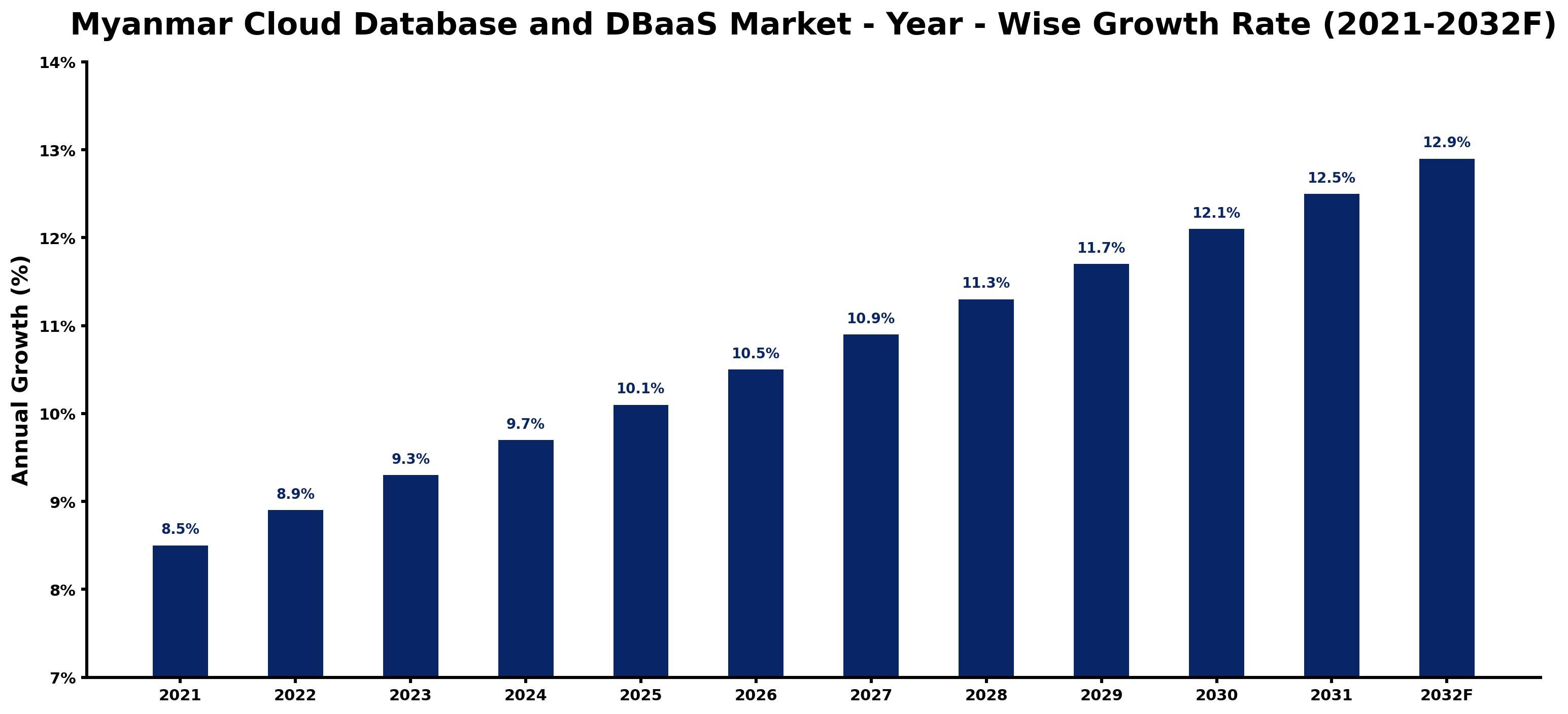
This graph illustrates the annual growth rates of the Myanmar Cloud Database and DBaaS Market from 2021 to 2032, highlighting a steady upward trajectory and projected expansion over the forecast period.
The table below presents the year‑wise growth rates along with the key drivers influencing the market
| Year | Growth Rate | Major Drivers |
| 2021 | 8.5% | Increased mobile internet penetration driving cloud adoption. |
| 2022 | 8.9% | Government's Digital Economy Policy promoting data services. |
| 2023 | 9.3% | Growing e-commerce sector demands scalable database solutions. |
| 2024 | 9.7% | Local startups leveraging DBaaS for innovative applications. |
| 2025 | 10.1% | Educational institutions adopting cloud databases for online learning. |
| 2026 | 10.5% | Rural businesses transitioning to digital infrastructures for efficiency. |
| 2027 | 10.9% | Healthcare sectors utilizing cloud for patient data management. |
| 2028 | 11.3% | Financial institutions enhancing cloud security standards compliance. |
| 2029 | 11.7% | Population growth stimulating demand for local storage solutions. |
| 2030 | 12.1% | Emergence of fintech increasing need for cloud databases. |
| 2031 | 12.5% | Government incentives for tech startups boosting cloud investments. |
| 2032 | 12.9% | Rising urbanization rates boosting data service requirements. |
Note: Market size estimations and growth projections presented in this report are based on 6Wresearch's proprietary forecasting methodology, utilizing the latest available industry data, government publications, and primary research inputs.
Myanmar Cloud Database and DBaaS Market Key Takeaways
Below are some of the specific key takeaways from the market, including:
- Rapid growth driven by digital transformation initiatives across various sectors.
- Increasing demand for Database as a Service (DBaaS) solutions among SMEs and large enterprises.
- Emerging technologies like AI and machine learning are being integrated into cloud database services.
- Concerns regarding data privacy and regulatory compliance remain a key focus for businesses.
- Investments in internet infrastructure are essential to facilitate market expansion.
Evaluation of Restraints in Myanmar Cloud Database and DBaaS Market
Despite the promising growth potential, the Myanmar Cloud Database and DBaaS market faces substantial restraints. Limited internet infrastructure, particularly in remote areas, hampers the widespread adoption of cloud services. Additionally, concerns over data security and privacy regulations can deter businesses from migrating to cloud-based solutions. The shortage of skilled IT professionals adept in cloud technologies further exacerbates these challenges, making it imperative for stakeholders to address these issues to unlock the market's full potential.
Myanmar Cloud Database and DBaaS Market Trends
The market is witnessing several key trends that are influencing demand. Firstly, the migration of traditional on-premises databases to cloud-based solutions is gaining momentum. This shift is complemented by the growing integration of AI and machine learning capabilities in database management, which enhances data analytics and operational efficiency. on top of that, an increasing focus on data security and compliance is shaping the offerings of cloud database providers, aligning them more closely with the needs of modern businesses.
Myanmar Cloud Database and DBaaS Market Opportunities
Opportunities for growth in this market are abundant. The rising trend of digital transformation across industries presents a fertile ground for cloud database and DBaaS providers to expand their offerings. As more organizations prioritize efficient data management and analytics, there is a significant demand for innovative solutions that meet these needs. Additionally, as internet infrastructure continues to improve, it will open new avenues for market penetration, particularly in underserved regions.
Government Initiatives in the Myanmar Cloud Database and DBaaS Market
Government policy is gradually evolving to support the growth of the Myanmar Cloud Database and DBaaS market. The Myanmar government is prioritizing digital transformation, recognizing the importance of cloud technology in fostering economic growth. While specific regulations targeting cloud databases remain limited, the intent to enhance technological infrastructure indicates a favorable environment for future investments.
- A national digital infrastructure upgrade programme now in its rollout phase aims to improve connectivity nationwide.
- Current discussions are underway for a regulatory framework that will enhance data privacy and security measures for cloud services.
- A planned public-private initiative is expected to expand telecom infrastructure access by 2028, facilitating better cloud service adoption.
- In early 2025, the government launched an initiative to provide tax incentives for companies investing in cloud technology.
Future Insights of the Myanmar Cloud Database and DBaaS Market
Looking ahead to 2026-2032, the Myanmar Cloud Database and DBaaS market is set for substantial growth. With an increasing number of businesses recognizing the importance of data-driven decision-making, the demand for scalable and cost-effective cloud solutions will intensify. The rise of e-commerce and mobile applications will further necessitate advanced data management capabilities. As government initiatives to enhance internet infrastructure progress, the market will likely see a more inclusive growth trajectory, benefiting vendors and service providers alike.
Myanmar Cloud Database and DBaaS Market Latest Developments
In the past year, the Myanmar Cloud Database and DBaaS market has experienced notable developments. Companies are increasingly rolling out innovative cloud solutions that cater to the growing needs of businesses. This momentum indicates a dynamic shift towards embracing cloud technologies across various sectors.
- A leading regional operator launched a new DBaaS offering in early 2025, aimed at small to medium enterprises seeking affordable solutions.
- An ongoing initiative focuses on enhancing cloud data security protocols, expected to conclude by mid-2026.
- In late 2024, a major technology vendor partnered with local businesses to provide training programs for cloud technology, enhancing the skilled labor pool.
- There is a planned rollout of a new cloud service expected to begin in Q3 2025, which will incorporate advanced analytics features for users.
Myanmar Cloud Database and DBaaS Market - Key Attractiveness of the Report
- 10 Years of Market Numbers
- Historical Data Starting from 2022 to 2025
- Base Year: 2025
- Forecast Data until 2032
- Key Performance Indicators Impacting the Market
- Major Upcoming Developments and Projects
Key Highlights of the Report:
- Myanmar Cloud Database and DBaaS Market Outlook
- Market Size of Myanmar Cloud Database and DBaaS Market, 2025
- Forecast of Myanmar Cloud Database and DBaaS Market, 2032
- Historical Data and Forecast of Myanmar Cloud Database and DBaaS Revenues & Volume for the Period 2022-2032F
- Myanmar Cloud Database and DBaaS Market Trend Evolution
- Myanmar Cloud Database and DBaaS Market Drivers and Challenges
- Myanmar Cloud Database and DBaaS Price Trends
- Myanmar Cloud Database and DBaaS Porter's Five Forces
- Myanmar Cloud Database and DBaaS Industry Life Cycle
- Historical Data and Forecast of Myanmar Cloud Database and DBaaS Market Revenues & Volume By Database Type for the Period 2022-2032F
- Historical Data and Forecast of Myanmar Cloud Database and DBaaS Market Revenues & Volume By SQL for the Period 2022-2032F
- Historical Data and Forecast of Myanmar Cloud Database and DBaaS Market Revenues & Volume By NoSQL for the Period 2022-2032F
- Historical Data and Forecast of Myanmar Cloud Database and DBaaS Market Revenues & Volume By Service for the Period 2022-2032F
- Historical Data and Forecast of Myanmar Cloud Database and DBaaS Market Revenues & Volume By Professional Services for the Period 2022-2032F
- Historical Data and Forecast of Myanmar Cloud Database and DBaaS Market Revenues & Volume By Consulting for the Period 2022-2032F
- Historical Data and Forecast of Myanmar Cloud Database and DBaaS Market Revenues & Volume By Implementation for the Period 2022-2032F
- Historical Data and Forecast of Myanmar Cloud Database and DBaaS Market Revenues & Volume By Support and Maintenance for the Period 2022-2032F
- Historical Data and Forecast of Myanmar Cloud Database and DBaaS Market Revenues & Volume By Managed Services for the Period 2022-2032F
- Historical Data and Forecast of Myanmar Cloud Database and DBaaS Market Revenues & Volume By Vertical for the Period 2022-2032F
- Historical Data and Forecast of Myanmar Cloud Database and DBaaS Market Revenues & Volume By Banking, Financial Services and Insurance (BFSI) for the Period 2022-2032F
- Historical Data and Forecast of Myanmar Cloud Database and DBaaS Market Revenues & Volume By Telecom and Information Technology (IT) for the Period 2022-2032F
- Historical Data and Forecast of Myanmar Cloud Database and DBaaS Market Revenues & Volume By Government for the Period 2022-2032F
- Historical Data and Forecast of Myanmar Cloud Database and DBaaS Market Revenues & Volume By Consumer Goods and Retail for the Period 2022-2032F
- Historical Data and Forecast of Myanmar Cloud Database and DBaaS Market Revenues & Volume By Manufacturing for the Period 2022-2032F
- Historical Data and Forecast of Myanmar Cloud Database and DBaaS Market Revenues & Volume By Energy and Utilities for the Period 2022-2032F
- Historical Data and Forecast of Myanmar Cloud Database and DBaaS Market Revenues & Volume By Media and Entertainment for the Period 2022-2032F
- Historical Data and Forecast of Myanmar Cloud Database and DBaaS Market Revenues & Volume By Healthcare and Life Sciences for the Period 2022-2032F
- Historical Data and Forecast of Myanmar Cloud Database and DBaaS Market Revenues & Volume By Component for the Period 2022-2032F
- Historical Data and Forecast of Myanmar Cloud Database and DBaaS Market Revenues & Volume By Solution for the Period 2022-2032F
- Historical Data and Forecast of Myanmar Cloud Database and DBaaS Market Revenues & Volume By Services for the Period 2022-2032F
- Historical Data and Forecast of Myanmar Cloud Database and DBaaS Market Revenues & Volume By Deployment Model for the Period 2022-2032F
- Historical Data and Forecast of Myanmar Cloud Database and DBaaS Market Revenues & Volume By Public Cloud for the Period 2022-2032F
- Historical Data and Forecast of Myanmar Cloud Database and DBaaS Market Revenues & Volume By Private Cloud for the Period 2022-2032F
- Historical Data and Forecast of Myanmar Cloud Database and DBaaS Market Revenues & Volume By Hybrid Cloud for the Period 2022-2032F
- Historical Data and Forecast of Myanmar Cloud Database and DBaaS Market Revenues & Volume By Organization Size for the Period 2022-2032F
- Historical Data and Forecast of Myanmar Cloud Database and DBaaS Market Revenues & Volume By Large Enterprises for the Period 2022-2032F
- Historical Data and Forecast of Myanmar Cloud Database and DBaaS Market Revenues & Volume By Small and Medium-sized Enterprises (SMEs) for the Period 2022-2032F
- Myanmar Cloud Database and DBaaS Import Export Trade Statistics
- Market Opportunity Assessment By Database Type
- Market Opportunity Assessment By Service
- Market Opportunity Assessment By Vertical
- Market Opportunity Assessment By Component
- Market Opportunity Assessment By Deployment Model
- Market Opportunity Assessment By Organization Size
- Myanmar Cloud Database and DBaaS Top Companies Market Share
- Myanmar Cloud Database and DBaaS Competitive Benchmarking By Technical and Operational Parameters
- Myanmar Cloud Database and DBaaS Company Profiles
- Myanmar Cloud Database and DBaaS Key Strategic Recommendations






































