Myanmar Distribution Boards Market Size, Share & Growth Rate
The Myanmar Distribution Boards Market was estimated at USD 202 Million in 2025 and is projected to reach USD 285 Million by 2032, growing at a CAGR of 5.0% from 2026 to 2032. This growth trajectory is primarily fueled by rapid urbanization and significant investments in the country's infrastructure, which are creating a strong demand for efficient electricity distribution solutions. Additionally, as industrial sectors expand, the need for robust and reliable distribution systems becomes increasingly vital.
Myanmar Distribution Boards Market Year-wise Growth Rate and Key Drivers
This graph highlights how the Myanmar Distribution Boards Market has steadily grown over the years, supported by major growth factors.
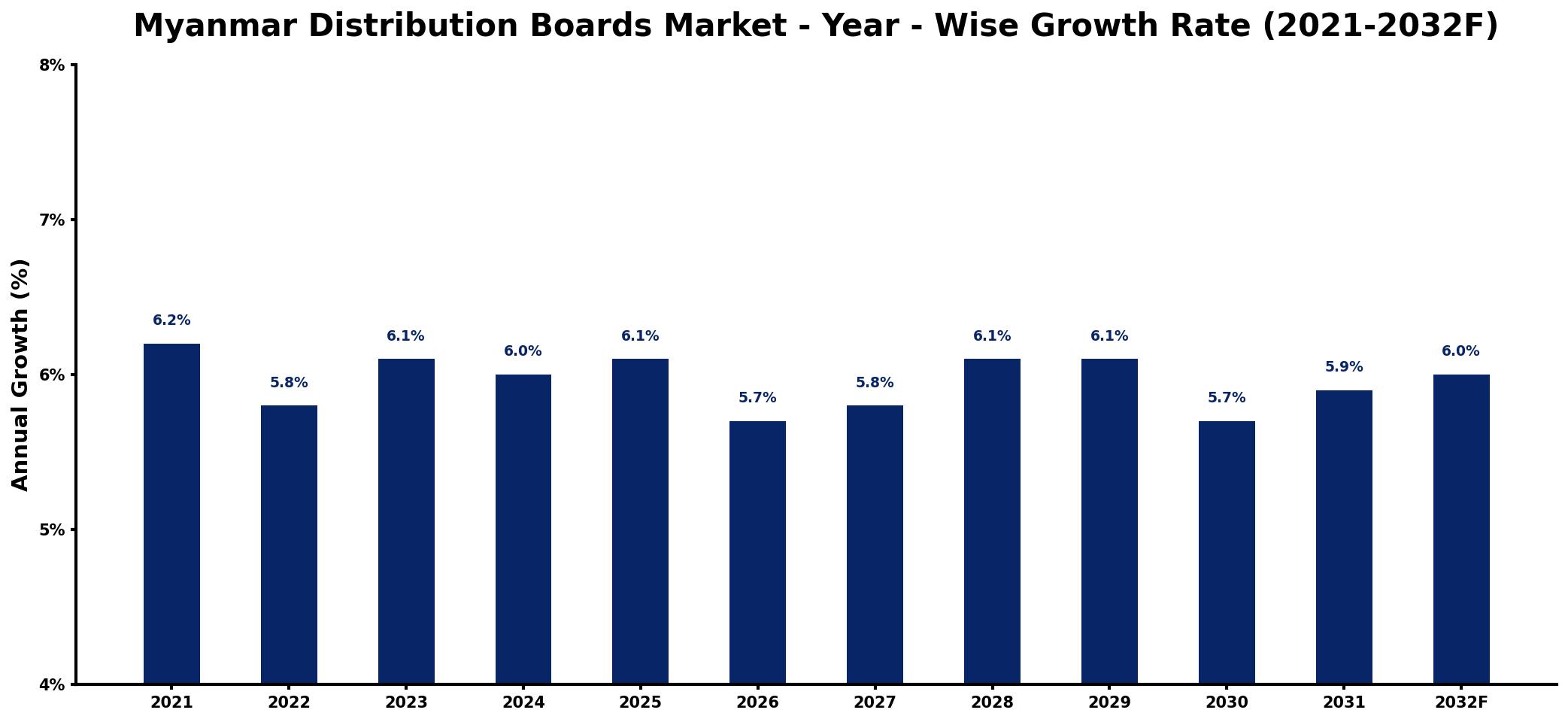
The table below presents the year‑wise growth rates along with the key drivers influencing the market
| Year | Growth Rate | Major Drivers |
| 2021 | 6.2% | Infrastructure investments in urban areas |
| 2022 | 5.8% | Rising demand for renewable energy |
| 2023 | 6.1% | Expansion of commercial construction projects |
| 2024 | 6.0% | Increased residential housing developments |
| 2025 | 6.1% | Government incentives for energy efficiency |
| 2026 | 5.7% | Growth in industrial automation sectors |
| 2027 | 5.8% | Surge in telecommunication infrastructure projects |
| 2028 | 6.1% | Development of smart city initiatives |
| 2029 | 6.1% | Rising interest in sustainable technologies |
| 2030 | 5.7% | Demand for electric vehicle infrastructure |
| 2031 | 5.9% | Enhancements in building safety standards |
| 2032 | 6.0% | Adoption of advanced energy technologies |
Note: Market size estimations and growth projections presented in this report are based on 6Wresearch's proprietary forecasting methodology, utilizing the latest available industry data, government publications, and primary research inputs.
Myanmar Distribution Boards Market Synopsis
Urbanization is the strongest force currently shaping the Myanmar Distribution Boards Market. As cities expand and populations grow, the demand for safe and efficient electrical systems in residential and commercial sectors is surging. This trend is further amplified by ongoing government initiatives aimed at enhancing electrification across the nation.
Moreover, the push for modernization in industrial settings is driving the adoption of advanced distribution board technologies. With increasing awareness of energy efficiency and sustainability, consumers and businesses alike are prioritizing innovative solutions that not only enhance safety but also optimize energy management.
Myanmar Distribution Boards Market Key Takeaways
- Significant growth is projected due to urbanization and infrastructure investments.
- The market is evolving towards smart, energy-efficient distribution board technologies.
- Government initiatives are focusing on improving electrical safety and energy efficiency.
- Challenges include a lack of standard regulations and skilled labor shortages.
- Opportunities abound for tailored, innovative solutions in the growing construction sector.
Evaluation of Restraints in Myanmar Distribution Boards Market
While the Myanmar Distribution Boards Market shows promise, it is not without its challenges. One major restraint is the lack of standardized regulations that can lead to varying product quality and safety standards across the market. This inconsistency poses significant risks for consumers and businesses alike. Additionally, the limited availability of skilled labor for the installation and maintenance of distribution boards undermines the reliability of electrical systems. Infrastructure issues, such as frequent power outages and inadequate facilities, further complicate operations. Finally, the presence of counterfeit products can create distrust among consumers, emphasizing the need for stringent quality control measures.
Myanmar Distribution Boards Market Trends
The Myanmar Distribution Boards Market is currently witnessing a notable trend towards energy-efficient and technologically advanced solutions. A growing interest in smart homes and buildings is leading to the adoption of distribution boards that feature remote monitoring and energy management capabilities. Furthermore, modular and customizable designs are gaining traction, enabling tailored applications for various industrial and commercial needs. There's also an increasing integration of renewable energy sources, such as solar power, driving demand for innovative distribution boards that can effectively manage diverse energy inputs.
Myanmar Distribution Boards Market Opportunities
Given the robust growth projected in the Myanmar Distribution Boards Market, investors have multiple avenues for exploration. The expanding construction sector, coupled with government initiatives to improve access to electricity, presents a lucrative environment for new entrants. Collaborations with local manufacturers or establishing production facilities within the country can be an effective strategy. Additionally, focusing on cutting-edge, energy-efficient solutions customized for local market needs will be essential for companies looking to establish a competitive edge.
Government Initiatives in the Myanmar Distribution Boards Market
Government policies play a crucial role in shaping the Myanmar Distribution Boards Market, primarily by emphasizing safety and efficiency in electrical distribution systems. Regulations mandating the use of certified distribution boards are in place to mitigate electrical hazards and fire risks. Alongside these requirements, guidelines aimed at promoting energy efficiency and sustainable practices are being implemented. Companies within this market must comply with these regulations to ensure their products contribute positively to the overall reliability and safety of the nations electrical infrastructure.
Future Insights of the Myanmar Distribution Boards Market
As we look towards 2026-2032, the Myanmar Distribution Boards Market is poised for steady growth. The convergence of urbanization and industrial expansion is likely to sustain demand for advanced distribution solutions. Furthermore, with increased investments in renewable energy and infrastructure modernization, the push for smart distribution technologies will intensify. Adapting to evolving consumer demands for safety, efficiency, and sustainability will be paramount for market participants aiming to thrive in this dynamic environment.
Myanmar Distribution Boards Market Latest Developments (2025 - 2026)
In recent months, the Myanmar Distribution Boards Market has seen a significant shift towards the adoption of smart technologies. Companies are focusing on integrating automation features and enhancing energy management solutions. Additionally, public-private partnerships are emerging as a key strategy to improve infrastructure and boost the development of safer electrical systems. Meanwhile, ongoing efforts to tackle counterfeit products are gaining momentum, emphasizing the need for authenticity and compliance with established standards.
Myanmar Distribution Boards Market - Key Attractiveness of the Report
- 10 Years of Market Numbers
- Historical Data Starting from 2022 to 2025
- Base Year: 2025
- Forecast Data until 2032
- Key Performance Indicators Impacting the Market
- Major Upcoming Developments and Projects
Key Highlights of the Report:
- Myanmar Distribution Boards Market Outlook
- Market Size of Myanmar Distribution Boards Market, 2025
- Forecast of Myanmar Distribution Boards Market, 2032
- Historical Data and Forecast of Myanmar Distribution Boards Revenues & Volume for the Period 2022-2032F
- Myanmar Distribution Boards Market Trend Evolution
- Myanmar Distribution Boards Market Drivers and Challenges
- Myanmar Distribution Boards Price Trends
- Myanmar Distribution Boards Porter's Five Forces
- Myanmar Distribution Boards Industry Life Cycle
- Historical Data and Forecast of Myanmar Distribution Boards Market Revenues & Volume By Voltage Rating for the Period 2022-2032F
- Historical Data and Forecast of Myanmar Distribution Boards Market Revenues & Volume By Low Voltage for the Period 2022-2032F
- Historical Data and Forecast of Myanmar Distribution Boards Market Revenues & Volume By Medium Voltage for the Period 2022-2032F
- Historical Data and Forecast of Myanmar Distribution Boards Market Revenues & Volume By End Use for the Period 2022-2032F
- Historical Data and Forecast of Myanmar Distribution Boards Market Revenues & Volume By Transmission & Distribution Utilities for the Period 2022-2032F
- Historical Data and Forecast of Myanmar Distribution Boards Market Revenues & Volume By Manufacturing & Processing Industry for the Period 2022-2032F
- Historical Data and Forecast of Myanmar Distribution Boards Market Revenues & Volume By Commercial & Residential for the Period 2022-2032F
- Historical Data and Forecast of Myanmar Distribution Boards Market Revenues & Volume By Others for the Period 2022-2032F
- Myanmar Distribution Boards Import Export Trade Statistics
- Market Opportunity Assessment By Voltage Rating
- Market Opportunity Assessment By End Use
- Myanmar Distribution Boards Top Companies Market Share
- Myanmar Distribution Boards Competitive Benchmarking By Technical and Operational Parameters
- Myanmar Distribution Boards Company Profiles
- Myanmar Distribution Boards Key Strategic Recommendations






































