Myanmar Electrical Components Market Size, Share & Growth Rate
The Myanmar Electrical Components Market was estimated at USD 451 Million in 2025 and is projected to reach USD 602 Million by 2032, growing at a CAGR of 4.2% from 2026 to 2032. This growth trajectory is primarily fueled by rapid urbanization and a surge in infrastructure development initiatives led by the government. As industrialization intensifies and the demand for reliable energy distribution systems rises, the market's expansion is poised to accelerate.
Myanmar Electrical Components Market Year-wise Growth Rate and Key Drivers
This graph highlights how the Myanmar Electrical Components Market has steadily grown over the years, supported by major growth factors.
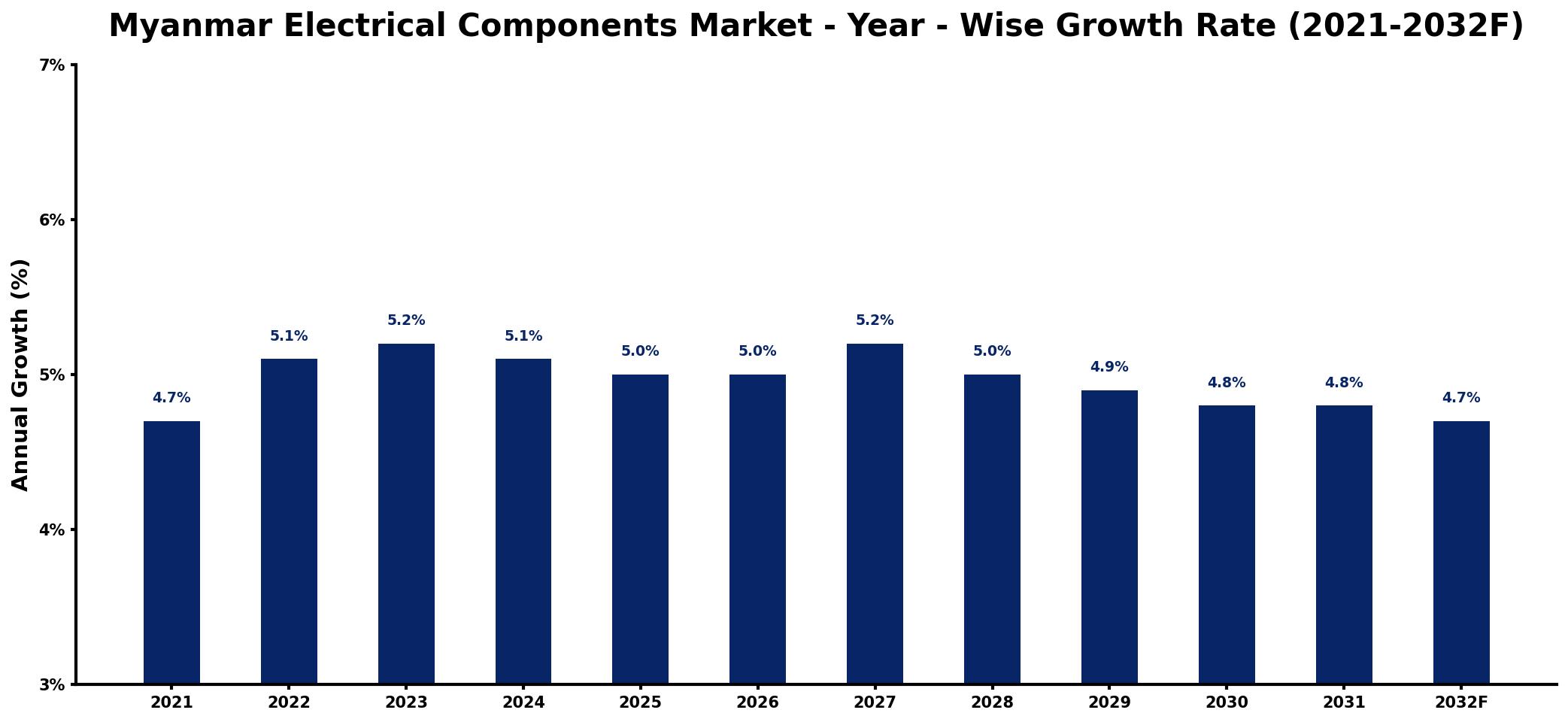
The table below presents the year‑wise growth rates along with the key drivers influencing the market
| Year | Growth Rate | Major Drivers |
| 2021 | 4.7% | Rising construction sector investments |
| 2022 | 5.1% | Increased renewable energy projects |
| 2023 | 5.2% | Growing manufacturing capabilities expansion |
| 2024 | 5.1% | Expansion of urban infrastructure projects |
| 2025 | 5.0% | Surge in export opportunities |
| 2026 | 5.0% | Enhanced telecommunications network development |
| 2027 | 5.2% | Boost in industrial automation adoption |
| 2028 | 5.0% | Growing demand for smart technologies |
| 2029 | 4.9% | Increased private sector investments |
| 2030 | 4.8% | stronger distribution network expansion |
| 2031 | 4.8% | Rise in residential energy efficiency |
| 2032 | 4.7% | Growing interest in sustainable solutions |
Note: Market size estimations and growth projections presented in this report are based on 6Wresearch's proprietary forecasting methodology, utilizing the latest available industry data, government publications, and primary research inputs.
Myanmar Electrical Components Market Synopsis
The most significant force shaping the Myanmar Electrical Components Market today is the government's commitment to enhancing electricity access throughout the country. With initiatives such as the National Electrification Plan, there is a clear roadmap for increasing electricity accessibility in rural areas, driving demand for electrical products.
Alongside governmental support, the growing presence of international manufacturers is helping to modernize the market landscape. These players are not only meeting local demands but also bringing in advanced technology and competitive pricing, positioning the market for robust growth as infrastructure projects ramp up.
Myanmar Electrical Components Market Key Takeaways
- Rising urbanization and industrialization are key drivers of market growth.
- Government initiatives aim to significantly improve electricity access, creating vast opportunities.
- International manufacturers are increasingly entering, leading to enhanced technology and competition.
- Consumer preference is shifting toward energy-efficient and sustainable electrical products.
- Infrastructure challenges continue to be a primary concern for market participants.
Evaluation of Restraints in Myanmar Electrical Components Market
Despite its promising outlook, the Myanmar Electrical Components Market is confronted with several critical restraints. One of the most pressing issues is the unstable regulatory environment, which can disrupt business planning and investor confidence. Frequent changes in regulations make it challenging for companies to adopt long-term strategies effectively.
In addition, the country's infrastructure remains underdeveloped, leading to unreliable power supply and inadequate distribution systems. These shortcomings create operational challenges for manufacturers and distributors alike. Finally, inconsistent quality standards across different suppliers can undermine consumer trust and lead to reliability issues in the marketplace.
Myanmar Electrical Components Market Trends
Current trends in the Myanmar Electrical Components Market indicate a growing demand for energy-efficient products, motivated by environmental concerns and the government's push for sustainability. Additionally, as the manufacturing sector expands, there is a noticeable increase in the adoption of smart technologies and automation, which is further driving the demand for advanced electrical components.
The market is also witnessing an increased focus on renewable energy sources, particularly solar power, as both businesses and the government seek to diversify energy portfolios. This shift not only presents new product opportunities but also encourages international partnerships to enhance technological capabilities.
Myanmar Electrical Components Market Opportunities
Investment opportunities abound in the Myanmar Electrical Components Market, especially as the government prioritizes infrastructure development and aims to meet the electricity needs of its growing population. The expansion of the manufacturing sector, coupled with rising urbanization, creates demand for a range of electrical components such as cables, switches, and circuit breakers.
Furthermore, the increasing adoption of renewable energy technologies, including solar panels and related products, presents substantial market potential. Companies looking to invest will benefit from forming partnerships with local distributors to navigate the unique challenges and capitalize on emerging opportunities effectively.
Government Initiatives in the Myanmar Electrical Components Market
The Myanmar government has implemented several initiatives aimed at bolstering the electrical components market. The Myanmar National Electrification Plan (NEP) strives to achieve universal electricity access by 2030, signaling a strong commitment to infrastructure investment. Policies such as the Electricity Law and related regulations are designed to promote private investment in the sector.
Additionally, the Myanmar Investment Commission (MIC) is encouraging foreign investments in the electrical components industry by offering incentives and tax breaks. While challenges remain, these initiatives are fundamental in setting the groundwork for future market growth.
Future Insights of the Myanmar Electrical Components Market
Looking ahead to 2026-2032, the Myanmar Electrical Components Market is expected to thrive, driven by continued infrastructure investments and the expansion of energy distribution networks. The ongoing modernization of the electrical landscape will be complemented by increasing investments in manufacturing and renewable energy sectors, enhancing demand for various electrical components.
As the regulatory environment stabilizes and technological capabilities improve, the market will likely witness accelerated growth. However, stakeholders must remain vigilant of potential hurdles, such as political instability and infrastructure inadequacies that could impact market dynamics.
Myanmar Electrical Components Market Latest Developments (2025 - 2026)
Recent developments in the Myanmar Electrical Components Market indicate a stronger push from both government and private sectors towards modernizing the electrical infrastructure. Collaborative efforts are being observed between local and international entities aimed at boosting electricity access and enhancing product quality standards. Additionally, investments in renewable energy technologies are becoming more commonplace, paving the way for a more sustainable energy future.
Myanmar Electrical Components Market - Key Attractiveness of the Report
- 10 Years of Market Numbers
- Historical Data Starting from 2022 to 2025
- Base Year: 2025
- Forecast Data until 2032
- Key Performance Indicators Impacting the Market
- Major Upcoming Developments and Projects
Key Highlights of the Report:
- Myanmar Electrical Components Market Outlook
- Market Size of Myanmar Electrical Components Market, 2025
- Forecast of Myanmar Electrical Components Market, 2032
- Historical Data and Forecast of Myanmar Electrical Components Revenues & Volume for the Period 2022-2032F
- Myanmar Electrical Components Market Trend Evolution
- Myanmar Electrical Components Market Drivers and Challenges
- Myanmar Electrical Components Price Trends
- Myanmar Electrical Components Porter's Five Forces
- Myanmar Electrical Components Industry Life Cycle
- Historical Data and Forecast of Myanmar Electrical Components Market Revenues & Volume By Building Automation for the Period 2022-2032F
- Historical Data and Forecast of Myanmar Electrical Components Market Revenues & Volume By Datacom Accessories for the Period 2022-2032F
- Historical Data and Forecast of Myanmar Electrical Components Market Revenues & Volume By Security & wiring Accessories for the Period 2022-2032F
- Historical Data and Forecast of Myanmar Electrical Components Market Revenues & Volume By Cables & Wires for the Period 2022-2032F
- Historical Data and Forecast of Myanmar Electrical Components Market Revenues & Volume By Datacom Cables for the Period 2022-2032F
- Historical Data and Forecast of Myanmar Electrical Components Market Revenues & Volume By LV Cables for the Period 2022-2032F
- Historical Data and Forecast of Myanmar Electrical Components Market Revenues & Volume By MV&HV Cables for the Period 2022-2032F
- Historical Data and Forecast of Myanmar Electrical Components Market Revenues & Volume By Special Cables for the Period 2022-2032F
- Historical Data and Forecast of Myanmar Electrical Components Market Revenues & Volume By Industrial Automation for the Period 2022-2032F
- Historical Data and Forecast of Myanmar Electrical Components Market Revenues & Volume By Automation Controls for the Period 2022-2032F
- Historical Data and Forecast of Myanmar Electrical Components Market Revenues & Volume By Auxiliary Controls for the Period 2022-2032F
- Historical Data and Forecast of Myanmar Electrical Components Market Revenues & Volume By Drives & Motion Controls for the Period 2022-2032F
- Historical Data and Forecast of Myanmar Electrical Components Market Revenues & Volume By Measurement Controls and Relays for the Period 2022-2032F
- Historical Data and Forecast of Myanmar Electrical Components Market Revenues & Volume By Lighting for the Period 2022-2032F
- Historical Data and Forecast of Myanmar Electrical Components Market Revenues & Volume By Fixtures for the Period 2022-2032F
- Historical Data and Forecast of Myanmar Electrical Components Market Revenues & Volume By Lamps & LEDs for the Period 2022-2032F
- Historical Data and Forecast of Myanmar Electrical Components Market Revenues & Volume By Power Distribution for the Period 2022-2032F
- Historical Data and Forecast of Myanmar Electrical Components Market Revenues & Volume By Cable Management for the Period 2022-2032F
- Historical Data and Forecast of Myanmar Electrical Components Market Revenues & Volume By Enclosures & Panels for the Period 2022-2032F
- Historical Data and Forecast of Myanmar Electrical Components Market Revenues & Volume By LV Electrical Distribution for the Period 2022-2032F
- Historical Data and Forecast of Myanmar Electrical Components Market Revenues & Volume By Renewable Energies for the Period 2022-2032F
- Historical Data and Forecast of Myanmar Electrical Components Market Revenues & Volume By HVAC for the Period 2022-2032F
- Historical Data and Forecast of Myanmar Electrical Components Market Revenues & Volume By Renewable energy for the Period 2022-2032F
- Historical Data and Forecast of Myanmar Electrical Components Market Revenues & Volume By Safety & Tools for the Period 2022-2032F
- Historical Data and Forecast of Myanmar Electrical Components Market Revenues & Volume By Safety Equipment for the Period 2022-2032F
- Historical Data and Forecast of Myanmar Electrical Components Market Revenues & Volume By Working Tools & Accessories for the Period 2022-2032F
- Myanmar Electrical Components Import Export Trade Statistics
- Market Opportunity Assessment By Building Automation
- Market Opportunity Assessment By Cables & Wires
- Market Opportunity Assessment By Industrial Automation
- Market Opportunity Assessment By Lighting
- Market Opportunity Assessment By Power Distribution
- Market Opportunity Assessment By Renewable Energies
- Market Opportunity Assessment By Safety & Tools
- Myanmar Electrical Components Top Companies Market Share
- Myanmar Electrical Components Competitive Benchmarking By Technical and Operational Parameters
- Myanmar Electrical Components Company Profiles
- Myanmar Electrical Components Key Strategic Recommendations






































