Myanmar Engineered Wood Market Size, Share & Growth Rate
The Myanmar Engineered Wood Market was estimated at USD 271 Million in 2025 and is projected to reach USD 370 Million by 2032, growing at a CAGR of 4.5% from 2026 to 2032. This growth trajectory is driven largely by the construction sector's robust expansion and a surging preference for sustainable building materials. As awareness of eco-friendly solutions increases, engineered wood products are becoming integral to various construction applications across the country.
Myanmar Engineered Wood Market Year-wise Growth Rate and Key Drivers
This graph highlights how the Myanmar Engineered Wood Market has steadily grown over the years, supported by major growth factors.
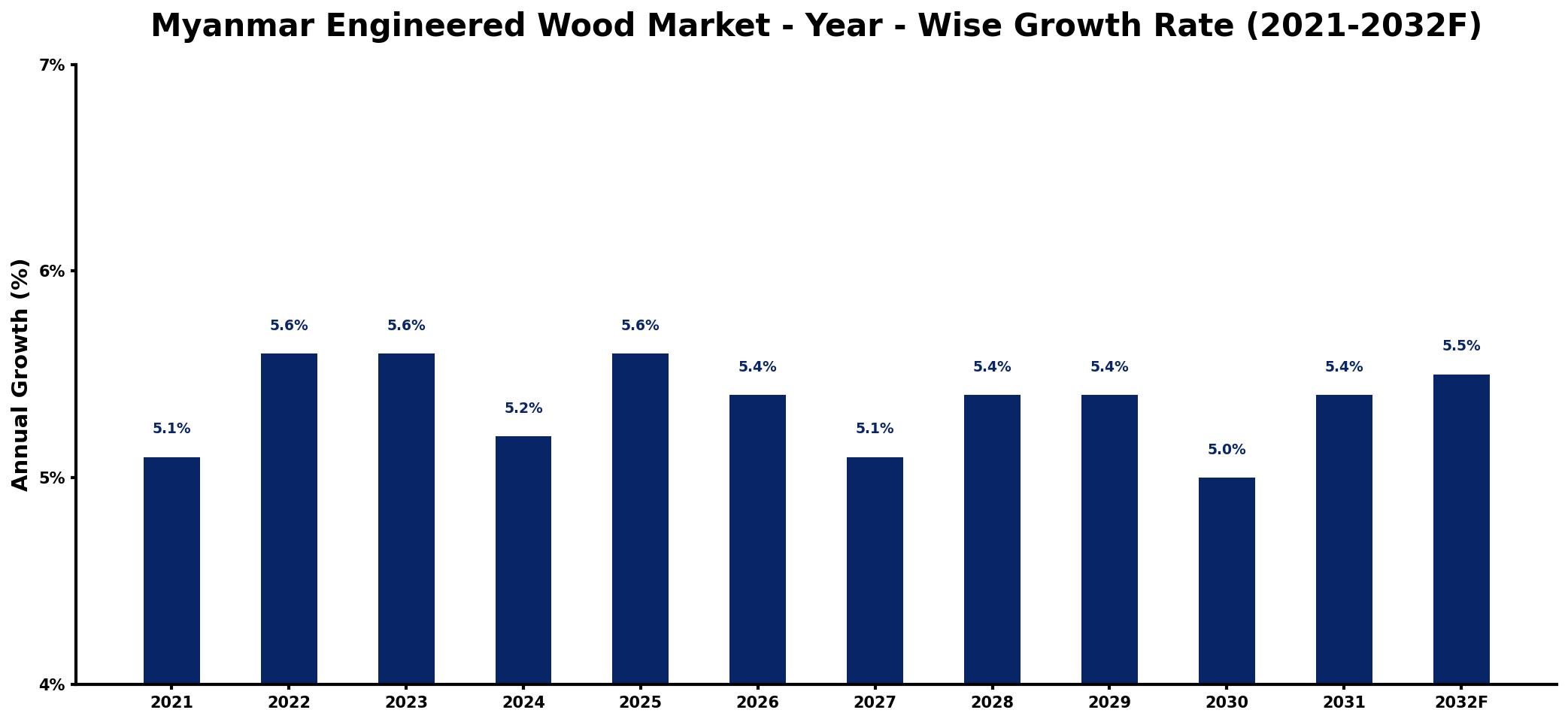
The table below presents the year‑wise growth rates along with the key drivers influencing the market
| Year | Growth Rate | Major Drivers |
| 2021 | 5.1% | Rising construction sector investments |
| 2022 | 5.6% | Increasing urbanization and infrastructure |
| 2023 | 5.6% | Growing demand for sustainable materials |
| 2024 | 5.2% | Expansion of residential housing projects |
| 2025 | 5.6% | Increased foreign direct investments |
| 2026 | 5.4% | Boost in furniture manufacturing capacity |
| 2027 | 5.1% | Surge in home renovation activities |
| 2028 | 5.4% | Growing popularity of interior design |
| 2029 | 5.4% | Strengthening regional trade partnerships |
| 2030 | 5.0% | improved raw material availability |
| 2031 | 5.4% | Increasing consumer preference for aesthetics |
| 2032 | 5.5% | Rise in eco-friendly construction trends |
Note: Market size estimations and growth projections presented in this report are based on 6Wresearch's proprietary forecasting methodology, utilizing the latest available industry data, government publications, and primary research inputs.
Myanmar Engineered Wood Market Synopsis
The Myanmar Engineered Wood Market has recently seen a momentum shift, fueled by rising construction activities and environmental consciousness among consumers. In contrast, the market is set for sustainable growth as more players in the industry invest in modern production technologies and facilities.
As the demand for products like plywood, MDF, and particleboard surges, the market is transitioning away from traditional wood products. The focus on durability, versatility, and sustainability is paving the way for engineered wood's dominance in construction and furniture sectors, promising a vibrant future for the market.
Myanmar Engineered Wood Market Key Takeaways
- The market is projected to grow steadily, driven by a CAGR of 4.5% from 2026 to 2032.
- Increasing demand for sustainable and cost-effective building materials is reshaping consumer preferences.
- Government initiatives focused on eco-friendly practices are supporting market growth.
- Technological advancements in manufacturing are enhancing product quality and availability.
- Urbanization and infrastructure development present lucrative investment opportunities.
Evaluation of Restraints in Myanmar Engineered Wood Market
Despite its promising outlook, the Myanmar Engineered Wood Market faces several constraints. Limited consumer awareness regarding the benefits of engineered wood often leads to a preference for traditional solid wood, hindering broader adoption. Furthermore, the absence of standardized regulations and certifications raises concerns about product quality, creating a barrier for both manufacturers and consumers. Infrastructure challenges, including logistics and transportation inefficiencies, also impact the market's overall development, making it crucial for stakeholders to address these issues through focused initiatives and education.
Myanmar Engineered Wood Market Trends
A significant trend in the Myanmar Engineered Wood Market is the rising consumer demand for eco-friendly products, as more builders and designers seek sustainable alternatives to traditional materials. This shift is complemented by advancements in manufacturing technology, leading to improved product options that cater to a variety of applications, including residential and commercial constructions. The market is also witnessing increased integration of engineered wood in furniture manufacturing, reflecting its versatility and aesthetic appeal.
Myanmar Engineered Wood Market Opportunities
Investment opportunities in the Myanmar Engineered Wood Market are abundant, particularly given the rapid urbanization and growth in construction activities. Establishing manufacturing plants focused on engineered wood products can be particularly profitable, as demand continues to outpace supply. Additionally, the government's commitment to sustainable construction practices offers incentives for businesses willing to innovate within the engineered wood sector, positioning stakeholders to capitalize on long-term market growth.
Government Initiatives in the Myanmar Engineered Wood Market
The government of Myanmar has implemented several initiatives aimed at promoting the engineered wood market, focusing on sustainable forestry practices and environmental conservation. Regulations encouraging responsible timber harvesting are complemented by incentives for manufacturers adopting eco-friendly production methods. Research and development funding, along with capacity-building programs, further support the industry's growth and aim to ensure that economic benefits do not come at the expense of environmental protection.
Future Insights of the Myanmar Engineered Wood Market
Looking towards the future, the Myanmar Engineered Wood Market is set to benefit from increasing construction activities and a growing emphasis on sustainable building practices. As urbanization continues, engineered wood is likely to be at the forefront of meeting the demand for high-quality, cost-effective materials. With heightened awareness of the ecological impacts of construction, engineered wood products are well-positioned to capture market share as the industry evolves to embrace greener solutions.
Myanmar Engineered Wood Market Latest Developments (2025 - 2026)
Recent developments in the Myanmar Engineered Wood Market have highlighted a surge in investment in manufacturing technologies aimed at enhancing product quality. Additionally, there has been a noticeable shift in consumer preferences towards engineered wood products across various sectors, including furniture and construction. Stakeholders are increasingly focusing on establishing stronger supply chains to tackle logistical challenges, fostering an environment conducive to sustained market growth.
Myanmar Engineered Wood Market - Key Attractiveness of the Report
- 10 Years of Market Numbers
- Historical Data Starting from 2022 to 2025
- Base Year: 2025
- Forecast Data until 2032
- Key Performance Indicators Impacting the Market
- Major Upcoming Developments and Projects
Key Highlights of the Report:
- Myanmar Engineered Wood Market Outlook
- Market Size of Myanmar Engineered Wood Market, 2025
- Forecast of Myanmar Engineered Wood Market, 2032
- Historical Data and Forecast of Myanmar Engineered Wood Revenues & Volume for the Period 2022-2032F
- Myanmar Engineered Wood Market Trend Evolution
- Myanmar Engineered Wood Market Drivers and Challenges
- Myanmar Engineered Wood Price Trends
- Myanmar Engineered Wood Porter's Five Forces
- Myanmar Engineered Wood Industry Life Cycle
- Historical Data and Forecast of Myanmar Engineered Wood Market Revenues & Volume By Type for the Period 2022-2032F
- Historical Data and Forecast of Myanmar Engineered Wood Market Revenues & Volume By I-Beams for the Period 2022-2032F
- Historical Data and Forecast of Myanmar Engineered Wood Market Revenues & Volume By Plywood for the Period 2022-2032F
- Historical Data and Forecast of Myanmar Engineered Wood Market Revenues & Volume By Laminated Veneer Lumber (LVL) for the Period 2022-2032F
- Historical Data and Forecast of Myanmar Engineered Wood Market Revenues & Volume By Glulam (Glued Laminated Timber) for the Period 2022-2032F
- Historical Data and Forecast of Myanmar Engineered Wood Market Revenues & Volume By Oriented Strand Boards (OSB) for the Period 2022-2032F
- Historical Data and Forecast of Myanmar Engineered Wood Market Revenues & Volume By Cross-Laminated Timber (CLT) for the Period 2022-2032F
- Historical Data and Forecast of Myanmar Engineered Wood Market Revenues & Volume By Others for the Period 2022-2032F
- Historical Data and Forecast of Myanmar Engineered Wood Market Revenues & Volume By Application for the Period 2022-2032F
- Historical Data and Forecast of Myanmar Engineered Wood Market Revenues & Volume By Construction for the Period 2022-2032F
- Historical Data and Forecast of Myanmar Engineered Wood Market Revenues & Volume By Furniture for the Period 2022-2032F
- Historical Data and Forecast of Myanmar Engineered Wood Market Revenues & Volume By Flooring for the Period 2022-2032F
- Historical Data and Forecast of Myanmar Engineered Wood Market Revenues & Volume By Packaging for the Period 2022-2032F
- Historical Data and Forecast of Myanmar Engineered Wood Market Revenues & Volume By Others for the Period 2022-2032F
- Historical Data and Forecast of Myanmar Engineered Wood Market Revenues & Volume By End-User for the Period 2022-2032F
- Historical Data and Forecast of Myanmar Engineered Wood Market Revenues & Volume By Residential for the Period 2022-2032F
- Historical Data and Forecast of Myanmar Engineered Wood Market Revenues & Volume By Commercial & Industrial for the Period 2022-2032F
- Myanmar Engineered Wood Import Export Trade Statistics
- Market Opportunity Assessment By Type
- Market Opportunity Assessment By Application
- Market Opportunity Assessment By End-User
- Myanmar Engineered Wood Top Companies Market Share
- Myanmar Engineered Wood Competitive Benchmarking By Technical and Operational Parameters
- Myanmar Engineered Wood Company Profiles
- Myanmar Engineered Wood Key Strategic Recommendations






































