Myanmar Guitar Market Size Growth Rate
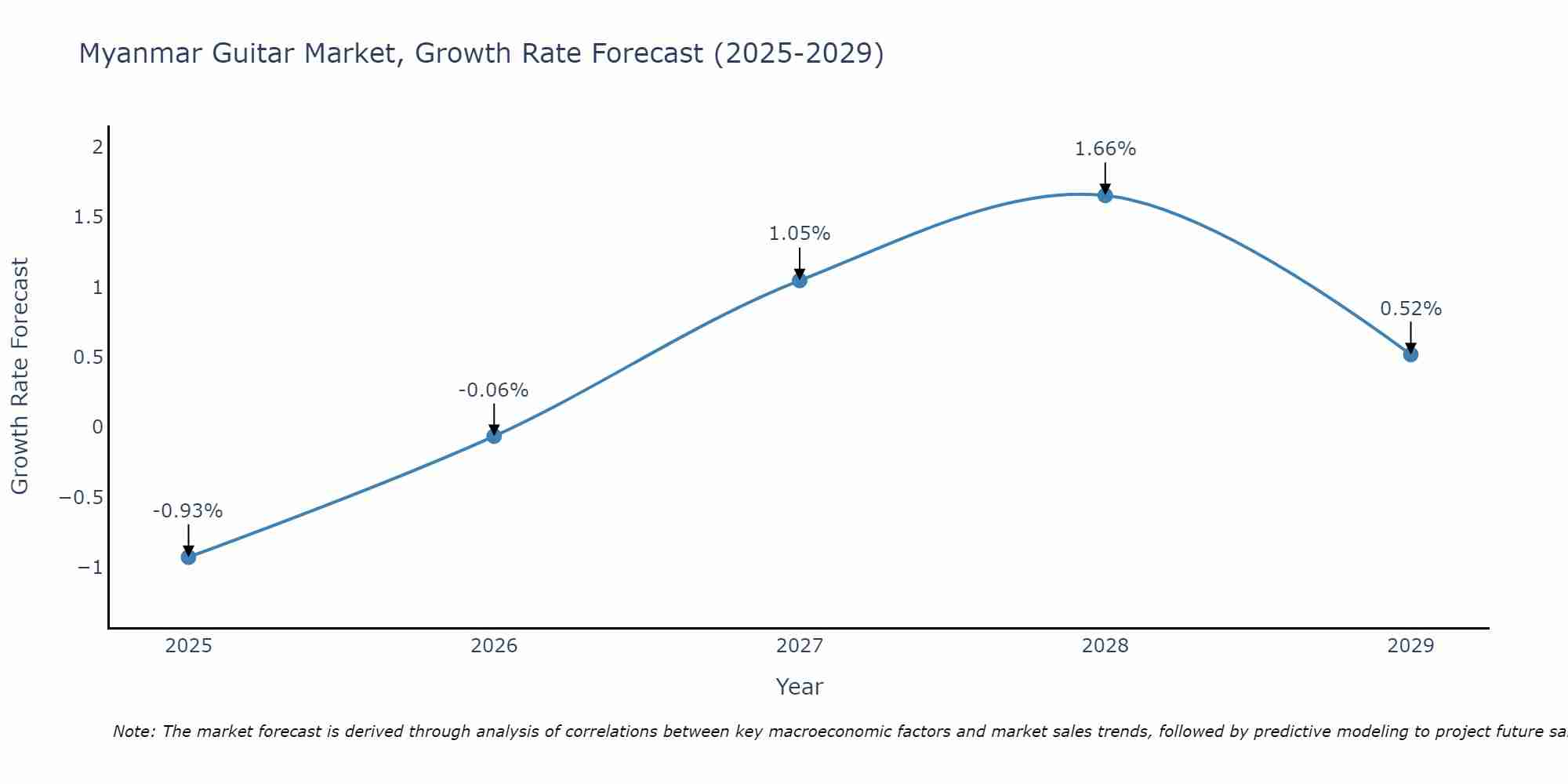
The Myanmar Guitar Market is projected to witness mixed growth rate patterns during 2025 to 2029. Starting at -0.93% in 2025, the market peaks at 1.66% in 2028, and settles at 0.52% by 2029.
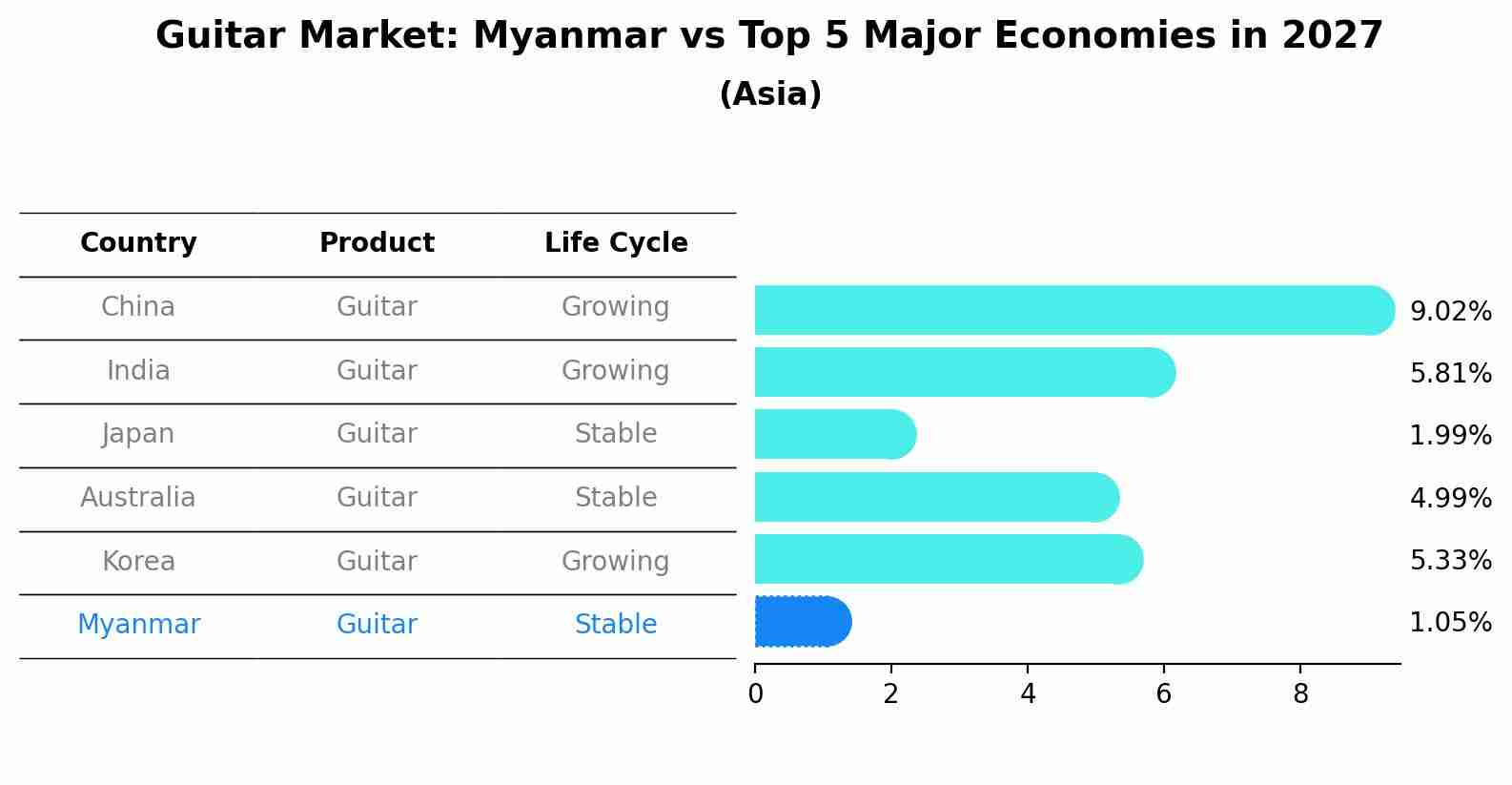
Guitar Market: Myanmar vs Top 5 Major Economies in 2027 (Asia)
By 2027, the Guitar market in Myanmar is anticipated to reach a growth rate of 1.05%, as part of an increasingly competitive Asia region, where China remains at the forefront, supported by India, Japan, Australia and South Korea, driving innovations and market adoption across sectors.
Myanmar Guitar Market Overview
The Myanmar guitar market is experiencing steady growth, driven by a rising interest in music among the younger population. The market primarily consists of acoustic and electric guitars, with both local and international brands competing for market share. Local manufacturers are increasing their production capacity to meet the growing demand for affordable instruments, while international brands are leveraging their reputation for quality and innovation. The market is also witnessing a trend towards online purchasing, with e-commerce platforms providing a convenient way for consumers to access a wider range of products. As disposable incomes rise and music education becomes more widespread, the Myanmar guitar market is expected to continue its growth trajectory in the coming years.
Myanmar Guitar Market Trends
The Myanmar guitar market is experiencing a growing interest in acoustic and electric guitars, driven by a rising number of music enthusiasts and professionals. Sales of entry-level and mid-range guitars are increasing, reflecting a growing music culture and demand for quality instruments. Domestic guitar brands are gaining popularity, offering competitive pricing and customization options. Additionally, the trend of online purchasing is on the rise, providing consumers with access to a wider range of products and brands. Social media platforms and online music communities are also playing a significant role in promoting guitar playing and influencing purchasing decisions. Overall, the Myanmar guitar market is witnessing a shift towards higher quality instruments, increased brand diversity, and a growing online presence.
Myanmar Guitar Market Challenges
The Myanmar Guitar Market faces several challenges, including limited access to quality instruments and a lack of formal music education infrastructure. Most guitars available in the market are low-quality, imported from neighboring countries, leading to high prices and limited options for musicians. Additionally, there is a shortage of skilled guitar teachers and music schools, hindering the development of aspiring musicians. The lack of a strong distribution network and online presence further restricts the market`s growth potential. These challenges make it difficult for local guitar enthusiasts to access affordable, high-quality instruments and proper training, impacting the overall development of the music industry in Myanmar.
Myanmar Guitar Market Investment Opportunities
The Myanmar Guitar Market presents several investment opportunities for growth and expansion. With the increasing interest in music and Western culture in Myanmar, there is a growing demand for high-quality guitars among musicians and enthusiasts. Investing in local guitar manufacturing or distribution businesses could tap into this market potential. Additionally, offering guitar lessons, music accessories, and organizing music events could also be lucrative opportunities. Collaborating with local artists and musicians to promote guitar playing and music education could further enhance the market presence and profitability. Overall, investing in the Myanmar Guitar Market provides a chance to capitalize on the country`s emerging music scene and growing consumer base.
Myanmar Guitar Market Government Policy
Government policies related to the Myanmar Guitar Market are designed to promote local manufacturing and protect local industries. The government imposes a tariff on imported guitars to incentivize consumers to purchase domestically produced guitars, supporting local manufacturers and boosting the economy. Additionally, there are regulations in place to ensure the quality and safety of guitars sold in the market, with strict standards that manufacturers must adhere to. The government also provides support and incentives for local guitar makers through programs such as grants and subsidies to encourage innovation and growth in the industry. Overall, government policies in Myanmar aim to foster a competitive and sustainable guitar market while safeguarding the interests of local manufacturers and consumers.
Myanmar Guitar Market Future Outlook
The Myanmar guitar market is poised for steady growth in the coming years, driven by a growing interest in music among the younger population and an increasing number of music schools and academies offering guitar lessons. The market is expected to see a rise in demand for both acoustic and electric guitars, with a preference for entry-level and mid-range instruments. International brands are likely to continue expanding their presence in Myanmar, offering a wider variety of products to cater to different consumer preferences. As disposable incomes rise and the economy stabilizes, more consumers are expected to invest in musical instruments, further fueling the growth of the guitar market in Myanmar. Overall, the future outlook for the Myanmar guitar market is positive, with opportunities for both local retailers and international manufacturers to capitalize on the growing demand.
Key Highlights of the Report:
- Myanmar Guitar Market Outlook
- Market Size of Myanmar Guitar Market, 2024
- Forecast of Myanmar Guitar Market, 2031
- Historical Data and Forecast of Myanmar Guitar Revenues & Volume for the Period 2021 - 2031
- Myanmar Guitar Market Trend Evolution
- Myanmar Guitar Market Drivers and Challenges
- Myanmar Guitar Price Trends
- Myanmar Guitar Porter's Five Forces
- Myanmar Guitar Industry Life Cycle
- Historical Data and Forecast of Myanmar Guitar Market Revenues & Volume By Type for the Period 2021 - 2031
- Historical Data and Forecast of Myanmar Guitar Market Revenues & Volume By Acoustic Guitars for the Period 2021 - 2031
- Historical Data and Forecast of Myanmar Guitar Market Revenues & Volume By Electric Guitars for the Period 2021 - 2031
- Historical Data and Forecast of Myanmar Guitar Market Revenues & Volume By Application for the Period 2021 - 2031
- Historical Data and Forecast of Myanmar Guitar Market Revenues & Volume By Online Retail for the Period 2021 - 2031
- Historical Data and Forecast of Myanmar Guitar Market Revenues & Volume By Offline Retail for the Period 2021 - 2031
- Myanmar Guitar Import Export Trade Statistics
- Market Opportunity Assessment By Type
- Market Opportunity Assessment By Application
- Myanmar Guitar Top Companies Market Share
- Myanmar Guitar Competitive Benchmarking By Technical and Operational Parameters
- Myanmar Guitar Company Profiles
- Myanmar Guitar Key Strategic Recommendations






































