Myanmar Industrial Flooring Market Size, Share & Growth Rate
The Myanmar Industrial Flooring Market was estimated at USD 169 Million in 2025 and is projected to reach USD 186 Million by 2032, growing at a CAGR of 1.4% from 2026 to 2032. This trajectory is largely driven by the expansion of industrial facilities and a burgeoning manufacturing sector, necessitating robust flooring solutions that can endure heavy loads and chemical exposure. Increased investment in infrastructure further catalyzes demand, making industrial flooring a critical component of Myanmar's economic growth.
Myanmar Industrial Flooring Market Year-wise Growth Rate and Key Drivers
This graph highlights how the Myanmar Industrial Flooring Market has steadily grown over the years, supported by major growth factors.
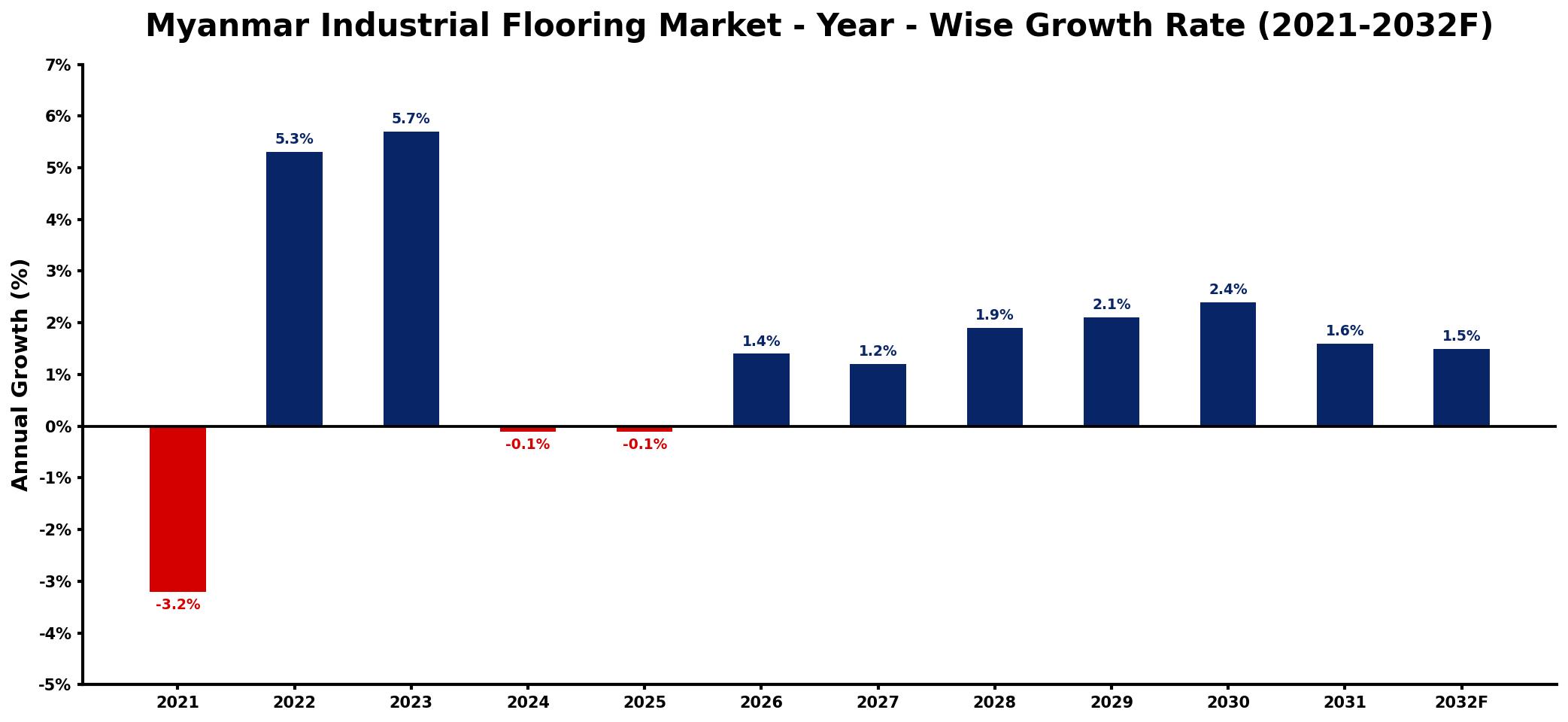
The table below presents the year‑wise growth rates along with the key drivers influencing the market
| Year | Growth Rate | Major Drivers |
| 2021 | -3.2% | decrease in construction activities |
| 2022 | 5.3% | investment in infrastructure projects |
| 2023 | 5.7% | growth in manufacturing sectors |
| 2024 | -0.1% | fall in foreign investments |
| 2025 | -0.1% | slowdown in construction sector |
| 2026 | 1.4% | expansion of logistics facilities |
| 2027 | 1.2% | rise in retail developments |
| 2028 | 1.9% | increased demand from automotive |
| 2029 | 2.1% | increased capital investment inflows |
| 2030 | 2.4% | expanding manufacturing base activity |
| 2031 | 1.6% | growing downstream application demand |
| 2032 | 1.5% | increased pharmaceutical industry usage |
Note: Market size estimations and growth projections presented in this report are based on 6Wresearch's proprietary forecasting methodology, utilizing the latest available industry data, government publications, and primary research inputs.
Myanmar Industrial Flooring Market Synopsis
In Myanmar, the industrial flooring landscape is rapidly evolving, underpinned by a pressing need for durable solutions in manufacturing plants, warehouses, and laboratories. The market's growth is significantly influenced by the increasing construction of industrial facilities, which require flooring systems capable of withstanding harsh environments.
Current innovations in flooring materials and technologies have further pushed the boundaries of what is possible in this sector. As manufacturers seek reliable and cost-effective flooring options, the demand for advanced solutions continues to rise, creating an exciting yet challenging market environment.
Myanmar Industrial Flooring Market Key Takeaways
- The Myanmar Industrial Flooring Market is expected to experience steady growth driven by infrastructure investments.
- Innovative materials are reshaping the competitive landscape, enhancing durability and performance.
- Product quality and installation expertise remain pivotal for market participants.
- Government policies are facilitating market entry through supportive regulations and incentives.
- The expansion of the manufacturing sector is a significant demand driver in the industrial flooring segment.
Evaluation of Restraints in Myanmar Industrial Flooring Market
Despite its promising outlook, the Myanmar Industrial Flooring Market encounters notable restraints that hinder its growth potential. A primary challenge is the inconsistency in product quality, which can lead to significant safety hazards in industrial environments. Additionally, the limited availability of skilled contractors complicates the installation of advanced flooring solutions, which may otherwise provide significant benefits in terms of durability and maintenance. These constraints highlight the need for better training and quality assurance within the sector.
Myanmar Industrial Flooring Market Trends
A strong trend towards sustainability is reshaping the industrial flooring market, with increasing demand for eco-friendly materials and solutions. Manufacturers are investing in research and development to create flooring systems that not only meet performance criteria but are also environmentally responsible. Furthermore, the integration of smart technologies into flooring solutions is on the rise, enhancing safety and operational efficiency.
Myanmar Industrial Flooring Market Opportunities
The expansion of industrial activities presents a wealth of opportunities for market players in Myanmar. As new facilities are constructed, there is a pressing need for high-performance flooring that can adapt to various applications, including cleanrooms and chemical storage areas. Furthermore, the increasing adoption of automated systems in warehouses creates demand for flooring solutions that can withstand the rigors of heavy machinery, positioning innovative product offerings as key to capturing market share.
Government Initiatives in the Myanmar Industrial Flooring Market
To bolster industrial development, the Myanmar government has implemented several initiatives aimed at enhancing infrastructure and promoting sustainable practices in industrial flooring. These measures include establishing standards for flooring materials and installation, thereby improving quality assurance in the sector. Additionally, there are incentives designed to encourage investments in durable flooring solutions, which support both economic growth and environmental sustainability.
Future Insights of the Myanmar Industrial Flooring Market
Looking ahead to 2026-2032, the Myanmar Industrial Flooring Market is poised for gradual expansion, propelled by continued investments in manufacturing and infrastructure. As industries evolve, the emphasis on safety and sustainability will guide product development and innovation. The market will likely see a shift towards more technologically advanced flooring systems that meet the diverse needs of various industrial applications, ultimately shaping a dynamic future for this sector.
Myanmar Industrial Flooring Market Latest Developments (2025 - 2026)
Recent trends indicate a growing interest in advanced flooring technologies within the Myanmar Industrial Flooring Market, with several companies exploring partnerships for research and development. These initiatives aim to address the challenges of quality and installation standards, ensuring that customers receive reliable and durable flooring solutions. Moreover, ongoing discussions about sustainability are influencing product offerings, as stakeholders look to enhance their environmental credentials while meeting industry demands.
Myanmar Industrial Flooring Market - Key Attractiveness of the Report
- 10 Years of Market Numbers
- Historical Data Starting from 2022 to 2025
- Base Year: 2025
- Forecast Data until 2032
- Key Performance Indicators Impacting the Market
- Major Upcoming Developments and Projects
Key Highlights of the Report:
- Myanmar Industrial Flooring Market Outlook
- Market Size of Myanmar Industrial Flooring Market, 2025
- Forecast of Myanmar Industrial Flooring Market, 2032
- Historical Data and Forecast of Myanmar Industrial Flooring Revenues & Volume for the Period 2022-2032F
- Myanmar Industrial Flooring Market Trend Evolution
- Myanmar Industrial Flooring Market Drivers and Challenges
- Myanmar Industrial Flooring Price Trends
- Myanmar Industrial Flooring Porter's Five Forces
- Myanmar Industrial Flooring Industry Life Cycle
- Historical Data and Forecast of Myanmar Industrial Flooring Market Revenues & Volume By End User Industry for the Period 2022-2032F
- Historical Data and Forecast of Myanmar Industrial Flooring Market Revenues & Volume By Chemical for the Period 2022-2032F
- Historical Data and Forecast of Myanmar Industrial Flooring Market Revenues & Volume By Food and Beverages for the Period 2022-2032F
- Historical Data and Forecast of Myanmar Industrial Flooring Market Revenues & Volume By Healthcare for the Period 2022-2032F
- Historical Data and Forecast of Myanmar Industrial Flooring Market Revenues & Volume By Transportation and Aviation for the Period 2022-2032F
- Historical Data and Forecast of Myanmar Industrial Flooring Market Revenues & Volume By Others for the Period 2022-2032F
- Historical Data and Forecast of Myanmar Industrial Flooring Market Revenues & Volume By Thickness for the Period 2022-2032F
- Historical Data and Forecast of Myanmar Industrial Flooring Market Revenues & Volume By Light duty for the Period 2022-2032F
- Historical Data and Forecast of Myanmar Industrial Flooring Market Revenues & Volume By Medium Duty for the Period 2022-2032F
- Historical Data and Forecast of Myanmar Industrial Flooring Market Revenues & Volume By Heavy Duty for the Period 2022-2032F
- Historical Data and Forecast of Myanmar Industrial Flooring Market Revenues & Volume By Material Type for the Period 2022-2032F
- Historical Data and Forecast of Myanmar Industrial Flooring Market Revenues & Volume By Epoxy for the Period 2022-2032F
- Historical Data and Forecast of Myanmar Industrial Flooring Market Revenues & Volume By Polyaspartic for the Period 2022-2032F
- Historical Data and Forecast of Myanmar Industrial Flooring Market Revenues & Volume By Polyurethane for the Period 2022-2032F
- Historical Data and Forecast of Myanmar Industrial Flooring Market Revenues & Volume By Anhydrite for the Period 2022-2032F
- Historical Data and Forecast of Myanmar Industrial Flooring Market Revenues & Volume By Others for the Period 2022-2032F
- Myanmar Industrial Flooring Import Export Trade Statistics
- Market Opportunity Assessment By End User Industry
- Market Opportunity Assessment By Thickness
- Market Opportunity Assessment By Material Type
- Myanmar Industrial Flooring Top Companies Market Share
- Myanmar Industrial Flooring Competitive Benchmarking By Technical and Operational Parameters
- Myanmar Industrial Flooring Company Profiles
- Myanmar Industrial Flooring Key Strategic Recommendations






































