Turkey Industrial Flooring Market Size, Share & Growth Rate
The Turkey Industrial Flooring Market was estimated at USD 1224 Million in 2025 and is projected to reach USD 1744 Million by 2032, growing at a CAGR of 5.2% from 2026 to 2032. This growth trajectory is primarily driven by the increasing demand for robust, high-performance flooring solutions across sectors such as manufacturing, food processing, and healthcare. Additionally, the enhanced focus on workplace safety and hygiene standards, coupled with a shift towards eco-friendly materials, is expected to further fuel market expansion.
Turkey Industrial Flooring Market Year-wise Growth Rate and Key Drivers
This graph highlights how the Turkey Industrial Flooring Market has steadily grown over the years, supported by major growth factors.
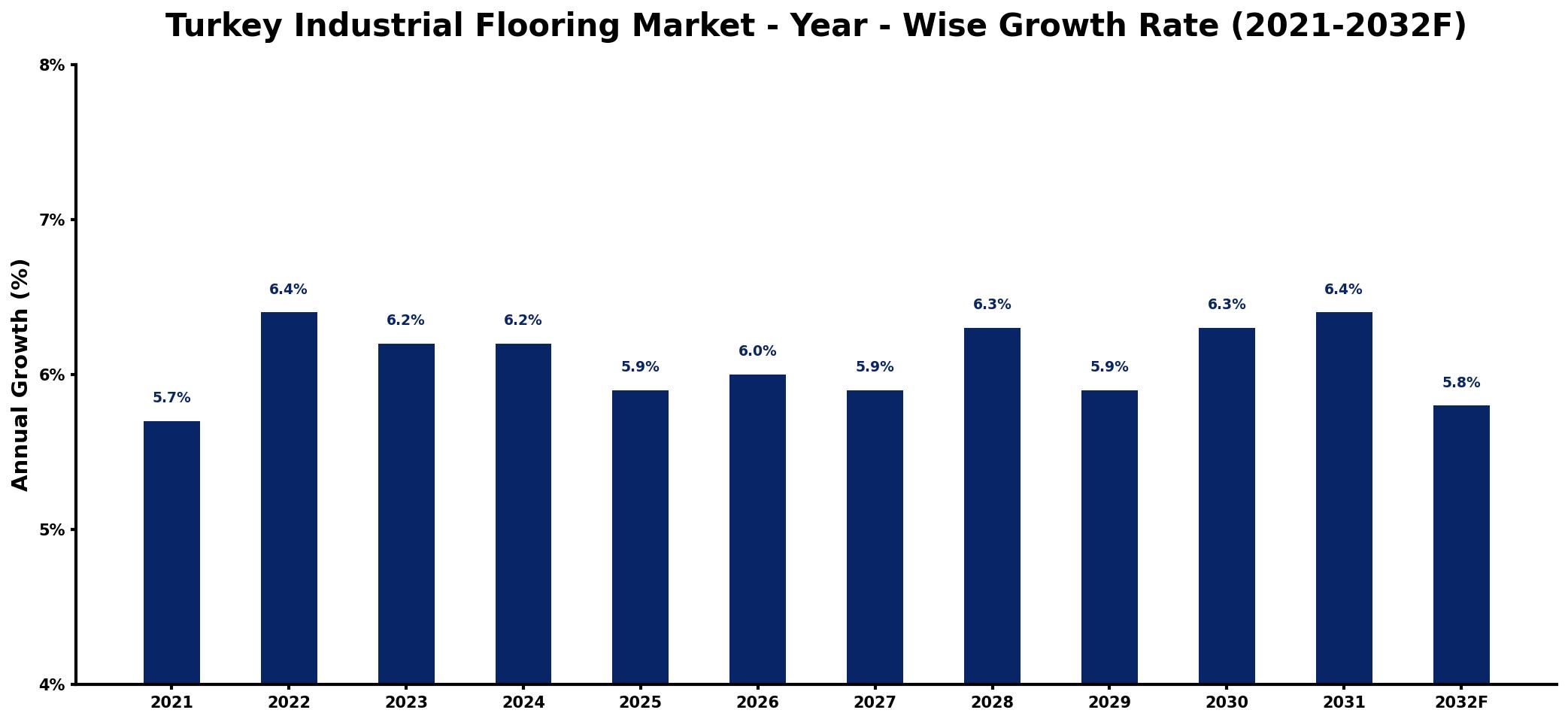
The table below presents the year‑wise growth rates along with the key drivers influencing the market
| Year | Growth Rate | Major Drivers |
| 2021 | 5.7% | Rising construction sector investments |
| 2022 | 6.4% | Increased manufacturing facility expansions |
| 2023 | 6.2% | Growing demand for hygienic surfaces |
| 2024 | 6.2% | Surge in logistics infrastructure projects |
| 2025 | 5.9% | Expansion of retail space renovations |
| 2026 | 6.0% | Boost in automotive production facilities |
| 2027 | 5.9% | Rising focus on environmental sustainability |
| 2028 | 6.3% | Increased adoption of smart technologies |
| 2029 | 5.9% | Growth in food processing plants |
| 2030 | 6.3% | rising procurement volume requirements |
| 2031 | 6.4% | Rising demand for energy efficiency |
| 2032 | 5.8% | Increased investments in warehousing solutions |
Note: Market size estimations and growth projections presented in this report are based on 6Wresearch's proprietary forecasting methodology, utilizing the latest available industry data, government publications, and primary research inputs.
Turkey Industrial Flooring Market Synopsis
In Turkey, the industrial flooring sector is witnessing a notable evolution, largely influenced by advancements in materials and technology. Facilities ranging from manufacturing plants to hospitals are increasingly prioritizing durable, hygienic flooring solutions that can withstand harsh conditions.
Recent trends indicate a growing adoption of flooring systems that provide not only chemical resistance but also ease of maintenance. As industries evolve, there is an urgent need for flooring solutions that cater to specific operational requirements, making this market dynamic and competitive.
Turkey Industrial Flooring Market Key Takeaways
- The market is primarily driven by demand across sectors such as manufacturing, food processing, and healthcare.
- Technological advancements are paving the way for innovative flooring solutions with enhanced performance characteristics.
- Eco-friendly materials are increasingly being adopted, reflecting a broader commitment to sustainability within the industry.
- Government policies are supportive of innovation, providing financial incentives for R&D in flooring technologies.
- High production costs and competition from alternative flooring options remain significant challenges for industry players.
Evaluation of Restraints in Turkey Industrial Flooring Market
The Turkey Industrial Flooring Market is encountering several restraints that limit its growth potential. High production and installation costs are paramount, primarily due to the rigorous standards for durability and performance required in industrial applications. The market is also facing stiff competition from alternative flooring solutions, along with international manufacturers who often have lower cost bases. Moreover, compliance with evolving regulatory frameworks related to safety and environmental impact increases operational complexities. Economic fluctuations further exacerbate these challenges, impacting demand from key end-use industries, including logistics and retail.
Turkey Industrial Flooring Market Trends
A significant trend in the Turkey Industrial Flooring Market is the growing adoption of eco-friendly materials, driven by an increasing consumer awareness of sustainability. Technologies enhancing the performance of flooring systems, such as antimicrobial properties and superior durability, are also emerging. Moreover, there is a heightened focus on automated flooring solutions that integrate seamlessly into smart factory environments, reflecting broader technological shifts across industries.
Turkey Industrial Flooring Market Opportunities
The industrial flooring sector in Turkey presents numerous growth opportunities, particularly for businesses willing to invest in innovative and sustainable technologies. As industries continue to upgrade their facilities to meet modern standards, there is a strong market for customized flooring solutions tailored to specific operational needs. Additionally, the burgeoning healthcare sector offers a ripe landscape for specialized flooring products that meet hygiene and safety regulations.
Government Initiatives in the Turkey Industrial Flooring Market
The Turkish government actively supports the industrial flooring market through various policies aimed at fostering innovation and quality manufacturing. Initiatives include financial incentives for research and development in advanced flooring technologies, as well as tax breaks for manufacturers who meet quality standards. The government also enforces strict quality and safety regulations, which not only enhance product reliability but also promote a competitive market environment.
Future Insights of the Turkey Industrial Flooring Market
Looking ahead to 2026-2032, the Turkey Industrial Flooring Market is poised for substantial growth driven by technological advancements and increasing regulatory focus on safety and environmental impact. As businesses continue to prioritize workplace safety and operational efficiency, demand for high-quality, specialized flooring solutions is expected to rise. Furthermore, with ongoing governmental support for innovation, the market is likely to see the emergence of new players and products, contributing to a more dynamic competitive landscape.
Turkey Industrial Flooring Market Latest Developments (2025 - 2026)
Recent developments in the Turkey Industrial Flooring Market indicate a strong shift towards sustainable practices. Manufacturers are increasingly focusing on integrating eco-friendly materials into their flooring solutions, responding to both consumer demand and regulatory pressures. Moreover, advancements in flooring technologies are enhancing the durability and maintenance of products, leading to broader adoption across sectors. Collaborative initiatives aimed at developing smarter flooring systems are also gaining traction as industries embrace automation.
Turkey Industrial Flooring Market - Key Attractiveness of the Report
- 10 Years of Market Numbers
- Historical Data Starting from 2022 to 2025
- Base Year: 2025
- Forecast Data until 2032
- Key Performance Indicators Impacting the Market
- Major Upcoming Developments and Projects
Key Highlights of the Report:
- Turkey Industrial Flooring Market Outlook
- Market Size of Turkey Industrial Flooring Market, 2025
- Forecast of Turkey Industrial Flooring Market, 2032
- Historical Data and Forecast of Turkey Industrial Flooring Revenues & Volume for the Period 2022-2032F
- Turkey Industrial Flooring Market Trend Evolution
- Turkey Industrial Flooring Market Drivers and Challenges
- Turkey Industrial Flooring Price Trends
- Turkey Industrial Flooring Porter's Five Forces
- Turkey Industrial Flooring Industry Life Cycle
- Historical Data and Forecast of Turkey Industrial Flooring Market Revenues & Volume By End User Industry for the Period 2022-2032F
- Historical Data and Forecast of Turkey Industrial Flooring Market Revenues & Volume By Chemical for the Period 2022-2032F
- Historical Data and Forecast of Turkey Industrial Flooring Market Revenues & Volume By Food and Beverages for the Period 2022-2032F
- Historical Data and Forecast of Turkey Industrial Flooring Market Revenues & Volume By Healthcare for the Period 2022-2032F
- Historical Data and Forecast of Turkey Industrial Flooring Market Revenues & Volume By Transportation and Aviation for the Period 2022-2032F
- Historical Data and Forecast of Turkey Industrial Flooring Market Revenues & Volume By Others for the Period 2022-2032F
- Historical Data and Forecast of Turkey Industrial Flooring Market Revenues & Volume By Thickness for the Period 2022-2032F
- Historical Data and Forecast of Turkey Industrial Flooring Market Revenues & Volume By Light duty for the Period 2022-2032F
- Historical Data and Forecast of Turkey Industrial Flooring Market Revenues & Volume By Medium Duty for the Period 2022-2032F
- Historical Data and Forecast of Turkey Industrial Flooring Market Revenues & Volume By Heavy Duty for the Period 2022-2032F
- Historical Data and Forecast of Turkey Industrial Flooring Market Revenues & Volume By Material Type for the Period 2022-2032F
- Historical Data and Forecast of Turkey Industrial Flooring Market Revenues & Volume By Epoxy for the Period 2022-2032F
- Historical Data and Forecast of Turkey Industrial Flooring Market Revenues & Volume By Polyaspartic for the Period 2022-2032F
- Historical Data and Forecast of Turkey Industrial Flooring Market Revenues & Volume By Polyurethane for the Period 2022-2032F
- Historical Data and Forecast of Turkey Industrial Flooring Market Revenues & Volume By Anhydrite for the Period 2022-2032F
- Historical Data and Forecast of Turkey Industrial Flooring Market Revenues & Volume By Others for the Period 2022-2032F
- Turkey Industrial Flooring Import Export Trade Statistics
- Market Opportunity Assessment By End User Industry
- Market Opportunity Assessment By Thickness
- Market Opportunity Assessment By Material Type
- Turkey Industrial Flooring Top Companies Market Share
- Turkey Industrial Flooring Competitive Benchmarking By Technical and Operational Parameters
- Turkey Industrial Flooring Company Profiles
- Turkey Industrial Flooring Key Strategic Recommendations






































