Myanmar Industrial Furnace Market Size, Share & Growth Rate
The Myanmar Industrial Furnace Market was estimated at USD 172 Million in 2025 and is projected to reach USD 188 Million by 2032, growing at a CAGR of 1.3% from 2026 to 2032. This growth is primarily fueled by the burgeoning manufacturing sector, which is increasingly demanding efficient heating solutions. Additionally, ongoing infrastructure development projects are expected to further bolster the market as industries seek modernized technology to enhance their operational capabilities.
Myanmar Industrial Furnace Market Year-wise Growth Rate and Key Drivers
This graph highlights how the Myanmar Industrial Furnace Market has steadily grown over the years, supported by major growth factors.
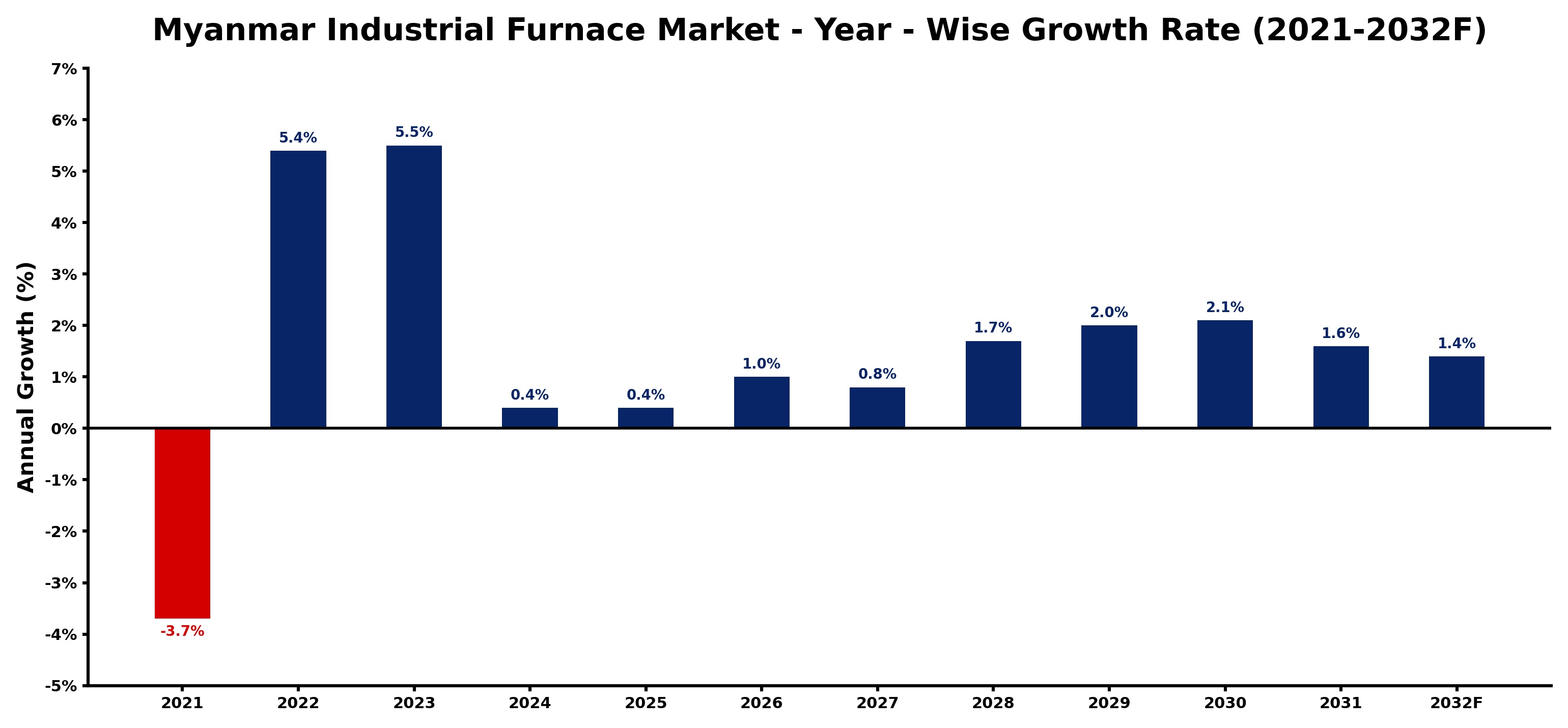
The table below presents the year‑wise growth rates along with the key drivers influencing the market
| Year | Growth Rate | Major Drivers |
| 2021 | -3.7% | Higher inflation rates curtailed capital investments in furnace projects |
| 2022 | 5.4% | Advanced steel production techniques boost furnace capacity utilization rates |
| 2023 | 5.5% | Export driven demand for precision steel components boosts local manufacturing investments |
| 2024 | 0.4% | Advanced furnace technologies boosted steel production efficiency across sectors |
| 2025 | 0.4% | Improved infrastructure development boosts industrial furnace demand significantly |
| 2026 | 1.0% | Local brick manufacturers upgrade kilns to meet construction demand |
| 2027 | 0.8% | New manufacturing investments boost local foundry furnace production capabilities |
| 2028 | 1.7% | Furnace upgrades boosted energy efficiency and production throughput |
| 2029 | 2.0% | Post pandemic construction projects drive furnace demand across sectors |
| 2030 | 2.1% | Improved furnace technology adoption enhances metal recycling efficiency |
| 2031 | 1.6% | Domestic steel demand fuels furnace upgrades in manufacturing facilities |
| 2032 | 1.4% | Technological upgrades in local foundries boost steel casting production |
Note - Market size estimations and growth projections presented in this report are based on 6Wresearch’s advanced forecasting approach, validated with industry datasets as of June 2026.
Myanmar Industrial Furnace Market Synopsis
Recently, the Myanmar Industrial Furnace Market has gained momentum, driven by a heightened focus on energy efficiency and environmental compliance. However, the landscape is rapidly evolving as local manufacturers and international entrants adapt to an increasingly competitive environment shaped by technological innovations and sustainability demands.
Looking ahead, the market is likely to witness substantial growth as industries such as metal processing and ceramics expand. Despite challenges related to technological access and skilled labor shortages, the ongoing shift towards automation and digital solutions presents opportunities for increased productivity and efficiency.
Myanmar Industrial Furnace Market Key Takeaways
- Strong growth trajectory supported by infrastructure and industrial expansion.
- Transition towards energy-efficient and environmentally sustainable furnace technologies.
- Increasing demand for maintenance services to ensure operational longevity.
- Emerging trends in automation and digitalization influencing market dynamics.
- Investment opportunities exist in advanced technologies and local manufacturing.
Evaluation of Restraints in Myanmar Industrial Furnace Market
The Myanmar Industrial Furnace Market is currently constrained by several factors, including limited access to advanced technologies and machinery. These limitations are exacerbated by inadequate infrastructure for energy supply, impacting manufacturers' ability to operate at full capacity. Furthermore, a shortage of skilled labor continues to hamper productivity and operational efficiency. Import restrictions and fluctuating currency values pose additional challenges, making it difficult for businesses to acquire necessary equipment and spare parts. These barriers necessitate strategic investments in technology and workforce development to unlock the market's full potential.
Myanmar Industrial Furnace Market Trends
The market is currently witnessing a marked shift towards energy-efficient furnace systems. As manufacturers strive to adhere to tightening environmental regulations, there is a growing preference for electric and induction furnaces that minimize carbon emissions. Additionally, customization and automation capabilities are increasingly being incorporated into furnace designs to meet the diverse needs of industries such as ceramics, glass, and metal processing. This transition underscores a broader trend toward sustainability and innovation within the sector, as manufacturers seek to differentiate themselves in a competitive landscape.
Myanmar Industrial Furnace Market Opportunities
The Myanmar Industrial Furnace Market holds significant potential for investment, particularly in the realm of advanced and energy-efficient technologies. As the local manufacturing landscape continues to evolve, opportunities abound for suppliers who can provide modern heating solutions tailored to specific industrial requirements. Establishing strategic partnerships with local manufacturers can enhance market presence and share, especially as domestic production capabilities are promoted. Emphasizing eco-friendly options also aligns with global trends towards sustainability, making it a strategic focus for investors looking to capitalize on emerging market dynamics.
Government Initiatives in the Myanmar Industrial Furnace Market
The government of Myanmar is actively pursuing policies aimed at fostering a sustainable industrial environment. Emphasis is placed on environmental protection and the promotion of energy-efficient technologies in industrial furnace operations. Through regulatory frameworks, the government seeks to ensure compliance with emission standards while encouraging local manufacturing to reduce dependency on imports. By promoting these initiatives, the government aims to create a balanced approach that supports industrial growth while safeguarding environmental interests.
Future Insights of the Myanmar Industrial Furnace Market
Looking forward to 2026-2032, the Myanmar Industrial Furnace Market is poised for gradual expansion. The accelerating pace of industrialization and ongoing infrastructure projects are set to drive demand for industrial furnaces across various sectors, including manufacturing and automotive. Government incentives aimed at attracting foreign investment and bolstering industrial capacity will likely support this trajectory. Despite potential challenges, including the need for technological advancements and skilled labor, the market is expected to adapt and innovate, positioning itself for long-term growth.
Myanmar Industrial Furnace Market Latest Developments (May 2025 - June 2026)
In recent months, the Myanmar Industrial Furnace Market has observed a pivot towards integrating more automated solutions within manufacturing processes. Manufacturers are increasingly focusing on enhancing their production capabilities through advanced control systems that optimize furnace operations. Concurrently, local initiatives aimed at improving infrastructure support are gaining traction, which is anticipated to ease some of the current limitations. These developments signal a positive trend towards modernization and operational efficiency within the sector.
Myanmar Industrial Furnace Market - Key Attractiveness of the Report
- 10 Years of Market Numbers
- Historical Data Starting from 2022 to 2025
- Base Year: 2025
- Forecast Data until 2032
- Key Performance Indicators Impacting the Market
- Major Upcoming Developments and Projects
Key Highlights of the Report:
- Myanmar Industrial Furnace Market Outlook
- Market Size of Myanmar Industrial Furnace Market, 2025
- Forecast of Myanmar Industrial Furnace Market, 2032
- Historical Data and Forecast of Myanmar Industrial Furnace Revenues & Volume for the Period 2022-2032F
- Myanmar Industrial Furnace Market Trend Evolution
- Myanmar Industrial Furnace Market Drivers and Challenges
- Myanmar Industrial Furnace Price Trends
- Myanmar Industrial Furnace Porter's Five Forces
- Myanmar Industrial Furnace Industry Life Cycle
- Historical Data and Forecast of Myanmar Industrial Furnace Market Revenues & Volume By Furnace Type for the Period 2022-2032F
- Historical Data and Forecast of Myanmar Industrial Furnace Market Revenues & Volume By Gas/fuel Operated Industrial Furnace for the Period 2022-2032F
- Historical Data and Forecast of Myanmar Industrial Furnace Market Revenues & Volume By Electrically Operated Industrial Furnace for the Period 2022-2032F
- Historical Data and Forecast of Myanmar Industrial Furnace Market Revenues & Volume By Arrangement for the Period 2022-2032F
- Historical Data and Forecast of Myanmar Industrial Furnace Market Revenues & Volume By Tube or Clamshell Type for the Period 2022-2032F
- Historical Data and Forecast of Myanmar Industrial Furnace Market Revenues & Volume By Box Type for the Period 2022-2032F
- Historical Data and Forecast of Myanmar Industrial Furnace Market Revenues & Volume By Bottom Loading & Car Bottom Furnace for the Period 2022-2032F
- Historical Data and Forecast of Myanmar Industrial Furnace Market Revenues & Volume By Top Loading Furnace for the Period 2022-2032F
- Historical Data and Forecast of Myanmar Industrial Furnace Market Revenues & Volume By Others for the Period 2022-2032F
- Historical Data and Forecast of Myanmar Industrial Furnace Market Revenues & Volume By End-User for the Period 2022-2032F
- Historical Data and Forecast of Myanmar Industrial Furnace Market Revenues & Volume By Metals & Mining for the Period 2022-2032F
- Historical Data and Forecast of Myanmar Industrial Furnace Market Revenues & Volume By Transportation for the Period 2022-2032F
- Historical Data and Forecast of Myanmar Industrial Furnace Market Revenues & Volume By Oil & Gas for the Period 2022-2032F
- Historical Data and Forecast of Myanmar Industrial Furnace Market Revenues & Volume By Chemicals for the Period 2022-2032F
- Historical Data and Forecast of Myanmar Industrial Furnace Market Revenues & Volume By Others for the Period 2022-2032F
- Myanmar Industrial Furnace Import Export Trade Statistics
- Market Opportunity Assessment By Furnace Type
- Market Opportunity Assessment By Arrangement
- Market Opportunity Assessment By End-User
- Myanmar Industrial Furnace Top Companies Market Share
- Myanmar Industrial Furnace Competitive Benchmarking By Technical and Operational Parameters
- Myanmar Industrial Furnace Company Profiles
- Myanmar Industrial Furnace Key Strategic Recommendations






































